

You're probably here because you've done one of two things. You spotted a cluster of mushrooms on a walk in Southeast Michigan and wondered if they were dinner or danger. Or you've heard about the michigan mushroom hunters club and want to know whether joining a real foraging community is better than trying to learn from scattered posts, apps, and guesswork.
The short answer is yes. A good mushroom club shortens the learning curve, makes your first hunts less intimidating, and keeps beginners from making the classic mistakes. That matters in Michigan, where the woods can reward you with excellent edible species but can also punish sloppy identification.
For Detroit and Ann Arbor readers, there's another layer. Traditional mushroom culture in Michigan often centers on rural hunts and established clubs, while many newer foragers live in apartments, spend their weekends in metro parks, and connect through group chats before they ever step into a forest. That doesn't make you less of a forager. It just means you need a slightly different path into the community.
What Is a Michigan Mushroom Hunting Club
A mushroom hunting club is part classroom, part field lab, and part community. The best ones aren't built around showing off giant hauls. They're built around learning how to identify fungi carefully, repeatedly, and in context.
That matters because mushroom foraging isn't like berry picking. You can't rely on one trait, one photo, or one confident guess. Michigan has over 100 edible wild mushroom species but also approximately 50 poisonous species, which is exactly why clubs matter so much for safe identification and education, as noted by Michigan Mushroom Hunters.
What a club actually does
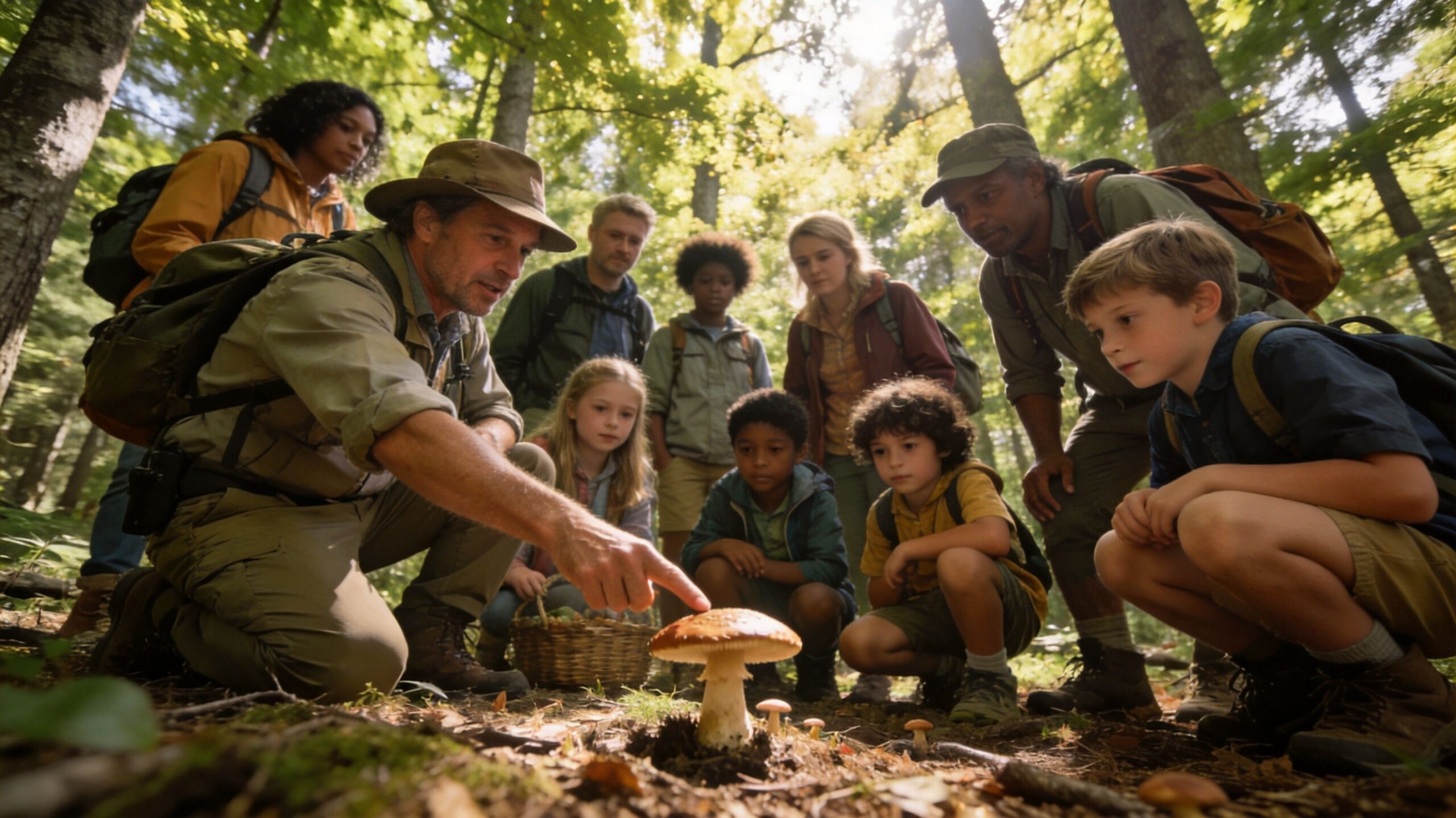
A newcomer usually expects a club to be a group hike. In practice, a solid club does much more:
- Guided forays: Members walk habitat together, compare finds, and learn where certain species tend to fruit.
- Identification help: People examine cap shape, gill structure, pore surfaces, bruising, substrate, smell, and growth pattern.
- Seasonal pattern training: You start learning when to look for morels, when hardwoods are producing, and when a patch is worth revisiting.
- Safety culture: Experienced members slow you down when you're moving too fast, which is one of the most useful lessons a beginner can get.
A lot of first-timers want a simple yes or no answer about whether a mushroom is edible. Clubs teach something better. They teach why an ID is reliable, and why uncertainty is a signal to stop.
Practical rule: If you can't explain the identification features out loud, you aren't ready to eat that mushroom.
Why clubs work better than solo learning
Books matter. Apps can help. Photo groups can be useful for narrowing possibilities. But none of those replace standing beside someone who points out the difference between a lookalike on the forest floor.
That apprenticeship model is why people improve faster in clubs than in isolation. You see fresh specimens, old specimens, bug-damaged specimens, waterlogged specimens, and mushrooms at awkward in-between stages that never look as neat as field guide photos.
For city-based readers, this is also why a club can be the bridge between casual curiosity and real skill. If you're exploring local resources on wild mushrooms in Michigan, a club gives those names and photos real-world context. You stop thinking of fungi as random woodland objects and start seeing habitat, timing, and structure.
What beginners usually get wrong
New foragers often think the goal is to bring something home. It isn't. The goal is to come home with better judgment.
That means some of your best early hunts will end with photos, notes, and no food basket at all. That's not failure. That's training. A good michigan mushroom hunters club helps you enjoy the process before you ever trust yourself with the meal.
Finding Your Foraging Community in Michigan
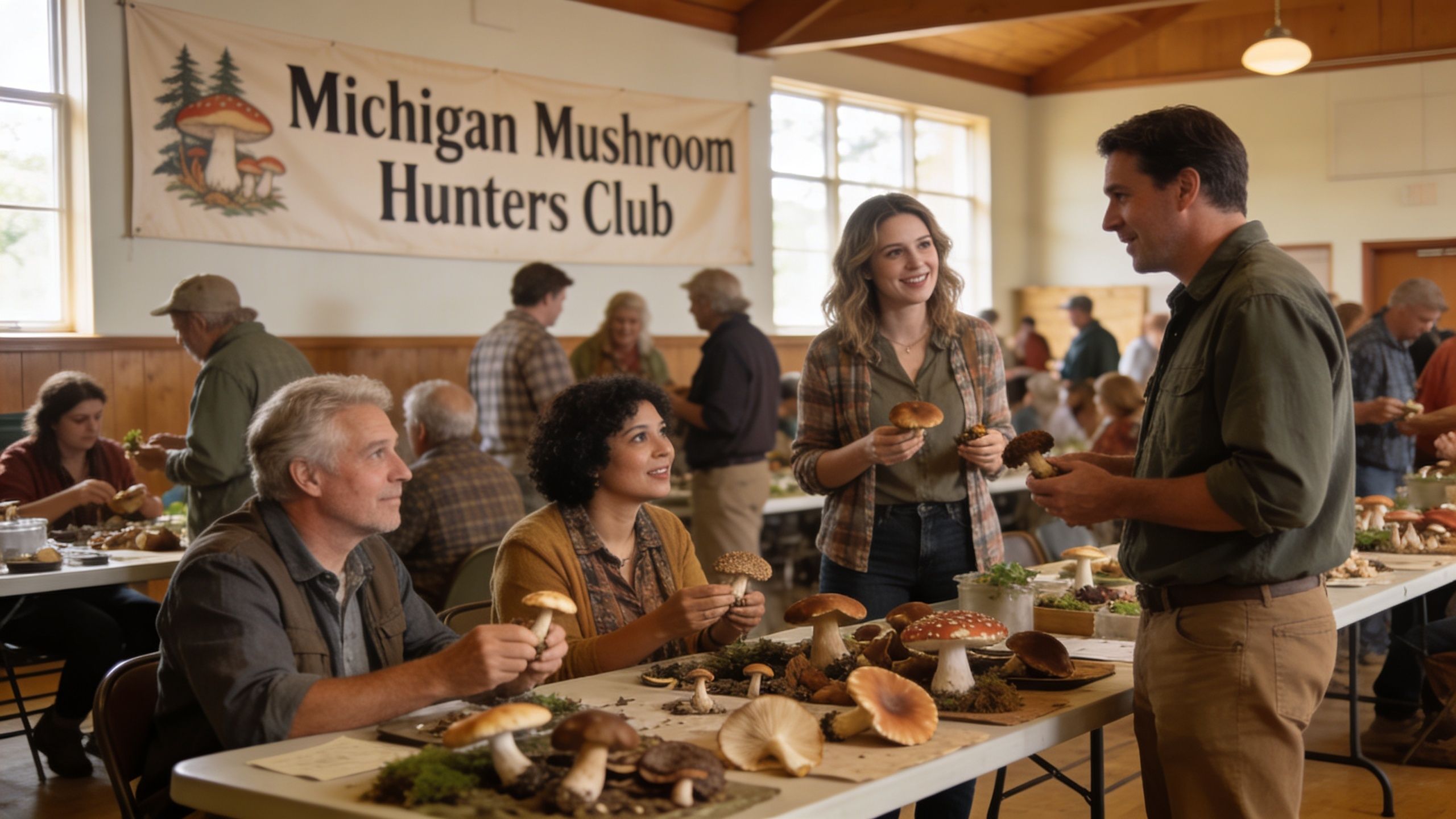
If you want the established starting point, the Michigan Mushroom Hunters Club is the obvious place to begin. It's one of the oldest mycological organizations in the country, established in 1984, and is over 42 years old as of 2026, according to the North American Mycological Association club listing. Longevity matters in mushroom circles. It usually means members have seen many seasons, many false assumptions, and many beginner mistakes.
Why MMHC still matters
An older club brings structure that newer online groups often don't. You're more likely to find organized forays, consistent identification standards, and a culture that values caution over hype. For a beginner, that's a real advantage.
It also helps to join a community where members have deep local memory. Mushrooms are seasonal, weather-sensitive, and frustratingly inconsistent. A club with decades behind it often knows which habitats are worth watching, which public events are useful, and which species newcomers should learn first.
The urban gap is real
Here's the trade-off. If you live in Detroit, Ann Arbor, or the inner suburbs, a single long-running club won't always feel local enough. Some hunts may be farther out than you want for a weekday evening. Some discussions may assume easy access to rural woods. Some newcomers quietly drop off because the geography doesn't fit their life.
That doesn't mean you're stuck. It means you should think of community in layers.
A modern forager often belongs to more than one circle. One established club for depth, one local meetup for convenience, and one digital group for day-to-day questions.
How to build a practical community near Detroit or Ann Arbor
If you can attend MMHC events, do it. Then add a second layer closer to home. The most useful setup usually looks like this:
| Community type | Best use | What to watch for |
|---|---|---|
| Established club | Field training and reliable ID culture | Longer drive, less spontaneous |
| Local meetup | Quick walks, neighborhood connections | Skill levels vary |
| Digital group | Photo sharing, event planning, reminders | Weak IDs if moderation is poor |
A lot of urban foragers do best when they stop waiting for the perfect club and start piecing together a working network.
What works if no nearby group fits
Use a practical filter when you search social platforms or local bulletin boards:
- Look for recurring walks, not vague interest groups: A group that actually meets in parks and natural areas is more useful than one that only posts photos.
- Prioritize moderation and caution: The best communities welcome uncertainty and discourage eating from crowd-sourced guesses.
- Start small if needed: Even three people who agree to meet monthly, compare finds, and verify IDs later can become a strong learning group.
- Choose accessible locations: Metro parks, nature preserves, and edge habitats near the city are often better for consistent meetups than remote destinations.
If you decide to start your own group, keep it simple. Pick one monthly date. Limit the first walk to observation and photography. Ask everyone to bring one field guide or app. Don't make the first outing about collecting dinner.
Signs you've found the right people
A good community doesn't reward the loudest person. It rewards the most careful one.
The right group will say “I'm not sure” without embarrassment. Members will separate uncertain finds from likely edibles. They'll compare notes after the walk instead of pretending confidence in the field. That's what you want, especially if your goal is to become a steady Michigan forager rather than a lucky one.
A Forager's Calendar What to Find Each Season
Michigan rewards patience. If you chase the wrong species at the wrong time, even a great patch will feel empty. If you learn the rhythm of the year, the woods start making more sense.
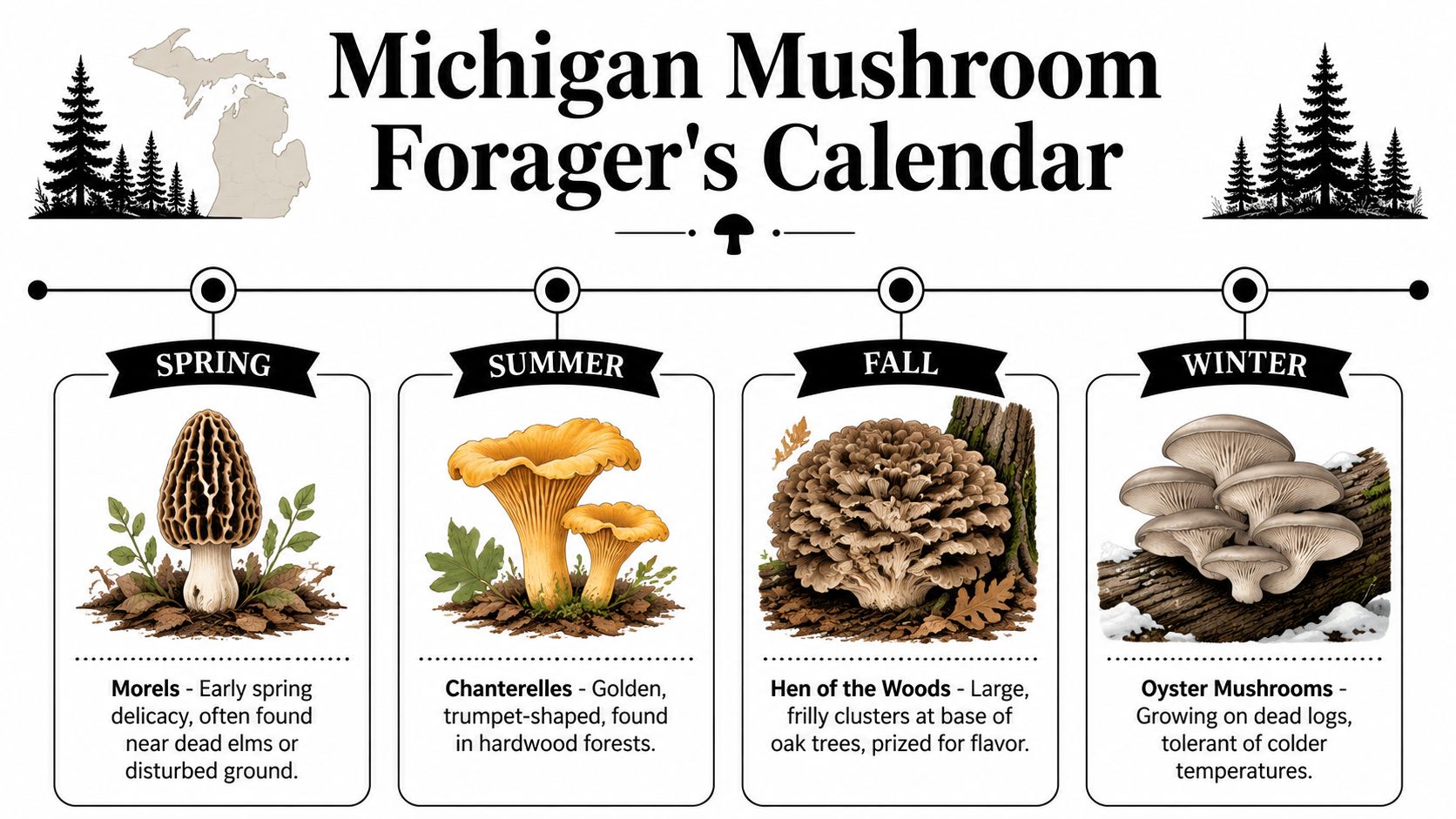
Spring
Spring is when most Michigan newcomers catch the bug. Morels are the obvious draw. They're a favorite because they're distinctive, exciting to find, and tied to a narrow seasonal window that gets people out walking with purpose.
A beginner should also know that spring can produce plenty of false confidence. Morel season attracts people who haven't looked at mushrooms all year, and that's when sloppy assumptions creep in. Learn the habitat, learn the structure, and don't rush because everyone else is posting finds.
Summer
Summer foraging shifts the pace. The star species for many people are chanterelles and chicken of the woods.
Chanterelles reward attention to hardwood forest habitat and a careful look at the underside. Chicken of the woods is often easier for a beginner to notice because it tends to stand out visually on wood. Still, bright color alone isn't an identification method. Summer heat also ages mushrooms fast, so texture matters as much as recognition.
In summer, the mushroom that looked perfect two days ago may be buggy, waterlogged, or tough today. Freshness is part of the decision, not an afterthought.
Fall
Fall is where a lot of Michigan foragers become regulars instead of dabblers. Hen of the woods is a classic target, and lion's mane gets plenty of attention from people who like both culinary and visual appeal.
This is also the season when the woods feel abundant enough to tempt overharvesting. Don't let that happen. Fall teaches restraint. Take what you'll use, leave what should mature, and notice which trees keep producing.
Winter
Winter isn't dead time. It's just different. Oyster mushrooms are one of the species that keep many Michigan foragers paying attention in colder months, especially on dead or dying wood.
Winter walks are good training because they strip the process down. Less lush ground cover means you spend more time reading bark, logs, and tree condition. If you want to sharpen your eye, cold-weather outings can help more than people expect.
Essential Gear and Safety Basics for Foraging
Most beginners overpack the wrong things and underprepare on identification. You don't need a huge kit. You need a few useful tools and a safety mindset that doesn't bend when you get excited.
The gear that earns its place
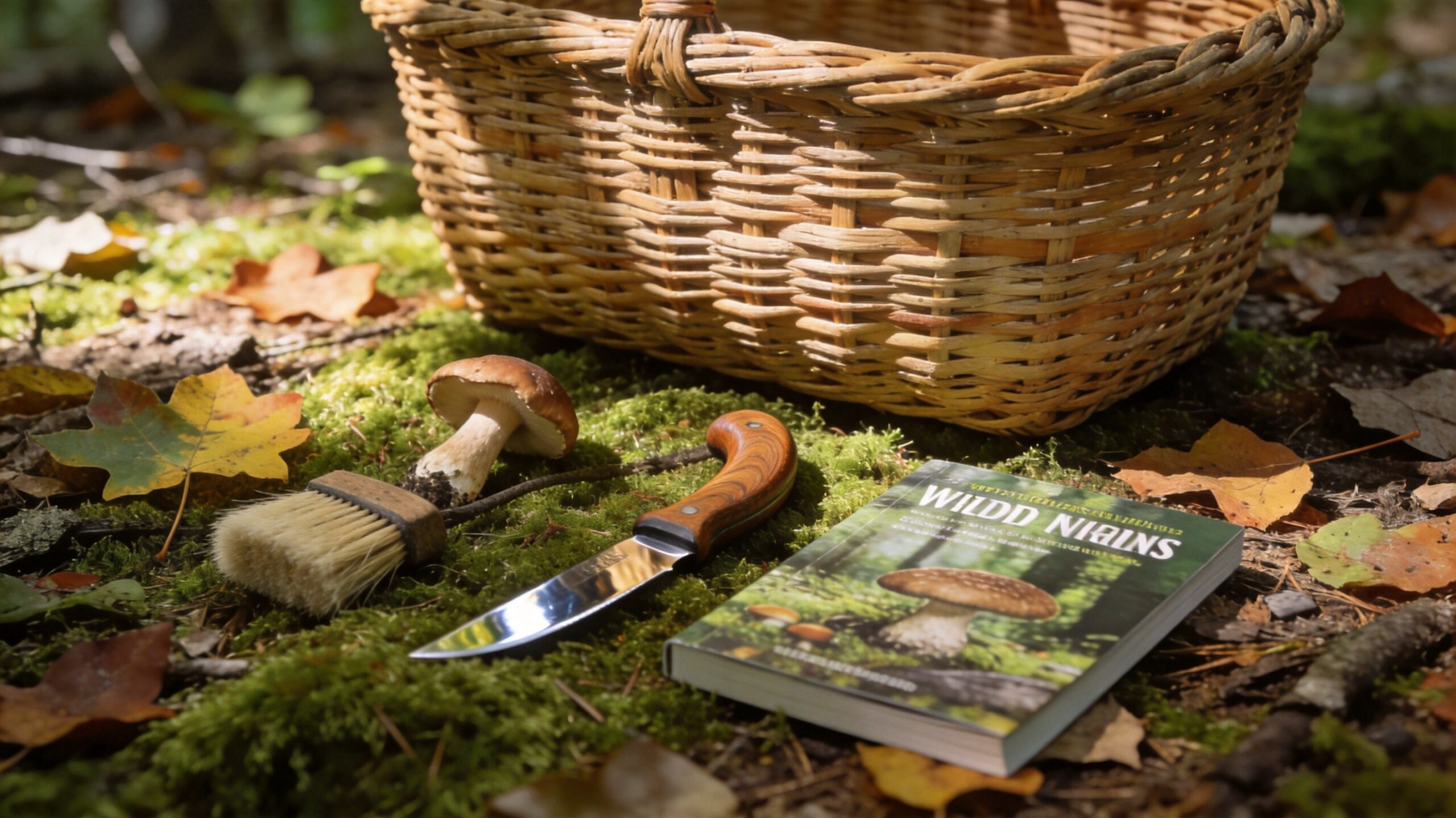
A simple kit is enough for most Michigan walks:
- Basket or rigid container: Better than a plastic bag because it protects specimens and keeps them from turning into a mashed, sweaty pile.
- Knife: A mushroom knife is nice, but a clean pocket knife works fine.
- Small brush: Useful for clearing dirt before mushrooms smear over each other.
- Notebook or phone for notes and photos: Take habitat shots, underside shots, and side profiles.
- Field guide or trusted app: Best used as a comparison tool, not as a final authority.
What doesn't work well? Grocery bags, blind confidence in image-matching apps, and mixing everything together loose. If you collect several unknowns and let them tumble around, you make later identification harder.
The non-negotiable rules
The biggest safety rule is simple. Eat only what you can identify with complete confidence.
That sounds obvious, but beginners often weaken the rule with phrases like “pretty sure,” “looks like,” or “everyone online agreed.” None of those belong in your kitchen.
A second rule matters just as much. Keep uncertain mushrooms separate from anything you may eat. Cross-contamination and mix-ups happen when people get lazy at the end of a walk.
If you want a good refresher on dangerous lookalikes and risk awareness, this guide to Michigan poisonous mushrooms is worth reviewing before you start bringing home wild finds.
What to do in the field
A practical field routine keeps you out of trouble:
- Observe before picking: Note the tree species, the soil or wood substrate, and how the mushroom is growing.
- Photograph multiple angles: Top, underside, stem base, and surrounding habitat.
- Collect selectively: Take one representative specimen if allowed, not every mushroom you see.
- Label or separate finds: Different paper bags or compartments help later.
- Review at home in better light: Many bad decisions happen in the woods, when people feel rushed.
A short visual primer can help reinforce the basics before your next outing.
Field habit: Slow down whenever you feel excited. Excitement makes people see what they want to see.
What experienced foragers do that beginners often skip
They check the whole specimen. They inspect the base. They compare several examples from the same patch. They reject mushrooms that are too old, too damaged, or too ambiguous.
That restraint is what keeps foraging enjoyable over the long term. Good foragers don't prove themselves by eating risky finds. They prove themselves by walking away from them.
Michigan Foraging Rules and Public Land Use
Foraging skill is only half the job. The other half is understanding whether you should be collecting in that spot at all.
Interest in mushroom hunting keeps growing, and that puts pressure on public land. The annual Fungus Fest reportedly saw attendance grow by 25% in 2025, according to MMHC public hunts information. More people in the woods means rules and etiquette matter more, not less.
Know the land before you pick
Michigan foragers often move between different types of land without thinking much about the distinction. That's a mistake. Rules can vary depending on whether you're on local land, a state-managed area, or another public site with its own policies.
The practical habit is simple. Check the land manager's current rules before your trip, not after you've filled a basket. If the guidance isn't clear, call or email and ask directly. That's much easier than explaining yourself after the fact.
The legal side and the ethical side
A lot of people focus only on whether foraging is technically allowed. Experienced foragers think one step further. They ask whether harvesting in that exact patch is wise, respectful, and sustainable.
Use this checklist before collecting:
- Confirm access first: Don't assume all public land is treated the same.
- Respect private property boundaries: “I thought this was public” won't fix a trespass problem.
- Harvest lightly: Leave mushrooms behind, especially in healthy fruitings.
- Avoid trampling habitat: The mushroom in front of you isn't the only thing that matters.
- Pack out what you bring in: Food wrappers and drink containers have no place on a foray.
A better standard than “Is it allowed?”
The strongest local foragers follow a stewardship standard. They leave a place looking as if no one had been there except for footprints that will fade. They don't rake leaf litter apart, tear bark off logs, or strip a productive patch because they got there first.
That standard matters in urban-adjacent spaces too. Metro parks and neighborhood natural areas can handle only so much pressure. If you're introducing friends to foraging, teach them how to behave before you teach them where to go.
Good public-land etiquette protects both the habitat and the future of foraging access.
Some readers also come to mushrooms through broader interest in fungi, including psilocybin topics. If that's part of your research, keep the categories separate and learn the legal framework carefully rather than blending assumptions from one area into another. This overview of magic mushrooms in Michigan is useful as background reading, but it shouldn't be confused with food foraging rules on public land.
What doesn't work
Three habits cause most avoidable problems.
First, people assume that because they've seen others forage somewhere, it must be permitted. Second, they harvest too much from one patch because they're afraid they won't return in time. Third, they post exact locations publicly and unintentionally drive heavy traffic into fragile spots.
Discretion helps. So does leaving enough behind that the next careful forager, and the ecosystem itself, still have something to work with.
Common Questions for Aspiring Foragers
Do I need to be an expert to join a club
No. In fact, clubs are where many people stop pretending they should already know everything.
Beginners usually do best when they arrive ready to observe, ask direct questions, and accept correction. You don't need expertise. You need patience, curiosity, and enough humility to hear “that's not a safe ID yet.”
Are there foraging groups near Detroit or Ann Arbor
There can be, but they may not always look like a formal club with a long history. In metro areas, community often forms through smaller meetups, naturalist circles, park walks, and digital spaces where people plan outings.
If you're in Detroit or Ann Arbor, use a layered approach. Join the established michigan mushroom hunters club if you can, then look for a closer circle that fits your schedule. If you can't find one, start a small observational group and keep the first few outings focused on photography and identification practice.
Is foraging in the city pointless compared with rural hunts
No, but the experience is different. Rural hunts often offer bigger habitat and a stronger tradition of organized outings. Urban and suburban foraging demands more flexibility, more discretion, and more attention to land-use rules.
City-based foragers often improve by learning edge habitats well. They revisit the same parks, storm-damaged woodlots, and wooded corridors instead of constantly chasing distant spots. Familiarity can beat novelty.
What's the difference between foraging for food and searching for magic mushrooms
They overlap only in the broad sense that both involve fungi. The practical mindset should be kept separate.
Food foraging focuses on culinary species, habitat reading, and careful identification for the table. Psilocybin-related interest sits in a different legal and cultural lane. Confusing the two leads people to make bad assumptions about identification, legality, and safety.
Is it better to use a book or an app for identification
Use both, but don't let either make the final call alone. A field guide helps you compare stable traits and learn terminology. An app is convenient in the woods and useful for organizing photos or narrowing possibilities.
The weak approach is letting an app tell you what you want to hear. The better approach is comparing multiple features, checking your guide, and getting human confirmation when the mushroom is destined for the pan.
Should I collect every mushroom I want to identify
No. Sometimes a photo set is enough, especially in places where collection may be restricted or where the specimen is too young or too old to be useful. Collecting without purpose creates clutter in your bag and confusion at home.
A better habit is to collect selectively and document thoroughly. One well-documented specimen teaches more than ten random ones.
What if I'm not sure after I get home
Then you don't eat it. That answer disappoints people, but it's the one that keeps foraging sustainable as a hobby and safe as a practice.
A lot of progress in mushrooming comes from delayed satisfaction. You study the uncertain find, compare it, ask questions, and come back stronger next time. That's normal. It's how people become dependable in the woods.
If your interest in mushrooms goes beyond wild foraging and into the broader world of fungi, Metro Mush offers a Detroit and Ann Arbor option for adult consumers exploring curated psilocybin products, including dried strains, chocolates, and drinks. It's a separate lane from field foraging, but for many people the curiosity starts in the woods and grows from there.