
You’re probably here because you saw a polkadot mushroom chocolate bar online, in a group chat, or on a shelf somewhere and wondered whether it’s the easy, tasty shortcut people make it sound like. The packaging looks polished. The names sound playful. The dosing squares make it seem controlled.
That’s exactly why this category deserves a careful look.
As educators, we see the same confusion over and over. People assume a chocolate bar with mushroom branding must contain mushrooms, must be measured properly, and must be safer than loose material from an unknown seller. In the unregulated market, those assumptions can go very wrong. The Polkadot phenomenon is a useful case study because it shows both sides of the modern edible market: high consumer demand, and serious safety problems when products aren’t verified.
The Allure of Polkadot Mushroom Chocolate
A lot of people meet Polkadot bars the same way. You scroll past a bright wrapper on social media. Someone says the bar is smooth, strong, and simple to dose. Another person says each square makes it easy to control the experience.
That appeal is real.
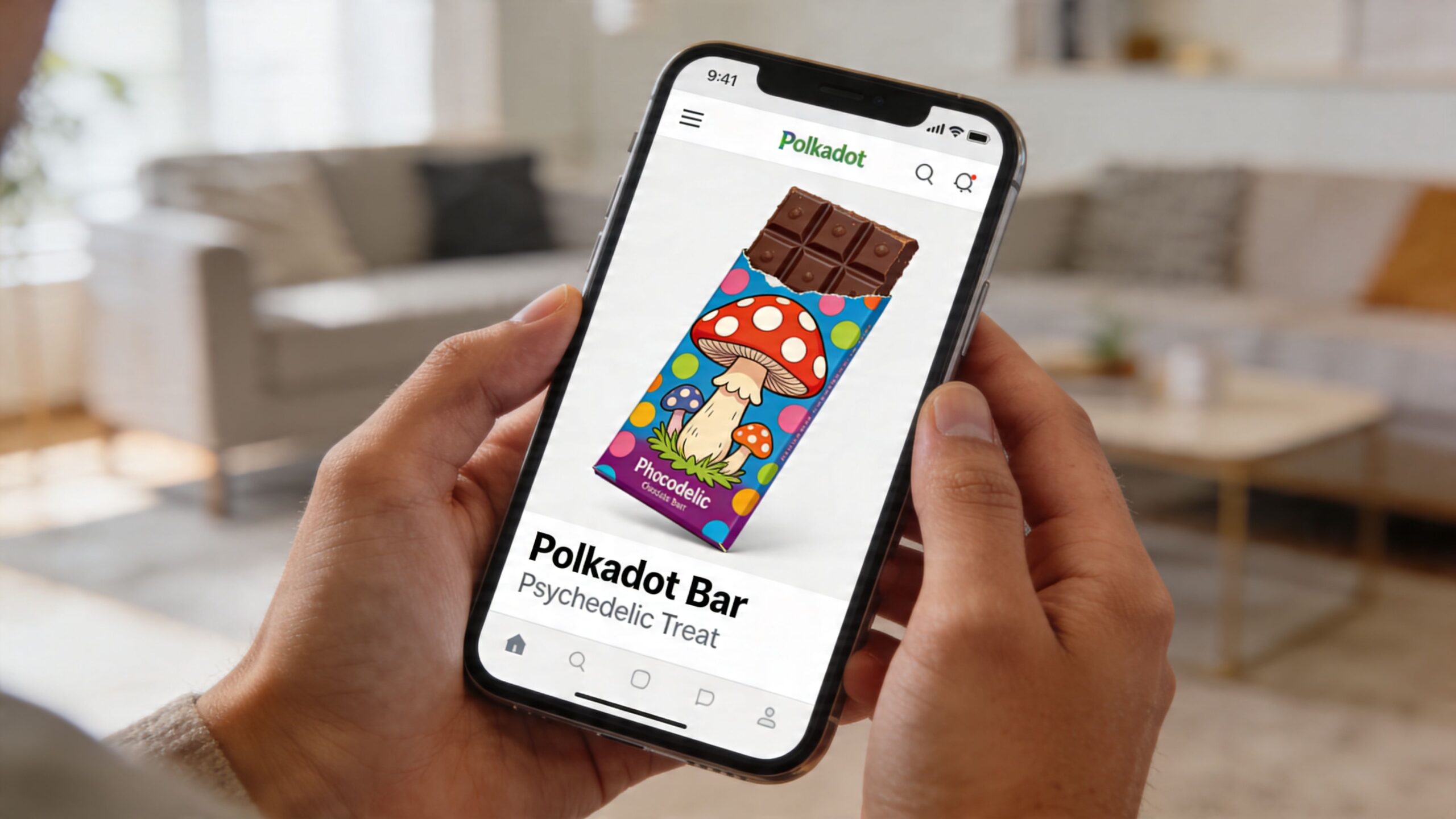
Chocolate is familiar. It feels less intimidating than dried mushrooms. A segmented bar also suggests precision. If a product is divided into squares, many buyers assume each piece has been measured carefully and made under consistent conditions. That’s a comforting idea, especially for first-time consumers.
Why the format feels approachable
A chocolate bar promises a few things at once:
- Taste over texture. Many people dislike the flavor of raw mushrooms.
- Discrete use. A bar looks ordinary compared with loose mushrooms.
- Easier portioning. Breaking off a square feels simpler than weighing plant material.
- Less friction for beginners. Packaging does some of the emotional work. It makes the product feel familiar.
Those features explain the hype. They don’t answer the most important question.
The question buyers need to ask
The main issue isn’t whether a Polkadot bar looks appealing. It’s whether the contents match the label.
If a product is unregulated, attractive packaging can hide uncertain ingredients, uneven potency, or something other than what the buyer thinks they purchased.
That’s where many readers get stuck. They’re not asking for a chemistry lesson. They just want to know whether the bar is what it claims to be. With Polkadot-style products, that’s exactly where caution matters most.
What Polkadot Chocolate Claims to Contain
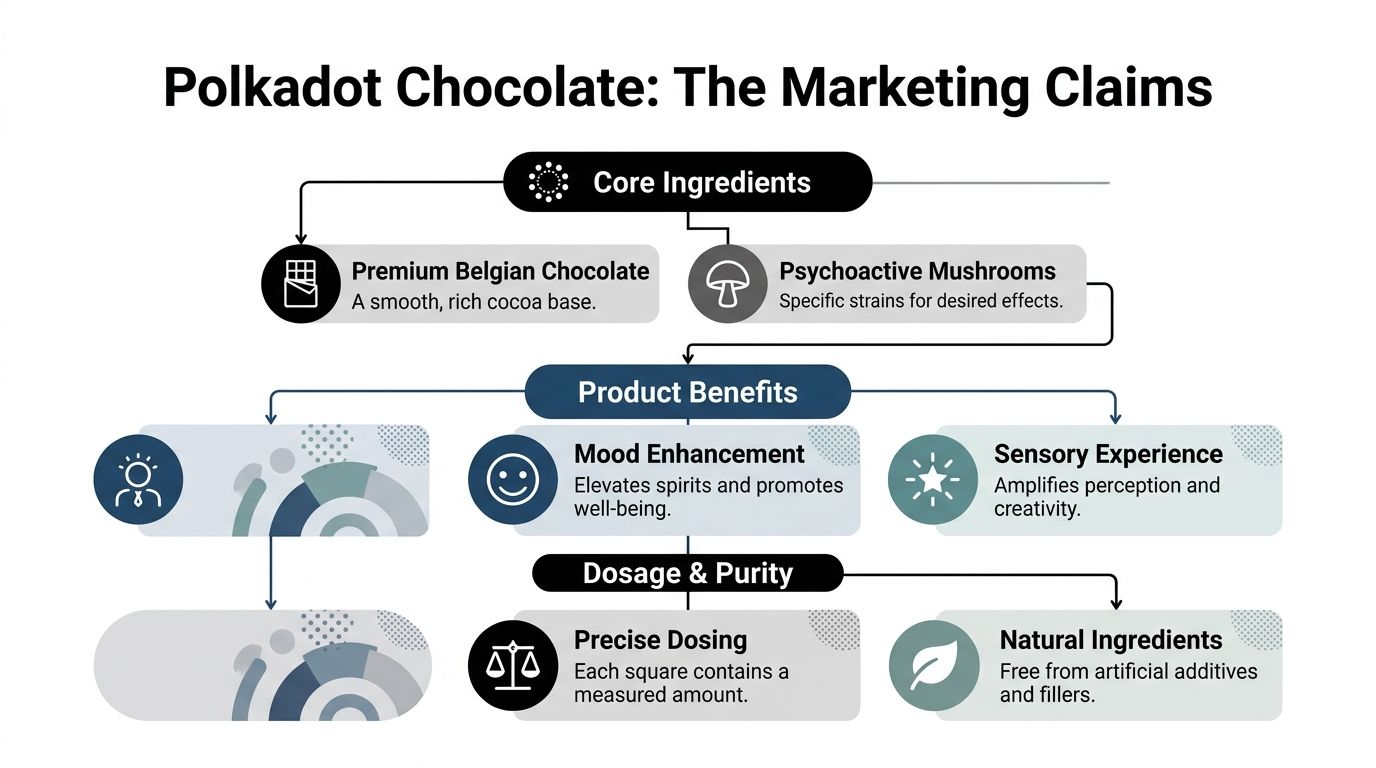
At face value, Polkadot bars are marketed like premium mushroom wellness edibles. The product presentation usually combines upscale chocolate branding with language about mushrooms, precise dosing, and a cleaner experience than raw material.
One common product description says Polkadot Mushroom Chocolate Bars are marketed as 2.1 oz (60g) premium Belgian chocolate edibles containing a 10,000mg proprietary blend of functional mushrooms, divided into 20 pieces for precise dosing at 500mg per piece, with some variants specifying 0.5mg muscimol isolate from Amanita muscaria per piece in a published product review.
What that marketing means in plain language
Think of the packaging like a supplement label mixed with a candy bar. The message is usually:
| Claimed feature | What the buyer is meant to believe |
|---|---|
| Premium Belgian chocolate | The product is high quality and carefully made |
| Proprietary mushroom blend | The bar contains multiple mushrooms chosen for purpose |
| Segmented squares | Each piece can be used as a measured serving |
| Amanita or mushroom wording | The psychoactive effect comes from mushrooms, not synthetic additives |
For many consumers, that sounds tidy and modern. It feels more legitimate than buying something loose in a bag.
Why the square format matters so much
The bar is often broken into 20 pieces, and that detail drives buyer behavior. People see a square and assume the product supports controlled use. Someone curious about microdosing might take a single piece. Someone more experienced might count out a few pieces and believe they’re increasing dose in a predictable way.
That belief is central to the whole category.
Practical rule: A dosing system only helps if the product inside the wrapper is consistent and honestly labeled.
The promise behind the branding
Polkadot-style marketing often pulls from two different ideas at once.
- Wellness language. Functional mushroom names suggest a health-oriented product.
- Experience language. The format hints at mood, perception, or a guided psychoactive experience.
- Precision language. Piece counts and milligram claims imply reliable control.
That combination is why these bars attract both cautious beginners and experienced buyers who want convenience. The packaging isn’t random. It’s designed to reduce doubt.
The problem is that packaging can make a product feel organized even when the supply chain behind it isn’t.
The Unregulated Reality What's Really Inside
A shopper sees a polished wrapper, neat chocolate squares, and familiar mushroom language, then assumes the product category works like any other packaged edible. That assumption breaks down fast in the unregulated market.
State health officials have warned consumers not to eat some PolkaDot brand Mushroom Magic Blend Chocolate Bars after finding adulteration with illegal psychoactive drugs. The recall notice identified specific products and described a large embargo and destruction of inventory, which is a very different problem from a bar that is merely weak or stale.
That distinction matters. A mislabeled edible does not just disappoint the buyer. It can change the drug exposure itself.
Why the Polkadot name creates so much confusion
Many buyers talk about “Polkadot” as if it refers to one stable, verified brand. In practice, the market often looks more like a floating collection of bars, copied wrappers, reposted listings, and lookalike products sold through different channels. The package may stay visually consistent while the supply chain behind it changes.
A chocolate wrapper works like a book cover. It can tell you what the publisher wants you to believe. It does not prove who wrote the contents, whether the batch was tested, or whether the stated ingredients match what is inside.
That is why products that look organized can still be risky.
What testing and reporting have found
Reporting on lab analyses has shown that some Polkadot-style mushroom chocolates contained undisclosed synthetic psychoactive compounds such as 4-AcO-DMT, according to Los Angeles Times reporting on mushroom chocolate testing. For a consumer, that changes the whole decision. Someone may believe they are selecting a mushroom edible and end up taking a different substance with a different intensity profile.
This is the core consumer safety lesson in the Polkadot case study. The problem is not only that the market lacks oversight. The format itself can make an unverified product feel more trustworthy than it is.
If you compare that with a verified local option, the difference is straightforward. A trusted dispensary should be able to explain what the product is, how it is dosed, and how the batch is checked before it reaches the shelf. That is the standard consumers should use whether they are looking at bars or lab-tested mushroom gummies from Metro Mush.
A quick visual explainer helps make that gap easier to understand.
The clearest way to read the risk
- The label says mushroom. The buyer expects a mushroom-derived experience.
- Testing finds undeclared psychoactive compounds. The buyer may be exposed to something else entirely.
- The bar is divided into squares. That only helps if the contents are uniform and accurately labeled.
- The product is popular online. Popularity does not verify ingredients, manufacturing, or batch consistency.
A polished wrapper cannot confirm who made the product, what is in the batch, or whether the dosing is reliable.
That is why Polkadot is useful as a case study. It shows how easy it is for packaging to create confidence that the product itself has not earned.
Expected Effects vs Potential Dangers
People usually approach mushroom chocolate with a straightforward expectation. They expect a measured edible with a gradual onset, a manageable build, and effects that broadly match what they intended to take.
With an unregulated bar, that expectation can break fast.
A CDC investigation published in 2026 detailed 180 cases of severe illness across 34 states linked to mushroom-containing chocolate products, with hospitalization and ICU admission rising significantly with the amount consumed. That’s not a vague warning. It’s a documented pattern of serious harm tied to this broader product category.
What people expect
When buyers choose a chocolate format, they often expect:
- A slower edible onset
- A more controlled ramp-up
- A consistent relationship between pieces eaten and intensity felt
That’s why segmented bars are so attractive. They seem easier to manage than improvising with loose material.
What can actually happen with adulterated products
When the product contains undisclosed compounds, the experience may not match the plan at all. Instead of a steady, understandable arc, the person may face effects that feel stronger, stranger, or more chaotic than expected.
Common points of confusion include:
- Delayed onset can encourage re-dosing. A person takes more because nothing seems to be happening yet.
- The wrapper creates false confidence. The buyer assumes each square behaves predictably.
- The effect profile may not match mushroom expectations. If undeclared synthetics are involved, the experience can feel unfamiliar and harder to manage.
The difference between a verified edible and an unknown edible isn’t just product quality. It’s whether the consumer can make meaningful decisions before and during the experience.
If you’ve been comparing bars and gummies, it helps to treat this whole category with the same caution discussed for polka dot mushroom gummies. The format changes, but the verification problem can stay the same.
The practical takeaway
A genuine, tested edible gives you a basis for planning. An unregulated bar can turn dosage into guesswork.
That’s why “effects” and “danger” can’t be separated in this category. With a verified product, effect is something you prepare for. With an unknown product, effect can become the warning sign itself.
A Responsible Dosing Guide for Mushroom Chocolate
A person unwraps a chocolate bar, sees neat little squares, and assumes dosing will be simple. That assumption only holds if the bar was made and labeled with real consistency.
With verified mushroom chocolate, portioning works like a measuring cup in a kitchen. The markings help because the contents are known. With an unregulated bar, the same squares can create false confidence. The shape looks precise even when the product is not.
That is why any dosing guide should be treated as a guide for verified psilocybin chocolate only, not for Polkadot-style products with uncertain sourcing.
Start with the product before the portion
Before counting squares, answer a few basic questions about the bar itself:
- Who made it?
- Is the dose clearly labeled?
- Is the product consistent from piece to piece?
- Do you trust the seller enough to believe the label?
If those answers are fuzzy, the number of squares does not mean much.
General Dosing Guide for Verified Psilocybin Chocolate
| Dose Level | Amount (Squares) | Expected Effects |
|---|---|---|
| Microdose | Partial square to about 1 square | Subtle or barely perceptible changes. The goal is usually a slight shift, not a full psychedelic experience. |
| Low dose | 1 to 2 squares | Mild mood lift, light sensory changes, and a gentler experience that remains easier to track. |
| Moderate dose | 2 to 4 squares | Clear psychoactive effects, stronger introspection, and a more immersive experience that needs more planning. |
| High dose | 4 or more squares | Intense effects that call for experience, a stable setting, and a real willingness to sit with strong changes. |
These ranges are broad on purpose. One square only means something when each square is made to contain the same amount.
How to approach dosing responsibly
The safest approach is patient and boring. That is a good thing.
Start lower than you think you need
New users and returning users both make the same mistake. They choose a number based on confidence instead of certainty.Give the chocolate time to come on
Edibles often create a delay between eating and feeling. That gap can trick people into taking more before the first dose has fully arrived.Use the setting as part of the dose
A modest amount in a loud, social, unpredictable place can feel harder than a higher amount in a calm, familiar room.Treat someone else’s dose as irrelevant data
Body size, sensitivity, recent food intake, experience, and product consistency all affect how a dose feels.
One more point matters here. A chocolate bar is still an edible, not a snack. The flavor can make people forget that.
If you want a better basis for comparison, look at clearly labeled magic mushroom chocolate bars instead of relying on branded mystery bars that make dosing look simpler than it is.
The mistake that causes trouble
People often frame dosing as a math problem. Sometimes it is really a product identity problem.
If the bar is verified, dosing is about choosing cautiously and waiting patiently. If the bar is questionable, the risk starts before the first bite because the consumer is making decisions with weak information. That distinction is the whole lesson of the Polkadot case. The wrapper may suggest control, but only a trusted, consistently dosed product gives you a real chance to dose responsibly.
Verified Edibles from Metro Mush A Safer Alternative
The Polkadot case teaches a simple lesson. The biggest safety difference in mushroom edibles isn’t flavor, branding, or how cool the wrapper looks. It’s verification.
A trusted local dispensary can offer something the unregulated online market often can’t. Clear product identity. Consistent dosing. A real local point of contact. A menu that doesn’t depend on mystery packaging to build trust.
What a safer option looks like
Compare the two buying experiences.
| Unregulated online bar | Verified local edible |
|---|---|
| Unclear maker | Known seller |
| Packaging-centered trust | Product-centered trust |
| Hard to verify ingredients | Ingredients and dose are part of the buying decision |
| Little support after purchase | Real people can answer product questions |
| Hype drives choice | Transparency drives choice |
That difference sounds simple, but it changes everything. If a customer can verify what they’re buying, the whole experience becomes easier to evaluate before they consume it.
Why local transparency matters
A local dispensary operates under practical conditions. Customers come back with questions. They compare batches. They judge consistency. They expect straightforward answers.
That dynamic is healthier than the anonymous online environment where reposted packaging and vague claims do most of the selling.
Metro Mush focuses on curated mushroom products for adult consumers in the Detroit and Ann Arbor areas, including edibles such as OuterSpore Milk Chocolate Bars, Mush Love Chocolate Bars, Rocket Fuel shroom drinks, and Moon Bars. Those product names matter because they give buyers a concrete item to evaluate instead of a floating internet brand story.
Buy from the place that can tell you what the product is, how it’s presented, and what category it actually belongs to. Don’t buy from the wrapper alone.
The better standard for buyers
When adults choose mushroom edibles responsibly, they usually look for:
- A real menu, not just a viral product photo
- Consistent presentation across products
- Clearer expectations around dose and format
- A local source that stands behind what it sells
That’s the opposite of the Polkadot problem. One model asks you to trust a package. The other asks you to evaluate a seller.
How to Order Trusted Edibles in Detroit and Ann Arbor
If you’re in Southeast Michigan, ordering from Metro Mush is straightforward.
Text 734-691-6122 for the Detroit Metro area, or text 734-280-2868 for the Ann Arbor Metro area. There’s a $75 minimum order.
Current ways to save
- Mix & Match Saturdays. Combine any three chocolate bars or drinks for $100, with savings of up to $40.
- Veterans and first responders. Fire, police, and veterans receive 10% off.
- Discord members. Community members can receive 20% off and keep up with drops and promotions.
If you want a simple starting point in bar form, the Moon Chocolate Bar 250 mg is one example to review alongside the broader menu.
Ordering locally gives you something random online listings don’t. You know who you’re contacting, where the service operates, and what kind of menu you’re buying from.
Conclusion Your Safest Path to Mushroom Edibles
Polkadot mushroom chocolate became popular because it looks easy. The bar format feels familiar. The square dosing seems approachable. The branding lowers people’s guard.
The safety problem is that attractive edible packaging can hide an unverified product. The Polkadot case shows why that matters. In this category, the key question isn’t “how strong is it?” It’s “what is it, really?”
The best path is simple. Choose transparency over hype. Choose verification over mystery. Choose a real local source over reposted packaging and guesswork. That mindset doesn’t remove every risk, but it gives you a much better foundation for making an informed decision.
Metro Mush offers adult consumers in Detroit and Ann Arbor a more trustworthy way to explore mushroom edibles, with a curated menu, local delivery, and clear ordering by text. Browse the latest options and learn more at Metro Mush.