
If a psilocybin mushroom syringe does not contain psilocybin, why do so many people assume it is automatically illegal?
That question exposes a significant gap in how many individuals think about this topic. Many readers lump spores, mycelium, mushrooms, and psilocybin into one bucket. Legally and scientifically, they are not the same thing.
For Michigan readers, that distinction matters. Detroit and Ann Arbor residents often hear about decriminalization, online spore vendors, and mushroom products in the same conversation. The result is confusion. A syringe can look serious, the word psilocybin can sound incriminating, and the law can seem contradictory.
The simplest way to understand it is this. A spore syringe is usually a research tool, not a ready-to-use psychoactive product. What matters is what is inside it, what stage of fungal life it represents, and what the law says about that stage.
Understanding the Psilocybin Mushroom Syringe
A psilocybin mushroom syringe usually refers to a spore syringe. Think of spores like the fungal version of seeds. They are tiny reproductive units that can eventually grow into a fungus under the right conditions, but on their own they are not the same as a mature mushroom.
That is the first place people get tripped up. They hear “mushroom syringe” and picture liquid psilocybin. That is not what a spore syringe is.
What is inside
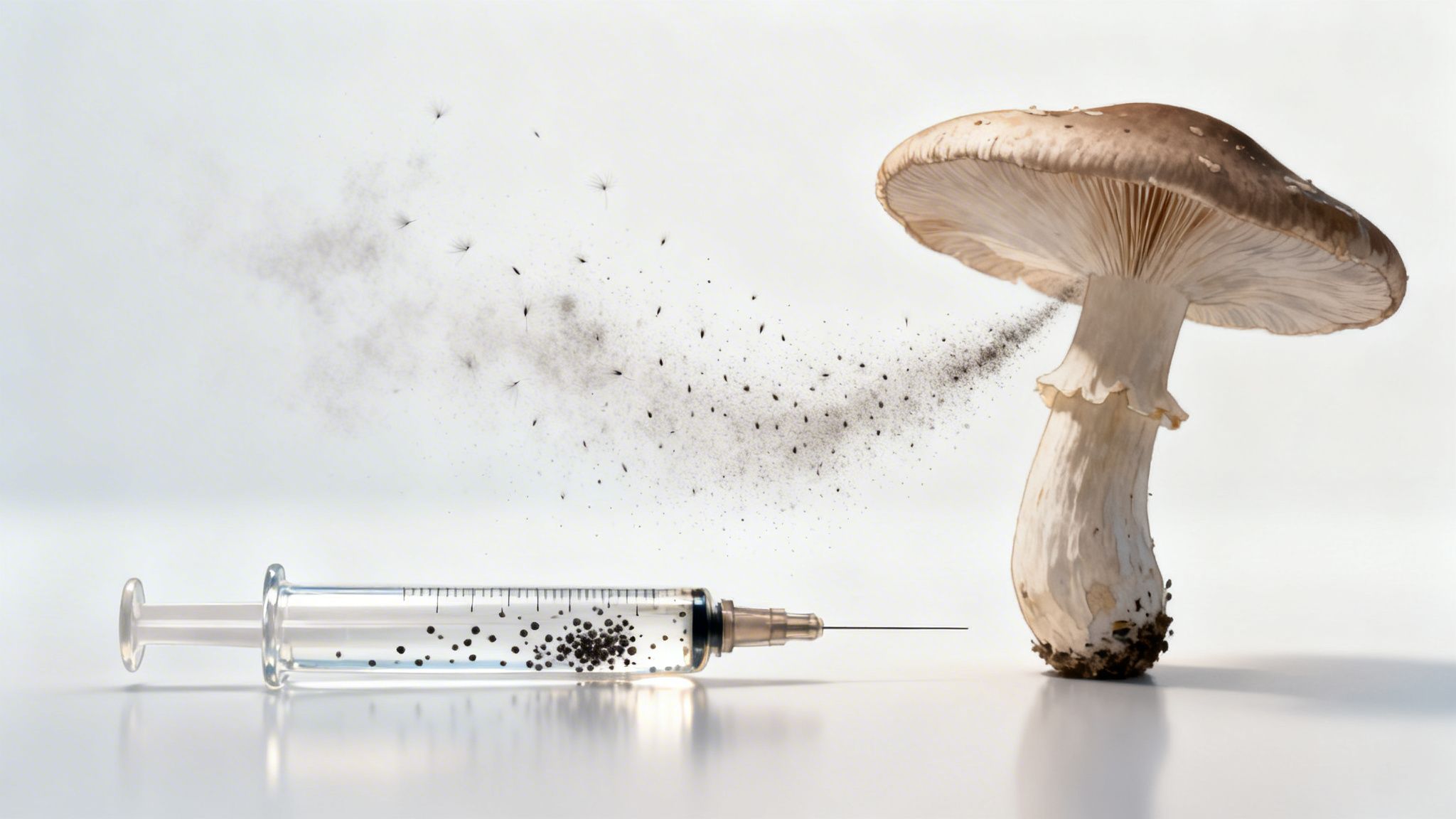
A high-quality spore syringe contains millions of hydrated Psilocybe cubensis spores suspended in sterilized distilled water. The water used to make it is pressure-cooked at 15 PSI for over 30 minutes to eliminate more than 99.9% of bacterial endospores, which helps create a sterile sample for microscopy or research, according to this explanation of spore syringe preparation.
In plain language, the syringe is just a clean transport system. It keeps microscopic material suspended in sterile water so a researcher can examine it or preserve it.
Why the liquid matters
The liquid in a spore syringe is typically clear or slightly cloudy. That surprises a lot of people because they expect something visibly “active.” But the appearance is part of the point. The syringe is not meant to look like a drug product. It is meant to keep spores distributed in water.
A simple analogy helps:
- Plant seed packet: holds the starting material for future growth.
- Spore syringe: holds fungal starting material in a sterile liquid form.
- Finished mushroom product: the later stage that people usually mean when they talk about psilocybin effects.
Those are different stages, and each stage carries different practical and legal implications.
What readers often confuse
Three terms get blended together:
| Term | Plain meaning | Why it matters |
|---|---|---|
| Spores | Microscopic reproductive cells | Starting point for study |
| Mycelium | The living fungal network that develops after germination | A later biological stage |
| Mushroom | The fruiting body people recognize | The stage most associated with psilocybin discussions |
Key takeaway: A psilocybin mushroom syringe is usually called that because of the species the spores come from, not because the syringe itself contains an active psychedelic ingredient.
For a Michigan consumer, the practical takeaway is simple. A spore syringe is best understood as a biological sample in sterile water, not as a consumable product.
Spore Syringes vs Liquid Culture Syringes
A lot of confusion disappears once you separate spore syringes from liquid culture syringes. They may look similar from the outside, but they are not the same tool.
The simplest difference
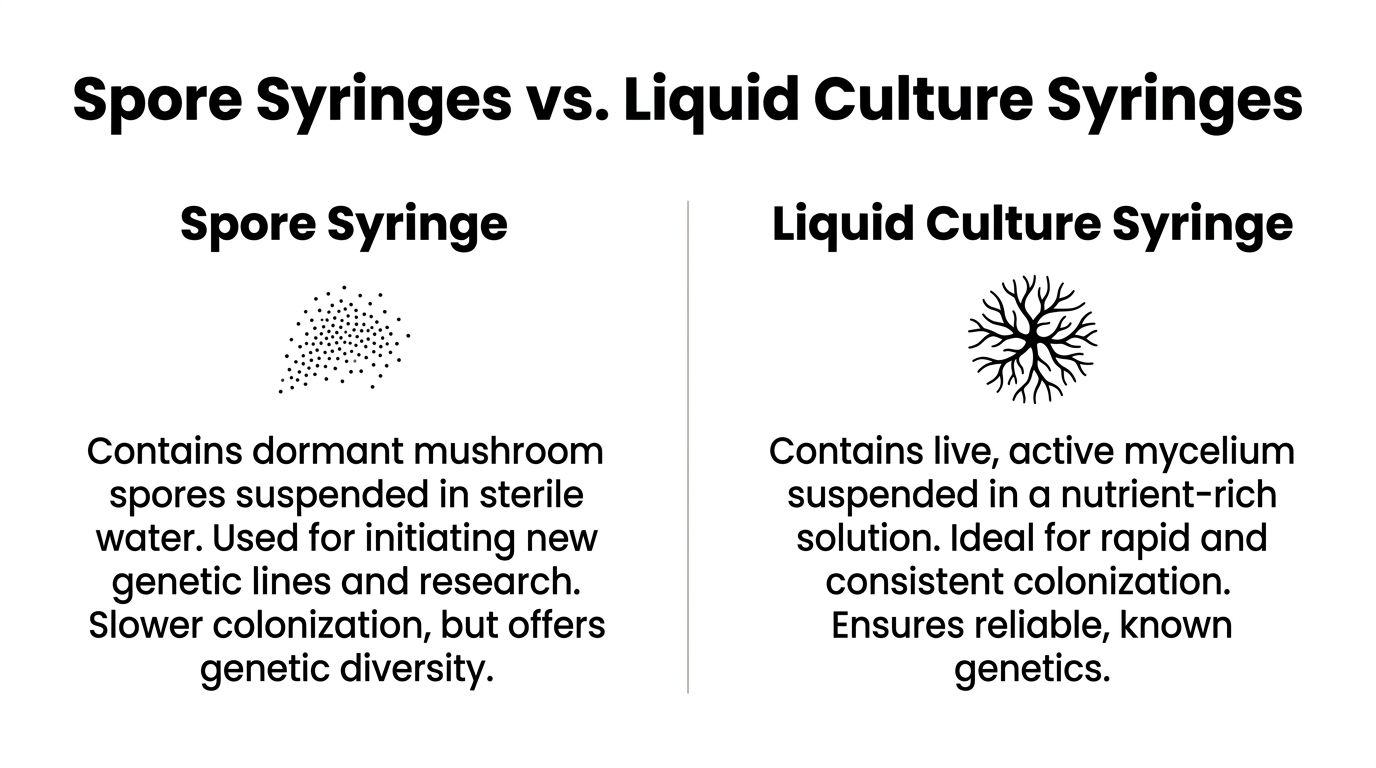
A spore syringe contains dormant spores in sterile water.
A liquid culture syringe contains active living mycelium suspended in a nutrient-rich solution. That means the culture has already moved beyond the dormant spore stage and into early fungal growth.
If you browse retailers that discuss Psilocybe spore syringes, this distinction is the one to keep front of mind. Two syringes can look similar on a product page while representing very different biology.
Why researchers treat them differently
Spores are genetically broad. In a multi-spore sample, you are looking at many possible genetic combinations. That makes spore syringes useful for observation, comparison, and broad research interest.
Liquid culture is more targeted. It contains active mycelial material, so it is favored when consistency and speed matter more than broad genetic variation.
Here is the side-by-side view:
| Feature | Spore syringe | Liquid culture syringe |
|---|---|---|
| Contents | Dormant spores in sterile water | Live mycelium in nutrient broth |
| Research character | Broad genetics, more variation | More consistent genetics |
| Speed | Slower start | Faster start |
| Typical interest | Microscopy, strain comparison, early-stage fungal study | Faster propagation of known material |
The time difference is not minor
Liquid culture syringes can reach 95-100% colonization in 3-7 days because they contain active mycelium and skip the 14-21 day germination phase required for spores, according to this liquid culture explanation.
That faster start matters because every extra day in an early stage creates more opportunity for contamination or failed research samples.
Practical tip: If someone says two mushroom syringes are “basically the same,” ask one question. Does it contain dormant spores or active mycelium? That answer changes almost everything.
Which one causes the most confusion
Spore syringes confuse beginners because they sound more advanced than they are. They are the simpler concept. They hold spores in water.
Liquid culture confuses people for the opposite reason. It sounds similar, but biologically it is already alive and growing. That makes it more active as a research material and changes how people think about reliability, storage, and legal risk.
For Michigan readers, the important point is not to treat every syringe as interchangeable. The label “psilocybin mushroom syringe” can refer to different materials, and the difference starts at the microscopic level.
The Surprising Legality of Spore Syringes
The legal gray area makes more sense when you focus on chemistry instead of the product name.
A spore syringe may be associated with a psilocybin-producing species, but that does not mean the syringe itself contains a controlled substance. That is the key distinction.

Why federal law treats spores differently
The DEA clarified in a January 2024 letter that mushroom spores are not controlled under the federal Controlled Substances Act because they do not contain psilocybin or psilocin. That is why they can be possessed and sold for microscopy in most U.S. states, with state-level exceptions such as California and Georgia, as described in this review of mushroom spore legality.
That explanation is easier to grasp with an analogy. Federal law is looking for the scheduled chemicals, not just the name of the organism. If the spores do not contain those chemicals, the legal analysis starts from a different place than it would for mature psilocybin-containing material.
The scientific reason behind the gray area
Spores are the beginning of the life cycle. They have the genetic instructions, but they have not yet developed into the stage people associate with psilocybin-producing mushrooms.
That is why words matter here:
- Spore does not automatically mean controlled substance.
- Mycelium and later growth stages raise different concerns.
- Cultivation intent can create legal problems even when the starting material itself sits in a gray area.
Courts have also treated grow kits and cultivation materials differently when they are tied to producing psilocybin mushrooms. So while spores may be treated one way, conduct and intent can be treated another.
Where Michigan fits
Michigan adds another layer because local policy conversations often blur together. In cities such as Detroit and Ann Arbor, readers may hear broad public discussion around mushrooms, decriminalization, and adult access. That does not erase the need to separate local enforcement trends from federal and state legal frameworks.
For broader local context, Michigan mushroom law and access discussions often get read alongside spore information, even though they are not identical topics.
This short video gives a useful visual frame for the legal questions people keep asking.
Legal awareness matters: “Available online” does not mean “legal everywhere for every purpose.” State rules, local enforcement, and intended use all matter.
For a Michigan buyer, the safest mental model is this. A spore syringe sits in a legal category built around what it contains right now, not around what people imagine it could become later.
Primary Uses and Research Applications
So what do people do with a psilocybin mushroom syringe when they are using it in a legitimate research context?
The answer is much less dramatic than most first-time readers expect. The most straightforward use is microscopy. Researchers and hobbyists use spores to observe shape, distribution, and identifying traits under magnification.
Microscopy and identification
Spores help people study fungal structure without handling a finished mushroom product. That can be useful for species comparison, taxonomy, and preservation of genetic lines for later scientific work.
For many readers, taxonomy sounds abstract. A simpler way to think about it is “sorting and identifying fungi accurately.” Spores can carry important clues about what species or strain a sample belongs to.
Preservation and long-term study
Spores also matter because they are a stable starting point for preserving genetics. If someone wants to keep a line available for future observation or research, spores offer a compact and practical way to do that.
This is one reason strain names attract attention. Different strains can be valuable to researchers because they represent different genetics, growth characteristics, and observable traits.
A separate but related category is liquid culture. Readers comparing research materials often also look at mushroom liquid culture because it serves a different role from spore-based observation.
Why the market exists at all
If spores were only a niche curiosity, there would be much less interest in syringes. Their appeal comes from being a workable entry point into fungal research.
For research purposes, the genetics in a single spore syringe can be highly efficient. Optimized laboratory methods can potentially yield 150-200 dry grams from a single research project, according to this Psilocybe cubensis overview. That helps explain why specific strains attract attention from serious mycology enthusiasts.
That figure should not be read as a home-use promise. It is better understood as a sign that the underlying genetics can be productive in well-controlled research settings.
The legitimate use case in plain English
A reader who wants the cleanest summary can think of spore syringes this way:
- Observation: studying spores under a microscope
- Identification: comparing characteristics across samples
- Preservation: keeping fungal genetics available for future research
- Lab starting material: a research input, not a finished consumer item
The “for microscopy and research” label is not just a throwaway disclaimer. It reflects the actual role these products can play when used in a lawful and scientific context.
Safe Handling and Harm Reduction for Researchers
With a psilocybin mushroom syringe, harm reduction starts with respecting what the product is. It is a biological sample. The main safety concern is not “how strong is it,” but “how clean and viable is it?”
That changes the advice. The best practices focus on storage, contamination control, and realistic expectations about shelf life.
Storage matters more than people think
A 2025 mycology paper found that standard cubensis spores retain 85% viability after 18 months refrigerated, while high-potency isolates such as Enigma can drop to 60% viability in that same refrigerated period due to fragility, according to this summary of syringe viability.
That tells you two useful things. First, refrigeration matters. Second, not all genetics age the same way.
Storage tip: Cool, stable, dark storage supports sample quality better than repeated warming, sunlight, or casual handling in a drawer.
What responsible handling looks like
A careful researcher usually focuses on a few habits:
- Keep it cold: Refrigerated storage helps preserve viability over time.
- Handle cleanly: Clean hands, clean surfaces, and clean tools reduce the chance of introducing contamination.
- Check appearance: A sample should look like a suspended biological material, not a neglected container with obvious debris or damage.
- Use it in a reasonable timeframe: Even refrigerated samples change with age.
Where beginners make mistakes
The most common misunderstanding is treating a syringe like a shelf-stable gadget. It is not. It contains living or potentially viable biological material, and that material can degrade.
Another mistake is assuming “premium strain” means “lasts longer.” Sometimes the opposite is true. More delicate genetics may need more careful storage and more realistic timing.
A simple decision framework
If you are evaluating a research syringe, ask:
| Question | Why it matters |
|---|---|
| Has it been stored cold? | Supports viability |
| How old is it? | Older samples may be less reliable |
| Is the seller clear about intended use? | Good sign of responsible handling standards |
| Does the sample look clean and intact? | Helps screen for poor quality |
Responsible handling is not glamorous, but it is where most successful research starts. Clean storage and realistic expectations do more for a sample than hype ever will.
From Research to Reality The Metro Mush Alternative
A spore syringe belongs in a research conversation. Many Michigan adults, though, are not trying to study spores under a microscope or compare fungal genetics. They are looking for a more direct, easier-to-understand consumer experience.
That is where the difference becomes practical. Research materials ask a lot from the buyer. They require background knowledge, legal awareness, and comfort with technical products. Ready-made consumer products are a different category altogether.
Why many adults do not want DIY research materials
Some readers are curious about mushrooms and begin by searching broad phrases like “psilocybin mushroom syringe.” What they often discover is that a syringe is not a straightforward consumer product. It is a technical item wrapped in legal nuance.
For adults in Southeast Michigan, that gap matters. A person interested in low-dose chocolate, a measured drink, or a familiar packaged format is not looking for sterile water full of microscopic spores. They are looking for convenience and clarity.
The consumer question is different
A research buyer asks, “What biology is in this syringe?”
A consumer asks different questions:
- How easy is this to use?
- Is the format approachable?
- Can I choose between dried mushrooms, chocolates, or drinks?
- Is there a simple ordering process?
Those are not microscopy questions. They are retail questions.
Why this distinction helps Michigan shoppers
In places where mushroom conversations are more visible, people often blur the line between research products and adult-use products. Keeping those categories separate helps people make better decisions.
If your interest is scientific, a syringe may be relevant. If your interest is adult-oriented product access, it makes more sense to look at curated options such as dried strains and edibles offered through a local service model.
That distinction can also reduce confusion around legal exposure. Research materials come with one set of issues. Consumer-ready formats come with another set of considerations. Treating them as the same thing usually leads to bad assumptions.
Practical takeaway: The right product depends on your actual goal. Curiosity about mushrooms does not automatically mean a syringe is the right place to start.
For many adult consumers in the Detroit and Ann Arbor area, the better path is not learning how to evaluate a lab-style syringe. It is finding a trusted local option that already speaks the language of servings, formats, and convenience.
Frequently Asked Questions
| Question | Answer |
|---|---|
| Does a psilocybin mushroom syringe contain psilocybin? | Usually a spore syringe does not. It generally contains spores suspended in sterile water, which is the central reason it is treated differently from psilocybin-containing material. |
| Why do people call it a psilocybin mushroom syringe then? | The name usually refers to the species the spores come from, such as Psilocybe cubensis, not to the presence of active psilocybin in the syringe itself. |
| Is a spore syringe the same as liquid culture? | No. A spore syringe contains dormant spores. A liquid culture syringe contains active mycelium in nutrient liquid. They look similar but represent different biological stages. |
| Are spore syringes legal in Michigan? | Federal treatment of spores differs from treatment of psilocybin because spores do not contain psilocybin or psilocin. State and local context still matters, so readers should stay aware of current Michigan rules and any state-specific restrictions when ordering across borders. |
| What are spore syringes commonly used for? | The clearest legitimate uses are microscopy, fungal identification, taxonomy, and genetic preservation. |
| How should a research syringe be stored? | Refrigerated storage is the most important baseline. Cool, stable conditions help protect viability over time. |
| Do all strains store equally well? | No. Some genetics appear more fragile than others, so age and storage conditions matter. |
| Is a syringe a good fit for someone who just wants a simple mushroom product? | Usually not. A syringe is a research-oriented item. Adults looking for a straightforward consumer experience often prefer ready-made formats instead of technical biological materials. |
If you are an adult in Southeast Michigan and want mushroom products without dealing with the complexity of research syringes, Metro Mush offers a more practical path. You can browse dried strains like Penis Envy and Enigma, or choose approachable edibles such as OuterSpore Milk Chocolate Bars, Mush Love Chocolate Bars, Rocket Fuel shroom drinks, and Moon Bars. Orders are available by text in the Detroit Metro at 734-691-6122 and in the Ann Arbor Metro at 734-280-2868, with a $75 minimum order. Shoppers can also look for Mix & Match Saturdays, where any three chocolate bars or drinks are $100, with savings of up to $40. Fire, police, and veterans receive 10% off, and Discord members can unlock a 20% discount while staying updated on new drops and promotions.