

A controlled laboratory study of 14 cultivated Psilocybe cubensis strains found total measured tryptamines varying more than 7.8-fold, from 2.62 to 20.65 milligrams per gram of dried mushroom (the 14-strain analysis, published in the peer-reviewed literature). Same species. Same growing protocol. Same analytical method. The strongest sample carried roughly eight times the alkaloid load of the weakest.
That single result reframes the search for the strongest mushroom strain. The question sounds like it has one answer, a name you can memorize. What the measurements show is a range, and the range inside one species is wider than the gap between the two most-cited names in the category.
So the useful answer comes in two parts. Named strains do differ in measured potency, and the difference is large enough to matter. But batch-level variation and the way a lab counts compounds can move a number further than a strain name does, which is why a verified batch beats a famous label every time.
Strongest Named Strains in Lab Tests
Penis Envy leads the named cultivars in the controlled 14-strain comparison, at 17.59 mg/g total tryptamines: 15.49 mg/g psilocybin, 1.77 mg/g psilocin, 0.20 mg/g baeocystin and 0.12 mg/g aeruginascin. Enigma, the other name that appears in nearly every potency ranking, measured 8.11 mg/g total tryptamines, including 7.91 mg/g psilocybin and 0.11 mg/g psilocin.
That is about 2.17 times Enigma's total tryptamines and about 1.96 times its psilocybin. The two ratios differ because the compound list differs. Counting every tryptamine widens Penis Envy's lead: its psilocin, baeocystin and aeruginascin add more milligrams than Enigma's minor compounds do. Psilocybin alone still leaves Penis Envy nearly double Enigma, so the ranking does not depend on the minor tryptamines.
The study's own ceiling sits above both names. The strongest sample reached 20.65 mg/g total tryptamines and the weakest 2.62 mg/g. Penis Envy, at 17.59 mg/g, is high and still about 3 mg/g short of that ceiling. Enigma, at 8.11 mg/g, sits nearer the middle of the set than the top.
| Strain or sample | Reported value | Measure | Study |
|---|---|---|---|
| Penis Envy | 17.59 mg/g | Total tryptamines, including 15.49 mg/g psilocybin | 14-strain study |
| Enigma | 8.11 mg/g | Total tryptamines, including 7.91 mg/g psilocybin | 14-strain study |
| Lowest of 14 strains | 2.62 mg/g | Total tryptamines | 14-strain study |
| Highest of 14 strains | 20.65 mg/g | Total tryptamines | 14-strain study |
What the ranking can and cannot support
All four rows share one growing protocol and one analytical method, so Penis Envy versus Enigma is a matched comparison. A figure from another lab, a percent of dry weight, or psilocybin reported alone cannot be dropped onto this table and treated as a higher or lower rank.
One study, one scale. 17.59 mg/g and 8.11 mg/g can be compared with each other. A result in a different unit, or one that counts a different set of compounds, stays off this ranking until it is restated on the same basis.
The researchers also estimated what a high-potency sample implies for a weighed amount. 2.5 to 3 grams of dried mushroom from that sample could correspond to roughly 25 to 30 mg of psilocybin, near amounts used in some clinical research. That estimate is tied to the fruiting bodies they tested. It is not a serving size, and it does not describe an untested jar.
A strain name records where a cultivar landed in this comparison. The 3 mg/g gap between Penis Envy and the strongest sample, and the spread from 2.62 to 20.65 mg/g under identical conditions, are both large relative to the gap shoppers treat as a settled ranking of names. Genetics, cultivation, drying, storage and the next batch can move the delivered amount off the table. The figure that applies to a given product is the verified batch, not the name on the label.
How Potency Numbers Are Measured
A potency figure is the product of three decisions made before the mushroom was ever weighed: which compounds the lab counted, which unit it reported, and what the weight refers to. Change any one of them and the number moves while the fungus stays exactly the same.
Which compounds count, and in what unit
Psilocybin is the main psychoactive compound stored in the fruiting body and the one most often reported on its own. Psilocin is the active molecule the body produces from psilocybin, usually present in much smaller amounts. Baeocystin and aeruginascin are minor tryptamines that appear in trace quantities. Total tryptamines is the sum of everything the lab managed to measure, minor compounds included.
Units create the second layer of confusion. Results appear either as milligrams per gram of dried mushroom or as a percentage of dry weight, and those are the same measurement written two ways.
The only conversion you need: 1% of dry weight equals 10 mg/g. A strain testing at 1.36% is carrying 13.6 mg of that compound per gram of dried tissue.
Creeper, which topped a 2024 controlled analysis of five Psilocybe cubensis strains at 1.36% combined psilocybin and psilocin, therefore carries 13.6 mg/g of those two compounds, as RoseHill's summary of the 2024 strain data sets out. Compare that with Penis Envy's 15.49 mg/g psilocybin and the figures look close, but they answer different questions: one counts two compounds, the other counts one of the same two plus three more.
| Measure | Unit | What it covers | Common misreading |
|---|---|---|---|
| Psilocybin | mg/g or % dry weight | The main psychoactive compound | Treated as total potency on its own |
| Psilocin | mg/g or % dry weight | Active form the body produces from psilocybin | Left out of psilocybin-only results |
| Psilocybin plus psilocin | % dry weight | The two main compounds added together | Compared with totals that include minor tryptamines |
| Total tryptamines | mg/g dried mushroom | All measured tryptamines, including baeocystin and aeruginascin | Higher totals may just reflect more compounds counted |
| Fresh weight basis | Percent or mg/g of fresh weight | Mushroom including its water content | Reads far lower than dry-weight figures |
Weight basis is the third decision, and the one readers miss most often. Fresh mushrooms are mostly water, so a fresh-weight figure reads far lower than a dry-weight figure taken from the same material. The two cannot be placed side by side.
The same discipline applies outside fungi. Reading lab reports beyond THC means checking which cannabinoids were counted, in what unit and on what basis, which is exactly the breakdown a proper lab report gives for cannabis flower. The logic transfers: a number is only as useful as the definitions behind it.
When two results disagree, check the compound list, the unit and the weight basis before concluding that one strain is stronger.
Why the Same Strain Varies Between Batches
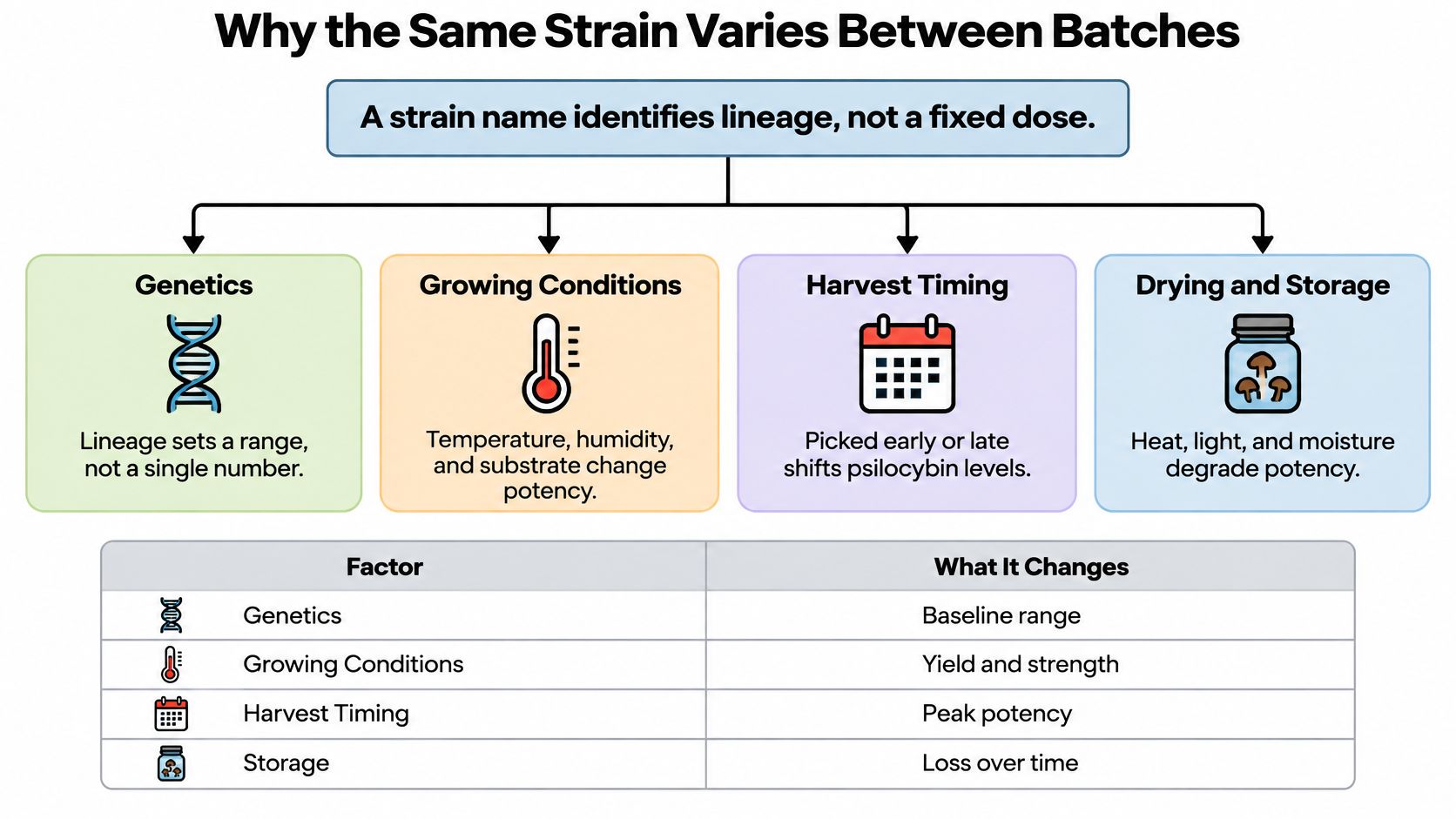
A strain name identifies a lineage. It does not identify a dose, and the published data on variation makes that gap concrete. A 2025 review reports that psychoactive-compound concentrations vary considerably within and between strains because of genetics and cultivation conditions, while analytical work on individual mushrooms found 12.81% to 23.39% variation in psilocybin among fruiting bodies from the same selected strains (the review of potency variability). Products sold side by side in the same market can also test at widely different strengths. Two mushrooms carrying the same name can deliver materially different doses.
That spread is why a strain label and a verified batch are not interchangeable pieces of information.
Three levels of variation
- The strain label describes a lineage and the general range a cultivator can expect from it. It is the widest and least specific level, and it is the one most potency lists operate on.
- The batch test describes one harvest from one grow. It is the level a buyer can use, though it still averages across many fruiting bodies.
- The individual fruiting body is the smallest unit, and it is where the 12.81% to 23.39% spread appears. Neighbours from the same flush can differ by roughly a fifth to a quarter of their psilocybin content.
Each level down is more specific and more useful. Each level up averages away the differences that decide what a dose contains.
| Factor | Effect on potency | What to check |
|---|---|---|
| Genetics and lineage | Sets the potential range; two lines with the same name can differ | Whether the grower names the cultivar and tests it |
| Cultivation conditions | Substrate, humidity and temperature shift compound levels | Batch or grow documentation, if provided |
| Harvest maturity | Fruiting bodies picked at different stages carry different amounts | Harvest date on the batch record |
| Drying and handling | Poor drying or handling can degrade compounds | Drying method and timing on the record |
| Storage over time | Heat, light and age reduce potency | Storage conditions and test date |
| Individual fruiting bodies | Psilocybin varied 12.81% to 23.39% within the same selected strains | Whether results come from one sample or a batch average |
Rankings built on names inherit uncertainty from every level beneath them. A list that calls one cultivar strongest is really saying the average of a small number of samples of that cultivar exceeded the average of a small number of samples of another. That is a statement about a lineage, not about the eighth of an ounce someone is holding. When the within-batch spread approaches the between-strain gap, the batch report outranks the name on the label.
Storage is the one factor a buyer controls after purchase, and the right way to store shrooms determines whether a tested batch keeps the potency its report describes.
Ask whether a result comes from a single sample or a batch average. A missing answer means the potency is unknown, not that it is high.
How to Read a Batch Report
A potency claim is a claim until you've seen the report behind it. Work through the checks below in order, because each one determines whether the next one means anything.
- Confirm the testing lab is named and independent. A lab you can look up means the result wasn't self-reported. Without a lab name, the report is marketing with numbers attached.
- Match the batch number and test date to your product. A real result belongs to one harvest, so the code on the report should match the code on the package. Mismatched codes mean you're reading someone else's test.
- Check which compounds were measured. Psilocybin alone, psilocybin plus psilocin, and total tryptamines are three different figures from one sample. Note which one you're comparing before you compare it.
- Confirm the unit and the weight basis. Milligrams per gram against percent is a factor of ten, and fresh weight against dry weight is a much wider gap. A number without its basis can't be set against any other product.
- Look for the analytical method. Liquid chromatography and rapid screening techniques can produce different values from the same material. Two results generated by different methods may not be directly comparable, so the method is part of the result.
- Look for a range or a variation figure. One sample describes one mushroom. A report that states a range tells you how much the batch moves, which is the information a single number hides.
Here is the checklist compressed into the four checks that catch most bad claims.
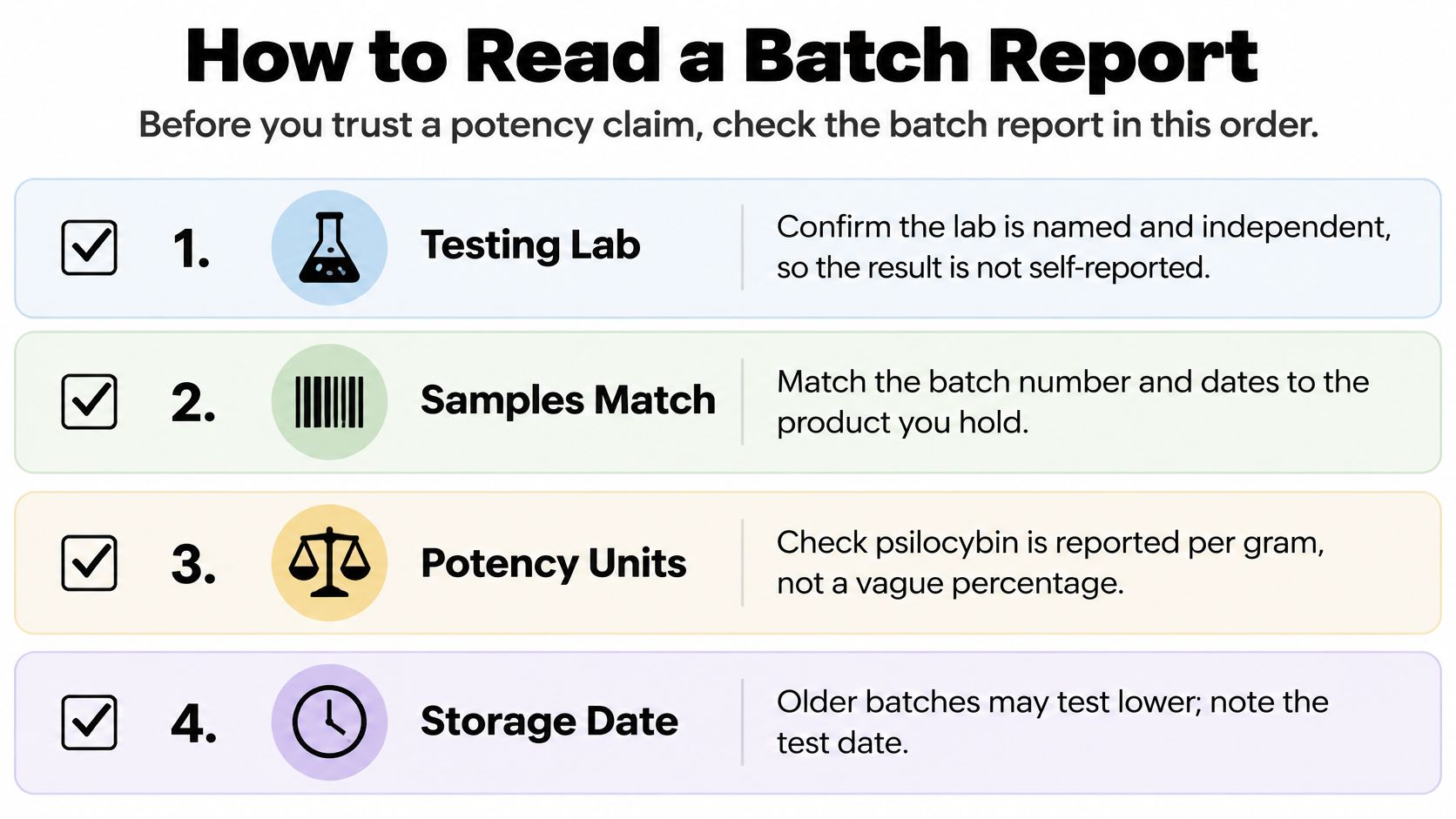
An absent item makes a number unverified, not weak. That distinction matters, because unverified products are the ones most likely to carry an unsupported strength claim. The same standard applies to other fungi sold on health claims, where a reishi label and testing checklist covers identity, extraction and contaminant screening rather than one headline potency figure.
Counterfeit and relabelled products make the matching step more important than the number itself, which is why spotting fake products starts with packaging and batch codes rather than potency.
Decision rule: a verified number from a named batch is worth more than any strain name or reputation. If you can't verify it, treat the strength as unknown and choose accordingly.
Safety Factors That Change the Risk
The highest measured concentration isn't the same thing as the best experience, and the difference matters most for people who are cautious, who take medication, or who buy chocolates and drinks instead of dried mushrooms. Public-health evidence identifies headaches, nausea, anxiety, dizziness and increased blood pressure among the most frequent adverse effects, and most reported events were manageable and resolved within two days, according to a Washington State Liquor and Cannabis Board research brief. The same body of work notes that cannabis co-use is common and may raise the risk of adverse events.
Findings from controlled clinical trials also don't transfer automatically to uncontrolled real-world use. A dose delivered in a trial, with screening, supervision and a measured pharmaceutical compound, isn't the same event as an unmeasured retail product taken at home.
Highest measured is not the same as most suitable. For a first experience, the lower tested dose is the better choice, even when a stronger batch is on the same shelf.
The checks that matter before a strong dose
Confirm your age and the legal status where you live before ordering anything. Don't drive, and don't plan to. Skip alcohol and cannabis on the same day, since co-use can add risk without adding anything you wanted. Have a sober, trusted person available who knows what you took and when. If you take prescription medication, or you have a heart or blood pressure condition, talk to a clinician first rather than after.
Seek medical help for symptoms that are severe, persistent or frightening, and don't wait to see whether they settle on their own. Intensity, onset, duration, product format and setting all change how a given dose lands, so the same measured amount can produce very different evenings for two people.
Choosing a lower, tested dose is one of the few risk factors you control directly. That single decision does more than any strain ranking.
Match Strength to Your Goal Before You Buy
The strongest product is rarely the right purchase, because "strongest" means at least three different things. It can mean the highest measured concentration, the most predictable dose, or the most suitable option for an experienced user, and each of those points to a different choice.
| Situation | Better-fitting approach | Why it fits |
|---|---|---|
| First-time user | Lower-potency, tested product with a clear amount | Easier to predict and control the dose |
| Experienced user seeking intensity | Tested high-potency batch with stated compounds and units | Measured values reduce guesswork |
| Microdosing | Small, verified weight rather than the strongest strain | Low doses need consistent amounts |
| Chocolates or drinks | Check the amount per piece or per serving | Edibles depend on the dose per unit, not the strain name |
| Mixing with cannabis or alcohol | Lowest-potency option, or avoid the combination | Co-use can raise the chance of adverse effects |
Potency is only one of several things that shape how strong an experience feels. Onset and duration change with format, since a drink is absorbed faster than dried mushrooms chewed and swallowed, and a chocolate bar releases its dose over a longer, less even curve. Set and setting, meaning your mood and your surroundings, decide how a measured dose lands. A tested gram taken in a bad frame of mind can feel heavier than an untested gram taken in a good one.
Dose per piece beats strain name for edibles
Edibles move the question from strain to arithmetic. What matters is the milligrams per piece and how many pieces you take, not which cultivar the chocolate was made from. Ask for the amount per serving, divide by the piece count, and treat the answer as your dose. For a fuller walkthrough of starting amounts and timing between adjustments, the guide to dosing magic mushrooms sets out how to pick a starting weight rather than a starting strain.
Before you buy, request the report
Run the verification before money changes hands. Confirm the lab, match the batch code and test date, check the compounds and units, and note whether the result is a single sample or a batch average. A seller who can answer those questions in writing is offering something a potency ranking can't.
We've spent over four years growing and refining our strains, and our current Hillbilly Pumpkin (HBP) culture has tended to come out on the higher side for potency. It's sold in 3.5 gram, 7 gram, 14 gram and 28 gram sizes, so you can buy a known weight and work from there instead of guessing at strength.
Check the law where you are before ordering anything, since rules on psilocybin differ by state and by country and change without much notice.
Stronger batches exist, and so do weaker ones under the same name, which is why the batch matters more than the label. Metro Mush carries the strains this comparison keeps returning to, including Penis Envy and Enigma, alongside chocolates and drinks dosed per piece so the amount is written down rather than guessed. Visit Metro Mush to see current strains, sizes and edible options, then ask for the batch details before you choose a starting amount.