
Psilocybin for PTSD is investigational, not an established treatment. The figure cited most often comes from a single open-label pilot in 12 U.S. military veterans with severe, treatment-resistant PTSD, where clinician-rated CAPS-5 scores dropped 27.5 points about a month after two supervised doses delivered inside psychotherapy, and 75% of participants met the study's response and remission criteria.
Both numbers are real, and both arrive with conditions attached. The pilot had no placebo arm, no randomization and no blinding. Every participant knew what they were receiving, and so did the clinicians scoring their symptoms.
What the headline also hides is the delivery. The intervention wasn't a mushroom, a chocolate bar or a drink. It was a measured dose of psilocybin wrapped in clinical screening, weeks of psychological preparation, monitored administration and follow-up therapy. Those layers are part of the treatment, and no retail product carries them.
What the PTSD Evidence Shows So Far
A 2020 VA clinical research update describes an open-label pilot involving 12 U.S. military veterans with severe, treatment-resistant PTSD. Participants followed an approximately 11-week protocol that included preparation sessions, two psilocybin dosing sessions and integration work afterward, as described in the VA research update.
At one-month follow-up, CAPS-5 scores fell 27.5 points from baseline (95% CI, 19.9 to 35.1; Cohen's d = 2.30; p < 0.001), while 75% of participants met the study's response and remission criteria. That is a substantial change in a small group, not proof that psilocybin caused the improvement.
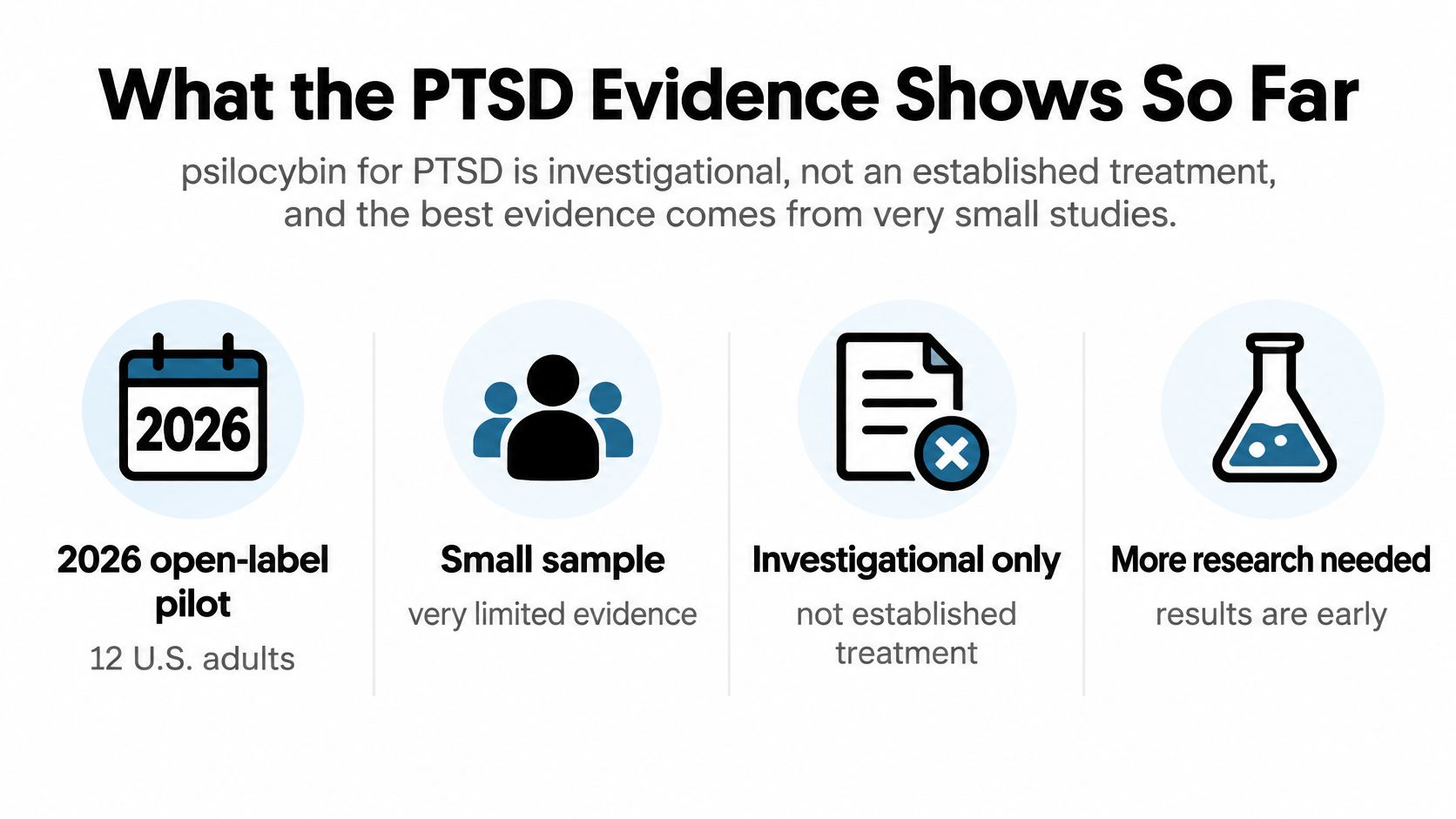
The study had no randomization, placebo control or blinding. Expectancy effects and regression to the mean therefore cannot be separated from the drug's contribution. The results also reflect an intensive protocol, not psilocybin alone: participants volunteered for a trial and received preparation, supervised dosing and follow-up support.
A separate qualitative study cannot be used to strengthen the efficacy claim unless its population and intervention are clearly established. Interviews can describe participants' experiences, but they do not by themselves show whether PTSD symptoms improved.
What the guideline position actually is
The VA/DoD clinical practice guideline states that evidence is insufficient to recommend for or against psilocybin. VA materials describe the published PTSD research as limited, and psilocybin is not an approved PTSD treatment. The clinical infrastructure for its use remains largely within research settings.
| Source | Population | Design and dosing | Main finding | Key limitation |
|---|---|---|---|---|
| 2020 open-label pilot | 12 U.S. veterans with severe, treatment-resistant PTSD | Two supervised doses of 15 mg and 25 mg within psychotherapy | CAPS-5 down 27.5 points at 1 month; 75% met response and remission criteria | No randomization, placebo control or blinding |
| Qualitative PTSD research | Participants in a PTSD population | Interviews about psilocybin-assisted treatment | Describes participant experiences | Qualitative; does not establish efficacy |
| VA/DoD clinical practice guideline | Clinicians and veterans with PTSD | Not applicable | Evidence insufficient to recommend for or against psilocybin | Limited PTSD trial data overall |
What the numbers cannot answer yet
The pilot followed participants to one month. It does not establish whether symptom changes lasted longer. That uncertainty matters: a short-term result cannot show whether an intervention produces durable improvement.
Read the timeline before the headline: a one-month result is a signal for further study, not a prognosis.
For anyone weighing options, the practical conclusion is narrow. The pilot supports further research, while its design limits what can be concluded about benefit. Discuss treatment choices with a qualified clinician; choosing a therapist for PTSD can help structure questions about training and treatment approach. An overview of psychedelic therapy research explains how research findings differ from the products sold outside clinical studies. Retail mushrooms, chocolates and other products do not replicate a precisely dosed investigational intervention delivered with screening, preparation and integration.
How Psilocybin May Change Trauma Responses
A traumatic memory behaves less like a finished file and more like a document that briefly opens for changes when you access it. Recall makes it editable for a short window. What happens in that window decides whether it gets saved again with the same fear attached or filed under something new.
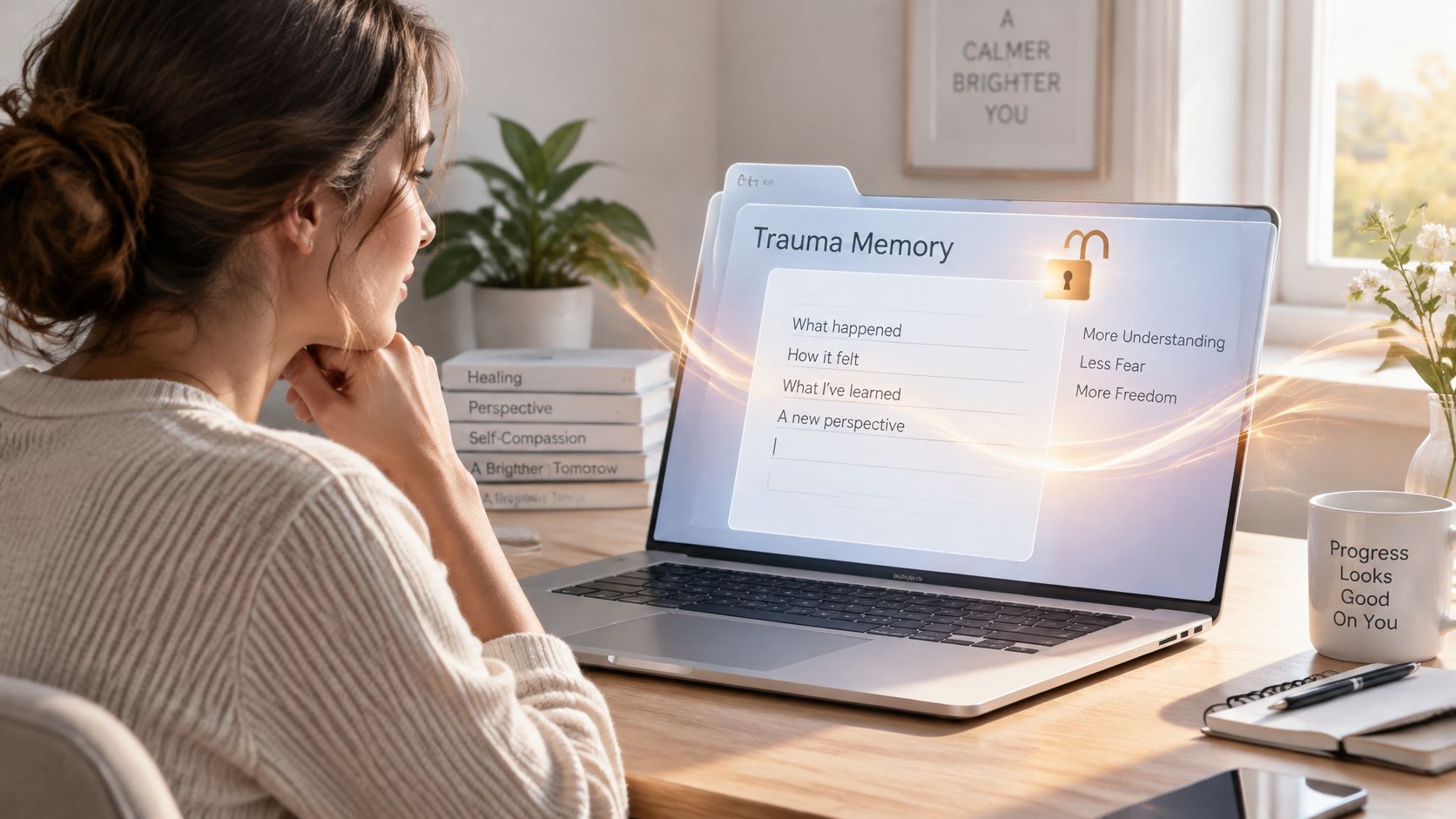
VA clinical reviews of psychedelic-assisted therapy describe psilocybin as potentially affecting three processes that matter for persistent trauma: fear-extinction learning, neural plasticity, and avoidance. Mood lift is the wrong frame for that proposal. The claim is narrower: a person might learn faster that a remembered threat no longer predicts danger, and might stay with the memory long enough for that learning to register. Those same reviews treat the PTSD evidence as minimal or insufficient for a treatment recommendation.
What separated the responders in the PTSD data
Within the early PTSD data, more intense self-transcendent experiences during sessions were linked to greater symptom improvement, though the samples are small. Stronger anxiety and distress during a session sat with the less favorable outcomes in that same early pattern.
Read the pattern as a hypothesis. A tolerable, psychologically supported altered state may increase emotional engagement with traumatic material and make new learning possible. Uncontrolled fear during the session may reinforce threat detection and avoidance instead. The sequence of those two experiences may matter more than the dose figure alone.
Setting and internal state carry as much weight as the molecule. A session run without support is a different event from the studied treatment.
The PTSD literature is still dominated by small, open-label studies. A symptom change in that setting is a signal about one tightly specified intervention, not a property of psilocybin in any form.
Why a hard session can leave someone worse
If emotional engagement is part of the mechanism, a session that tips into panic, disorientation, or dissociation can teach the nervous system that the material is even more dangerous than before. Avoidance then hardens around that lesson. Nobody trained to steady the person is present to interrupt it.
The early signal came from an investigational formulation, dosed to a set milligram amount, inside screening and supported sessions. A retail mushroom, capsule, tea, or chocolate product is chosen by weight, strain, or flavor, with no assay of psilocybin content and no clinician in the room. It cannot inherit a CAPS-5 change measured under those conditions.
For an adult considering this, psilocybin remains investigational for PTSD. Skip self-treatment during acute suicidality, mania, or psychosis risk, and get an evaluation from a qualified clinician instead of substituting a retail product for trauma-focused care.
Why Psychotherapy Is Part of the Treatment
A review of psilocybin evidence in psychiatric care places the strongest PTSD-specific data inside a supervised package: the 2026 pilot gave two supervised doses of 15 mg and 25 mg, two to three weeks apart, alongside psychotherapy, and carried no placebo or control group. The open question is how much of any change belongs to the molecule, and how much belongs to the preparation, monitoring and follow-up wrapped around those doses.
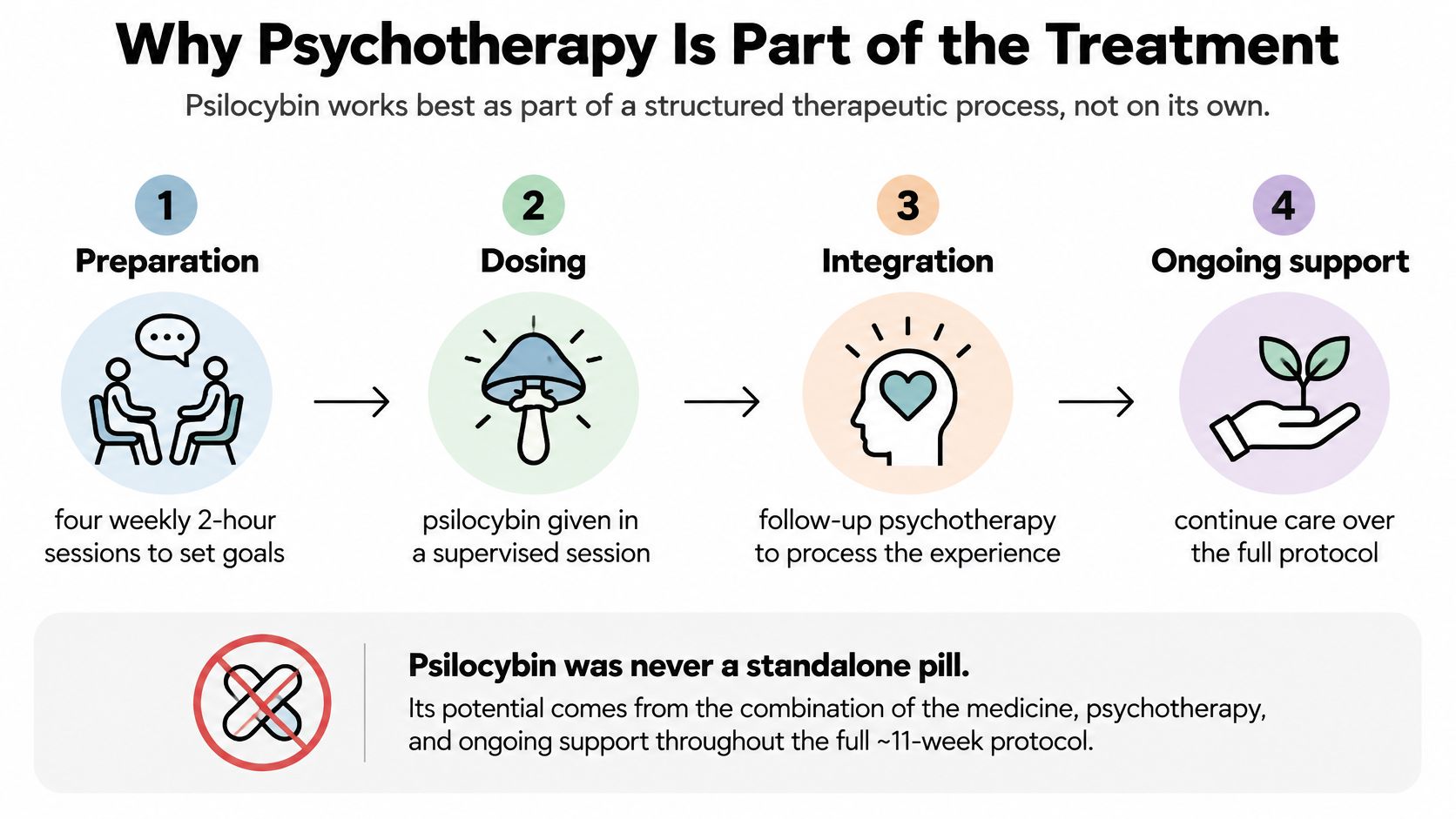
Participants move through three phases that do different jobs. Collapsing them into a dose plus a conversation drops the parts that make the studied procedure a treatment rather than an exposure to a drug.
| Phase | Sessions | Timing | Purpose |
|---|---|---|---|
| Preparation | A series of meetings before any drug | Over the weeks before dosing | Set goals, explain the range of possible experiences and build enough trust to say a session is going badly |
| Dosing | Two supervised sessions at 15 mg and 25 mg | Two to three weeks apart | Monitored administration of measured doses |
| Integration | Follow-up meetings after dosing | After each dosing session | Connect what surfaced to the trauma material and to daily life |
Preparation lowers the chance of a chaotic session. Monitoring is there to catch a medical problem while it is happening. Integration is the stretch in which an intense experience can become a revised belief about a memory. Each phase fails differently if it is skipped, so a shorter visit is not a scaled-down version of the same protocol.
Depression and anxiety trials do not transfer on their own. Product format, dose consistency, psychological support, trauma history and integration can each move the outcome. PTSD also brings avoidance and hyperarousal that those trials were not built to handle.
Why a chocolate bar can't inherit the results
A mushroom chocolate or a shroom drink supplies none of that sequence: no clinical screening, no measured dose, no preparation and no integration. It may contain psilocybin. It does not contain the intervention tied to improvement in a monitored veteran cohort. Treating a retail product as if it carried that result is a category error.
The video below walks through how supervised psychedelic therapy is structured in practice, a useful comparison when a product page uses the word "therapeutic."
If a provider offers psilocybin-assisted therapy, ask four direct questions: how much preparation comes before dosing, who is physically present during the session, what happens if panic does not settle, and who delivers integration afterward. A clinic that cannot answer all four is offering a dose, not the studied treatment. Therapy with Ben on psychedelic therapy looks at how the therapeutic relationship itself does part of the work. A separate account of what psychedelic therapy involves sets screening, preparation, the dosing session and integration out as one arc rather than a product claim.
Who Should Avoid Psilocybin or Get Screened First
Natural does not mean low risk. Arsenic is natural. The claim that a plant-derived substance is intrinsically gentle falls apart the moment you look at who was excluded from the studies, because every published PTSD result comes from screened volunteers dosed in a controlled room. Recent review evidence cited in VA guidance describes psychedelic studies as generally showing transient autonomic changes and other short-lived effects, while emphasizing that large samples, objective endpoints and long-term safety follow-up are still missing.
That leaves a question the official guidance doesn't answer with a yes or a no. The 2026 veteran pilot found no increase in suicidal ideation or behavior and reported stable heart rate and blood pressure during sessions, but the sample was tiny and every participant was treated in a controlled environment. You cannot carry those readings over to an adult eating an inaccurately labeled edible, mixing psilocybin with cannabis, or dosing alone without trained support.
| Condition or situation | Why it matters | First action |
|---|---|---|
| Current suicidal thoughts or recent suicidal behavior | Acute suicidality is a contraindication in the cited guidance | Complete a suicide risk assessment before any use |
| Psychosis, mania or bipolar disorder | Intense altered states can destabilize these conditions | Disclose full psychiatric history to a clinician |
| Cardiovascular conditions | Transient changes in heart rate and blood pressure have been described | Obtain a cardiology or primary care review |
| Antidepressants or other serotonergic medicines | Possible interactions, and MAO inhibitors carry serious risk | Ask the prescriber for a medication review |
| Complex PTSD or dissociation | Stronger session anxiety predicted less favorable outcomes | Request a trauma-informed assessment |
| Cannabis, alcohol or other substances | Combined effects are poorly studied | Disclose all substance use to the clinical team |
The substance question nobody asks on the dispensary floor
Psilocybin doesn't arrive into a clean system for most adults. It arrives alongside a nightly edible, two drinks on a Friday, a prescribed SSRI or a sleep aid. Those combinations are poorly studied, and a session that goes sideways often does so because two substances peaked together rather than because of the psilocybin alone.
Telling a clinician about cannabis and alcohol isn't a confession. It's the information that decides whether a supervised protocol is safe for you. Our breakdown of psilocybin drug interactions covers the medication categories that most often need a prescriber's review before any psychedelic use.
The screening standard: if a clinic wouldn't enroll you in the trial, a retail purchase is not a workaround. It's the same risk without the monitoring.
Complex PTSD deserves its own line here. Dissociation during an intense session is hard to manage even with a trained sitter, and the PTSD data pointed toward worse outcomes when session anxiety ran high. A trauma-informed assessment isn't gatekeeping. It's the difference between a difficult hour that resolves and one that doesn't.
Side Effects and Harm Reduction for Anyone Considering It
In the supervised veteran work, the reported complaints were ordinary and short-lived: headache, anxiety and dizziness, with no serious adverse events recorded in a monitored setting. That is what monitoring buys you. Someone is watching the blood pressure, someone recognizes the difference between expected distress and a problem, and someone can end the session.
For an adult who has been cleared clinically and still intends to use psilocybin, the risk profile changes the moment supervision disappears. These are the rules that matter most.
- Know your stated dose. A product that names its content, like our Moon Bar at 3.5 grams of McKennaii mushrooms, gives you a number to work with. An unlabeled chocolate gives you a guess, and potency varies from batch to batch and piece to piece.
- Set the room before you set the dose. A calm, familiar space, one sober adult present, phones charged, water within reach. No unfamiliar locations, no driving afterward, no stairs in the dark.
- Clear the day. Don't drive or operate machinery for the rest of the day, including the hours after the acute effects fade.
- Skip the stack. No alcohol, cannabis or sedatives unless a clinician has approved the combination. Mixing is where most bad nights start.
- Name the distress signals in advance. Panic that doesn't settle, chest pain, confusion about where or who you are, or thoughts of self-harm are reasons to stop and get help, not ride it out.
- Save the numbers. In the U.S., the Suicide and Crisis Lifeline is 988 by call or text. Add the local emergency number and one person who will answer at 3 a.m.
A supervised dose has a clinician ready to intervene. A self-directed dose relies on your judgment in the exact moment your judgment is most compromised.
The distinction isn't moral, it's structural. In the trial, a bad reaction was a clinical event with a protocol. At home, it's a decision made mid-experience by someone who is, by definition, not at baseline.
How to Move From Curiosity to Clinical Care and Decide
A large drop on a standard PTSD symptom scale among treatment-resistant veterans is the kind of signal that gets a field funded. It is still a signal, not a treatment you can buy off a menu. The sessions behind that signal used a measured psilocybin dose inside screening, preparation, and integration. A dried strain, a capsule, or a chocolate bar skips those steps, so the trial result does not transfer to the product.
Curiosity is a reasonable starting point. What makes it useful is getting a clinical read before any product decision.
- Book an evaluation with a primary care doctor or a mental health clinic. If you are a veteran, VA mental health services are the natural entry point, and a primary care visit can start the referral.
- Ask about established trauma therapies first. Cognitive processing therapy, prolonged exposure, and EMDR carry a stronger PTSD evidence base than psilocybin does today. A clinician can tell you whether you have already tried them.
- Search ClinicalTrials.gov for recruiting psilocybin PTSD studies and read the eligibility criteria line by line. Trials are free, monitored, and the only route to the version of this treatment that has been studied.
- Bring a complete list. Every medication, supplement, cannabis product, and drink, with amounts. Understating use is the usual way a screening gets wasted.
- Ask how sessions are monitored, who handles a medical emergency, and how integration is delivered afterward. Those answers show whether you are looking at a clinical program or a loosely supervised session.
- Build a crisis plan with two emergency contacts, the 988 lifeline, and the local emergency number, written down and shared with someone who lives nearby.
The checklist that decides your next step
Run these five checks before you spend money on anything.
- Full clinical evaluation completed. A person with a license and your history in front of them, not a questionnaire on a website.
- Evidence-based PTSD therapy considered or tried. If you have not been offered CPT, PE, or EMDR, that is the gap to close first.
- No current suicidality, psychosis, mania, or uncontrolled cardiovascular condition. Any of these belongs in a doctor's office.
- Medications and substances reviewed for interactions. Include the ones you do not think of as drugs.
- Access to supervised, screened dosing. If that access is not available to you, wait rather than substitute a retail product.
Fail any one of those and the next step is clinical care. Asking whether psilocybin is for sale and asking whether you would be screened for it lead to different places. Only the second question matches the protocol that was studied.
The verdict on psilocybin for PTSD
The signal is real and worth following through larger controlled trials. The evidence is still preliminary: samples are small, follow-up is short, and no official guideline recommends psilocybin for PTSD. Veterans should talk with their own providers before any treatment decision. A shop cannot run that screen, prepare the session, or provide integration, which is why a purchase cannot stand in for the intervention.
Schedule the evaluation this week. Bring the checklist, a written list of everything you take, and one question: given my history, would a supervised psilocybin protocol be safe for me, and what should I try first? Expect screening to take several weeks. That timeline is part of the safety design.
Adults in Southeast Michigan can browse the Metro Mush menu and place orders by text at 734-691-6122 (Detroit Metro) or 734-280-2868 (Ann Arbor). If you look at products at all, do it after the evaluation, with the screening question already written down. Screening is the part of the studied protocol no shop can replicate.