When comparing shrooms vs weed, it can seem as if one has to win. That question leads you astray. Cannabis and psilocybin mushrooms change different systems in your brain, last for different lengths of time, and create different kinds of impairment. A better question is simpler. What kind of day do you have, what risks do you carry, and which substance, if either, fits that day without asking you to gamble?
Shrooms vs Weed at a Glance
Start with the snapshot, then use the details that follow to make sense of it. The chart below puts the basic mechanics side by side.
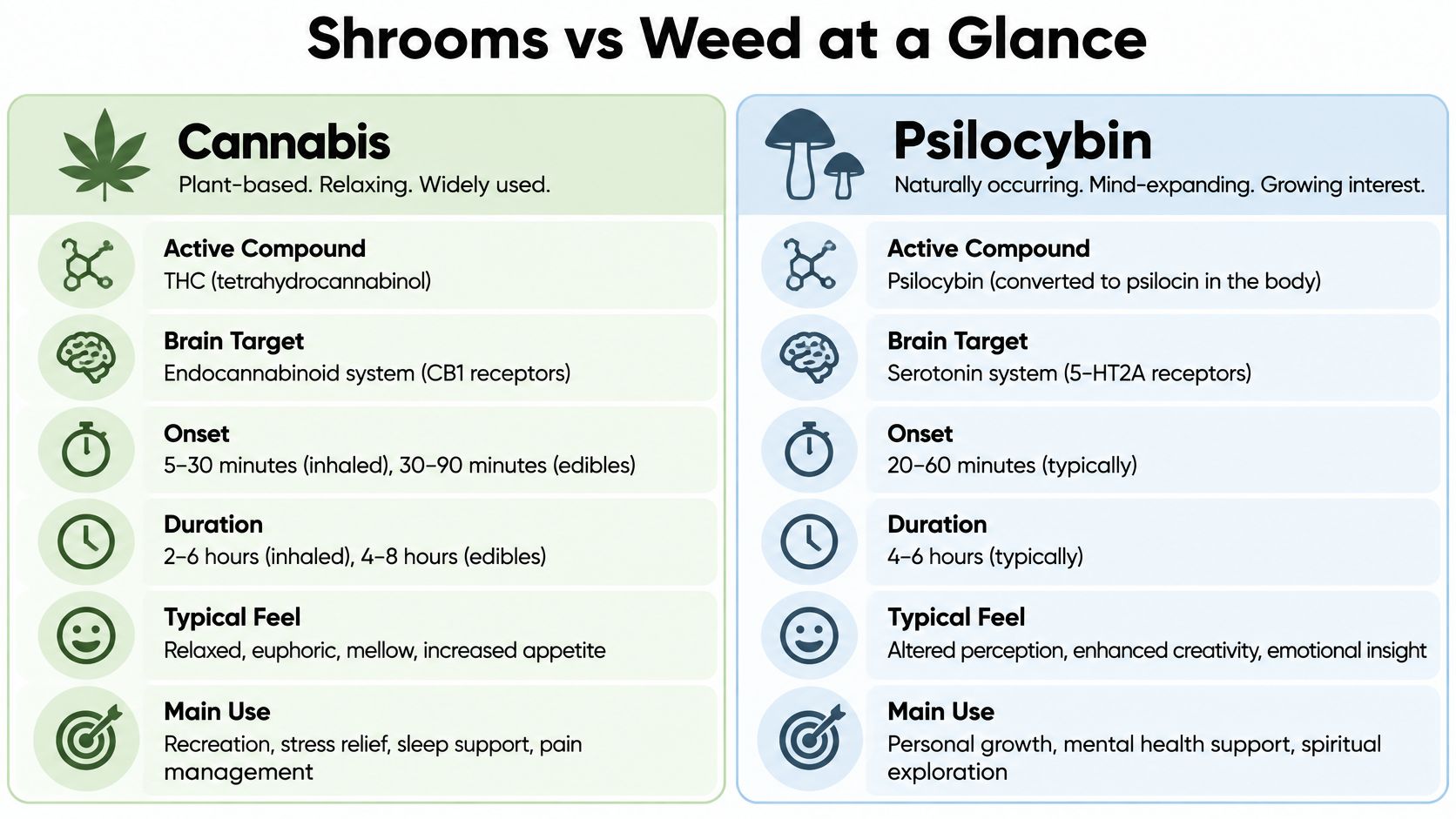
| Criterion | Cannabis | Psilocybin mushrooms |
|---|---|---|
| Main active compound | THC plus other cannabinoids | Psilocybin, converted to psilocin |
| Primary brain target | CB1 partial agonist | Serotonin 5-HT2A agonist (via psilocin) |
| Typical onset | Inhaled in minutes, edible in 30 to 90 minutes | 20 to 40 minutes after swallowing |
| Typical duration | Inhaled 2-4 hours, edible 4-8 hours | 4-6 hours |
| Usual subjective feel | Relaxation, time shift, appetite, mild euphoria | Visual change, emotion, altered meaning |
| Main acute problem | Impairment, anxiety, high-THC panic | Difficult experience, confusion, distress |
| Standard workplace drug test | Usually detected (THC metabolites, days to weeks) | Usually not on standard panels |
| US legal status | Adult-legal in many states including Michigan, federal Schedule I | Federal Schedule I, sale illegal in Michigan, local decriminalization is not legalization |
The Scale Gap Behind the Table
Cannabis is the mainstream product here by a wide margin. The 2023 National Survey on Drug Use and Health estimated that 21.8% of people aged 12 or older, approximately 61.2 million people, used marijuana during the previous year, while 15.4%, 43.6 million people, used it in the previous month.
By comparison, 3.1% of people aged 12 or older, about 8.8 million individuals, reported hallucinogen use during the previous year in that survey. That category bundles psilocybin mushrooms with LSD, PCP, mescaline, MDMA, ketamine, DMT, and related substances, so it doesn't isolate mushrooms.
Among young adults ages 19 to 30, approximately 42% reported cannabis use in the past year, 29% in the past month, and 10% daily or near-daily use, compared with 9% reporting past-year hallucinogen use. You can't turn that hallucinogen figure into a precise mushroom count, and you shouldn't try.
What you can take from the scale is familiarity. Cannabis has labeled products, routine serving sizes, and a huge base of repeat users in Michigan. Mushrooms sit in a smaller, less standardized market, which affects everything from dosing to product accuracy later in this guide.
How Each Drug Changes the Experience
Think of cannabis as bending a system you already use every day. THC partially activates CB1 receptors, which help regulate mood, pain signals, appetite, and short-term memory. That's why a moderate amount usually loosens an ordinary evening instead of replacing it. Music sounds richer, food tastes stronger, and your sense of time stretches, but you typically still know where you are and what's happening.
Other cannabinoids shape that bend. CBD doesn't intoxicate in the same way, and minor cannabinoids add their own effects, which is why two products with the same THC percentage can feel different. If you want the background on one of those minor cannabinoids, Cannabigerol and its role in cannabis explains where CBG fits in the plant.
Why Cannabis Dose Is Easier to Read
A regulated edible prints its dose in milligrams. For example, a cautious first amount is often 2.5 to 5 mg of THC, while 10 mg is a full standard serving that can overwhelm a new user. Flower commonly sits around 15 to 25 percent THC in modern products, and concentrates go much higher, so one inhalation is not a fixed unit either.
Inhaled cannabis gives you feedback fast. You can take a small amount, wait, and decide whether you want more. An edible removes that feedback loop because your stomach and liver process it first, which delays the signal by an hour or more.
Why a Swallowed Mushroom Dose Keeps Unfolding
Psilocybin works as a prodrug. You swallow it, your body converts it to psilocin, and psilocin strongly stimulates 5-HT2A receptors involved in perception and the meaning you assign to what you see and feel. That is a different lever from CB1, and pulling it changes more than mood.
Consumer guides often describe a microdose as 0.1 to 0.3 grams of dried mushroom, roughly a tenth to a fifth of a common full amount. A familiar full dried amount often falls around 1 to 3.5 grams. Those are grams of mushroom material, not milligrams of pure psilocybin, and that's the catch.
- No printed potency: A mushroom doesn't carry a lab label the way a regulated edible does.
- Same name, different strength: Two grows sold under one strain name can hit very differently.
- Uneven material: Caps, stems, and batches vary, so eyeballing is guessing.
Practical rule: Once you've swallowed a mushroom dose or an edible, you can't pause it, dilute it, or take part of it back. You can only wait it out.
That one fact explains the most common mistake with both substances. Nothing obvious happens at 30 minutes, so a person takes more, and then both doses arrive together. With inhaled cannabis you can titrate in small steps. With a swallowed mushroom, the dose you chose at the start keeps unfolding for hours whether you like where it's going or not.
Onset Duration and the Feel of Each
Say it's 7 p.m. and you're done for the day. The timeline matters more than adjectives, so walk through what each evening looks like.
The visual below maps how the two experiences rise and fall over time.
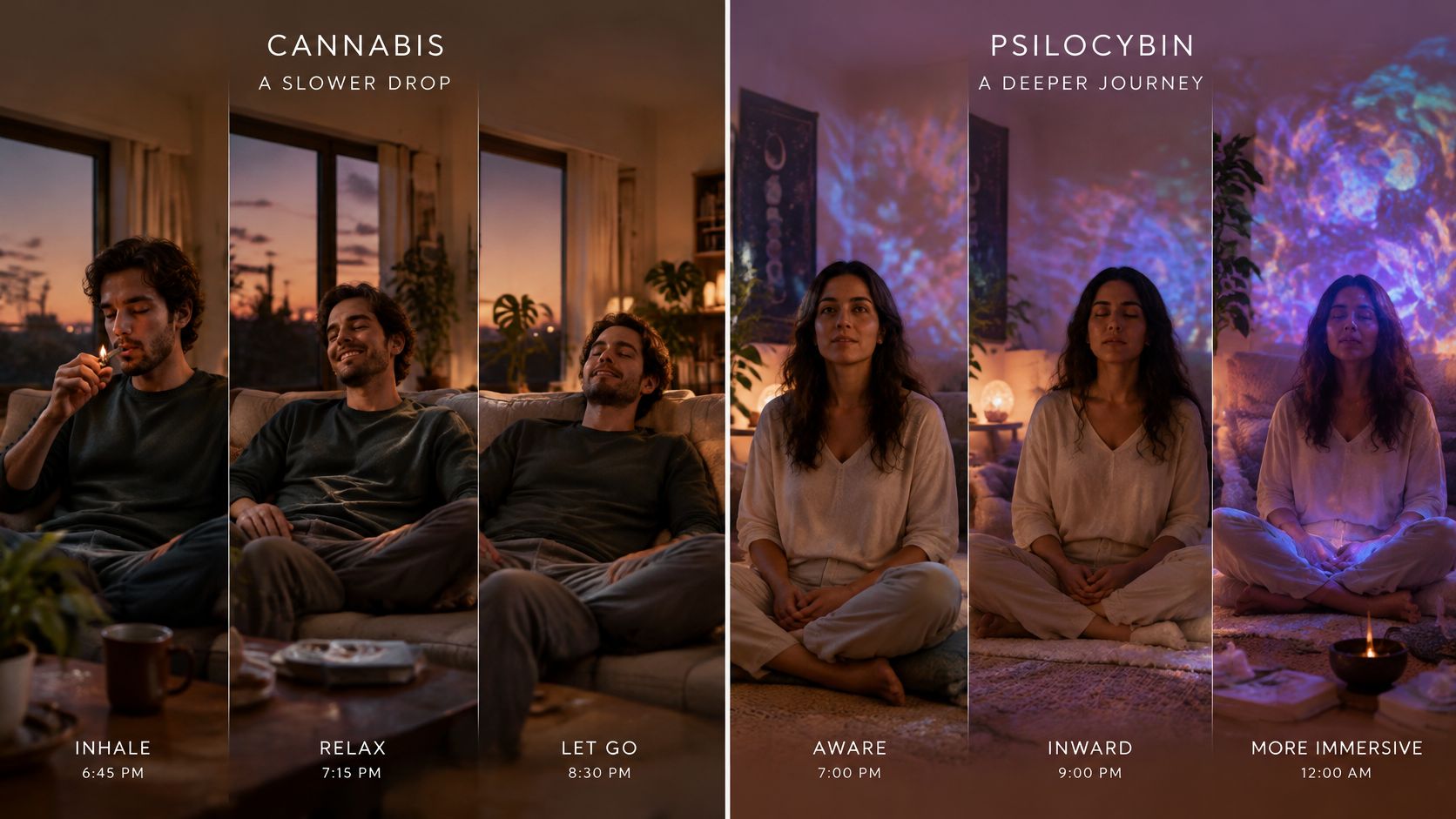
A Cannabis Evening
With inhaled cannabis, you usually notice the first change within minutes. Shoulders drop, laughter comes easier, snacks look better, and reaction time slows. The peak often lands near half an hour, and people drift back toward baseline within 2 to 4 hours, though a light fog can linger past that.
An edible or cannabis drink tells a different story. It can feel like nothing for an hour, then arrive all at once and stay strong for much of the night. Dry mouth, heavy eyelids, and looping anxious thoughts are common when the THC amount is high or you've eaten very little.
A Mushroom Evening
A mushroom experience usually starts with body signals at 20 to 40 minutes, yawns, a warm flush, or mild nausea. It builds for about 60 to 90 minutes, then peaks with changed visuals, stronger emotion, and a warped sense of time. The whole arc typically runs 4 to 6 hours, and if you're planning around that window, a detailed timeline of how long psilocybin lasts breaks down each phase.
Closed-eye imagery, sudden tears, awe, or a heavy memory surfacing are ordinary during that peak. They aren't, by themselves, proof that something medical has gone wrong. An afterglow of openness or tiredness can last the rest of the day.
Cannabis usually changes the volume of your day. Mushrooms can change the plot.
Neither peak pairs with driving, work messages, childcare, or a crowded public setting where you can't sit down and be left alone. Cannabis impairs your driving and judgment even when you feel mostly normal. A mushroom peak can make a familiar room feel unfamiliar, which is manageable on a couch with support and miserable in a checkout line.
What Safer Means for Each Substance
There isn't a single safety winner, and any ranking that gives you one is hiding the trade-offs. Split safer into four questions instead. How toxic is it to your body, how likely is psychological distress, how much does it impair function, and is the product what the label claims?
This checklist visual lays out those four checks.
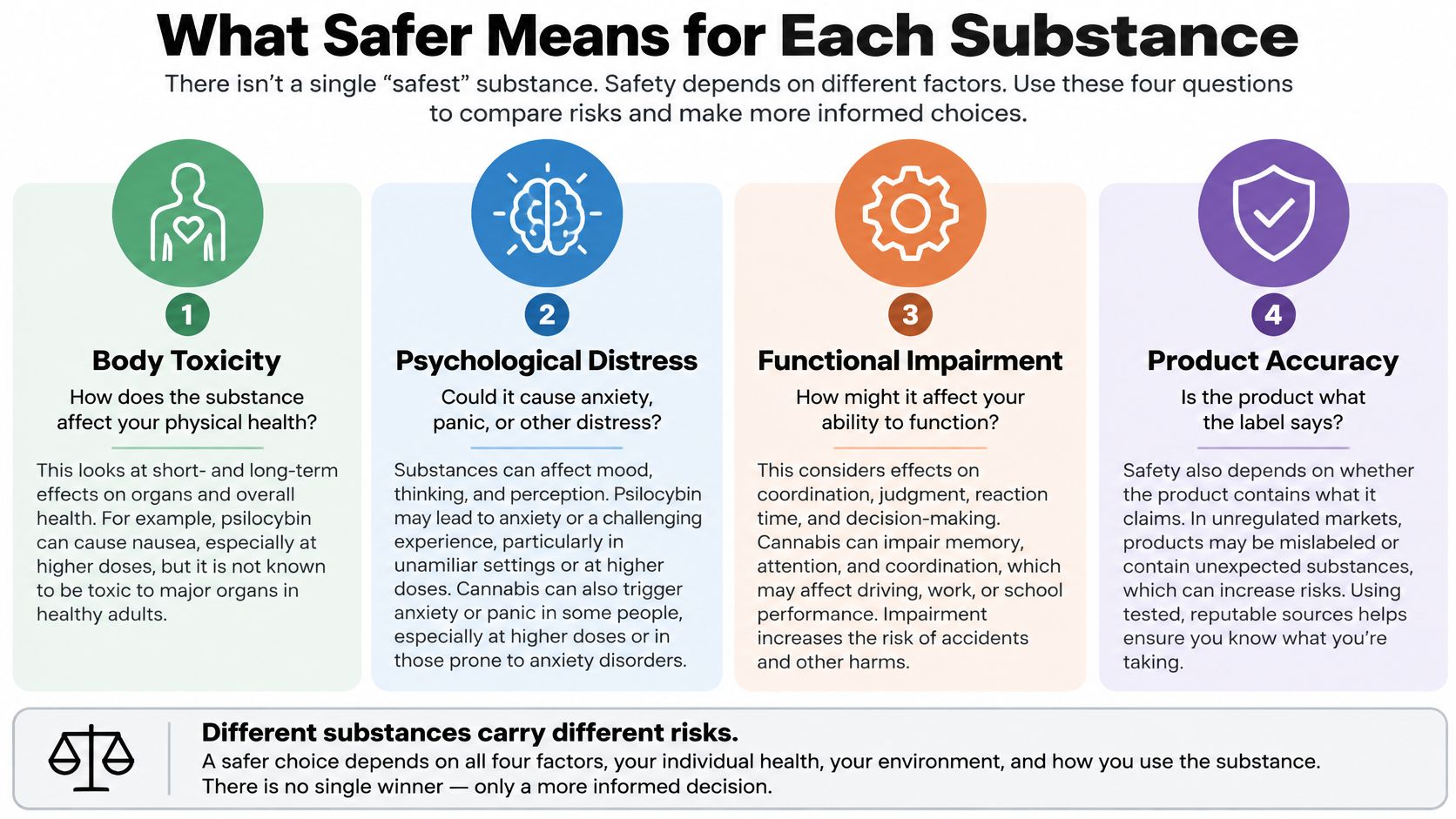
Four Different Safety Questions
For psilocybin, the acute body effects can include nausea, dizziness, blood-pressure changes, anxiety, paranoia, confusion, and emotional distress, and less commonly psychotic symptoms or persistent perceptual disturbances, as summarized in The Conversation on psilocybin going mainstream. That same source notes psilocybin appears to account for less than 0.1% of U.S. drug-related emergency-department visits annually.
Don't read that low figure as a safety guarantee. Emergency visits track how many people use a drug, what dose they took, what else they took with it, and whether the product was labeled accurately. The main acute risk for most mushroom users isn't organ toxicity. It's a difficult psychological experience that feels like it won't end, which is why planning ahead to avoid a bad trip matters more than bravado.
Cannabis carries the opposite trap. It's familiar, so people treat it as automatically mild. Occasional low-THC use and daily high-potency use aren't the same product in practice. Frequent strong cannabis is more often tied to dependence, motivation problems, panic, and, in susceptible people, psychosis risk.
The short video below adds clinical context on how these risks show up in real patients.
Run This Check Before Either One
- Mental health history: Personal or family psychosis is a stop sign for mushrooms and a strong caution for high-THC cannabis.
- Medications: Antidepressants and lithium can change psilocybin risk, so don't guess.
- Heart and body: Heart disease and pregnancy argue against experimenting.
- Obligations: Any driving, childcare, or next-day performance demand means not today.
- Support and setting: A full mushroom amount needs a trusted sober person present.
- No redose plan: Decide the amount once, and don't add more while you're waiting.
Neither substance pairs with driving, full stop. Chest pain, severe agitation, dangerous confusion, an inability to tell what's real, or a mushroom experience that won't settle needs urgent help, not more of either drug. Your history, medicines, and setting outrank any internet ranking of shrooms vs weed.
Combining Shrooms and Weed Safely
People combine these two often enough that you deserve a straight answer, not a hack and not a scare story. Treat the combination as an interaction with an unpredictable direction. Cannabis doesn't reliably smooth a mushroom experience out or reliably improve the visuals.
For some people, adding cannabis increases intoxication, anxiety, confusion, impairment, or perceptual intensity. For others it feels familiar and grounding for a few minutes, then intensifies everything. You can't know in advance which way it'll go, and that uncertainty is the point.
Where the Combination Goes Wrong
Timing and context matter as much as the substances themselves. Adding cannabis during the mushroom peak is the riskiest window because you're already at maximum intensity and least able to judge dose. Using a high-THC concentrate, redosing because the mushroom feels late, or being alone each stack more risk on top.
There's a second problem after things go sideways. Once both drugs are in your system, neither you nor a clinician can easily tell which one caused the bad reaction. That makes the next decision, wait, hydrate, or seek help, harder to make with confidence.
Five Rules if Co-Use Comes Up
- Learn each one separately: Know your solo response to cannabis and to psilocybin before any combination enters the picture.
- Never mix while testing: A new batch, new strain, or new dose gets tested on its own.
- Keep cannabis out of the peak: Don't add it during the strongest mushroom window in any session.
- Have a sober person present: Someone clear-headed should be able to drive, reassure, or call for help.
- Escalate on warning signs: Severe agitation, chest pain, dangerous confusion, or persistent loss of reality testing means emergency help, not another hit.
Mixing has no medical validation behind it. It isn't a treatment technique, and it isn't a reliable rescue for a difficult trip either. The safest version of this choice is usually the boring one, one substance, one measured amount, one clear-headed person nearby.
Therapy Claims and What Studies Show
A product that helps you feel better tonight and a treatment that holds up in a controlled trial are different things, and that difference applies to both substances. People use cannabis for sleep, appetite, pain, and winding down, and plenty swear by it. Personal experience is real, but it isn't proof of treatment, and the formal evidence is narrower than the marketing suggests.
This chart separates what is study-backed from what is general wellness talk.
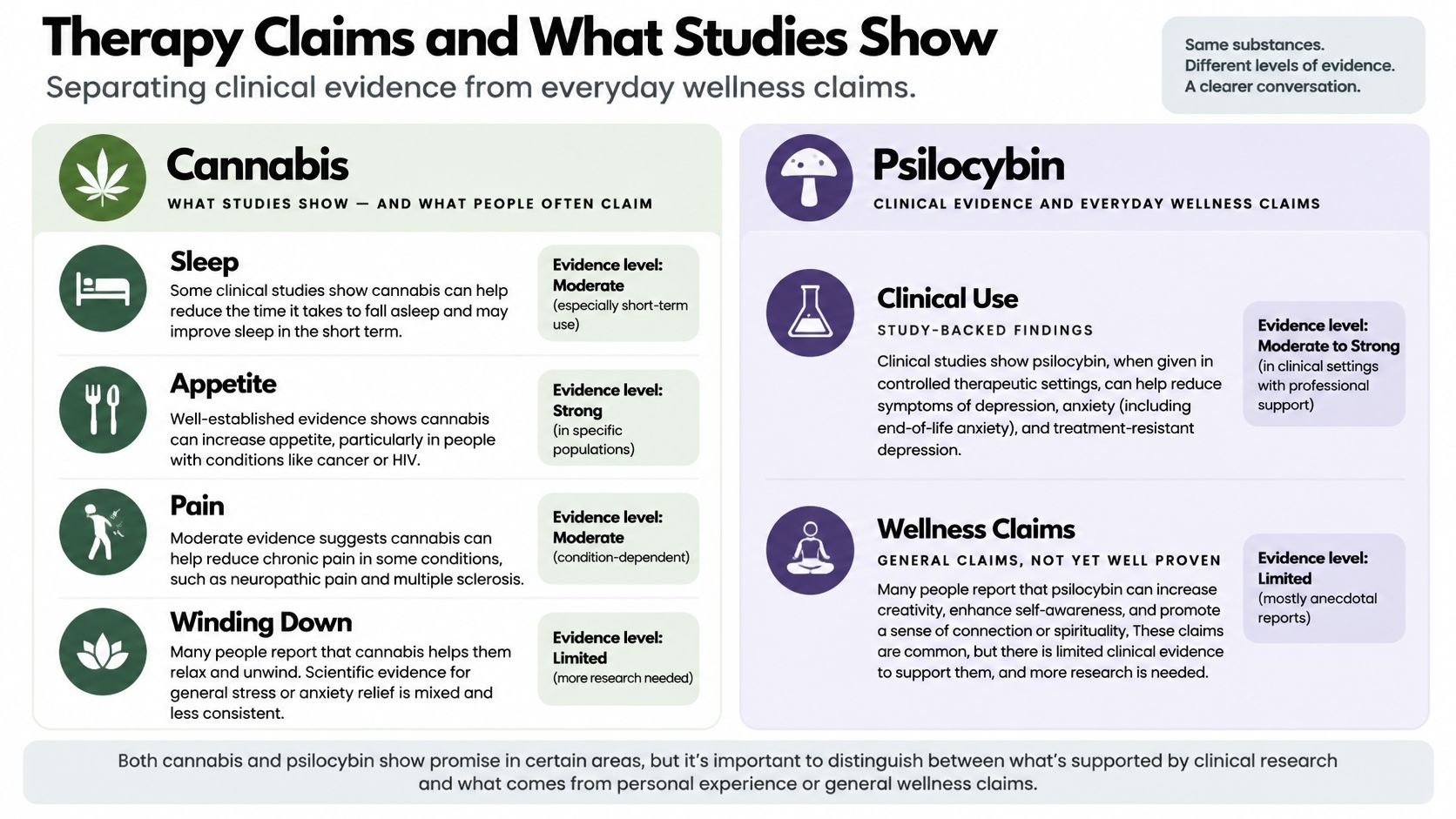
Cannabis Claims vs Approved Uses
Approved cannabis-derived medicines cover specific jobs. Dronabinol and nabilone are approved for particular nausea and appetite contexts, and plant-derived cannabidiol is approved for certain severe epilepsy syndromes. Evidence for chronic pain and sleep is more mixed, with modest average effects and real side effects to weigh.
That gap matters when you're exploring cannabis for stress management. A product that helps you unwind tonight can still raise anxiety at a higher THC dose or with daily use. Feeling relaxed after a session doesn't tell you whether your underlying stress, pain, or insomnia is improving over weeks.
What the Psilocybin Trials Actually Did
Psilocybin research was interrupted for decades, then rebuilt under tight supervision. An early Johns Hopkins study published in 2006 gave volunteers psilocybin in a supported setting, and most reported lasting gains in life satisfaction and well-being when researchers checked in more than a year later. Later depression trials ran small, carefully screened groups through two assisted sessions, and many participants met response or remission criteria weeks afterward.
Those results are striking, and they come with a caveat. Trial psilocybin works like a recipe where every ingredient is weighed: the dose, the screening, the preparation, and the sitter are all part of the outcome. If you want the broader picture, an overview of psychedelic therapy research covers how those trials are structured and who gets screened out before the first session.
A difficult trip is not therapy. Screening, preparation, a trained sitter, and integration sessions are what made those studies therapy.
Commercial dried mushrooms and chocolates aren't the measured psilocybin used in trials, and an unsupervised evening isn't an assisted session. Antidepressants and lithium change the risk picture too. If you're trying to treat a symptom rather than explore an experience, that question belongs with a clinician, not a product label.
Which Experience Fits Which Person
Psilocybin use isn't marginal anymore, which makes honest matching more useful than hype. The RAND report on psilocybin use and public opinion describes a country where psilocybin has moved well past the counterculture fringe, even as public support for legal psilocybin still trails support for legal cannabis by a wide margin.
Plenty of Michigan adults are curious, and plenty are unsure. The fix is matching: pick for the situation in front of you rather than for a substance's reputation. "Safer" isn't a single ranking either. Physical risk, psychological difficulty, impairment, and product uncertainty can each point to a different winner, which is why the table sorts by situation rather than crowning one drug.
| Situation | Closer fit | Why |
|---|---|---|
| Short social night with a way home | Low-dose cannabis | Faster offset and easier titration than a mushroom peak |
| Sleep or appetite on an ordinary evening | Low-dose cannabis, not a full trip | Mushrooms last for hours and can be emotionally activating |
| Free day, sitter, no driving, stable mental health | A planned mushroom experience | The duration and intensity need time and support |
| Cautious first psilocybin trial | Portioned low-dose edible, capsule or drink | Easier to measure than unlabeled dried material |
| Psychosis history, heart disease, or next-day duty | Neither today | Risk and impairment outweigh curiosity |
| Wanting weed to fix a difficult mushroom peak | Do not add cannabis | The mix can intensify anxiety and confuse the cause |
Reading the Table Honestly
If you want a social evening, help settling toward sleep, or the option to stop after a little, low-dose cannabis is usually the closer fit. You get faster feedback, a shorter tail, and an easier exit. Keep the THC amount low and known, eat something, and arrange the ride home before you start. Cannabis at low doses works like a dimmer switch you can still reach. A mushroom peak works more like a train you have already boarded.
A full mushroom experience sits at the other end of the effort scale. Its fit depends on several conditions holding at the same time, and the row treats them as a package rather than a menu. Health, schedule, company, and setting all have to cooperate, and a single missing piece is reason enough to pick a different day.
For a cautious first psilocybin trial, a clearly portioned low-dose chocolate, chew, capsule, or drink is easier to measure than an eighth of unfamiliar dried material. Portioning shrinks the guesswork without removing it, since potency still varies from batch to batch. Start at the low end and treat the session as information gathering. You are learning how your body responds, not chasing a peak.
The last row trips people up. Reaching for weed mid-peak feels natural because cannabis is the familiar tool, but the mix can intensify anxiety and blur which substance is causing what.
Some profiles point to neither. A psychosis history, serious heart disease, a next-day performance demand, or a personal habit of redosing when nothing has happened yet all say wait. Curiosity keeps. A bad night created by forcing the timing teaches you nothing useful about shrooms vs weed.
Choose for the Day You Actually Have
Use one decision rule. If you need to function, drive, host, answer messages, or keep a schedule, a full mushroom day is the wrong tool and even cannabis needs a low, known amount with a planned ride. If you don't need to function, you're still not automatically cleared for mushrooms.
Run the checks first. Stable mental health, no conflicting medications, no heart concerns, a free day, and a sober sitter all need to be true at once. Then choose a measured format for a first attempt and don't add cannabis to test it, because a clean single-substance session tells you what the mushroom did.
The Legal Check Comes Before Any Purchase
Federal law still lists psilocybin in Schedule I. Michigan has adult-legal cannabis but no legal psilocybin retail market, and lowest-priority enforcement policies in places like Ann Arbor and Detroit don't change state sale law. Where regulated psilocybin programs exist, such as Oregon service centers and Colorado healing centers, use only those licensed channels and confirm the rule where you live before buying or using anything.
For readers comparing formats, our shop lists 18 Magic Mushrooms products, 14 Edibles, 9 Popular Items, 8 Apparel, 6 Mushroom Stickers, and 5 Microdose products. As one concrete example of why format matters, the Moon Bar is a magic mushroom-infused chocolate bar containing 3.5 grams of McKennaii magic mushrooms and costs $45.00, which is a full amount in one bar, not a beginner serving.
If you're still unsure after the checks, go back to the situation table and find your actual day in it. Let that row decide, not a friend's story and not a larger dose.
If you're weighing shrooms vs weed and want clearly portioned mushroom options, from low-dose edibles and drinks to dried strains, browse the current menu before you decide on a format or amount. Visit Metro Mush to see what's available across the Detroit and Ann Arbor metro areas and pick the option that fits the day you have.