
The usual advice about the most potent psilocybin mushrooms is to memorize a few famous names and choose whichever sounds strongest. That's a poor substitute for understanding what a laboratory measured. A high-potency reputation can be worth investigating, but it doesn't tell an adult reader whether a particular sample is predictable, suitable, or even correctly identified.
A more useful comparison separates chemical strength from dose control. The first asks how much of the measured compounds a sample contains. The second asks how reliably someone can understand the contents of a particular portion. Those aren't the same question, and the strongest option isn't automatically the smarter choice.
What Potency Means Beyond a Strain Name
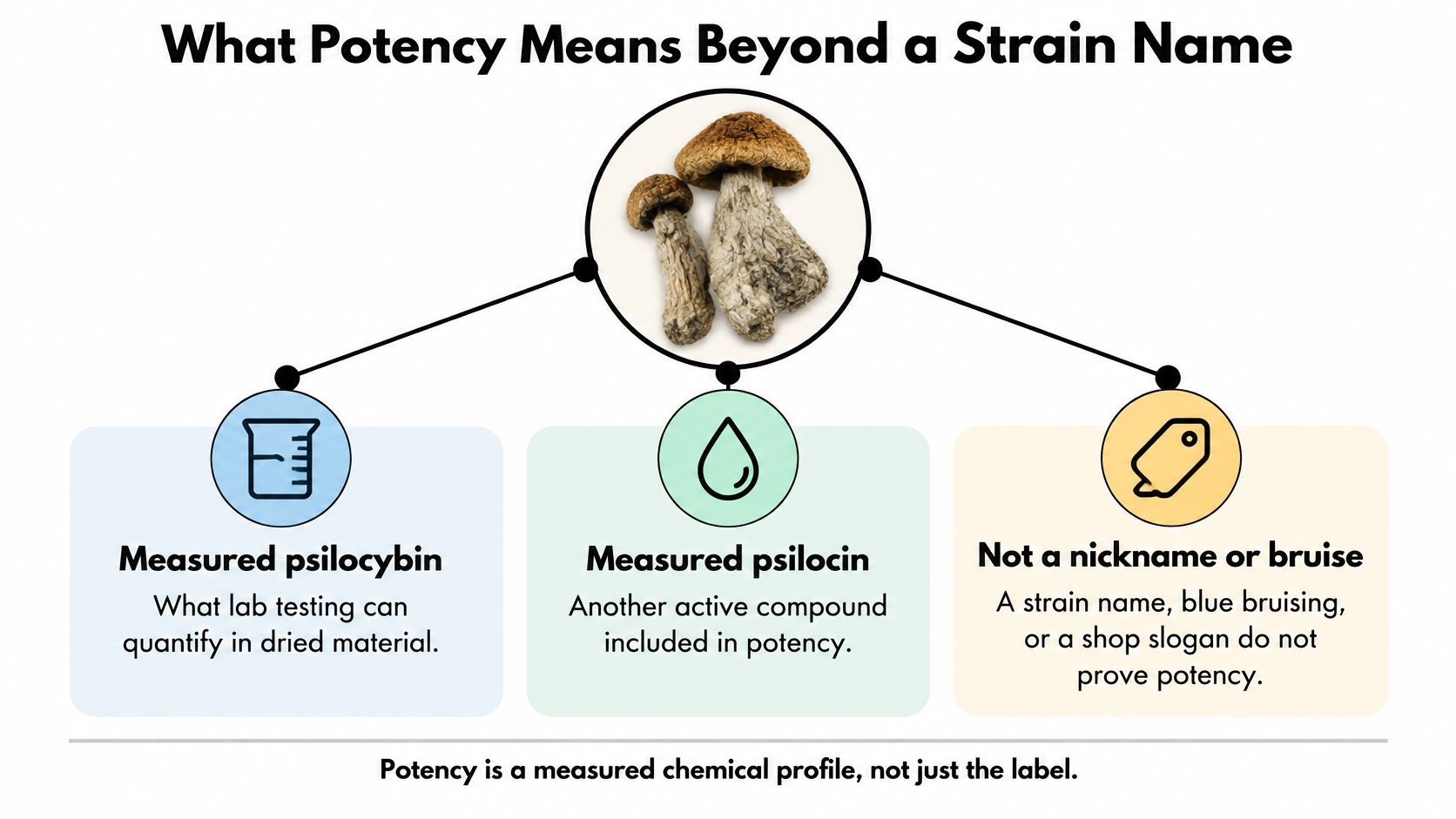
A famous strain name doesn't guarantee fixed strength. For a meaningful comparison, potency means the measured concentration of compounds such as psilocybin and psilocin in dried mushroom material. A nickname, blue bruising, or a shop slogan isn't a substitute for that measurement.
The distinction matters because a cultivated variety can have a higher average without every mushroom matching that average. Researchers measure particular samples under particular conditions. Their results describe those samples, not every future product sold under the same name.
Reading the numbers without overreading them
A 2024 liquid-chromatography study of cultivated Psilocybe cubensis reported average combined psilocybin-and-psilocin concentrations from 0.879% to 1.36% of dry weight, approximately a 55% difference between the tested averages; the same research context includes historical whole-mushroom psilocybin concentrations of roughly 0.37% to 1.30%, cap-versus-stem variation, and the useful conversion that 1% corresponds to approximately 10 milligrams of measured compounds per gram.
That conversion explains concentration, not a recommended amount to consume. It also doesn't make psilocybin-only results interchangeable with combined psilocybin-and-psilocin results. Before comparing any figures, check what the laboratory included in its total.
This visual summarizes the distinction between a chemical measurement and a marketing cue.
Concentration isn't the whole experience
A combined percentage is a starting description, not a forecast of someone's experience. The relative amounts of psilocybin and psilocin, personal sensitivity, preparation, and storage complicate that interpretation.
Consider a label that says only “high potency.” It doesn't identify the measured compounds, explain whether the result concerns dried material, or show whether the tested sample matches the product in front of you. Without those details, the label is incomplete.
Practical rule: Treat a strain name as an identification claim to investigate, not a certificate of strength.
For educational comparisons, ask for the chemical profile, the measurement basis, and the identity of the tested sample. Claims about the most potent psilocybin mushrooms become meaningful only when those details are available. Otherwise, readers are comparing reputations rather than evidence.
How Cultivated Cubensis Strains Compare in the Lab
Penis Envy's reputation isn't entirely folklore. Controlled analytical results support the possibility of above-average concentrations, while also showing why a related name shouldn't be treated as a chemical duplicate.
The following Cultivated Cubensis Potency Snapshots summarize a controlled comparison of 14 cultivated strains: Penis Envy averaged 15.49 mg/g psilocybin, 1.77 mg/g psilocin, and 17.59 mg/g total measured tryptamines, versus approximately 10 mg/g total tryptamines overall; Albino Penis Envy measured 11.38 mg/g psilocybin and 0.67 mg/g psilocin, while psilocybin across the tested strains ranged from 2.03 to 19.60 mg/g, an almost tenfold spread.
| Sample | Psilocybin | Psilocin | What it shows |
|---|---|---|---|
| Penis Envy | 15.49 mg/g dried material | 1.77 mg/g dried material | A high-reputation variety can test above the study's overall benchmark |
| Albino Penis Envy | 11.38 mg/g dried material | 0.67 mg/g dried material | Related names don't guarantee matching chemical profiles |
| All tested strains | 2.03 to 19.60 mg/g | Not summarized here | The comparison contains substantial variation |
What the comparison supports
The reasonable conclusion is narrow but useful: Penis Envy can test high. The unreasonable conclusion is that every package carrying that name has the study's reported concentration.
Albino Penis Envy makes that distinction especially clear. Its name suggests a close relationship, but the measured profile differs. A reader who assumes the names are interchangeable would miss information that matters more than branding.
There's another easy source of confusion in these figures. Total measured tryptamines isn't necessarily the same category as the sum of psilocybin and psilocin. Keep the laboratory's categories intact instead of relabeling a broader total as though it measured only those compounds.
How to use a strain guide
A guide to Psilocybe cubensis strains can help readers understand naming conventions and recognize varieties discussed in published comparisons. It shouldn't replace a report tied to the actual material being evaluated.
When reviewing a high-reputation variety, separate the questions:
- Identity: What variety does the supplier claim this material represents?
- Chemistry: What did the laboratory measure in the relevant sample?
- Applicability: Does that report concern the current batch?
Those questions prevent a published average from becoming an assumed retail guarantee. They also keep an unusually strong result in perspective: it's a reason for caution, not proof of superior quality.
For a cautious adult, the useful finding isn't which name wins. It's that familiar branding can conceal meaningful chemical differences. A verified, lower-concentration sample may be easier to evaluate than an untested product with a stronger reputation.
Wild Species That Can Exceed Typical Cubensis
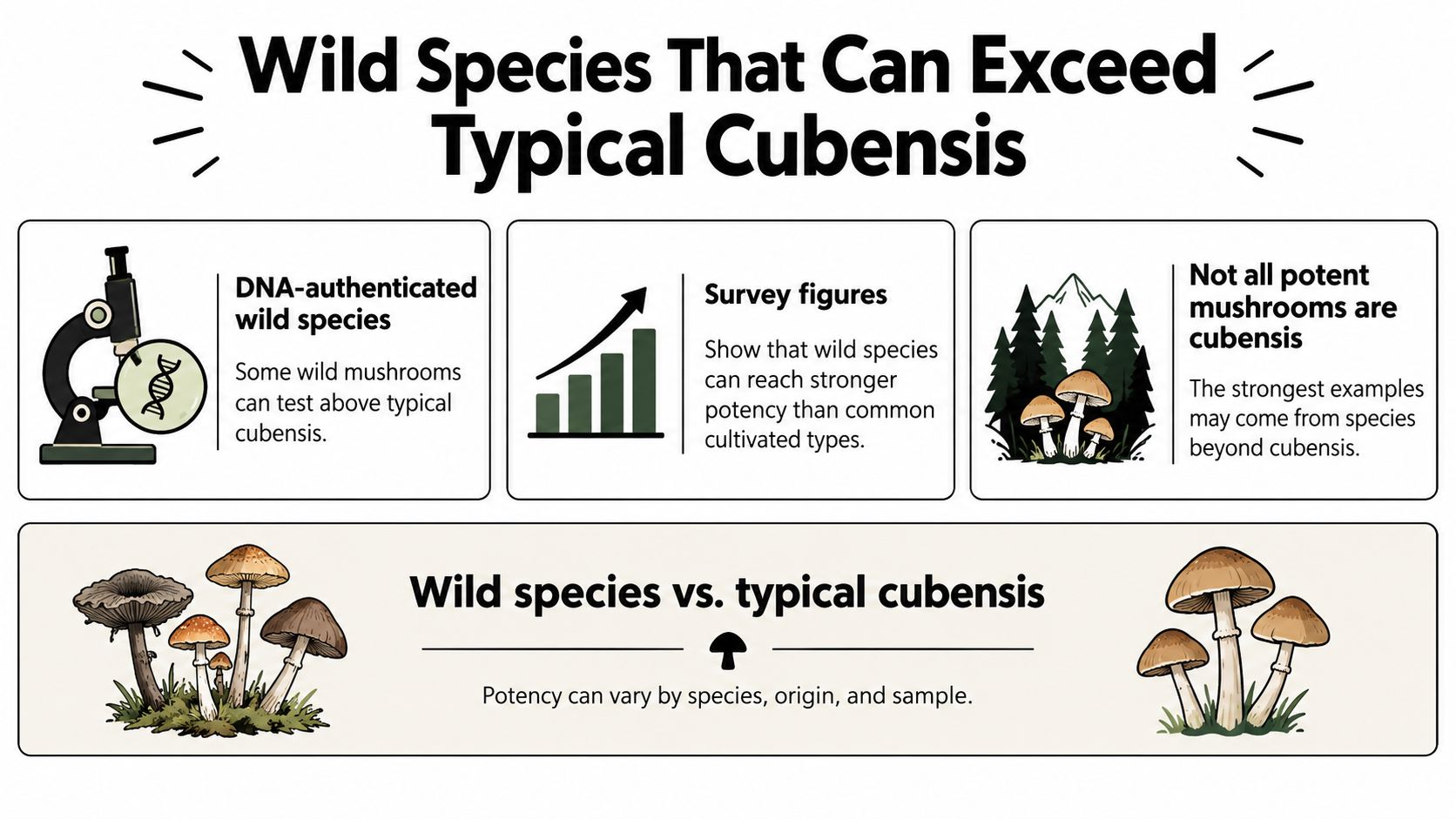
The most potent psilocybin mushrooms aren't necessarily cultivated P. cubensis. Some wild Psilocybe taxa can exceed common cultivated benchmarks, but their measured ranges are broad enough to undermine a simple species leaderboard.
The visual below highlights the central distinction: species comparisons describe measured samples, not a dependable strength attached to every wild mushroom.
What authenticated samples show
A DNA-authenticated chemical analysis and its research context reported P. cyanescens at 3.0–15.6 micrograms/mg psilocybin and 0.22–5.22 micrograms/mg psilocin, and P. semilanceata at 0.33–15.77 micrograms/mg psilocybin and 0.1–3.88 micrograms/mg psilocin; a separate broad survey reported 15.54 mg/g psilocybin in P. serbica var. bohemica.
These findings don't establish a universal champion. A high endpoint describes a measured specimen, while a range shows that other specimens may contain substantially less. Comparing only each species' maximum encourages readers to overlook that uncertainty.
The psilocybin-to-psilocin balance also deserves attention. Different profiles may affect onset and perceived intensity, so collapsing every result into a single “strength” label loses useful information. A ranking that ignores the compounds measured can look precise while comparing unlike results.
Identity is a separate safety requirement
For wild material, authenticated identity matters alongside chemistry. The practical analytical standard is confirmed species identity plus high-performance liquid chromatography, commonly called HPLC, for psilocybin and psilocin, with minor tryptamines such as baeocystin and norbaeocystin included when available.
A commercial description of dried Psilocybe azurescens belongs in a different evidence category from an authenticated laboratory result. A species name on a page doesn't establish the identity or concentration of an individual specimen.
Don't choose, consume, or market unverified wild mushrooms based on visual resemblance alone.
That boundary isn't a minor qualification to the potency discussion. If identity is uncertain, debating peak concentration is the wrong priority.
An accompanying video is included below, but it shouldn't be treated as species authentication or a substitute for analytical testing.
Why the Same Mushroom Can Test Differently
A mushroom's genetics are only part of its chemical profile. Cultivation conditions, developmental stage, sampling, storage, and laboratory technique can all influence the reported result, including within the same cultivated line.
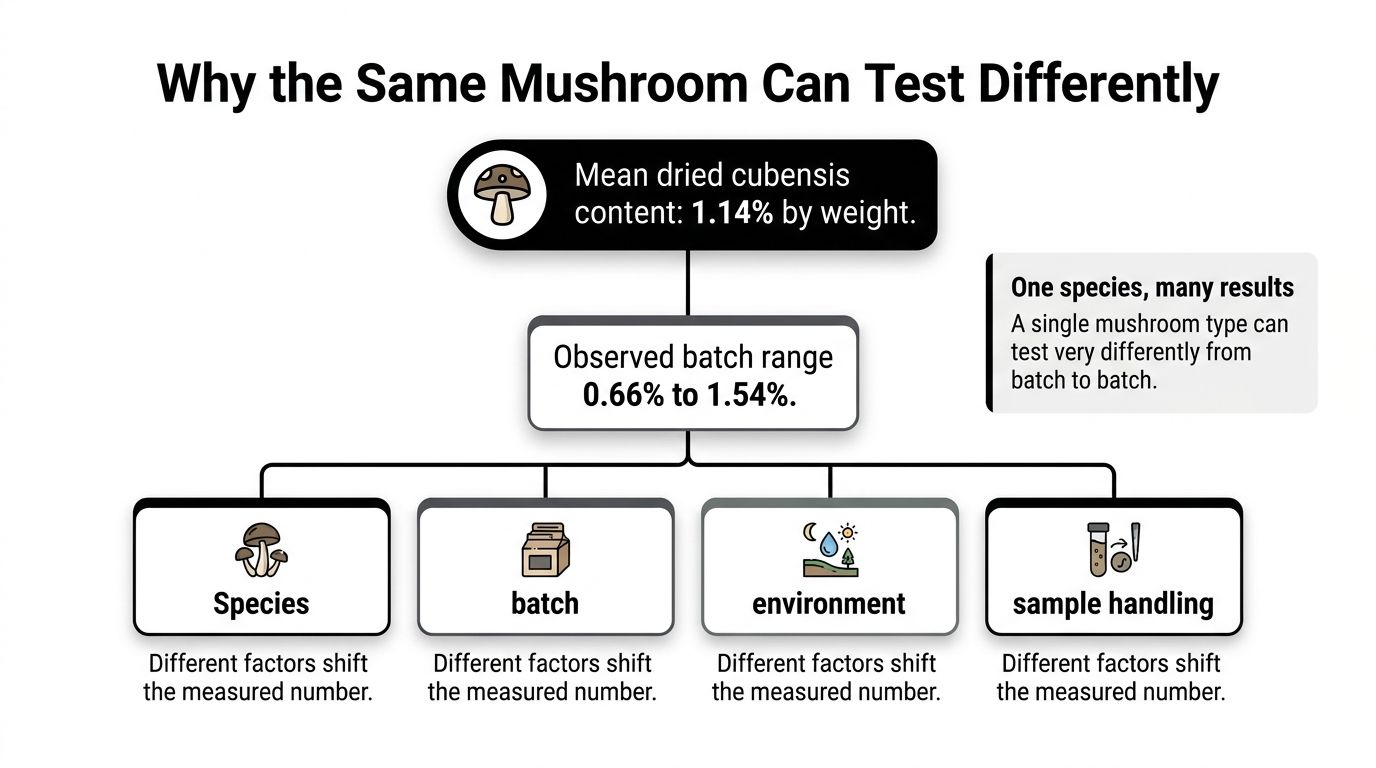
Analytical work on dried P. cubensis reports mean content around 1.14% by weight, with observed batches from 0.66% to 1.54%, and discusses variation associated with sampling, developmental stage, storage, and laboratory technique.
Follow the sample, not just the label
A report concerns the material the laboratory received. If the sample disproportionately represents caps, stems, or a particular developmental stage, that sampling choice matters. A result also needs to be interpreted in light of handling and storage rather than treated as permanently attached to a cultivated name.
The diagram below shows why a single headline percentage can conceal several layers of variation.
For a plain-language example, consider a chocolate made using previously tested mushroom material. That ingredient report may help describe what went into production, but it doesn't by itself establish what ended up in each serving. Uneven distribution introduces a different question from the original mushroom's concentration.
The same distinction applies to drinks. Convenient packaging doesn't demonstrate uniform contents, and a serving mark isn't the same thing as a serving-level laboratory result.
Rank evidence by the question it answers
A useful evidence ladder distinguishes the scope of the testing:
- Untested: The description relies on naming, reputation, appearance, or an unsupported strength claim.
- Batch-tested: A report concerns an identified production batch. Its usefulness depends on whether the sample and report genuinely correspond to the material being evaluated.
- Serving-tested: Testing addresses the finished portion, making it more relevant to questions about portion-level contents.
This is an evidence framework, not a guarantee of safety. A report should still identify what was measured and what material was tested.
Nor does chemical testing capture every contributor to the experience. Minor alkaloids, individual sensitivity, setting, concurrent substances, and prior experience can matter. The point of better evidence is to reduce avoidable uncertainty, not to promise a repeatable subjective outcome.
Choosing Strength for Real Use Cases
The strongest option answers a narrow question: which tested material contains the greatest measured concentration? Adults usually have a broader concern, such as avoiding an overwhelming experience, understanding an unfamiliar format, or keeping an evening manageable.
Those priorities don't automatically point toward high-potency dried mushrooms. For a first-time or cautious adult, lower verified concentration and clearer portion information are more sensible evaluation criteria than prestige. Choosing not to use an uncertain product is also a valid outcome.
Match the evidence to the situation
| Situation | More useful priority | What shouldn't decide it |
|---|---|---|
| First experience | Clear contents, conservative expectations, and appropriate professional guidance | A famous high-potency name |
| Cautious or taste-sensitive adult | Finished-product information and understandable portions | Chocolate or drink packaging that merely looks approachable |
| Experienced adult | Evidence relevant to the current material | Assuming previous experience transfers unchanged |
| Wellness-oriented adult | Qualified healthcare advice and realistic expectations | Treating “natural” as a medical endorsement |
| Someone considering multiple substances | Avoiding combinations and discussing concerns with a clinician | Assuming familiar products remain predictable together |
An experienced adult may be interested in concentrated dried material because less mushroom mass can contain a comparable quantity of measured compounds. That preference doesn't establish that the material is more suitable, and experience doesn't remove the uncertainty of an unfamiliar sample.
For a person who dislikes dried mushrooms, chocolates or drinks may offer a more convenient format. But convenience is a sensory or practical benefit, not evidence of lower intensity. An approachable flavor shouldn't be mistaken for an approachable chemical profile.
When milder is the smarter choice
A milder, well-characterized product is the more cautious direction when someone values control over intensity. The qualification matters: “milder” needs evidence too. A reassuring product name or a small-looking portion doesn't establish low concentration.
Decision check: If you can't explain what makes an option more controllable, don't assume it is.
People who also use cannabis should consider combinations a separate safety issue rather than an extension of choosing a mushroom format. Avoid stacking products to chase a stronger effect, and don't rely on a strain comparison to answer interaction questions.
A short evening is another poor reason to select maximum potency. Greater concentration isn't evidence of a shorter or easier experience. If someone's circumstances leave little room for uncertainty, postponing or declining use is more prudent than trying to solve that uncertainty with a stronger product.
Dosing Carefully and Knowing the Legal Line
Published milligrams describe research samples. They aren't a personalized dosing plan, and they don't establish the contents of an unrelated retail package. Treating a study average as a guaranteed label value creates false confidence before any other safety consideration enters the discussion.
This guide doesn't provide a consumption schedule or a universal starting amount. There isn't enough product-specific or personal information here to make an individualized recommendation. An unfamiliar, untested, or high-potency product calls for greater caution, not a calculation borrowed from a ranking.
Keep education separate from medical advice
A magic mushroom dosing guide can provide background terminology, but it shouldn't substitute for qualified healthcare advice. Ask a clinician about medications, relevant health history, and individual concerns before considering use.
Use these boundaries rather than treating potency figures as instructions:
- Don't drive: Avoid driving or operating machinery when impaired.
- Don't mix unknown products: Avoid combining substances or assuming that familiar branding establishes compatibility.
- Don't self-treat: Don't use a retail mushroom product as a substitute for care for depression, anxiety, PTSD, or addiction.
- Don't guess at identity: Decline unidentified wild material rather than trying to resolve uncertainty through appearance.
Small portions also shouldn't be described as automatically harmless or reliably sub-perceptual. Without relevant testing and individual clinical context, those are promises this information can't support.
If someone develops severe distress, becomes unresponsive, or may have consumed a misidentified mushroom, seek urgent medical help. Keep packaging or identifying information available for healthcare professionals rather than relying on a product nickname.
Check legal status independently
Local enforcement policy, lawful possession, and lawful commercial sale are different questions. Don't infer permission to purchase or possess a substance from the existence of a storefront, delivery menu, or local discussion of decriminalization.
Adults in Detroit, Ann Arbor, or neighboring states should verify current federal, state, and local requirements through official authorities or a qualified attorney. Travel raises separate jurisdictional questions, so a policy associated with a destination shouldn't be treated as permission to transport a product there.
This is legal caution, not a definitive interpretation of any local ordinance. Without current authoritative legal sources, a responsible educational guide shouldn't promise that a transaction or activity is permitted.
The practical boundary is straightforward: uncertainty about chemistry, identity, health suitability, or legality is a reason to pause. None of those questions is answered by choosing a product described as the strongest.
How Metro Mush Maps Potency to a Next Step
A local product menu provides an opportunity to apply these distinctions, not an exception to them. Dried varieties, chocolates, and drinks belong to different format categories, but their names alone don't establish measured strength or suitability.
The menu described for this publisher includes dried Penis Envy and Enigma, plus OuterSpore Milk Chocolate Bars, Mush Love Chocolate Bars, Rocket Fuel shroom drinks, and Moon Bars. Those are product descriptions, not independent verification of ingredients, finished-serving uniformity, or current availability.
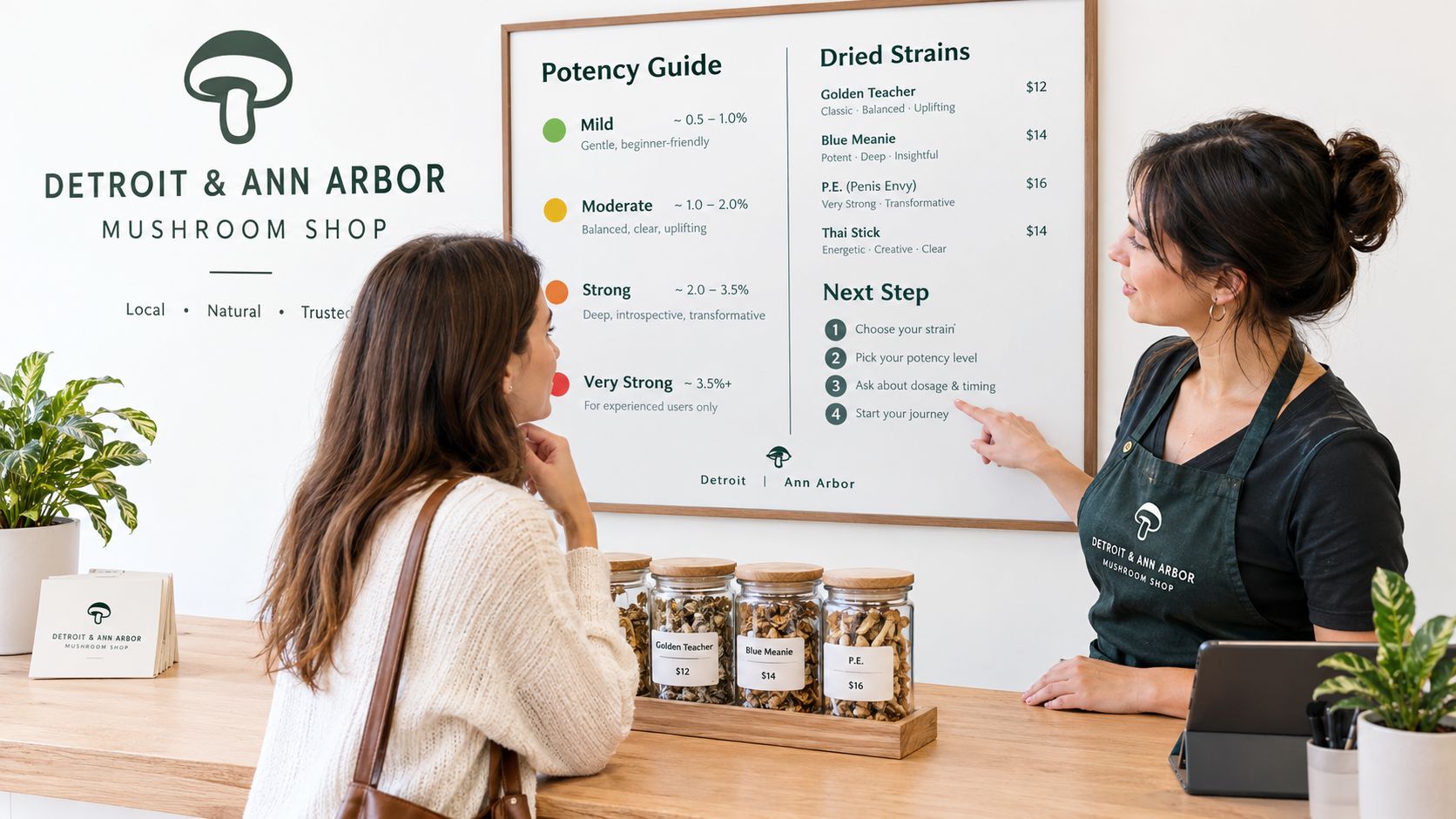
The supplied screenshot provides a visual reference for the website.
Apply the same standard to every format
Penis Envy belongs in the high-reputation dried category discussed earlier. Enigma's premium positioning doesn't establish its chemical profile. Neither description should be converted into a guaranteed milligram count without relevant analytical evidence.
The edible names raise a different set of questions. For OuterSpore Milk Chocolate Bars, Mush Love Chocolate Bars, and Moon Bars, ask whether any available report concerns the finished product rather than only its mushroom ingredient. For Rocket Fuel shroom drinks, ask what evidence supports the stated contents of an individual portion.
Useful questions include:
- Report relevance: Does the available documentation identify the exact product and batch?
- Measured compounds: Does it distinguish psilocybin, psilocin, and any broader tryptamine total?
- Finished portions: Has the producer addressed consistency across servings?
- Limits of guidance: Does the explanation acknowledge uncertainty instead of promising a particular experience?
Choose information before intensity
Retail guidance and independent analytical evidence serve different purposes. Staff may explain labels and product formats, but that conversation doesn't replace clinical advice, authenticated testing, or current legal information.
For an adult who wants a cautious, repeatable approach, the meaningful next step is identifying what can be verified. If documentation is unavailable, the honest conclusion is that the product's chemistry remains uncertain. That uncertainty shouldn't be disguised with a famous strain name or friendly packaging.
The most useful takeaway from a potency comparison is therefore not a shopping ranking. It's a standard for evaluating claims: prefer relevant evidence over reputation, recognize the limits of concentration figures, and don't confuse convenience with control.
Metro Mush describes a menu of dried mushroom varieties, chocolates, and drinks, formats that require different questions about potency and portion consistency. Visit Metro Mush to review its product information and look for testing documentation, while independently checking health suitability and current legal requirements.