

You're staring at a bag of mushrooms or a chocolate bar, with a beginner guide open on your phone. You don't want a trip. You'd just like a little more focus, a calmer morning, or less friction getting through an ordinary day.
The tempting question is how much to take. The more useful question is how much uncertainty you're willing to accept, and how you'll recognize when it's time to stop. That's the approach I recommend for microdosing mushrooms for beginners: understand the product, separate feelings from evidence, and decide your off-ramp before curiosity takes over.
What Microdosing Actually Means
Microdosing generally means taking a very small amount of a psychedelic, typically 5–10% of a usual recreational dose, intended to stay below noticeable hallucinations; the National Institute on Drug Abuse's psilocybin overview also states that research hasn't established whether psilocybin microdosing is safe or effective.
That percentage is a description, not a dosing calculator. You can't turn it into a dependable mushroom quantity without knowing the material's potency. A package labeled microdose doesn't solve that problem, either.
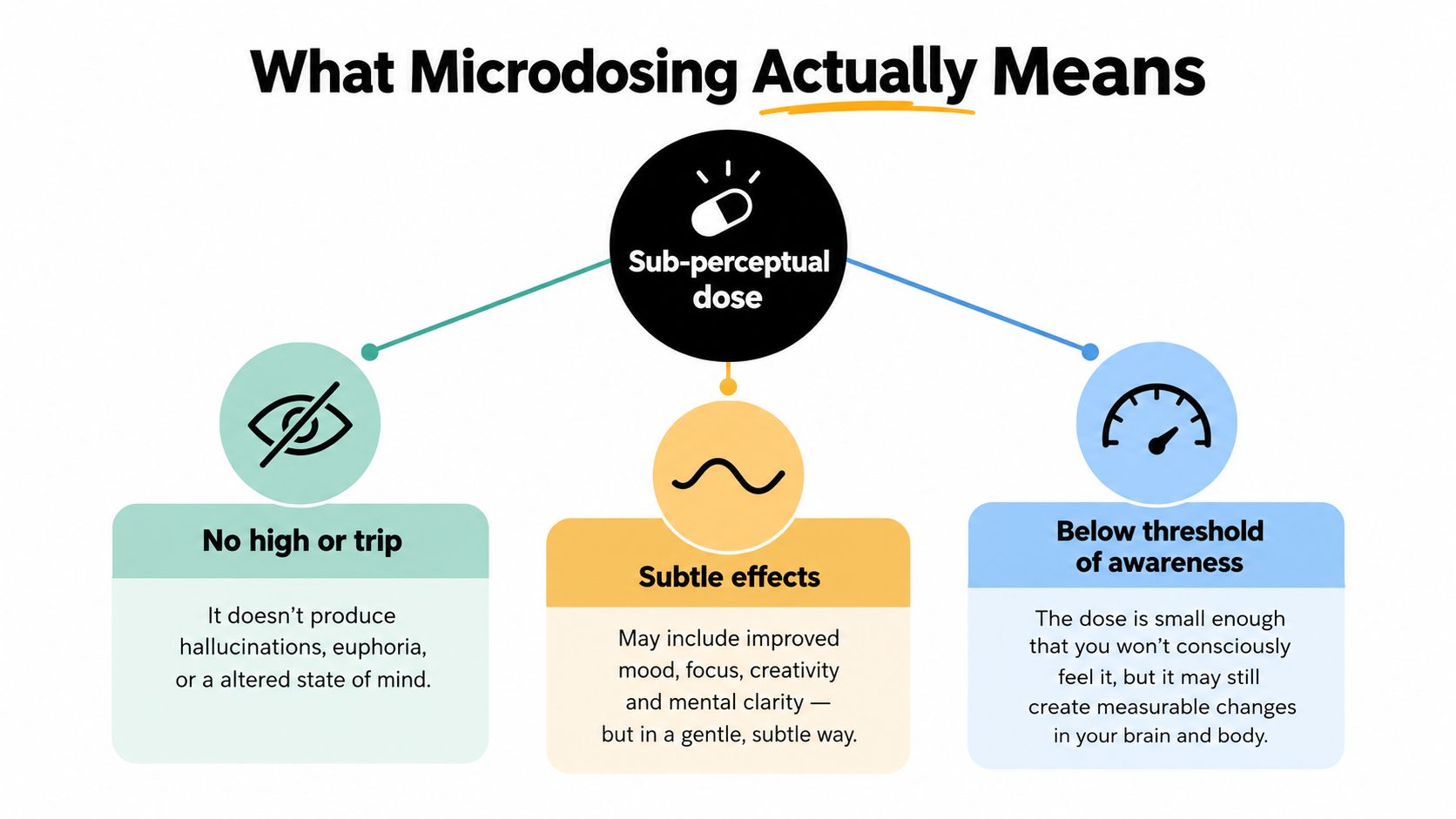
Sub-perceptual Is an Intention, Not a Guarantee
People often use sub-perceptual to mean no high, no trip, and no obvious disruption of normal functioning. It doesn't mean you're guaranteed to notice absolutely nothing. Some people report subtle changes in mood, energy, or focus, but noticing a change doesn't establish a benefit.
The diagram captures the intended distinction, not a promise about your response.
Use plain-language boundaries rather than marketing language:
- No psychedelic experience intended. Visual distortions or feeling clearly high don't fit the microdosing aim.
- No assumed performance boost. Feeling energized isn't the same as concentrating better.
- No medical promise. Don't treat a low-dose product as a medically validated treatment for depression, anxiety, or attention problems.
Practical rule: If you're clearly altered, stop treating the experience as a harmless addition to your routine.
Keep the Goal Ordinary
The difference between microdosing and macrodosing is useful to understand before choosing any product. Don't slide from wanting subtle effects into chasing a psychedelic experience while still calling it microdosing.
My recommendation is to describe your intention without mentioning mushrooms: you want to finish tasks more comfortably, feel less overwhelmed, or enjoy your day. That keeps your actual needs visible. You're trying to feel a little more like yourself on an ordinary Tuesday, not prove that a substance belongs in your life.
Why a Single Number Is a Trap
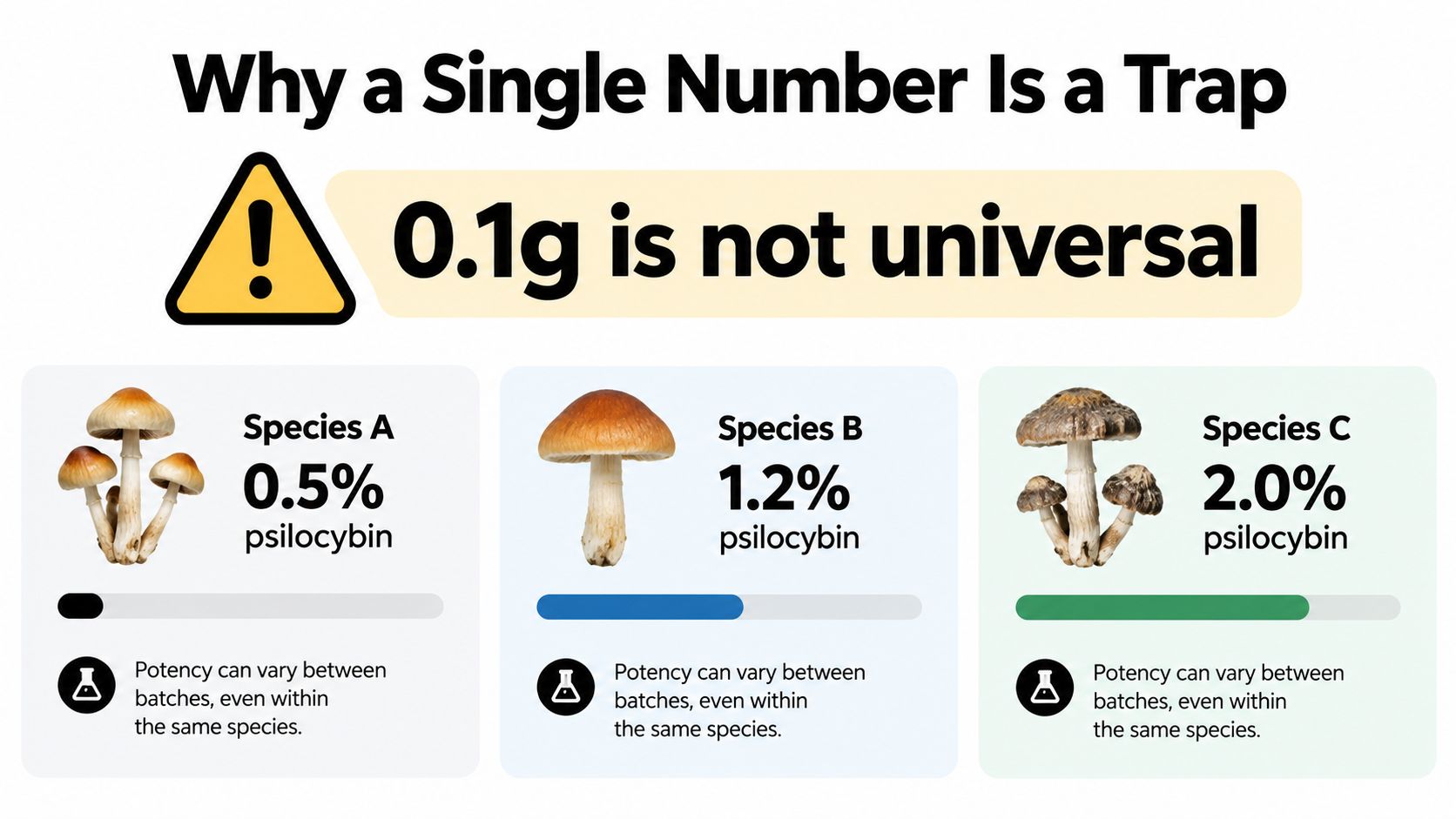
Strain names aren't potency labels. A familiar name on a bag tells you less than beginners often assume about the amount of active ingredient inside it. Penis Envy and Enigma may be recognizable product names, but neither name is a batch-specific measurement.
Mushroom potency varies across species, individual mushrooms, growing conditions, preservation, and cultivated batches. A double-blind study using 0.5 g of homogenized dried mushrooms estimated approximately 0.9 mg of psilocybin, while noting that the amount could be higher or lower with another source; the mushroom-potency discussion and analytical evidence also describe differences between batches carrying the same strain name.
The useful message in this visual is variability. Its illustrative species percentages shouldn't be treated as verified potency values or used to calculate a dose.
Weight Answers Only Part of the Question
A digital scale measures material. It doesn't measure psilocybin concentration. Accurately weighing poorly characterized mushrooms gives you an accurate weight, not a predictable psychoactive effect.
The distinction gets easier to miss with edibles. The printed weight of a Mush Love Chocolate Bar or an OuterSpore Milk Chocolate Bar isn't automatically its active-ingredient content. A chocolate square is a serving shape, not a laboratory result.
- Ask what's measured. Does the label describe mushroom material, active ingredient, or total food weight?
- Ask about the specific batch. Prefer professionally tested products available through lawful channels over confident claims based on a strain name.
- Treat preparation with transparency. Homogenization can make a batch more uniform, but it doesn't establish the batch's potency or make it medically validated.
Don't Convert Between Formats by Guesswork
Dried mushrooms, chocolate, and drinks aren't interchangeable just because they're sold for similar purposes. With edibles and drinks, delayed onset can encourage accidental redosing, so an initially quiet experience isn't a reason to add another product.
A precise-looking number can still describe an uncertain product.
I wouldn't offer a universal starting quantity. The responsible recommendation is to reduce uncertainty before considering use, and decline the product if you can't establish what it contains.
Choosing a Beginner Schedule
A named schedule can make microdosing look more established than it is. Neither a familiar protocol nor a tidy calendar establishes safety or effectiveness. Treat schedules as descriptions of use patterns, not prescriptions.
The Fadiman approach includes a dose day followed by a longer stretch of off days. Every-other-day use alternates dose days and non-dose days. Those descriptions don't tell you which pattern would suit you, and the evidence discussed below doesn't establish a winner.
Fadiman vs Every-Other-Day at a Glance
| Element | Fadiman Protocol | Every-Other-Day |
|---|---|---|
| Basic pattern | Dose day followed by a longer off-day interval | Alternating dose and non-dose days |
| Observation opportunity | More uninterrupted time away from dosing | More frequent transitions between dosing and not dosing |
| Calendar issue | Dose days may move across the working week | Dose days also shift across weekdays |
| Main limitation | The name doesn't validate the regimen | Simplicity doesn't validate the regimen |
| Reason to skip | Responsibilities or unresolved symptoms | Responsibilities or unresolved symptoms |
My advice is to choose observation over frequency. You don't owe a protocol your participation, and you don't need to make up a missed day. If your week includes driving, demanding work, or responsibilities that leave no room for an unpredictable response, the sensible choice is to postpone.
Make the Decision Around Your Life
Before considering any schedule, answer these questions:
- What are you trying to learn? Pick a concrete question about daily functioning rather than a vague hope of becoming more creative.
- Can you observe without pressure? A deadline-heavy day makes it harder to separate the substance's effects from ordinary stress.
- Are you willing to leave gaps? Non-dose days matter because they let you notice how you function without repeatedly adding another variable.
- Can you stop without feeling behind? A schedule that starts feeling compulsory is a poor fit for cautious self-observation.
Weekend-only use may sound easier to arrange, but a free calendar isn't evidence of a suitable setting. Don't attach experimentation to an important social event, a difficult conversation, or something you need to perform well at.
You also shouldn't use a schedule to manage persistent symptoms yourself. If sleep, mood, or anxiety hasn't returned to your usual baseline, the next scheduled day isn't permission to continue. Match the calendar to your responsibilities, not your curiosity.
Tracking Effects Without Fooling Yourself
A useful journal isn't a collection of good vibes. It's a record that lets you notice when your interpretation doesn't match your day.
A systematic review of microdosing methodology and outcomes supports prioritizing measurement and observation over escalation, including a clearly identified, precisely weighed product, low-demand timing, and records of dose, sleep, mood, anxiety, physical symptoms, and next-day effects.
Use a Log You'll Actually Complete
A paper notebook, a phone note, or a simple spreadsheet is enough. Don't build an elaborate scoring system that you'll abandon when you're tired.
This tracker shows the kind of everyday information worth keeping together.
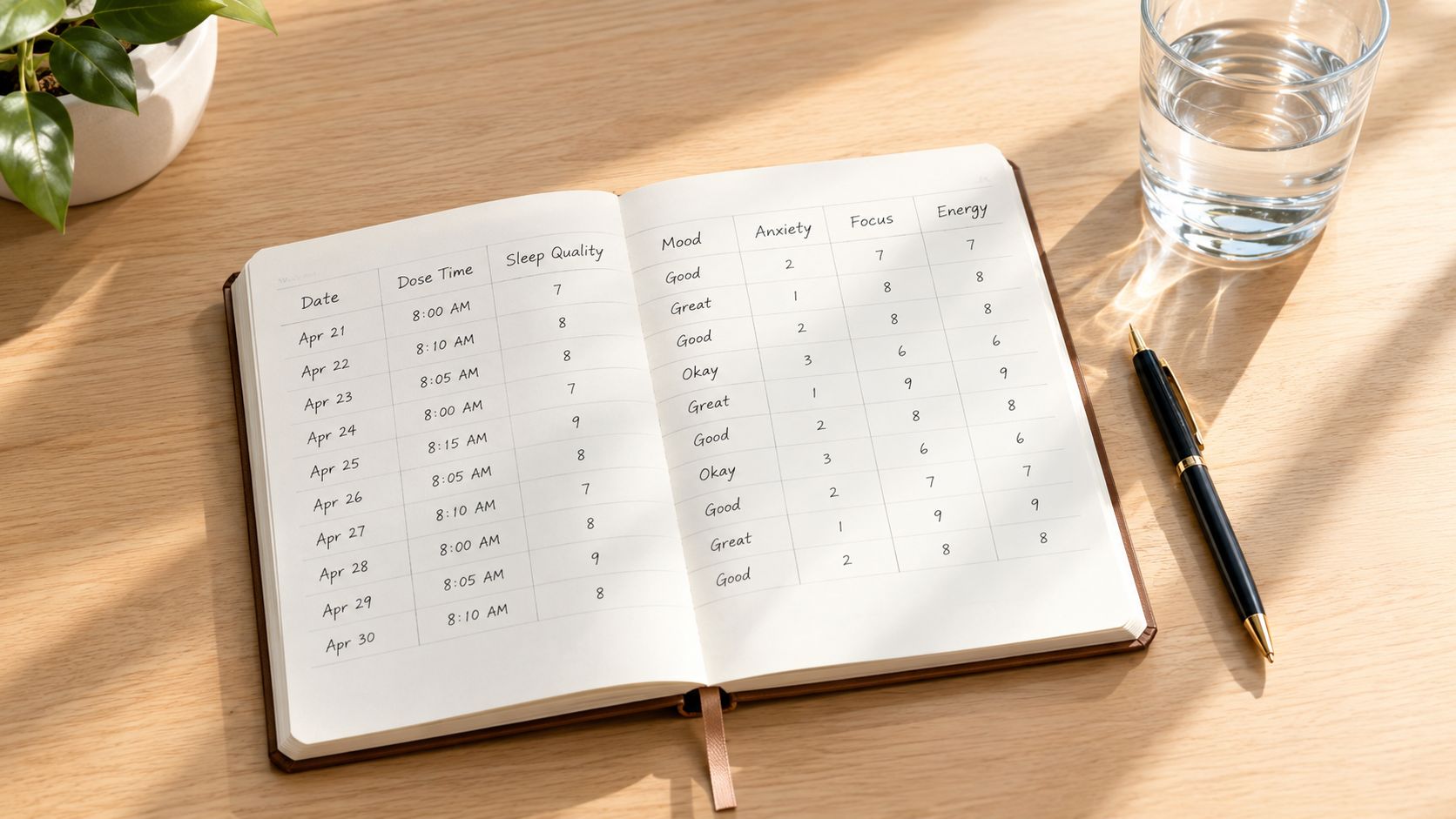
- Before use: Record sleep, baseline mood, anxiety, and anything unusual about the day.
- Product and timing: Note the product, batch information if available, measured amount, and when you took it.
- During the day: Describe focus, energy, physical discomfort, and tasks you completed.
- Next morning and off days: Record sleep quality, mood, anxiety, and whether ordinary responsibilities felt easier or harder.
Prefer Messy Observations to Polished Conclusions
An illustrative useful entry might read: Slept badly. Felt more energetic after taking it, but kept switching between tasks. Finished the email I'd avoided. Stomach felt unsettled. Next morning I was tired.
A less useful entry is: Amazing focus. Definitely working.
The first separates observations from interpretation. The second announces a conclusion without showing what happened.
Journal test: Could someone reading your entry tell both what felt better and what went worse?
Review entries when you're not in the middle of the experience. Compare similar days where possible, and don't ignore workload, sleep, or a change in routine.
Several weeks of notes may be enough to decide that continuing isn't worthwhile. They aren't enough to prove clinical effectiveness or long-term safety. You need less evidence to stop an optional experiment than to claim it works.
Expectancy Effects and What Trials Actually Show
Feeling better isn't fake just because expectation helped shape the experience. But a genuine feeling isn't automatically evidence of better cognition or a therapeutic effect.
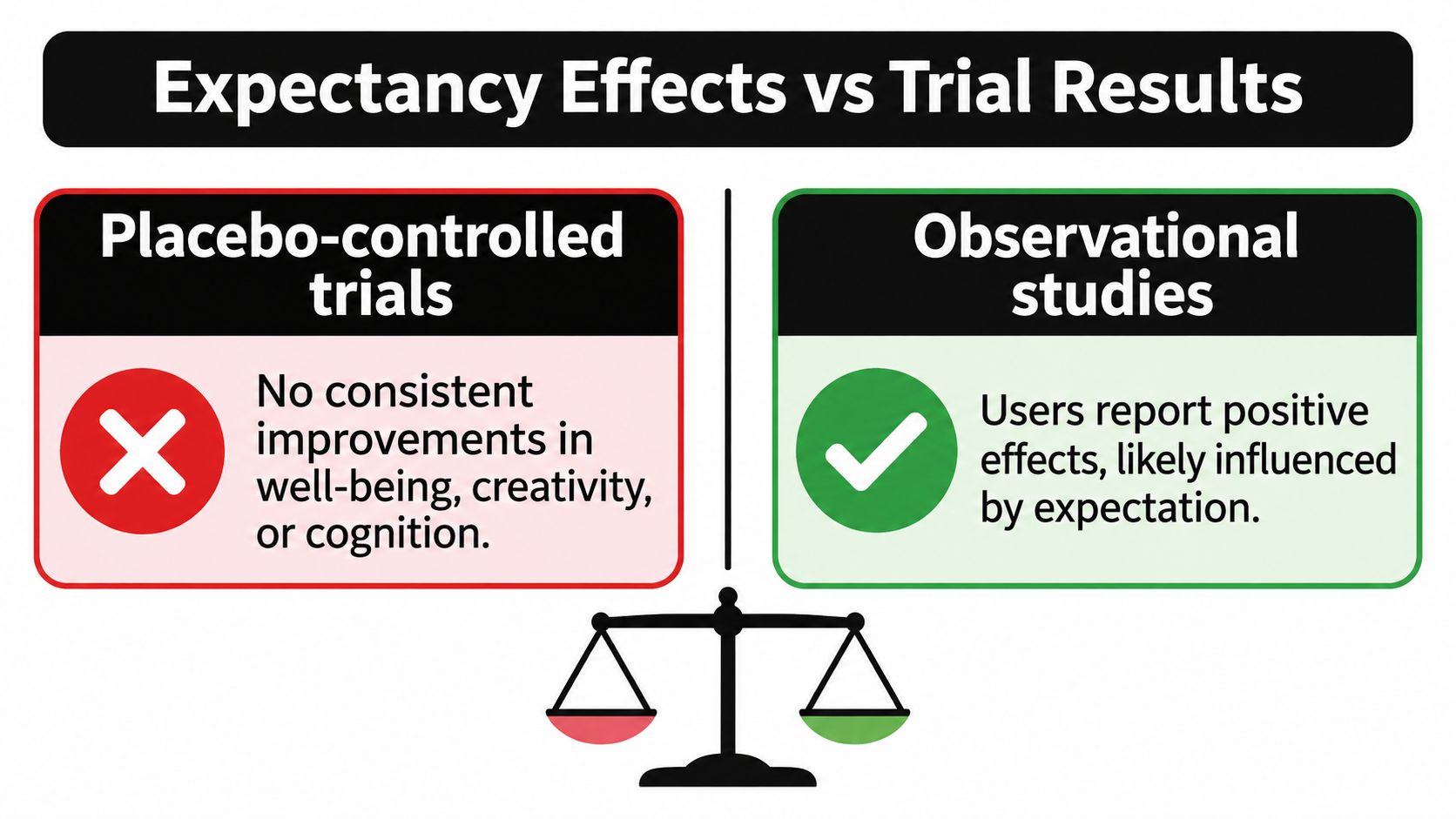
A rapid review of placebo-controlled psychedelic microdosing studies identified 19 studies and concluded that the available evidence couldn't determine whether reported benefits came from pharmacological effects, expectancy, or placebo effects; it also found no long-term safety studies.
The comparison below captures the tension between reported benefits and controlled results. Don't read it as proof that expectation explains every positive experience.
Notice the Difference Between Feeling and Functioning
In a placebo-controlled study of low-dose psilocybin mushrooms, participants experienced subjective effects and altered EEG activity, but researchers found no evidence of enhanced well-being, creativity, or cognitive performance. Some measures shifted slightly toward cognitive impairment.
That distinction matters. You can feel mentally stimulated while completing less work, or feel unusually creative without producing something more useful. Neither observation makes you dishonest.
Expectancy means your beliefs about an experience can influence how you interpret it. Blinding is difficult when participants recognize that they received an active substance, so a trial can struggle to separate the substance's effects from knowing it was taken.
For additional discussion, this video offers another format to consider.
Define Success Before the Experience
Write down what would count as a useful change before you start interpreting your notes. Choose observable functioning, such as finishing planned work without sacrificing sleep, rather than an exciting feeling.
- Keep benefits specific. A calmer morning is different from treating an anxiety disorder.
- Include costs. Extra energy doesn't compensate automatically for worse sleep.
- Allow a neutral result. Nothing worthwhile changing is a valid conclusion.
Apply the same scrutiny to condition-specific discussions, including microdosing for migraines. Reading about a possible use isn't evidence that it will help you.
Trust your notes over your preferred story. Don't keep moving the definition of success to accommodate the result.
Safety Habits for a First Month
Make the setup boring on purpose. The first month isn't a challenge to complete, and it isn't a deadline for finding a benefit.
The National Center for Complementary and Integrative Health's psilocybin safety guidance describes risks including increased heart rate and blood pressure, nausea, headache, dizziness, poor sleep, anxiety, cognitive disruption, and rare persistent psychosis; cardiovascular disease, vulnerability to psychotic or bipolar disorders, and unavailable pregnancy safety data warrant particular caution.
Clear the Risks Before Considering Use
If you have a personal or family history of psychosis or bipolar disorder, serious heart disease, or medications that may interact with psychoactive substances, get professional advice first. Don't stop prescribed treatment to make room for mushrooms.
Use this overview of psilocybin drug interactions to prepare questions for a clinician or pharmacist, not to clear yourself for use. If you're pregnant, don't interpret missing safety data as reassurance.
Keep the Day Uncomplicated
- Check lawful access. Verify the rules where you live before obtaining or using a product. Availability isn't a substitute for checking legality.
- Choose low-demand conditions. Don't combine a first experience with deadlines, caregiving duties, or consequential decisions.
- Don't mix substances. Avoid alcohol, cannabis, stimulants, and other psychoactive substances. Prescription questions belong with a professional.
- Don't drive or make safety-critical calls. Feeling ordinary isn't a dependable clearance test.
- Don't escalate to produce a sensation. The goal isn't to make the product announce itself.
Keep product and batch information attached to your records. Don't assume an identical measured weight from a new batch recreates an earlier experience, given the potency uncertainty already discussed.
Above all, don't rationalize a rising physical or emotional cost as necessary progress. Boring, uneventful observation is preferable to pushing through discomfort. No optional wellness experiment deserves priority over sleep, stability, or your ability to handle everyday responsibilities.
When to Stop and When to Seek Help
Stop using and seek medical advice for persistent anxiety, paranoia, severe insomnia, worsening mood, or perceptual changes that don't resolve. Don't wait for a journal pattern when something feels seriously wrong.
Chest tightness, chest pain, breathing difficulty, or feeling unsafe needs urgent assessment, not another entry in your tracker. Tell the clinician what you took, when you took it, and what else you use.
The Questions That Matter Next
- Can I redose because I don't feel it? No. Lack of a noticeable effect isn't evidence that more is appropriate, especially with an edible or drink.
- Does tolerance carry into a full dose? Don't use this guide to predict that response. There's no reliable individual conversion here, and a quiet low-dose experience doesn't justify planning a larger one.
- What means the experiment is over? Adverse effects, interference with responsibilities, or no meaningful benefit are sufficient reasons. You don't need to finish a schedule.
Your decision rule is simple: if continuing requires explaining away harm, stop. Self-monitoring can help you notice a problem; it can't replace professional assessment.
Metro Mush offers a curated selection of dried mushrooms and edibles for adult consumers in the Detroit and Ann Arbor areas. Visit the online menu to review product information and ask about ingredients, batch details, and available testing before considering a low-dose product. Don't let a product label make the safety decision for you.