

You're in Detroit or Ann Arbor, you've heard that mushrooms are “decriminalized,” and you're trying to work out what that means before placing an order. Does local decriminalization permit a storefront purchase? Can a seller advertise, deliver, or test products? Does the policy protect you from every kind of enforcement?
Those questions expose the problem with treating decriminalization vs legalization as a simple legal/illegal choice. The core issue is which activity a policy permits, tolerates, or regulates, and what consumer protections come with it.
What Decriminalization vs Legalization Actually Means
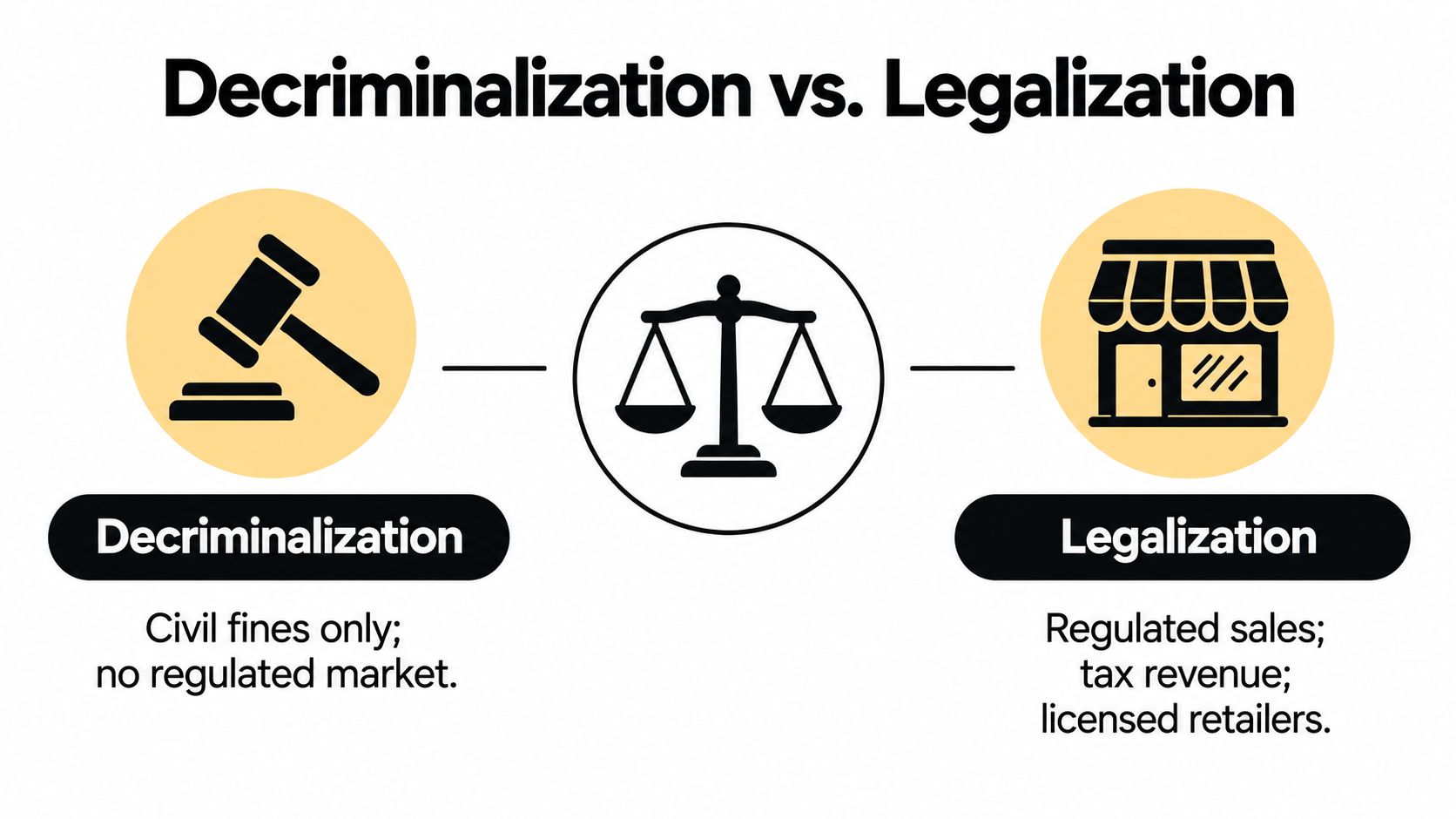
In local conversations around Ann Arbor and Detroit, “decriminalized” often sounds like “legal.” It isn't. Decriminalization usually changes the response to personal possession or use, reducing or removing criminal penalties in defined circumstances. It doesn't automatically authorize manufacturing, retail sales, advertising, delivery, laboratory testing, or supervised administration.
Legalization goes further. It creates a lawful activity under defined rules. Those rules can include licensing, product standards, age limits, testing, trained staff, facility requirements, taxation, and incident reporting. A legal service model may also restrict where and how a product can be administered instead of allowing ordinary take-home retail.
| Policy model | What it may change | What it doesn't automatically create |
|---|---|---|
| Decriminalization | Lower criminal-enforcement priority for personal possession or use | A licensed supply chain, tested products, or lawful retail |
| Legalization | Authorized production, services, or sales under rules | Unlimited access, unrestricted advertising, or permission everywhere |
| Supervised legalization | Licensed preparation, administration, and integration | Ordinary over-the-counter or take-home retail |
Portugal demonstrates the distinction clearly. On July 1, 2001, Portugal decriminalized personal use and possession of all illicit drugs, including cocaine and heroin, while retaining prohibitions on trafficking. Possession moved toward administrative and health-oriented responses rather than ordinary criminal prosecution, but Portugal didn't create a broad commercial supply chain through that reform. The Portuguese experience was associated with declines in problematic use, drug-related harms, and criminal-justice burdens, according to the Drug Policy Alliance review of Portugal's health-centered model.
Practical rule: A local non-enforcement policy may reduce arrest risk for a specific activity. It doesn't turn every connected activity into a licensed business.
How Each Policy Model Changes Enforcement and Market Access
Decriminalization mainly changes enforcement exposure. If local officials deprioritize personal possession, an adult may face less criminal risk for that specific conduct. The policy can leave several practical questions unanswered: where the product came from, whether its potency was measured, whether a seller may operate lawfully, and whether customers can receive a recall notice. A lower possession penalty does not by itself create a safer purchasing channel.
Legalization changes market structure as well as enforcement. Regulators may require inventory provenance, laboratory testing, customer eligibility checks, staff credentials, approved facilities, and incident records. These controls cannot remove every risk, but they give consumers and regulators a way to identify problems and respond when something goes wrong. For a Michigan consumer, the useful question is which activities the local rule permits, from possession to a regulated purchase or supervised service.
Oregon and Colorado show the middle ground
Oregon became the first U.S. state to combine psilocybin decriminalization with a legal therapeutic-use framework after voters approved Measures 109 and 110 in November 2020. Colorado adopted a similar state-level approach in 2022, reducing penalties around certain personal psychedelic activities while creating a regulated framework for supervised use. A policy review of Oregon and Colorado's reforms reports that adult psilocybin use increased by approximately 2% in both states after reform, compared with 0.4% in the rest of the United States. That comparison is descriptive and does not establish that legalization caused the change.
Oregon's system keeps personal policy separate from a licensed service pathway. Measure 109 authorized the Oregon Health Authority to license and regulate psilocybin manufacturing, transportation, delivery, sale, purchase, and administration. Administration occurs through licensed facilitators at designated service centers, alongside preparation and integration requirements. A customer therefore enters a supervised service system rather than buying an unregulated product at a retail counter for use at home.

Portugal shows how a health-focused enforcement policy can operate without opening commercial channels. Its reform redirected attention toward health services and away from ordinary criminal prosecution while production and commercial distribution remained prohibited. The Drug Policy Alliance account of Portugal's outcomes reports that new HIV/AIDS diagnoses among people who used drugs fell from 1,430 cases, or 52% of all new diagnoses, in 2000, to 77 cases, or 6%, in 2015. Drug-overdose deaths declined from 369 in 1999 to 54 in 2015, and the number incarcerated for drug offenses fell 43% from 1999. Those outcomes describe public-health effects, not permission for commercial retail.
For readers comparing local access with Oregon psychedelic therapy, the relevant distinction is the permitted activity. Check whether the policy covers possession, cultivation, facilitated administration, medical access, or commercial sale before assuming that a product or service is lawful.
Comparing Allowed Activities Side by Side
A policy label becomes useful only when it answers an activity-level question. “Decriminalized” may describe possession while leaving sale and production prohibited. “Legalized” may describe a supervised service framework without authorizing take-home products. Two jurisdictions can sound similarly permissive while giving consumers very different purchasing options.
| Activity | Decriminalization | Legalization |
|---|---|---|
| Personal possession | Criminal penalties may be reduced or removed within the local policy's scope. | Possession is authorized under defined rules, limits, or eligibility requirements. |
| Home cultivation | Not automatically permitted. A local enforcement policy may not create a cultivation exemption. | May be authorized only if the law expressly permits it and sets conditions. |
| Commercial sale | Usually remains legally ambiguous or prohibited unless separately authorized. | Can be lawful through licensed businesses, approved channels, or a restricted service model. |
| Product testing | No guaranteed batch testing, potency standard, labeling system, or recall process. | Regulators can require laboratory testing, provenance records, labels, and recalls. |
| Age verification | Not necessarily required or standardized by the policy. | Can be built into licensed sales or service access. |
| Supervised services | Not created automatically. Possession tolerance doesn't establish trained facilitation. | May be authorized through licensed facilitators, facilities, and service procedures. |
The practical difference is substantial. Decriminalization can lower the consequences attached to possession without making the product itself safer or the seller lawful. Customers may still have no standardized information about potency, contaminants, serving size, or storage. Retailers may also lack a recognized licensing pathway, which makes claims about compliance difficult to verify.
Legalization creates a chain of accountability, but the chain depends on the law's design. Oregon's regulated psilocybin program separates facility, facilitator, manufacturer, laboratory, and worker-permit categories. Its 2025 year-end data reported 377 facilitator licenses, 11 manufacturer licenses, 25 service-center licenses, one laboratory license, 197 worker permits, and 5,935 clients, according to the Oregon Health Authority's official year-end summary.
That doesn't mean every legalized model will use Oregon's structure. It does show what regulation makes possible: a regulator can identify responsible parties, inspect operations, track clients, and distinguish a licensed service from an informal retail transaction.
Real-World Scenarios for Michigan Consumers
A Detroit customer sees a delivery post and assumes local decriminalization makes the purchase lawful. That conclusion goes too far. A city policy may reduce enforcement priority for personal possession while leaving storefront sales, delivery operations, advertising, manufacturing, and interstate transport outside its protection. The customer's purchasing options still depend on the specific activity the policy covers.
Ann Arbor presents the same practical question. A permissive local policy does not guarantee that a product was tested or that a seller has authority to operate. Enforcement risk and product risk are separate questions. Assess both before treating a local rule as protection.

Three situations worth separating
A possession question: An adult carries a product in a city with a deprioritized-enforcement policy. That posture may affect the response of local officials, but it does not necessarily cover possession on federal land or conduct governed by state or federal authorities. The location and the exact conduct still matter.
A purchasing question: An adult orders from a seller that cites a local delivery area as its legal justification. The customer should still ask whether the policy authorizes commercial sale, delivery, advertising, and the product's specific form. Calling an area “decriminalized” does not answer those separate questions or establish that the transaction is licensed.
A quality question: An adult buys an edible without a standardized label, batch record, or testing documentation. Limited enforcement of possession does not show that the product has reliable potency or a traceable production history. Recent public-health evidence found more than 20-fold variation in psilocybin potency in testing from decriminalized regions, as reported in recent evidence on potency and public-health implications.
For Michigan consumers, packaging alone is weak evidence of control. Before relying on a local policy, match the exact activity to the policy's language and look for concrete safety information. That approach helps separate an available purchase from an authorized one, and a lower enforcement concern from a safer product.
Readers seeking broader context about products and magic mushrooms in Michigan should keep local, state, and federal rules distinct. Metro Mush customers can use that distinction to assess what a policy changes, what it leaves unresolved, and where purchasing risk remains.
Compliance and Harm-Reduction Steps for Metro Mush Customers
Policy literacy should change how you shop and use products. It shouldn't encourage you to treat a decriminalized area as a place where every transaction is automatically authorized.
Start with the legal boundary
- Identify the activity: Ask whether the local rule concerns possession, use, cultivation, facilitated administration, or sale. Don't substitute one category for another.
- Respect jurisdiction: A city policy doesn't necessarily control state or federal enforcement. Avoid possession on federal land, and don't assume an in-city rule protects interstate delivery or transport.
- Check seller practices: Look for clear product descriptions, serving information, contact details, storage guidance, and a process for reporting a concern. These practices don't prove legal authorization, but they help you assess avoidable risk.
- Keep products secure: Store them away from children, pets, and anyone who hasn't consented to use them. Don't combine psychedelic products with driving or other safety-sensitive activities.
Reduce preventable harm
Dose awareness matters because labels and potency can vary outside standardized testing systems. Start cautiously, avoid stacking products before effects are understood, and choose a calm setting with trusted support. Anyone with a personal or family history that makes psychedelic use medically concerning should seek qualified professional advice before proceeding.
Supervised access may offer a clearer safety pathway where a jurisdiction licenses facilitators, facilities, and reporting procedures. Oregon's model shows how preparation, administration, and integration can be built into a regulated service rather than left entirely to the buyer.
A harm-reduction guide can help customers think through setting, support, product information, and response planning. The purpose isn't to make an uncertain market appear risk-free. It's to make decisions more deliberate when the legal framework doesn't provide complete protection.
A lower chance of arrest isn't the same as a tested product, a licensed seller, or medically supervised care.
How to Choose the Right Path Based on Your Goals
Start with your priority, not the policy slogan.
If your main concern is minimizing enforcement exposure, identify exactly what a local decriminalization policy covers and what it leaves untouched. Treat the result as a narrower risk reduction, not a blanket authorization. You still need to consider state and federal rules, location, transport, and the seller's conduct.
If your priority is product accountability, look for a framework that can document testing, labeling, provenance, age verification, and recalls. Decriminalization alone usually doesn't create those controls. A regulated market can, although the protections depend on the specific program and whether the product or service falls inside it.
If your priority is guided support, look for a licensed supervised-service model rather than ordinary retail. Oregon's framework is built around designated service centers and licensed facilitators, which makes it materially different from buying a product for use at home.
The useful decision tree is simple:
- Do you want lower enforcement risk? Verify the local rule and its narrow scope.
- Do you want standardized product information? Look for testing and traceability, not just a decriminalization label.
- Do you want professional oversight? Seek a lawful supervised-service pathway.
- Do you want take-home retail? Confirm that commercial sales are authorized, because decriminalization doesn't establish them by itself.
That approach treats decriminalization vs legalization as a spectrum of permitted activities, which is more accurate than a binary. It also keeps consumer expectations realistic in Detroit, Ann Arbor, and surrounding communities.
Frequently Asked Questions About Local Policy
Does local decriminalization permit retail purchases?
Not automatically. Decriminalization generally addresses criminal penalties for personal possession or use. It doesn't necessarily authorize commercial production, storefront sales, delivery, advertising, testing, or take-home retail. Check the exact local policy and separate personal possession from the seller's business activity.
How does Oregon's model differ from Michigan's local landscape?
Oregon created a state-regulated psilocybin-services framework with licensed manufacturers, facilitators, service centers, laboratories, and worker permits. The model focuses on supervised administration rather than treating every decriminalized possession policy as an ordinary retail market. Michigan consumers shouldn't assume that a local enforcement policy provides Oregon-style licensing or oversight.
What safety information can regulated programs track?
Regulated programs can record clients, licensed operators, service encounters, and adverse incidents. Oregon's official data for January through April 2025 covered 1,509 clients and recorded two severe adverse behavioral reactions, three adverse medical reactions, and one post-session reaction, according to the Oregon Health Authority's interactive data dashboard.
A separate Oregon Health & Science University-led prospective study followed 346 participants through three months. Retention was approximately 90%, four participants, or 1.2%, all psychedelic-naive, experienced adverse behavioral reactions requiring medical attention, and no serious physical-health event was reported. At one month, 92.2% of respondents said they benefited. At three months, reported moderate-to-severe depression, anxiety, and PTSD symptoms declined, with relative risks of 0.40, 0.29, and 0.35, respectively. The study was observational and involved self-selected participants, so it doesn't prove that legalization caused therapeutic benefit. It does show why a regulated program can produce denominator-based safety and outcome data that informal markets often can't collect consistently.
What should a Michigan buyer remember?
Remember the activity, not the label. A local policy may affect enforcement around possession while leaving product quality, commercial authorization, federal jurisdiction, and supervised care unresolved. Ask what is permitted, what is tested, who is accountable, and where the activity occurs before making a decision.
Metro Mush offers adult consumers in the Detroit and Ann Arbor areas a local way to browse curated psilocybin products and arrange orders through its online menu and delivery service. Visit Metro Mush to review current availability and make a more informed choice based on your local policy, product information, and personal safety priorities.