

A controlled, randomized, double-blind trial of psilocybin for cluster headache reported a drop from 18.4 attacks per week to 9.8, about a 47% reduction, in the three weeks after treatment started, with no unexpected or serious adverse events (PubMed). That's why this topic gets attention, but it's also why it needs careful explanation. Cluster headache is brutal, and people who live with it deserve more than hype, they deserve a clear read on what the evidence does, and doesn't, show.
What Cluster Headaches Are and Why Patients Look Beyond Standard Care
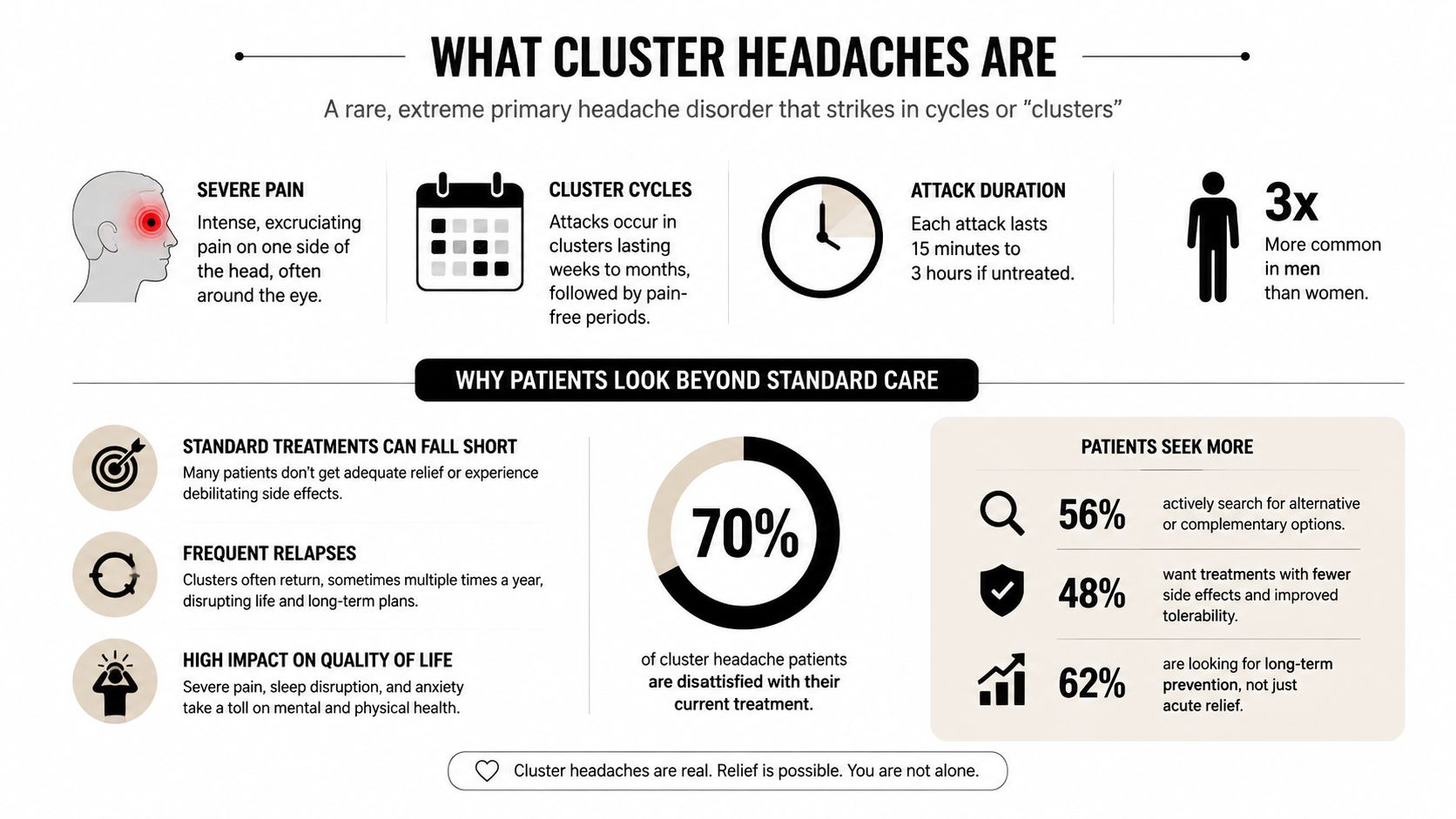
Cluster headache isn't “just a bad headache.” It's a primary headache disorder marked by severe, one-sided pain that many patients describe as if something is being driven behind the eye. The attacks often come in clusters, with periods of repeated attacks followed by remission, and that pattern can make daily life feel unpredictable even when the pain is absent between bouts.
For many people, standard care helps, but not enough. Oxygen therapy can abort attacks for some patients, and preventives such as verapamil or galcanezumab may reduce burden, yet response is uneven and side effects, access, or incomplete relief can leave a gap between what's available and what's needed. That gap is what drives people to search for psilocybin for cluster headaches, especially when attacks keep returning despite careful neurology care.
What makes this condition so hard to live with
The pain is only part of the problem. Cluster attacks tend to arrive with a sense of urgency, restlessness, and fear of the next one, which means patients aren't only managing pain, they're organizing their lives around the possibility of pain. That's one reason even preliminary research can feel meaningful to patients.
Practical rule: if a treatment sounds promising, ask whether it has controlled data, tolerable safety, and a realistic path to use. A dramatic story isn't enough when the disorder is this severe.
The right question isn't whether psilocybin is “natural” or “alternative.” The right question is whether the research shows a genuine signal that justifies further study, and whether that signal holds up outside a small research setting. That standard matters because people with cluster headache are often vulnerable to false hope.
How Psilocybin Works and Why Pulse Dosing Matters
Psilocybin is the compound in some mushrooms that the body converts into psilocin. In plain terms, psilocin is the form that interacts with serotonin systems in the brain, which is why psilocybin belongs in the broader psychedelic family rather than the headache medicine shelf. Its effects are different from LSD and ketamine, even though all three show up in headache conversations for different reasons.
The cluster headache hypothesis isn't about taking psilocybin every day like a vitamin. Researchers have focused on a pulse regimen, meaning a few doses spaced apart, because cluster headache itself tends to behave like a cycle. The idea is more like interrupting a recurring pattern than continuously suppressing symptoms.
Why the pattern of dosing matters
That's where people get confused. Microdosing usually means tiny, regular amounts taken repeatedly, often with no obvious psychedelic effect. The cluster headache studies have used a different model, a short course of low doses spaced over days, which is closer to a therapeutic pulse than to casual supplement-style use.
The best analogy is a short course of antibiotics versus a daily vitamin. Antibiotics are taken for a specific window to interrupt an infection, not to gently nudge the body forever. Psilocybin research in cluster headache uses a similar logic, a temporary intervention aimed at breaking a cycle.
The phrase matters because dosing pattern seems central to the theory, not just the amount swallowed. That's why a person reading internet anecdotes should be careful not to flatten all psychedelic use into one category. The evidence base for psilocybin for cluster headaches is tied to specific protocols, not to every version of mushroom use people discuss online.
For a deeper look at the brain-level discussion, see this overview of psilocybin effects on the brain.
A low-dose pulse is not the same thing as microdosing, and it's not the same thing as a full psychedelic session either. Those distinctions matter when people try to compare stories online.
What the Clinical Trials Show
The strongest signal comes from the randomized, double-blind, placebo-controlled study. It used a low-dose pulse regimen of 10 mg per 70 kg, given three times, 5 days apart, and attack frequency fell from 18.4 attacks per week at baseline to 9.8 attacks per week, a roughly 47% reduction (PubMed). The paper also reported that psilocybin was well tolerated, with no unexpected or serious adverse events.
That result matters because controlled trials reduce the chance that improvement is only expectation or coincidence. The finding still needs caution. One well-run study can point to a real effect, but it does not make psilocybin a standard treatment, and it does not answer the practical problem many patients face, namely that they cannot enroll in trials, cannot legally access psilocybin, and end up comparing scattered anecdotes with very different dosing patterns.
How to read the other studies
An earlier open-label study followed 10 patients over 10 weeks and found an average 31% reduction in cluster attack frequency after psilocybin treatment, with one patient experiencing 21 weeks of complete remission (PubMed). Open-label means both patients and researchers knew what was being given, so the result is easier to treat as a real-world signal and harder to separate from expectation.
That same study found a strong correlation between symptom improvement and hypothalamic-diencephalic connectivity, with R = -0.81. It does not prove why the improvement happened, but it does show the effect was not described as a vague impression alone.
A later blinded extension study suggested roughly a 50% reduction in attacks after the pulse regimen, regardless of whether participants had responded in the first round (ScienceDirect). The signal remained interesting, yet the sample sizes are still small and some analyses are exploratory.
| Study | Design | Sample Size | Dose | Reported Outcome |
|---|---|---|---|---|
| Landmark controlled trial | Randomized, double-blind, placebo-controlled | Not stated in the verified data | 10 mg per 70 kg, three doses, 5 days apart | 18.4 to 9.8 attacks per week, about 47% reduction |
| Earlier open-label study | Open-label clinical study | 10 patients | Psilocybin treatment, exact dose not stated in verified data | About 31% reduction in attack frequency, one patient had 21 weeks of remission |
| Blinded extension study | Blinded extension | Not stated in the verified data | Pulse regimen | Roughly 50% reduction in attacks (ScienceDirect) |
For people comparing psilocybin research with broader symptom reports, this overview of whether mushrooms help migraines is a useful adjacent read, but migraine and cluster headache are different disorders, so the evidence has to be interpreted separately.
The Hypothalamus Theory and Other Proposed Mechanisms
Cluster headache has long been linked to abnormal activity in the hypothalamus, a deep brain region that helps regulate circadian rhythm and internal timing. The idea is often compared to a misfiring thermostat, where the body's timing system is not tracking normally and attacks seem to follow that disturbance.
That biological link is part of why serotonergic psychedelics have drawn research interest. The open-label study found that symptom improvement tracked with changes in hypothalamic-diencephalic connectivity, which fits the idea that these drugs may influence the circuits involved in the cluster cycle. The brain story is still incomplete, but the pattern is not random.
Why no single mechanism is settled yet
Scientists have proposed several overlapping pathways. One is 5-HT2A receptor activity, the classic psychedelic target that may influence connectivity and perception. Another is downstream neuroplasticity, meaning the brain may become more flexible in how it maintains a cycle or leaves it.
Some discussions also include anti-inflammatory effects and 5-HT2B-related concerns, especially when different psychedelics are compared. No single mechanism has been confirmed as the answer, and readers should be cautious around anyone offering a neat one-receptor explanation.
The best mechanism claims are the ones that admit uncertainty. In cluster headache, the working model is a network of effects, not a finished theory.
The hypothalamus theory matters because it offers a biological reason a pulse regimen might interrupt repeated attacks without requiring continuous daily exposure. That fits the observed pattern better than a simple “trip makes headache go away” story. It also helps explain why the research keeps returning to timing, repetition, and short-term intervention.
Psilocybin Compared With LSD, Ketamine, and Standard Preventives
A common question in cluster headache care is whether psilocybin stands apart from the other options people hear about, or whether it is just one member of a larger group with similar promises. The comparison matters because patients are rarely choosing among psychedelics in a vacuum, they are usually comparing them against medicines already used in neurology clinics, and against the reality of what they can access.
Recent case-series work suggests LSD and ketamine may also reduce cluster burden, so psilocybin is not the only compound with a signal in this area (ScienceDirect). That finding is encouraging, but it does not mean the compounds should be treated as interchangeable. Their effects, legal status, and clinical use questions are different, which is why the controlled-trial signal has to be read alongside the much messier real-world gap. Individuals with cluster headaches often cannot enroll in trials, cannot legally access psilocybin, and are left sorting through anecdotal reports, so a careful comparison has to bridge research with harm-reduction-minded access decisions.
What to compare, and what not to compare
A useful comparison has four parts, evidence quality, how long the benefit lasts, access, and safety. Psilocybin has the clearest controlled signal among the psychedelic options named here, but that does not make it easier to obtain than standard care, and it does not make it appropriate for every patient.
LSD and ketamine sit in a different part of the map. They may show helpful signals, but the practical questions change with route, duration, supervision, and the setting in which they are used. Ketamine also belongs to a different pharmacologic family than psilocybin, so grouping them together as if they work the same way can blur important differences.
Standard preventives such as verapamil and oxygen remain the backbone of conventional management for many patients. Clinicians know them better, they are often easier to obtain legally, and they have a more established role in routine care. Even so, some people still have frequent attacks or incomplete relief, and that gap is part of why psychedelic research keeps attracting attention.
For readers trying to make sense of the options, the right question is usually not which treatment sounds most interesting. It is which option has the strongest cluster-specific signal, and which option fits a person's medical history, legal situation, and access limits without creating avoidable risk. For a broader look at medication combinations and precautions, psilocybin drug interactions is a useful follow-up.
Safety, Contraindications, and Interaction Warnings
Safety matters more than curiosity here. Psychedelics are not casual add-ons for people already juggling rescue meds, preventives, and a severe headache disorder. They can create psychiatric, cardiovascular, and drug-interaction problems that need to be taken seriously.
Some people should not self-experiment at all. That includes people with a personal or family history of psychosis, people taking MAOIs or lithium, and people with severe cardiovascular disease. If a patient already has a complicated cardiac or psychiatric history, the discussion belongs in a medical office, not a forum.
Medication interactions that need real caution
A few combinations deserve special attention. SSRIs may blunt effects for some people, which is why coordination with a psychiatrist matters. Tramadol is another medication that raises concern because of seizure risk, and psychedelic use should not be treated as isolated from the rest of the medication list.
Pregnancy and breastfeeding are also common reasons to avoid use. The key point is not fear, it's uncertainty and risk management, because the safety margin is narrower than many online discussions imply.
For a broader look at this topic, psilocybin drug interactions is a useful follow-up. The practical rule is simple, if someone is already on heart-active or serotonin-active medication, they need clinician review before making any changes.
If a treatment plan depends on stopping medications, starting something new, and hoping nothing interacts, it's not a DIY decision.
Legal Status and Pathways to Legal Access
Under US federal law, psilocybin remains a Schedule I controlled substance. That means legal access for cluster headache is not the same thing as “finding it online,” and local decriminalization does not create commercial medical access. It changes enforcement priorities, not the underlying federal status.
People often get Michigan confused on this point. Cities such as Detroit and Ann Arbor have decriminalized certain possession or enforcement priorities, but that doesn't equal broad medical legality or a clinician's permission to prescribe psilocybin for cluster headache. The law and the medical system are related, but they're not the same thing.
What legal access usually means in practice
The clearest route is a clinical trial, and the easiest way to find one is through ClinicalTrials.gov. Some patients may also qualify for expanded access, but that usually means a physician-supported process with screening, documentation, and a compelling medical rationale, not a quick approval.
In a few places, Oregon and Colorado have service-center models that may allow adult access under state rules, but those models are separate from headache-specific medical treatment. Patients need to be careful not to assume that legal adult use equals evidence-based cluster headache care.
If a path to access sounds effortless, it's probably not the real path.
For patients in Michigan and neighboring states, the options are still limited. Legal access is usually about research enrollment, structured state programs where they exist, or waiting for future regulatory changes. Anything else needs a view of legal risk as well as medical risk.
Harm Reduction, Medical Referral, and What to Do Next
The hardest part of this topic is emotional, not technical. People looking into psilocybin for cluster headaches are often doing it because standard care hasn't been enough, and that desperation is understandable. It doesn't, however, make the evidence stronger or the legal risks smaller.
Start with documentation. Keep a record of attack frequency, timing, triggers, and current medications before changing anything, because a baseline helps a clinician judge whether something is helping. Tell a neurologist about any planned psychedelic use, even if the conversation feels awkward, because hiding the plan raises the risk of interactions and missed contraindications.
A practical harm-reduction checklist
- Review current medications first: Ask whether any serotonergic, cardiac, or seizure-threshold-lowering drugs create a problem.
- Use medical screening, not guesswork: A headache specialist can help sort out whether you're even a candidate for a trial or expanded access pathway.
- Avoid combining with contraindicated drugs: Mixing without review can make a bad situation worse quickly.
- Don't do it alone: A sober support person matters if someone is in an altered state or becomes anxious.
- Treat legal status seriously: An underground route is a last resort, not a neutral workaround.
The referral ladder is straightforward. Start with a headache specialist, ask about clinical trial enrollment, then ask whether any form of expanded access is available if standard care has failed. If someone is still considering underground use after that, the conversation should shift from curiosity to risk management.
The evidence is promising, but it's not a cure, and it's not a license to self-prescribe. The most responsible move is to pair careful research reading with a clinician who can help interpret the risks in the context of your own history.
If you're trying to make sense of cluster headache options and want access to curated mushroom products with clear local service, visit Metro Mush to see what's available in the Detroit and Ann Arbor area. Their team can help adult consumers browse product options and stay informed, while you keep your medical decisions grounded in clinician guidance and the latest evidence.