A single 25 mg dose of psilocybin with psychological support reduced depression symptoms within 8 days, with benefits lasting up to 6 weeks in a major JAMA study on major depressive disorder. That result helps explain why psilocybin has moved from fringe curiosity to serious medical discussion.
People in Michigan are hearing about mushrooms from every angle. Some hear wellness claims on social media. Others hear caution from doctors, family, or the news. Many individuals are left trying to answer the same practical question: what are psilocybin health benefits, and what's hype?
This topic deserves a grounded answer. Psilocybin isn't a miracle cure, and it isn't harmless just because it comes from a mushroom. At the same time, the clinical evidence is strong enough that it can't be brushed aside as trend-chasing. Researchers are studying it for depression, anxiety, addiction, and other conditions. Consumers are also trying to figure out what safe use looks like in practical use, especially in places like Detroit and Ann Arbor where the legal picture is more nuanced than many assume.
A responsible conversation has to hold both truths at once. There's real promise here, and there are real risks. There's also a big gap between a monitored therapy room and casual use at home.
Introduction A New Hope for Mental Wellness
Nearly 1 in 5 U.S. adults lives with a mental illness in a given year, according to the National Institute of Mental Health. That scale helps explain why interest in psilocybin has grown so quickly. People are not only curious about a psychedelic experience. They are looking for better options when standard care feels incomplete, slow, or hard to sustain.
A familiar pattern in mental health care looks like trial and error. Someone starts a medication, waits weeks, manages side effects, adjusts the dose, or switches to something else. Against that backdrop, psilocybin has stood out because early research suggests it may help some people in a different way, especially when it is paired with structured psychological support.
That possibility deserves careful attention.
Psilocybin is a naturally occurring compound found in certain mushrooms. After it is consumed, the body converts it into psilocin, the form that affects the brain. For some patients in clinical settings, that temporary shift in perception and mood has been linked to meaningful changes in depression, anxiety, and substance use patterns. For other people, the same altered state can be disorienting, emotionally intense, or unsafe.
That tension matters more than the hype.
A good comparison is physical therapy after an injury. The exercise itself can help, but the setting, guidance, timing, and follow-through often shape whether it leads to recovery or strain. Psilocybin appears to work in a similar way. The substance gets attention, but preparation, support, and integration are a large part of why researchers take the treatment model seriously.
For Michigan consumers, this topic is also practical. People in Detroit, Ann Arbor, and nearby communities are trying to sort out two separate questions at once. What benefits does the research support, and what does safer, legal decision-making look like here at home? Those are not the same question, and mixing them together is where confusion starts.
Three basics help frame the rest of the discussion:
- What psilocybin is: a psychoactive compound from certain mushrooms that the body converts into psilocin.
- Why researchers study it: it may help interrupt rigid patterns of thought and emotion in some conditions.
- Why caution stays front and center: set, setting, dose, personal history, and local law all affect whether an experience is constructive or harmful.
That local context is easy to miss in articles that focus only on lab findings or only on culture. A Michigan reader needs both. The clinical promise means more when it is paired with clear harm-reduction advice, realistic expectations, and an honest explanation of what decriminalization does and does not allow.
How Psilocybin Works A Brain Reboot Explained
Psilocybin can seem mysterious until you translate the science into everyday language. A simple way to think about it is this: some brains get stuck in the same loops. Psilocybin appears to loosen those loops for a period of time.
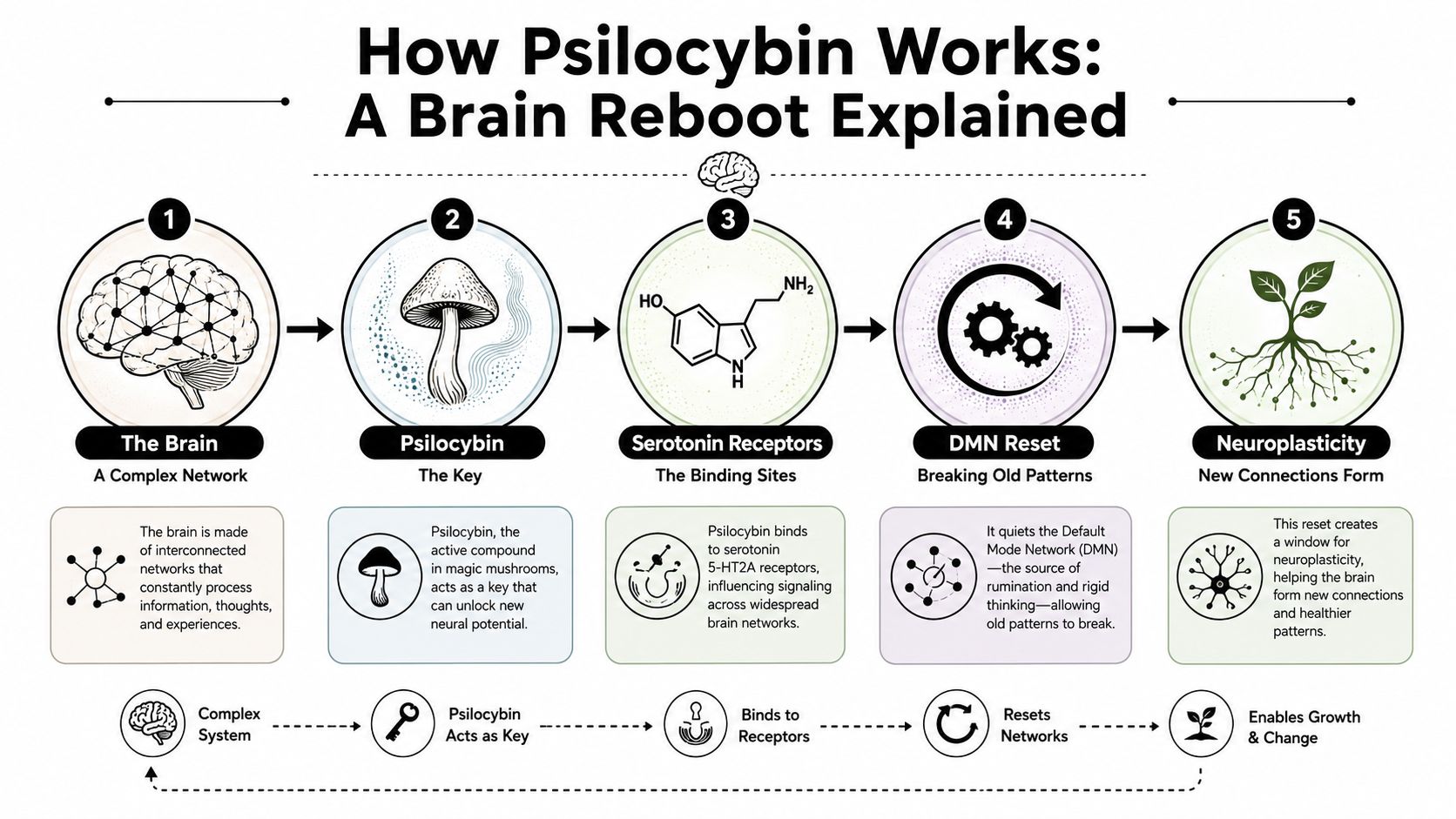
The receptor step
After a person takes psilocybin, the body converts it into psilocin. Psilocin interacts with serotonin receptors, especially the 5-HT2A receptor. You don't need to memorize the name. The practical point is that these receptors help regulate mood, perception, and cognition.
That receptor activity appears to be one reason psilocybin experiences can feel unusually vivid, emotionally charged, or perspective-shifting. If you want a broader plain-language overview, this guide on psilocybin effects on the brain is a useful companion.
The default mode network idea
A lot of people struggling with depression describe a repetitive internal soundtrack. Same worries. Same self-criticism. Same story about who they are and what won't change. Researchers often discuss this in relation to the default mode network, or DMN.
You can picture the DMN as the brain's autopilot for self-referential thinking. That autopilot is useful. It helps you reflect, remember, and make sense of your identity. But when it becomes too dominant, people may get trapped in rumination.
Psilocybin seems to temporarily quiet that overlearned pattern. The “brain reboot” analogy fits here. It's not that the brain shuts down. It's that the usual top-down control loosens, and different connections become possible.
Practical rule: People often report that psilocybin doesn't simply make them “feel good.” It can make them see old thoughts from a new angle.
Why neuroplasticity matters
Another key term is neuroplasticity. That means the brain's ability to form and reorganize connections. In plain terms, it's the brain's capacity to learn a new route instead of driving the same road every day.
That matters because many mental health conditions involve rigid patterns. Depression can lock people into hopeless interpretations. Addiction can lock people into compulsive cues and habits. Anxiety can lock people into threat scanning.
Psilocybin may create a temporary window where those patterns feel less fixed. But the experience alone isn't the whole story. What a person does before, during, and after matters. Preparation shapes the experience. Integration shapes what sticks.
Here's a simple comparison:
| Brain state | Everyday analogy | Why it matters |
|---|---|---|
| Rigid patterns | A sled track frozen into the snow | Thoughts keep following the same groove |
| Psilocybin state | Shaking the snow globe | Old tracks become less dominant for a time |
| Integration after use | Choosing a new path intentionally | New habits and insights have a better chance to last |
That's why clinical settings pair psilocybin with support instead of treating it like a stand-alone pill.
The Clinical Evidence for Psilocybin and Mental Health
The strongest evidence today is in depression. Other areas are promising, but not equally developed. That distinction matters if you want a realistic view of psilocybin health benefits.
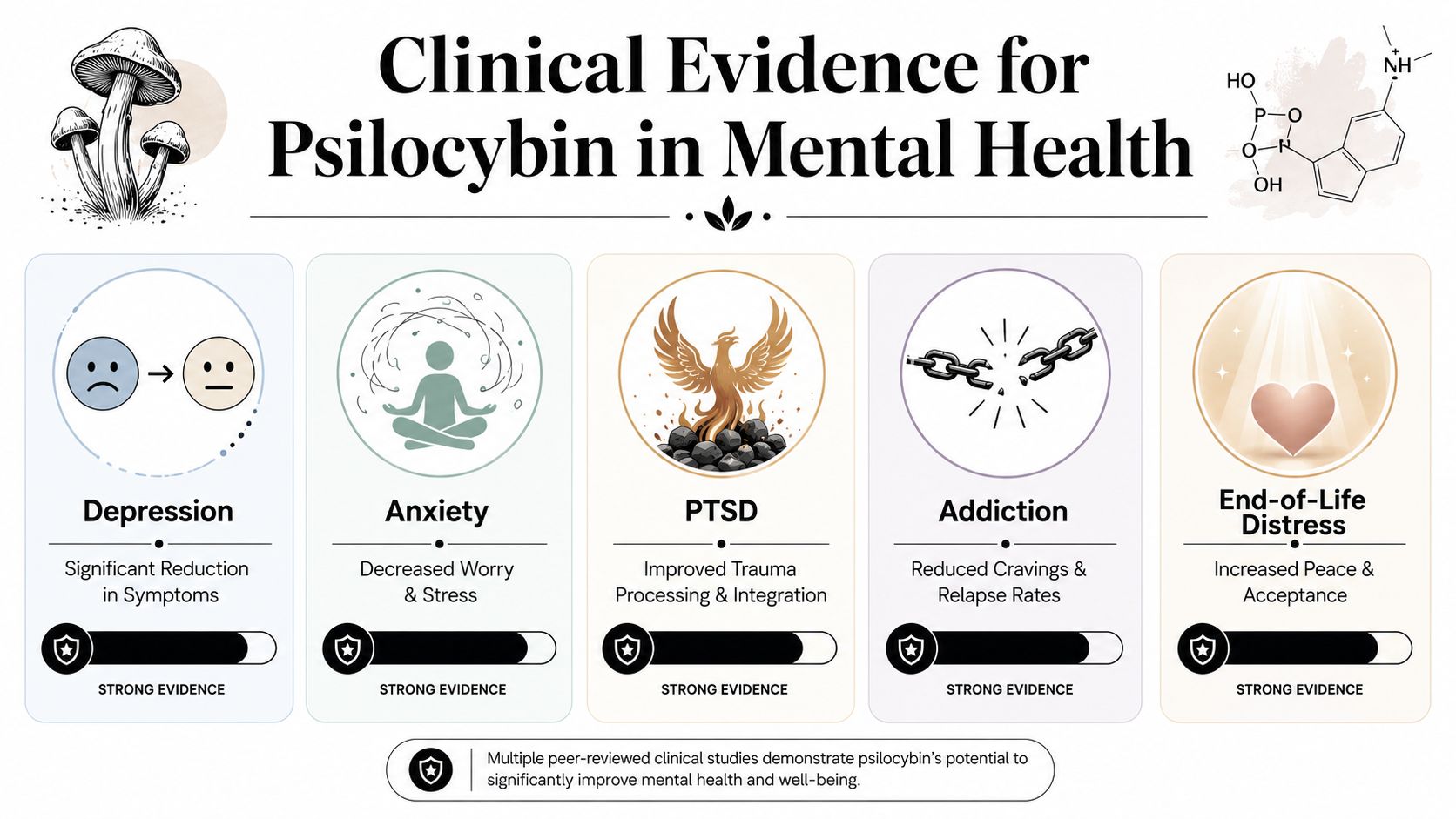
Depression has the clearest support
A 2023 BMJ meta-analysis of psilocybin-assisted therapy pooled data from 436 participants across seven clinical trials and found a large effect size on depression reduction with Hedges' g = 1.64 (95% CI 0.55–2.73, P<0.001). It also found that the likelihood of treatment response was about two times greater with a risk ratio of 2.02 (95% CI 1.33–3.07), and remission was nearly three times greater with a risk ratio of 2.71 (95% CI 1.75–4.20) compared with placebo.
That same analysis reported low heterogeneity between studies (I²=25.7%, P=0.23), which strengthens confidence that the findings weren't wildly inconsistent from one trial to another. In plain language, the antidepressant signal was strong and fairly stable across the included studies.
A good next step for readers trying to understand the treatment model is this overview of what psychedelic therapy is.
The treatment context matters
The clinical studies weren't testing a casual mushroom experience. They were testing psilocybin-assisted therapy. That means screening, preparation, support during the experience, and follow-up.
This is one place where people get confused. They hear “psilocybin helped depression” and assume the mushroom alone did all the work. In the actual trials, psychological support was part of the intervention. The setting wasn't a side detail. It was part of the treatment.
For readers who want a visual overview of the conditions currently being studied, this video is a helpful summary.
Anxiety end-of-life distress and addiction
Research interest extends beyond depression. Studies and clinical discussion often focus on anxiety, end-of-life distress, and substance use disorders. The common thread is that these conditions can involve fear loops, emotional avoidance, and rigid narratives that are hard to interrupt with insight alone.
The evidence is not equally mature across all of these areas. Still, there are reasons researchers continue to investigate them:
- Anxiety and end-of-life distress: Psilocybin-assisted sessions may help some people process fear, grief, and existential distress in a way that feels less defended and more emotionally direct.
- Addiction: The altered state may help people step outside compulsive patterns, reassess habits, and reconnect with personal motivation for change.
- Trauma-related symptoms: Interest is growing, but careful screening matters because intense inner experiences can help with processing for some people and overwhelm others.
What's missing from the evidence
Not every group has been studied well. That's a major limitation, not a footnote. Some populations with high need still don't have enough targeted clinical data.
A review of psychedelic therapy and underserved populations notes a gap for veterans, LGBTQ+ individuals, and people of color, even though these groups can face major barriers to care. The same source notes a Johns Hopkins survey of 300+ people with alcohol use disorder in which many reported reducing or abstaining from alcohol after psilocybin use, but it also points out that no targeted studies adequately answer how psilocybin might specifically serve veterans with PTSD or substance use disorders.
So the best summary is this: depression has the strongest current evidence, several other applications are under active study, and some of the communities that could benefit most remain underrepresented in the data.
Beyond Mental Health Emerging Psilocybin Research
Psilocybin research isn't staying inside psychiatry. Scientists are asking whether the same biology that affects mood and perception might also influence broader processes in the body.
One surprising example comes from aging research. A 2024 Emory University study, reported by Emory News on psilocybin and aging research, found that psilocin extended the lifespan of human skin and lung cells by more than 50%. The same report said mice given a low initial dose followed by monthly higher doses for 10 months showed a 30% increase in survival compared with controls.
That doesn't mean people should start thinking of psilocybin as an anti-aging supplement. The result is early and should be read as a research signal, not a consumer promise. But it does widen the conversation. Psilocybin may interact with biological systems linked to oxidative stress, DNA repair, and telomere preservation, not just mood.
Why this matters
When a compound first enters public discussion, people often put it in one box. Psilocybin was long boxed as either recreational or psychiatric. Research is pushing against both categories.
Scientists are now exploring questions like these:
- Cellular resilience: Could psilocin influence how cells respond to stress?
- Whole-body aging pathways: Might its effects extend beyond the brain?
- New treatment categories: Could compounds studied for mental health later find roles in other areas of medicine?
Early-stage findings are interesting because they open doors, not because they settle the question.
There's also long-standing interest in whether psilocybin may help with conditions such as cluster headaches, though the strongest precise data provided here is in the aging area. The broader lesson is simple: the field is moving, and some of the most interesting psilocybin health benefits being studied now may not fit the public's older assumptions.
Dosing Safety and Harm Reduction
Responsible education is of utmost importance. The way a person uses psilocybin changes the likely effects, the risks, and the quality of the experience. “Mushrooms” isn't one uniform category of use.
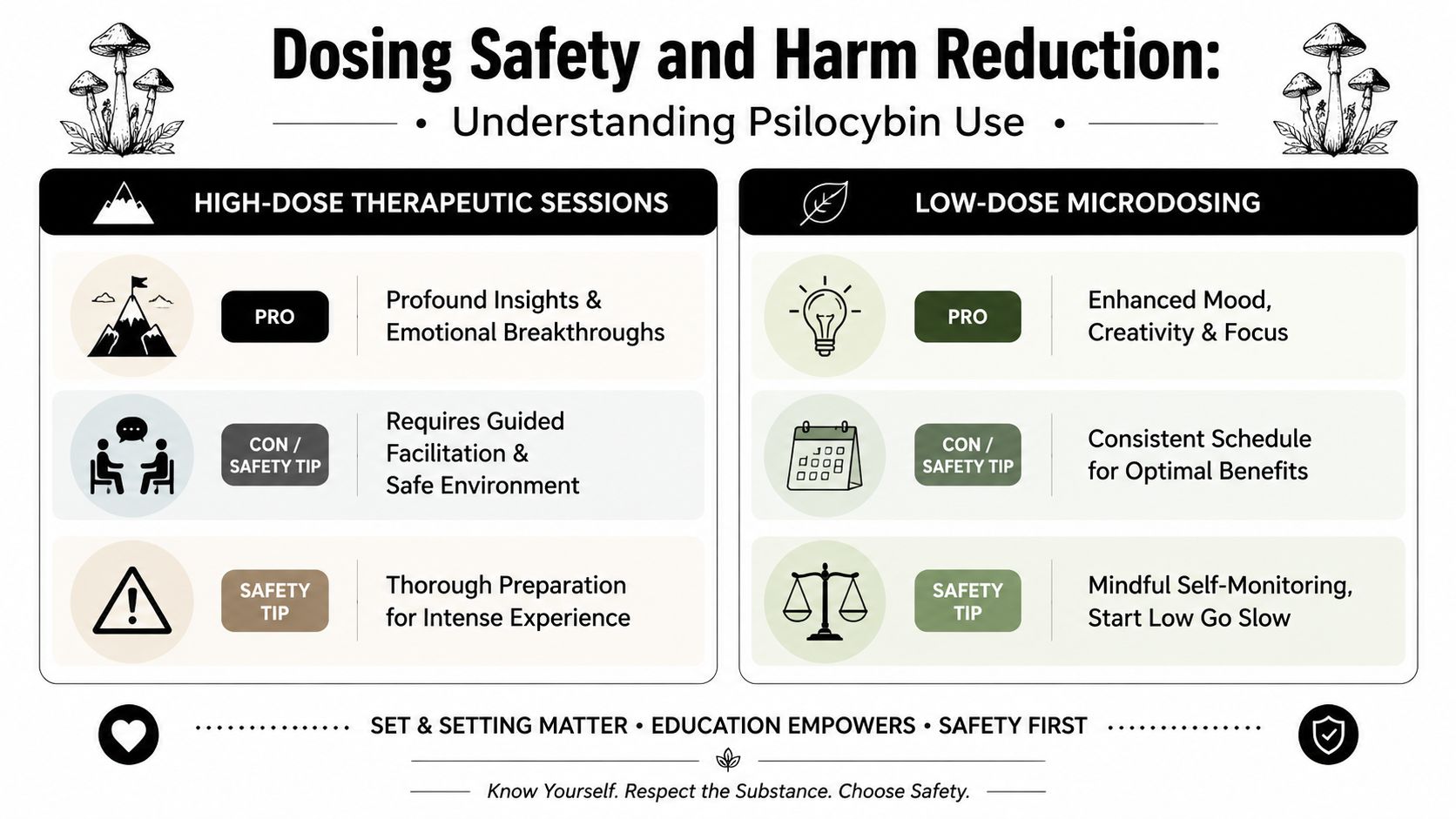
High-dose sessions and microdosing are not the same
A high-dose therapeutic session aims for a noticeable altered state. The purpose is often emotional breakthrough, perspective shift, or deep introspection. In clinical settings, that kind of session comes with preparation, monitoring, and integration support.
Microdosing tries to stay below the level of obvious psychedelic effects. People often pursue it for subtle mood, focus, or creativity changes while going about normal daily life.
Those are completely different goals. They shouldn't be judged by the same expectations.
| Approach | Main goal | Typical experience | Evidence quality |
|---|---|---|---|
| High-dose therapeutic use | Emotional and psychological shift | Clear altered state, often intense | Stronger support in clinical depression research |
| Microdosing | Subtle day-to-day changes | Little or no obvious trip | Mixed results and more uncertainty |
The microdosing hype is ahead of the evidence
A lot of first-time consumers assume microdosing is the safer, gentler, clearly beneficial option. However, it is more complicated.
The National Center for Complementary and Integrative Health overview on psilocybin and microdosing says controlled trials show mixed results, and a 2023 study in 104 depressed patients found no superior benefit over escitalopram. The same source warns that microdosing can carry risks, including increased anxiety, depression, insomnia, poor focus, and cognitive impairment.
That point surprises people because microdosing is often marketed in soft, harmless language. But low dose doesn't automatically mean low consequence. Subtle changes can still be destabilizing, especially for someone with anxiety, bipolar vulnerability, or sleep problems.
A dose that feels “too small to matter” can still matter if it disrupts sleep, sharpens anxiety, or encourages someone to self-treat without support.
Who should be especially cautious
Some people should slow down or avoid psilocybin unless they've had proper medical guidance.
- People with a history of psychosis: Psilocybin can intensify perception and thought patterns in ways that may be unsafe.
- People with bipolar concerns: Mood destabilization is a real concern, especially if someone is already prone to swings.
- People taking psychiatric medications: Drug interactions can change the effect profile. Some medications may blunt effects, while others can complicate safety.
- People under acute stress: Psilocybin tends to amplify what's already present. If someone is panicked, grieving, sleep deprived, or in conflict, the experience may become harder to manage.
Set and setting still matter
“Set and setting” may sound like old psychedelic jargon, but it remains one of the most useful harm-reduction ideas.
Set means mindset. What are you bringing into the experience? Fear, hope, denial, curiosity, unresolved conflict?
Setting means environment. Who is present, where you are, how safe you feel, and whether you can rest without interruption.
A safer framework looks like this:
- Screen carefully: Don't ignore mental health history, medications, or prior difficult reactions.
- Choose the environment carefully: Private, calm, familiar spaces reduce unnecessary stress.
- Have support available: A sober, trusted sitter can help if the experience becomes disorienting.
- Protect the next day: People often need quiet time to recover, reflect, and sleep.
Practical signs of risky thinking
Sometimes the red flags aren't medical. They're behavioral.
- “Natural means safe.” It doesn't.
- “If a little helps, more helps more.” That's a common path to panic.
- “I'll figure it out alone.” Maybe. But support lowers avoidable risk.
- “Microdosing can't hurt me.” The evidence doesn't support that assumption.
The most useful harm-reduction mindset is simple: respect the compound, respect your own history, and don't confuse internet confidence with real preparation.
Psilocybin in Michigan Legality and Local Access
Michigan consumers need a clear distinction between decriminalization and legalization. They are not the same.
What decriminalization usually means
In parts of Michigan, local policy has shifted so that enforcement related to entheogenic plants and fungi may be treated as a low law-enforcement priority. That can reduce practical enforcement pressure in some places.
It does not mean psilocybin is broadly legalized. It does not create the same kind of regulated statewide framework people may associate with cannabis. Federal law still treats psilocybin as illegal, and state and local interpretations can differ. If you want a place-specific overview, this guide to magic mushrooms in Michigan is useful for understanding the local situation.
What this means for Detroit and Ann Arbor consumers
For adults in Detroit and Ann Arbor, the biggest mistake is assuming local tolerance equals legal certainty. It doesn't. A lower enforcement priority is still not a retail system with universal protections, testing standards, or straightforward licensing rules.
That means practical caution matters:
- Know your city context: Local policy can shape risk, but it doesn't erase other legal layers.
- Avoid public-use assumptions: Public consumption can create unnecessary legal and safety issues.
- Keep expectations realistic: “Available” and “fully legal” are different categories.
Local access should never be confused with legal immunity.
How to approach access responsibly
If you're in Southeast Michigan, the safest consumer mindset is the same one you'd use for any high-impact substance. Verify what you're buying, avoid impulse decisions, and don't let convenience replace judgment.
For products, form matters. Dried mushrooms, chocolates, and drinks can create different user expectations around onset and predictability. A bar or beverage may feel more approachable to a new consumer, but it still requires the same caution around timing, total intake, and environment.
A local consumer should also ask practical questions before purchasing:
| Question | Why it matters |
|---|---|
| What format is this product in | Different formats may feel easier to consume quickly |
| Do I know my intention | Curiosity, coping, and recreation can lead to very different choices |
| Do I have a safe setting | Access without a plan is a weak form of preparation |
| Am I relying on rumor for legality | That's one of the most common mistakes in this space |
In Michigan, responsible access starts with legal humility. If you're not sure what's allowed, assume the answer is more limited than social media suggests.
Conclusion The Future of Psychedelic Wellness
Research interest in psilocybin has grown quickly, but the safest takeaway is still a measured one. The strongest clinical signal so far is in serious mental health conditions such as depression, while other possible benefits are still being studied. That puts psilocybin in an unusual category. It is promising enough to merit attention, and sensitive enough to require real care.
A simple way to understand the future of psychedelic wellness is to picture a powerful tool that works differently depending on who is using it, why they are using it, and what kind of support surrounds the experience. Psilocybin may help some people loosen rigid thought patterns, process difficult emotions, and return to old problems with more psychological flexibility. Those are meaningful possibilities. They are not guarantees.
Context changes outcomes.
For Michigan consumers, that point matters just as much as the science. Good information, honest product labeling, careful screening, and a safe setting are what turn curiosity into a more responsible decision. Local policy matters too. A person can hear that psilocybin is "decriminalized" in one place and wrongly assume that means broad legal protection, product standards, or medical oversight. Those are separate questions, and mixing them up is one of the easiest ways to make a poor decision.
The next phase of psychedelic wellness should include wider access to education, better inclusion in research, and clearer public guidance for people who are interested but cautious. Equity matters here. As noted earlier, underserved communities are often left out of both research and treatment access. If that pattern continues, psychedelic care could remain concentrated among people with more time, money, and social support, even though mental health strain is often heaviest elsewhere.
For a Southeast Michigan adult, the practical lesson is straightforward. Start with legal humility, realistic expectations, and harm reduction. Ask whether the source is trustworthy, whether the setting is safe, and whether your reason for using psilocybin is clear. Excitement is not a plan. Preparation is.
If you're an adult in Southeast Michigan looking for a thoughtful local option, Metro Mush offers a curated menu of dried mushroom strains, chocolates, and drinks for Detroit and Ann Arbor area consumers. You can browse products, place orders by text, and check current specials like Mix & Match Saturdays, plus discounts for veterans, fire, and police.