


You're probably here because you saw a cute animal toy online, or your child spotted one and immediately wanted it. The idea sounds simple enough. Animal pieces come apart, snap together with magnets, and suddenly a giraffe can wear a crocodile tail.
That kind of toy can be delightful for preschoolers. It supports hands-on play, invites silly storytelling, and keeps little fingers busy. But parents often run into a confusing problem fast. There isn't much clear guidance on what a safe, well-made set looks like, and many search results blur the line between commercial toys and DIY projects.
That matters. Some online examples treat mix and match magnetic animals as homemade craft projects rather than products designed for young children. As an educator, I'd approach them with both enthusiasm and caution. They can be wonderful play tools when they're thoughtfully made, age-appropriate, and inspected carefully.
What Are Mix and Match Magnetic Animals
Think of Mix and Match Magnetic Animals as animal LEGOs, but softer in concept and easier for young children to use. Instead of snapping tiny bricks together, children connect larger animal parts with hidden magnets. A set might include heads, middle sections, legs, wheels, tails, or full animal halves that can be swapped around to make new combinations.
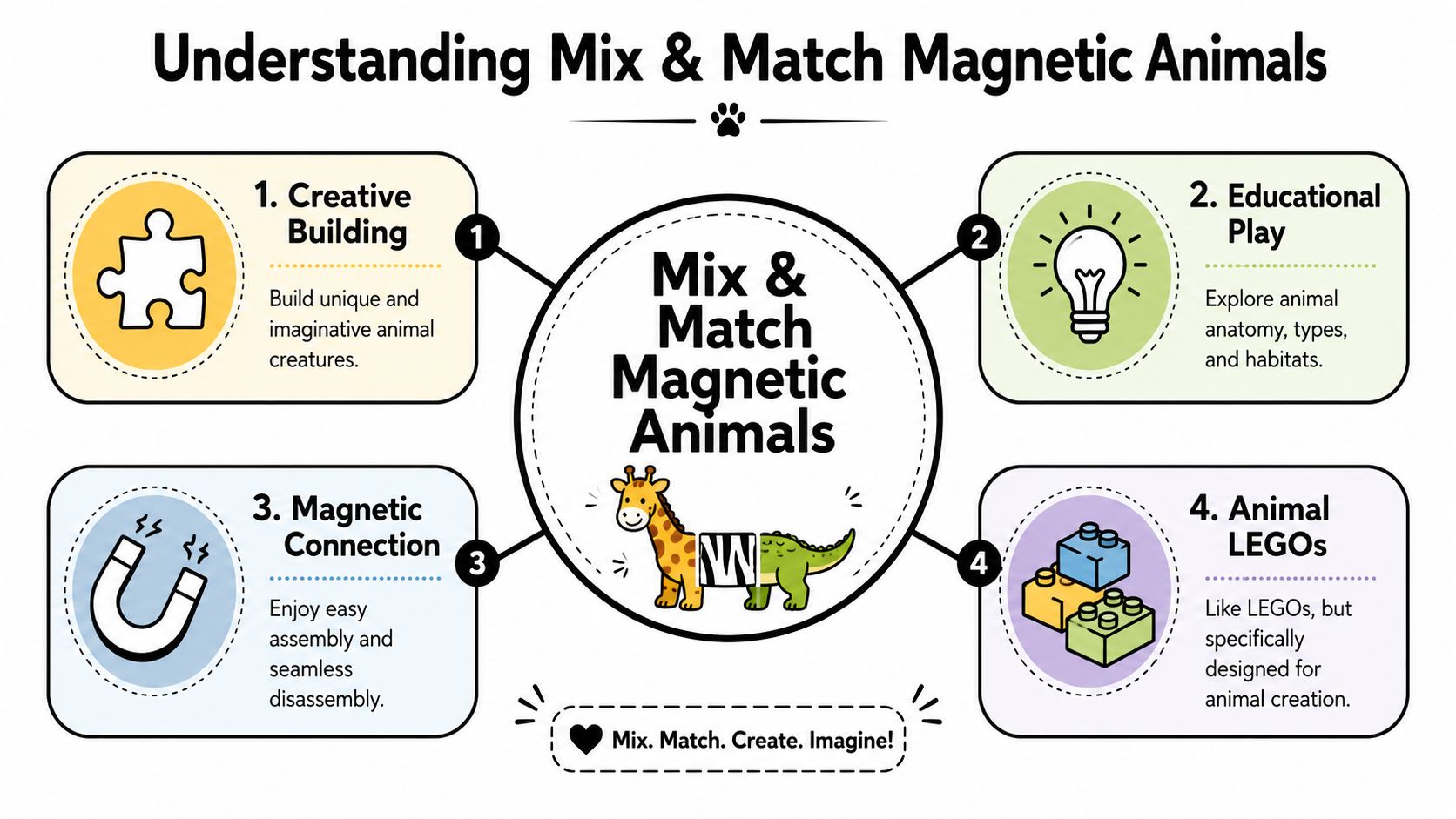
A child might build a normal farm animal first. Then the play usually shifts. The cow gets a duck body. The horse gets chicken wheels. A lion might turn into a made-up “li-phant” with an elephant-style front and a cat-like back. That playful mismatch is exactly what makes these toys appealing.
What a typical set includes
Most sets are built around interchangeable parts. Parents usually see a few common formats:
- Animal halves: Front and back pieces that connect in the middle.
- Body segments: Head, torso, and rear pieces that can be rearranged.
- Animal vehicles: Animal characters paired with magnetic carts or cars.
- Theme-based pieces: Farm, safari, woodland, or ocean animal parts.
The magnets are usually hidden inside the pieces so children only feel the smooth outer surface. When the design is done well, the connection feels satisfying without requiring much force. That's helpful for young children who are still learning controlled hand movements.
Practical rule: If your child already enjoys chunky puzzles, simple building toys, or pretend-play animals, they'll probably understand this toy category quickly.
Why children find them so engaging
These toys sit in a sweet spot between puzzle play and open-ended play. There's no single right answer. A child can match pieces correctly, mix them up on purpose, or invent a whole story around a silly creature.
That flexibility is part of the appeal for parents too. One toy can support naming animals, sorting pieces, making patterns, and imaginative play without feeling like a lesson.
There's also an important reality to keep in mind. The term Mix and Match Magnetic Animals doesn't refer to a recognized technical product category with established expert specifications. Verified background on this topic indicates that attempts to locate technical benchmarks or formal engineering data for this exact product category have yielded zero results across sources such as IEEE Xplore, Google Scholar, USPTO patent databases, and major toy safety standards, which suggests the label is loose and inconsistently used in the market. That's one reason parents need to look closely at each individual product rather than assuming all sets are built to the same standard.
The Developmental Benefits of Magnetic Play
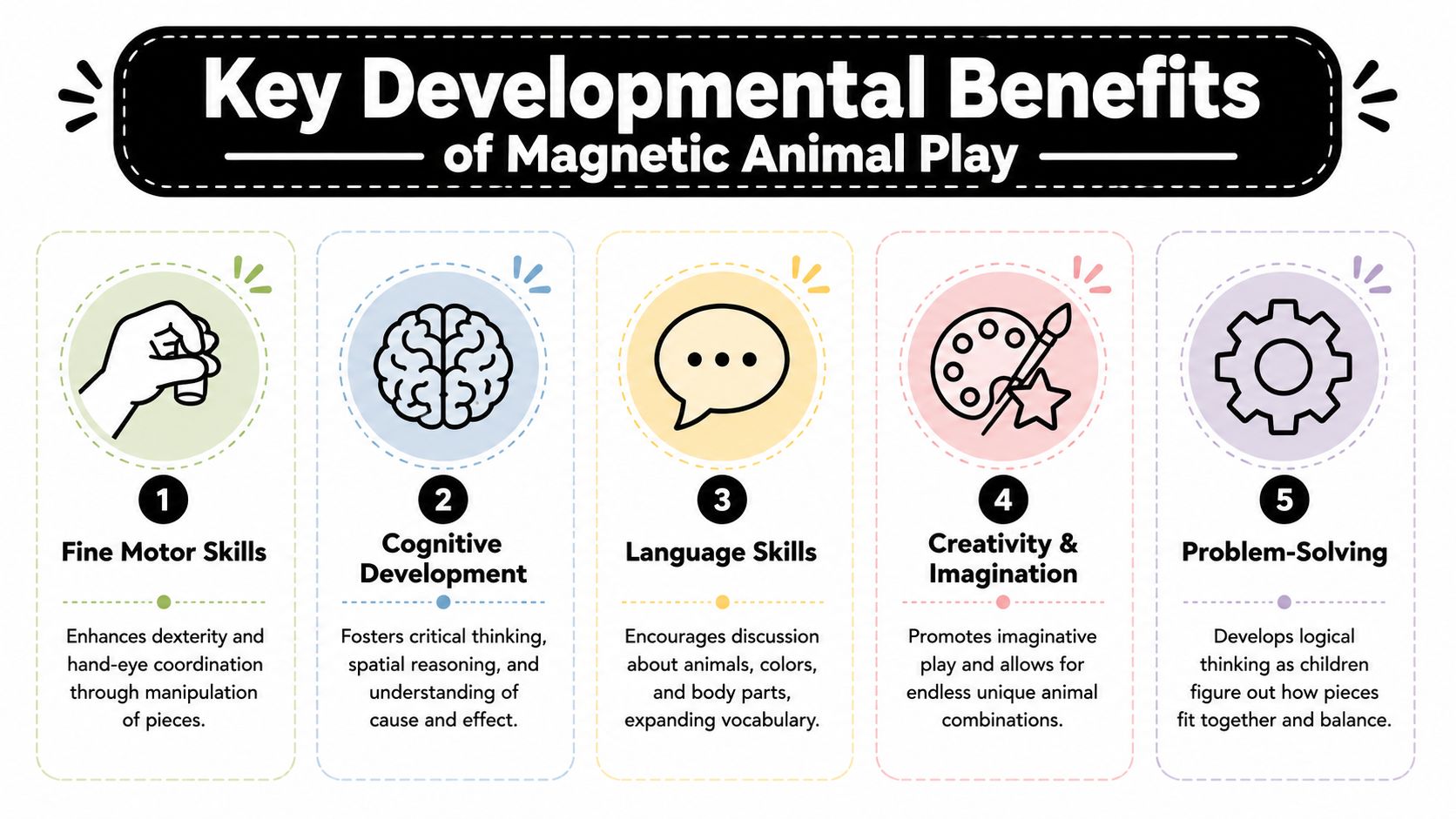
When children play with magnetic animal pieces, they're doing more than making funny creatures. They're practicing small movements, testing ideas, and building language through play. The value comes from the actions involved, not just from the finished toy.
Fine motor growth
Lifting a piece, turning it, lining it up, and connecting it all require hand control. Those small adjustments strengthen the kinds of movements children use later for dressing, drawing, and early writing tasks.
There is some encouraging evidence around this general type of play. A 2024 study from the Journal of Pediatric Rehabilitation found that magnetic manipulation toys significantly improve fine motor coordination in children ages 3 to 5, as described in this background reference on magnetic toy use. That doesn't mean every magnetic animal set is automatically therapeutic, but it does support the idea that magnetic play can serve real developmental goals.
Some children will happily connect pieces over and over. Others may lose steam quickly. Follow the child's pace rather than pushing for “more practice.”
One useful caution comes with that same finding. Existing reviews and tutorials don't spell out how many magnetic connections a child should manage in a session to avoid overstimulation or fatigue. So parents and educators should watch the child, not the clock. If attention fades, hands get clumsy, or frustration spikes, it's time to pause.
Thinking skills and spatial reasoning
Magnetic animal toys also support cause and effect. Children notice that a piece either connects smoothly or doesn't. They rotate it, try again, and gradually learn how shape, direction, and position matter.
That kind of trial and error helps with:
- Visual matching: noticing which pieces belong together
- Spatial reasoning: understanding how parts fit and face
- Problem-solving: trying a new approach when one connection fails
- Flexible thinking: accepting that there can be many “right” combinations
A child making a zebra-crocodile hybrid isn't being random. They're experimenting.
Language and imagination
These toys are also excellent conversation starters. You can ask, “What animal did you make?” or “Where does it live?” and suddenly the play expands into storytelling.
Children often practice language naturally through:
- Naming body parts like tail, beak, paws, and horns
- Describing features such as striped, fuzzy, big, or fast
- Explaining ideas when they tell you why their made-up animal can fly and swim
- Social play when siblings negotiate who gets which piece
That blend of movement, talk, and make-believe is what makes magnetic animal play so rich.
How to Choose the Right Set for Your Child
Shopping for these toys can feel harder than it should. Listings often emphasize cuteness first and construction details second. For parents, the better approach is to treat this like a quality check, not just a gift purchase.
Start with your child, not the box photo
A toddler who still mouths toys needs something very different from a preschooler who builds carefully and follows simple play rules. Look at the actual size of the pieces, how many parts come in the set, and how much coordination the toy expects.
A good fit usually has:
- Large, easy-to-hold pieces for younger children
- Simple connections that don't require force
- Clear animal shapes that are easy to recognize
- A manageable number of pieces so play feels inviting, not chaotic
If a set looks beautiful but the parts seem tiny, decorative, or overly intricate, it may be better for display than daily child-led play.
Material matters
You'll commonly see wood and plastic versions. Neither is automatically better. What matters is finish, durability, and how securely the pieces are built.
Wood often feels sturdy and pleasant in the hand. It can be a good option if the edges are smooth and the paint or finish appears even and intact.
Plastic can be easier to wipe clean and may hold bright colors well. But it shouldn't feel brittle, thin, or prone to cracking at the seams.
Choose the set that looks boringly well-made. For a child's magnetic toy, that's a compliment.
A practical shopping checklist
When you're comparing products, focus on these details:
- Magnet enclosure: The magnets should appear fully sealed inside the toy, not exposed or loosely inserted.
- Surface quality: Check for chips, rough edges, cracks, and weak seams.
- Paint and finish: The coating should look smooth and stable, not flaky or sticky.
- Piece design: Broad, chunky parts are usually easier for young children to manipulate.
- Realistic use: Ask yourself whether the toy looks ready for dropping, tugging, and repeated handling.
If product photos don't clearly show construction quality, I'd be cautious. A trusted retailer or maker should make the build quality visible.
Creative Play and Early STEM Activity Ideas
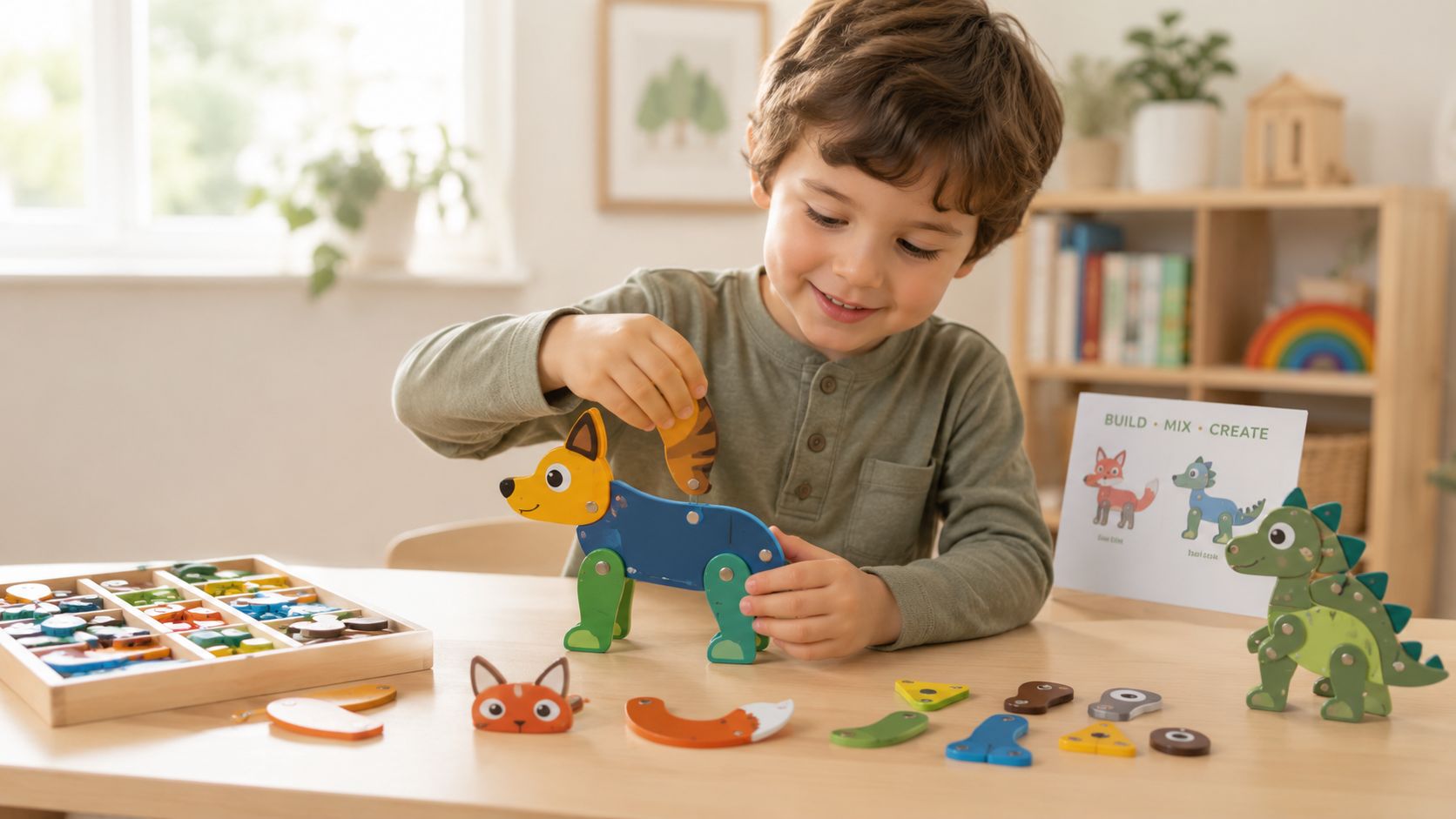
Once children understand that pieces can come apart and reconnect, the toy opens up in all kinds of useful ways. A simple set of magnetic animals can support pretend play one day and sorting or science talk the next.
The rescue story game
Set out a few mixed-up animals and create a tiny story. Maybe the animals got scrambled in the rain forest, or the farm helper needs to match everyone before bedtime. Your child can rebuild real animals first, then invent fantasy ones.
This kind of play encourages sequencing, memory, and expressive language. It's especially helpful for children who enjoy characters and narratives more than direct instruction.
You can borrow more family learning ideas from Metro Mush's education category if you like browsing broader at-home activity inspiration.
Sort, compare, and classify
If your child prefers structure, turn the pieces into a sorting challenge. Group by color, habitat, body covering, or type of movement. You might place all the farm animals together, then all the animals that swim, then all the pieces with wings.
Try prompts like:
- “Find all the tails.”
- “Make two animals that live on a farm.”
- “Build the tallest creature.”
- “Can you make one animal with feathers and one with fur?”
Those little challenges build thinking skills without making play feel formal.
A beginner STEM conversation
Magnets naturally invite curiosity. Children notice attraction right away, even if they don't have the words for it yet. You can keep it simple by saying, “This side wants to connect,” or “Turn it and see what happens.”
Ask open questions such as:
- What changed when you flipped the piece?
- Which animals connect easily?
- Can you build one that stands steadily?
- What happens when the pieces are too heavy or unbalanced?
That introduces early ideas about alignment, balance, and testing.
A short demo can help if your child likes seeing toys in action before trying them alone.
Therapy-friendly play ideas
For children who benefit from calmer, more focused activities, keep the setup small. Offer only a few pieces at a time and choose a clear goal, such as “make one animal” or “connect two pieces and pull them apart slowly.”
You can also vary the challenge:
- Easier: Match only two large halves
- Moderate: Build animals from three parts
- Open-ended: Create a new creature and tell its story
That gives children a sense of success without flooding them with too many choices at once.
Safety First A Guide to Inspecting Magnetic Toys
This is the part parents shouldn't skip. Magnets are not harmless when they come loose. According to child safety data, loose magnets in toys are a leading cause of emergency room visits for internal injuries when swallowed, with over 3,000 pediatric magnet ingestions reported annually in the US alone, as noted in this DIY magnetic animal toy reference discussing magnet risk.
That doesn't mean you need to avoid every magnetic toy. It means magnet security is paramount.
How to tell a safer commercial toy from a risky DIY version
A commercial toy designed for children should have magnets fully enclosed inside solid parts. A DIY version may use cut-open toys, added magnets, glue, or patched seams. Those homemade ideas may look clever online, but they don't necessarily meet the durability needed for repeated child use.
Be especially cautious if you see:
- Visible seams that look re-glued
- Magnets placed near openings or thin walls
- Small detachable components
- Rough cut lines or uneven surfaces
- No clear age guidance or safety information
If you can imagine the toy splitting during normal child play, don't buy it.
Magnetic toy safety checklist
| Check Point | What to Look For |
|---|---|
| Outer casing | Smooth, intact surface with no cracks, chips, or weak seams |
| Magnet enclosure | No visible magnet, no rattling, no shifting sensation inside |
| Edge finish | Rounded edges and no sharp points |
| Piece size | Large enough that the toy doesn't resemble a small loose part |
| Wear over time | No new gaps, breaks, peeling finish, or exposed inner material |
| Child use pattern | The toy still looks secure after drops, pulling, and repeated handling |
A simple inspection routine
Before purchase, zoom in on product photos. After purchase, hold each piece in your hand and inspect it slowly. Look, press, and feel.
Then keep checking it during the toy's life:
- Before play: scan for cracks or looseness.
- After drops: inspect the impact area.
- During cleanup: notice whether any piece feels lighter, hollow, or damaged.
- At the first sign of wear: remove the toy from use.
Parents often ask how to verify magnet integrity or seal strength before purchase, and there isn't a standardized checklist commonly included in product reviews. That gap makes your own inspection habits even more important.
How to Clean and Store Your Magnetic Animals
These toys last longer when families keep care simple and consistent. Cleaning also gives you a natural chance to inspect the pieces for wear.
Cleaning tips that work in real life
For plastic pieces, wipe with a damp cloth and mild soap, then dry them fully. For wooden pieces, use a lightly damp cloth rather than soaking them. Too much moisture can wear down finishes or seep into seams.
Skip harsh cleaners, heavy scrubbing, and anything that leaves a strong residue. If a piece looks damaged after cleaning, set it aside and inspect it before returning it to play.
Storage that protects the toy
Store magnetic animals in a small bin, basket, or cloth bag where all parts stay together. Clear containers help children see what belongs to the set, which supports cleanup and reduces missing pieces.
A few habits help:
- Keep pieces dry before putting them away
- Store all matching parts together so children can build more easily
- Avoid overstuffed bins that bang pieces together
- Do a quick check during cleanup for cracks or loose sections
Consistent care doesn't just protect the toy. It protects the child using it.
If you're in the Detroit or Ann Arbor area and also like discovering thoughtfully curated products from local businesses, Metro Mush is worth a look. They focus on convenient access to psilocybin products for adult consumers, with online browsing, local delivery options, and a menu that includes dried mushrooms, chocolates, drinks, and regular specials.