
You're probably here because the idea of a reset sounds appealing.
Maybe you've been stuck in the same mental loop for months. Maybe you've seen polished retreat photos with ocean views, white clothes, journals, and phrases like “deep healing” or “breakthrough experience.” Maybe you're curious, but you also want to know the less glamorous part: What happens, what can go wrong, and how do you tell a responsible program from expensive marketing?
That's the right mindset. Magic mushroom retreats can be meaningful for some people, but they aren't casual wellness getaways. They sit at the intersection of altered states, mental health, legal uncertainty, and consumer risk. If you treat them like a vacation package, you can miss the questions that matter most.
The Rise of Magic Mushroom Retreats
Magic mushroom retreats have moved far beyond a fringe travel trend. A major 2025 analysis found 648 retreat experiences across 440 distinct physical locations worldwide, including 130 locations in the United States and 310 outside the U.S., plus 7 online locations and 3 other locations according to this 2025 landscape analysis of psychedelic retreats.
That matters for one simple reason. You're not looking at a tiny underground scene anymore. You're looking at a broad commercial market with a lot of variation in quality.
Some programs are built with clear screening, structured support, and realistic expectations. Others borrow the language of therapy without offering the same level of care. For a first-time reader, that's where the confusion starts. People hear “retreat” and assume a common standard exists. It doesn't.
Why interest keeps growing
For many adults, the appeal is easy to understand. A retreat promises time away from work, fewer distractions, guided introspection, and a chance to approach old pain from a different angle. That's very different from recreational use at a party or at home with friends.
A retreat also sounds more manageable than trying to piece together an experience on your own. Staff, schedule, food, sleeping arrangements, and post-session support can all lower uncertainty, at least in theory.
Practical rule: A retreat isn't automatically safer because it looks organized. Safety comes from screening, supervision, and follow-up, not from branding.
If you're still sorting out the difference between a retreat model and clinical support, this overview of what psychedelic therapy is can help clarify the basic categories.
The real takeaway
The rise of magic mushroom retreats means you have more options. It also means you have more chances to choose poorly. A bigger market creates convenience, but it also creates copycat operators, vague promises, and flashy websites that can hide weak protocols.
That's why the smartest way to approach this space isn't with blind optimism or blanket fear. It's with consumer caution.
Understanding Retreat Types and Formats
A magic mushroom retreat is usually a guided experience built around intention, environment, and support. The core difference from recreational use is structure. The mushrooms aren't the whole product. The program, the setting, the facilitation, and the support around the session are the product.
That sounds abstract, so it helps to think of retreats as different kinds of containers. The same substance can feel very different depending on who's with you, what the rules are, how much privacy you have, and what kind of help is available if things get difficult.
Group retreats and private formats
Some retreats are group-based. You travel with other participants, attend shared meals, join orientation activities, and often have your session in the same room as others. This can feel supportive if you like community and shared reflection. It can also feel intense if you value privacy or get overstimulated around strangers.
Private formats are usually more individualized. You may still stay at a retreat center, but the preparation and session support are adapted more closely to you.
A quick comparison helps:
| Format | Often appeals to | Main upside | Main caution |
|---|---|---|---|
| Group retreat | People who like community | Shared support and lower isolation | Less privacy, more group energy |
| Private retreat | People with specific needs or strong privacy preferences | More personalized attention | Quality varies a lot, and “private” doesn't always mean clinically robust |
Short retreats and longer immersions
Duration changes the feel of the whole experience.
A shorter retreat might work for someone who wants a contained introduction. You arrive, prepare, have the session, and leave within a compressed window. That can be easier for work and family logistics, but it may also leave less time to settle in or process afterward.
Longer immersions create more room for emotional pacing. You aren't rushing from travel stress straight into an altered state and back into normal life. The tradeoff is cost, time away, and more dependence on the retreat's daily systems being well run.
Setting matters more than most people think
Two retreats can both advertise psilocybin and still feel completely different.
Some settings are polished and hospitality-driven, with private rooms, curated meals, and a wellness aesthetic. Others are rustic, ceremonial, or minimalist. Neither style is automatically better. The useful question is whether the environment matches your nervous system.
If noisy group housing, unfamiliar rituals, or remote travel tend to dysregulate you, a beautiful location won't fix that. If you need predictability, ask for specifics instead of accepting vague phrases like “held in sacred space.”
The safest format is usually the one that matches your actual tolerance for uncertainty, not the one that sounds the most profound online.
Questions that clarify fit
Before you even evaluate safety, ask yourself:
- Do you want privacy or community? If you prefer to process emotions privately, a large group may feel exposing.
- Can you handle travel stress well? Long flights, jet lag, and unfamiliar food can affect your mental state before the session begins.
- Do you need a plain-language environment? Some retreats use spiritual language heavily. Others are more practical and grounded.
- What kind of support do you expect afterward? A retreat that ends emotionally but not practically can leave you holding a lot on your own.
Retreat format isn't just a style choice. It's part of risk management. The wrong format can make an already vulnerable experience harder than it needs to be.
Understanding Legal and Safety Issues
You find a retreat online that looks polished, calm, and professionally run. The photos are beautiful. The testimonials sound life-changing. Then you ask one plain question: under what law are you operating here? If the answer gets slippery, treat that as a safety issue, not just a legal one.
A common first question is, “Is it legal?” That question matters because legal status affects what you can verify before you hand over money and put yourself in a vulnerable state. Law works like the frame around a building. It does not tell you whether every room inside is safe, but it does tell you whether there are likely to be rules, inspections, paperwork, and clear responsibility when something goes wrong.
Legal status also shapes how visible a retreat can be. A provider working within a clearly permitted system can usually describe its process in direct language. A provider operating in a gray area may rely on ambiguity, informal staffing, or partial disclosures that make proper vetting harder.
Legal, decriminalized, and illegal are different categories
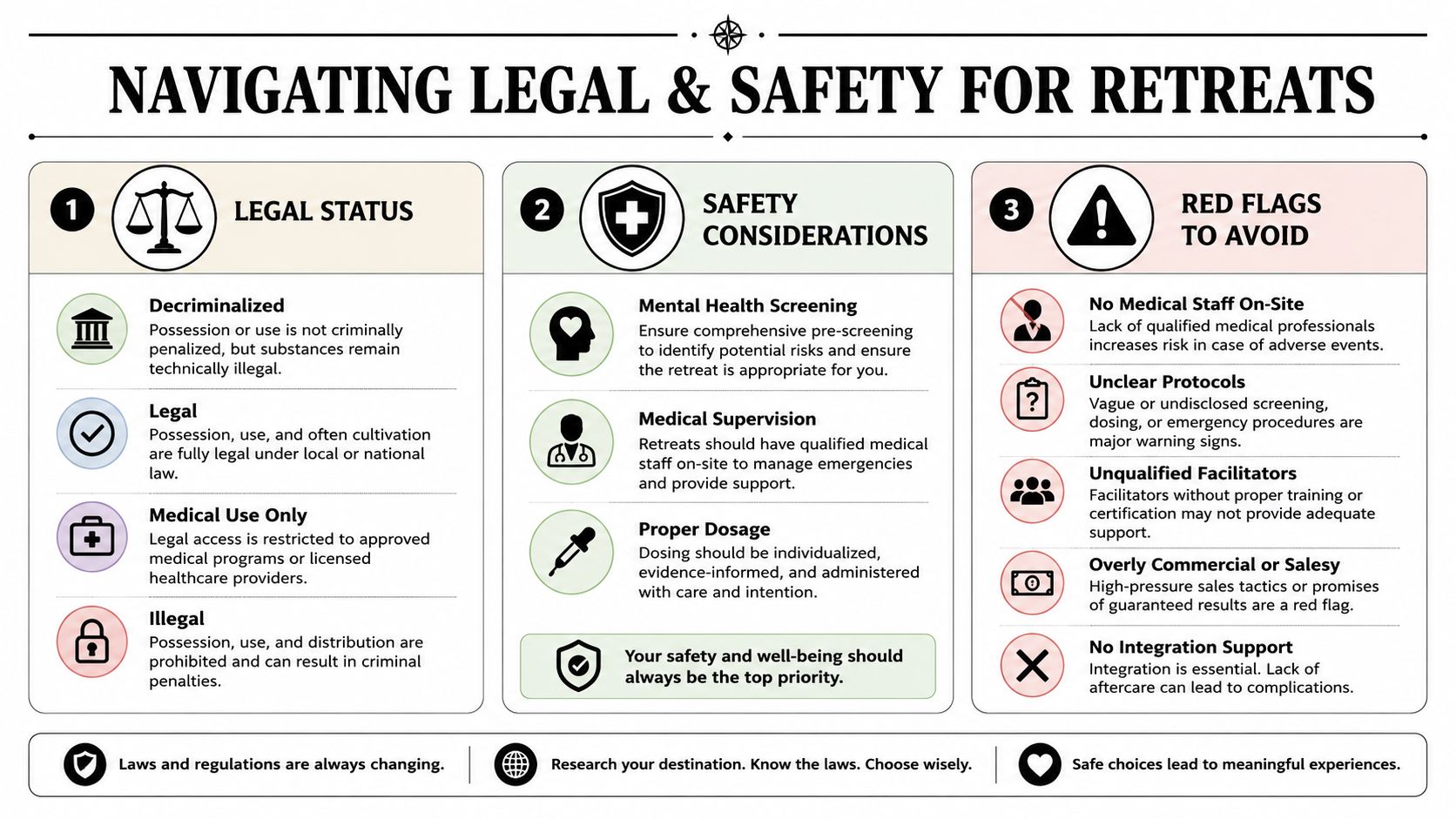
These terms often get blurred together, but they create different levels of consumer protection and different practical risks.
| Legal situation | What it generally means for you |
|---|---|
| Clearly legal or permitted framework | You have a better chance of finding formal operating rules, clearer expectations, and less secrecy around procedures |
| Decriminalized setting | Lower enforcement does not mean providers are licensed, medically supervised, or held to a shared standard |
| Illegal setting | Providers may operate underground or discreetly, and it can be harder to verify training, emergency planning, or accountability |
If you want a concrete example of how these gray areas work at the state level, this guide to magic mushrooms laws in Michigan can help clarify the difference between policy shifts and full legality.
Why medication policies deserve close attention
One published analysis of publicly advertised psychedelic retreat organizations found that many retreats disclosed the substances they offered and many also required or recommended stopping medications such as SSRIs, MAOIs, lithium, or benzodiazepines before attendance.
That should get your attention.
Changing psychiatric or other prescription medication is not a housekeeping detail. It can affect sleep, anxiety, withdrawal, mood stability, and relapse risk. A retreat that treats medication changes like a simple box to check is asking you to accept medical risk without enough protection.
A careful provider should explain what its policy is, why it exists, and why your own prescriber needs to be involved.
What legal status can and cannot tell you
A legal setting does not guarantee high-quality care. An illegal setting does not automatically mean reckless care. But legal status still gives you useful clues about how the operation handles responsibility.
Look for signs that the retreat behaves like a serious care environment, not a loosely assembled event:
- Detailed intake procedures instead of a short form with little follow-up
- Specific emergency pathways instead of broad reassurance that “you'll be supported”
- Named staff roles instead of a vague description of “our team”
- Written policies on medications, exclusions, consent, and participant conduct
- Plain-language answers about local law and operational limits
If a retreat cannot explain its legal footing in one clear paragraph, it has not earned your trust in more sensitive areas.
Red flags that should make you pause
Some warning signs are obvious. Others show up in tone, wording, and what the organizer avoids answering.
- Pressure to book fast. High-pressure sales tactics do not belong in a high-risk service.
- Big promises paired with thin screening. Marketing should never outrun safety planning.
- Medical-sounding claims without limits or exclusions. That can blur the line between wellness marketing and treatment claims.
- Unclear substance plans. You should know what is being offered, in what sequence, and by whom.
- Medication advice that cuts out your prescriber. That is a serious concern.
- Evasive legal language. If the retreat describes its status with mystical phrasing instead of direct facts, be careful.
Use legality as your first filter. Then verify the parts that affect your actual risk: who is responsible, what happens in an emergency, and whether the retreat can explain its own rules without hiding behind atmosphere.
How to Choose a Reputable Retreat
A good retreat should welcome careful questions. If an organizer gets defensive when you ask about screening, staffing, or emergency response, that's useful information. You're not being difficult. You're acting like a responsible adult making a high-stakes decision.
Start with this mindset: you're not auditioning for the retreat. The retreat is auditioning for you.
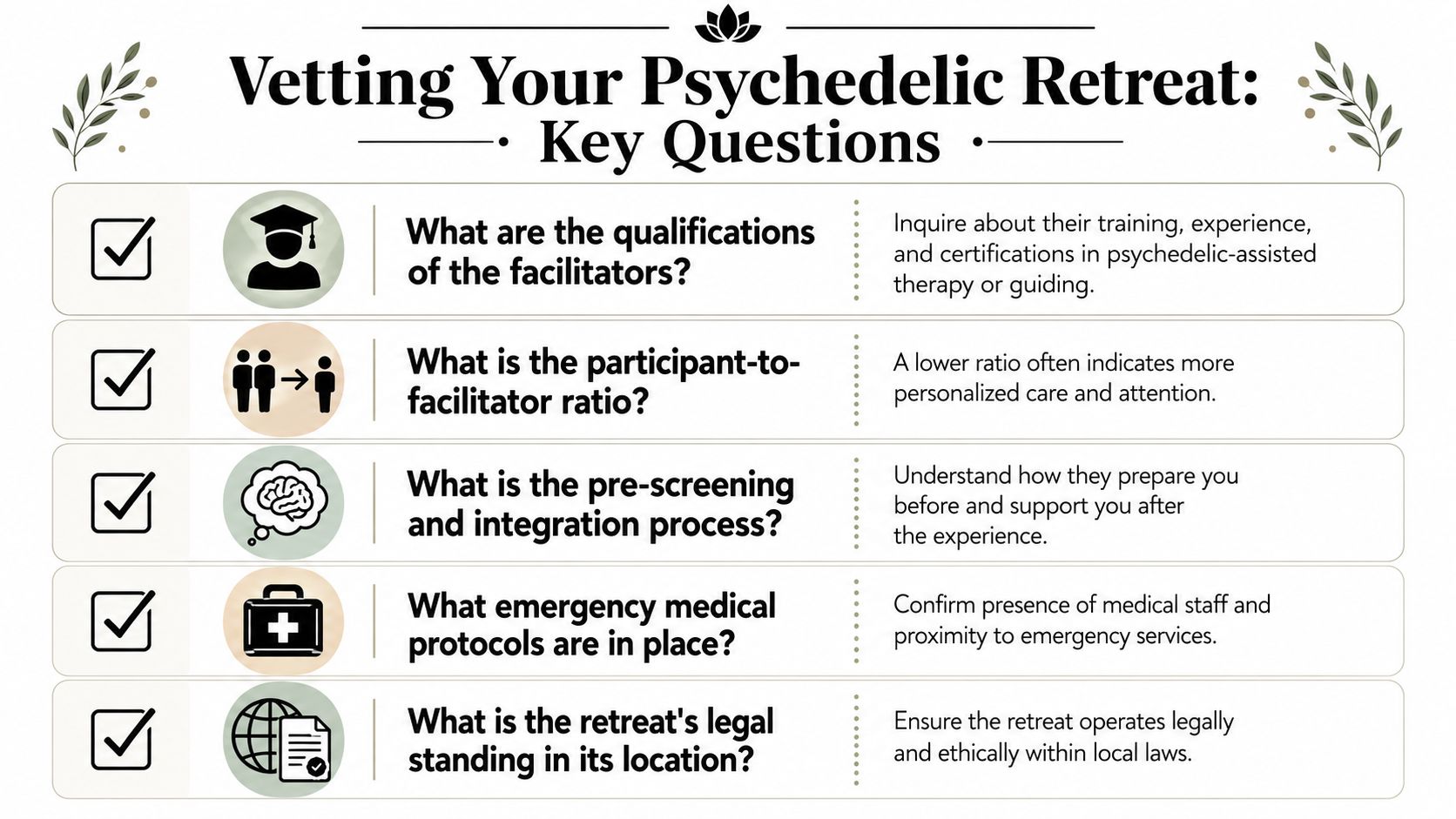
Questions worth asking before you pay
Use live conversation if possible. Email answers can be polished. Real-time answers reveal whether the team understands its own process.
- Who screens participants, and how? Ask whether medical and mental health history are reviewed in depth or collected through a simple form.
- Who is physically present during the session? You want names, roles, and responsibilities, not a vague promise that “support is available.”
- What happens if someone becomes panicked, disoriented, or medically unwell? Ask what staff do first, when outside care is used, and how transport works if needed.
- How do you handle medications and contraindications? If the answer sounds casual, move on.
- What support exists after the session ends? A retreat that treats integration like an optional add-on may be underbuilt where it counts.
Listen for precision, not inspiration
Some retreat websites sound beautiful because they're written like travel copy. That's fine for hospitality. It's not enough for risk management.
Compare these two answers in spirit:
| Weak answer | Stronger answer |
|---|---|
| “Our experienced team holds a safe container for your transformation.” | “You'll complete intake before acceptance, we review medical and mental health history, and we explain emergency procedures before the session.” |
| “We trust the medicine and the process.” | “We screen for contraindications, discuss medication concerns directly, and outline what support is and isn't available.” |
The point isn't to look for sterile language. It's to look for operational competence.
What you want to hear: calm, specific, boring answers. In high-risk environments, boring is often a good sign.
A short explainer may help you frame the right questions before you call:
Cost is a clue, but not proof
Price confuses people. Some assume expensive means safer. Some assume affordable means irresponsible. Neither is automatically true.
One legal guided psilocybin journey in Portland is described as costing $1,500 to $3,000, while access-focused organizations also note funding for people from underserved communities who otherwise couldn't afford treatment, according to Chariot's service information on legal guided psilocybin access.
That tells you two things. First, guided access can be costly even in legal contexts. Second, cost and accessibility are separate issues. A retreat may be expensive because it includes substantial support, or because it includes luxury branding, or both.
A practical vetting checklist
When you compare options, write down answers to these five categories:
Screening quality
Did they ask enough to exclude unsafe candidates, or just enough to protect the sale?Facilitator clarity
Do you know who's guiding, what they do, and what they're trained to handle?Emergency readiness
Is there a real plan for crisis, not just a calming philosophy?Integration support
Do they help you process the experience afterward in a structured way?Transparency about money
Can they explain what your payment covers without hiding behind vague package language?
A reputable retreat should make it easy to understand what you're buying, what risks they screen for, and what support they can provide.
The Three Phases of Your Journey
The safest way to understand a retreat is not as a single event, but as a process with three parts. The evidence-based model is preparation, supervised administration, and integration, and better preparation and follow-up are associated with stronger long-term outcomes and better risk management, as described in this overview of what a psilocybin retreat actually is.
That matters because many people focus only on the ceremony itself. That's like judging surgery by the operating room and ignoring the consult before and recovery after. The support around the intense moment often determines whether the whole experience feels grounded or destabilizing.
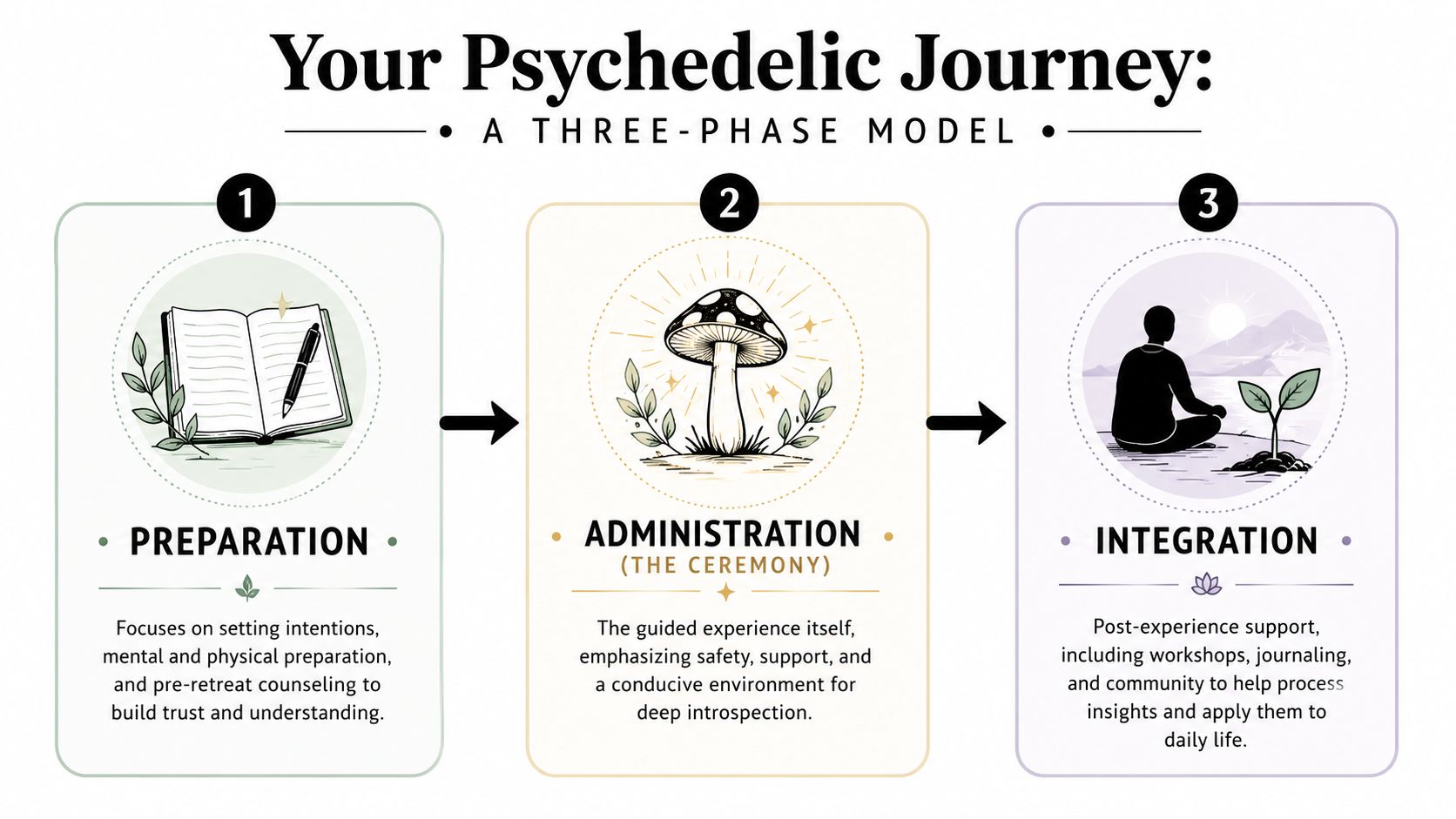
Preparation
Preparation starts before you arrive. A solid retreat uses this phase to learn who you are, what you're bringing emotionally, and whether the setting is appropriate for you.
That can include intake conversations, health history review, orientation calls, practical instructions, and discussion of intentions. “Intention” can sound mystical, but in plain terms it means this: what are you hoping to understand, face, release, or explore?
Preparation also helps lower avoidable stress. If you're uncertain about where you'll sleep, what the day looks like, who will be present, or how support works, that uncertainty can show up during the session itself.
Supervised administration
This is the part often imagined first. You arrive in the session space, meet staff, settle in, and take psilocybin in a monitored setting.
The range of possible experiences is wide. Some people feel emotional release, insight, grief, fear, awe, or confusion. Some move through several of those in one session. That doesn't mean something has gone wrong. But it does mean support has to be real, not symbolic.
A well-run ceremony usually includes a clear setting, known boundaries, and available help if you become overwhelmed. Think of facilitators less like entertainers and more like mountain guides. They can't hike the trail for you, but they should know the terrain, watch for danger, and intervene when needed.
Hard moments during a session aren't always a failure. Unsupported hard moments are the bigger problem.
Integration
Integration is where insight either becomes useful or fades into a dramatic memory.
After a strong psychedelic experience, people often feel open, raw, reflective, or unusually sensitive. Integration gives that state direction. It might involve journaling, group discussion, one-to-one follow-up, rest, practical planning, or support for returning home.
Without integration, a person can leave with big feelings and no method for applying them. That's why “transformation” isn't the best standard to use. A better question is whether the retreat helps you convert an intense experience into stable, everyday action.
What the full arc feels like
Here's the simplest way to picture it:
- Preparation is packing the mental backpack.
- Administration is the hike itself.
- Integration is unpacking what you carried home and deciding what belongs in your daily life.
If a retreat overinvests in the middle and underinvests in the beginning and end, it's out of balance. The ceremony may still feel profound, but the overall care model is weaker than it looks.
Medical Contraindications and Inherent Risks
This is the part many people try to skim. Don't.
A retreat can be well run and still be the wrong choice for you. Psilocybin is not appropriate for everyone, and honesty during screening is not optional. If you hide important medical or psychiatric information because you really want the experience, you increase the chance of turning a hopeful trip into a dangerous one.
Mental health history matters
Use extreme caution if you have, or have had, serious psychiatric instability. The same caution applies if close family history raises concern about vulnerability to psychosis or bipolar-spectrum conditions.
That doesn't mean every emotionally difficult past disqualifies you. It means altered states can intensify symptoms, lower your usual coping control, and make hidden instability harder to manage in a retreat environment.
Ask yourself bluntly:
- Have you had psychosis, mania, or severe dissociation?
- Have you had periods where reality testing felt shaky?
- Are you currently in crisis, barely sleeping, or emotionally ungrounded?
- Are you hoping the retreat will rescue you from an acute situation?
If the answer to any of those feels concerning, pause.
A retreat is not a substitute for stabilization. If your life feels psychologically on fire, don't add fuel because the setting looks peaceful.
Medication issues are not a side note
Many cautious readers land here because they take antidepressants, anti-anxiety medication, mood stabilizers, or other psychiatric medication. That's exactly where careful thinking belongs.
Medication changes should involve the clinician who prescribes them. A retreat organizer may understand the retreat's preferences. Your prescriber understands your treatment history. Those are not interchangeable roles.
If this is your main concern, read more about shrooms and antidepressants before making any decisions.
Physical health still counts
People sometimes talk about psychedelic risk as if it's purely emotional. It isn't. Physical health can matter too.
Be cautious if you have cardiovascular concerns, significant blood pressure issues, seizure-related concerns, or any condition that could become harder to manage during stress, altered perception, or disrupted routines. Also think about sleep, hydration, travel strain, and your ability to recover after an intense experience.
Your personal safety checklist
Before you even browse retreats, answer the following:
- Can I disclose my full medical and psychiatric history without minimizing?
- Would my prescribing clinician support a conversation about this, even if they don't recommend it?
- Am I seeking exploration, or am I desperate for rescue?
- Do I usually handle unfamiliar environments well?
- If the experience becomes difficult, do I have support for the days after?
If you can't answer those clearly, waiting may be the safer move. Delay is often wiser than forcing readiness.
Accessible Alternatives to a Full Retreat
You might be curious about psilocybin, yet a retreat still feels like too much. The price is high. Travel adds stress. Time away from work or family can be hard to justify. If you also have unanswered medical questions, a full retreat can feel less like a thoughtful experiment and more like stacking several risks at once.
For many adults, a smaller first step is the safer one.
A retreat is one format, not the whole category. If a retreat works like enrolling in an intensive course, local and lower-intensity options work more like taking one class before committing to the full program. That slower approach gives you room to learn, pause, and reconsider without the pressure of flights, deposits, and an unfamiliar setting.
Lower-threshold options
Some people begin with education only. They read about screening, set and setting, dosage differences, and legal access in their area before deciding whether any session makes sense. Others speak with a trusted clinician or another qualified professional who can help them sort curiosity from readiness.
Some adults choose a tightly bounded form of self-exploration instead of a destination retreat. The goal is not a dramatic breakthrough. The goal is to understand practical basics such as dose sensitivity, emotional response, environment, and recovery needs.
That kind of slower start can offer a few clear advantages:
- Less logistical pressure because you are not combining travel, scheduling strain, and an altered state all at once.
- More control over pace because you can stop, wait, or gather more information before taking another step.
- A better fit for cautious beginners who want to learn how they respond before committing to something immersive.
Everyday practicality matters
For some readers, microdosing or low-dose formats will feel more realistic than a retreat. Products such as chocolates or drinks may offer a more measured way to consider dose and routine. Caution still applies. Lower dose does not mean no risk, and product format does not replace screening, planning, or aftercare.
Metro Mush is one example of a local consumer option in the Detroit and Ann Arbor area, with dried mushroom strains and edible formats such as chocolate bars and shroom drinks. That is different from a retreat and should be understood on its own terms. The practical value is accessibility, not built-in guidance, medical oversight, or therapeutic support.
That distinction matters. Buying a product is like buying hiking gear. It does not tell you which trail fits your skill level, what weather to avoid, or what to do if conditions change.
A better first question
Instead of asking, “Should I go on a retreat?” ask, “What level of intensity, cost, and uncertainty fits my life right now?”
That question is more useful because it turns a vague desire into a risk check. It helps you compare options based on real constraints, not just hope. In some cases, the right answer is a carefully screened retreat later on. In other cases, the wiser choice is to wait, stay local, or keep learning before spending money on an experience that asks more of you than you can safely give.
The responsible path is the one you can enter with clear expectations, honest health disclosure, and a plan for what happens after the experience ends.