
You’re probably here because “chocolate mushroom cookies” can mean two very different things, and the internet rarely slows down long enough to separate them. One search result shows cute mushroom-shaped holiday cookies. Another shows psychoactive edibles with dosage claims, glossy packaging, and very little explanation.
That gap matters.
For a first-time buyer in Detroit or Ann Arbor, the difference between a themed snack and a psilocybin edible isn’t cosmetic. It changes how you read a label, how you think about timing, and how carefully you choose where a product came from. For experienced users, the same term can still create confusion because cookies, bars, and mushroom-blend products often get grouped together even when their ingredients and effects are completely different.
This guide treats chocolate mushroom cookies as an education topic, not a novelty. The goal is simple. Help you recognize what you’re looking at, understand how infused products are made, and make safer decisions in a market where presentation can look polished even when sourcing is questionable.
An Introduction to Psilocybin Chocolate Cookies
Mushroom-shaped chocolate treats have been around for a long time. Meiji Seika’s Kinoko no Yama, known internationally as Chocorooms, launched in 1975 and grew into one of Japan’s most recognizable snacks, with over 100 million units sold annually by the early 2000s according to the Kinoko no Yama history summary. That matters because it explains why mushroom-and-chocolate as a visual idea already feels familiar to so many people.
The modern edible version uses that same familiar format in a very different way. Instead of a playful cookie shape or a chocolate biscuit snack, the product may contain psilocybin mushrooms or a mushroom-derived infusion intended for psychoactive effects. The outside can still look friendly and approachable. The inside is where the actual difference begins.
Familiar shape, different purpose
A decorative mushroom cookie is just that. It’s a dessert. A psilocybin chocolate cookie is an edible delivery method. Chocolate helps mask earthy flavor, and a cookie format can make a product feel less intimidating than dried mushrooms.
That’s also where new users get tripped up. Edibles often seem gentler than they are because they look like normal sweets.
Practical rule: If a product looks like a snack, don’t assume it behaves like a snack.
Why this topic needs a careful approach
Chocolate mushroom cookies sit at the intersection of comfort and uncertainty. They borrow the language of dessert, but they can produce a full psychedelic experience. In places like Detroit and Ann Arbor, where interest is high and local policy has shifted, people need plain-language guidance more than hype.
A safe approach starts with a few basic questions:
- What kind of product is it really? Decorative cookie, functional mushroom product, or psilocybin edible.
- How was it infused? Whole mushroom powder and extract-based products don’t raise the same consistency questions.
- How is it portioned? A cookie can be one dose, several doses, or impossible to judge without reliable labeling.
- Who made it? In an unregulated space, seller transparency matters as much as the edible itself.
That’s the lens to use for everything that follows.
What Exactly Are Chocolate Mushroom Cookies
The term chocolate mushroom cookies covers two separate categories. If you don’t split them apart, nothing else about dosing or safety makes sense.
Two products that share one name
The first category is non-psychoactive. These are regular cookies that are either shaped like mushrooms or made with mushroom-themed decoration. They may use chocolate in the dough, the coating, or the topping. They’re dessert products, not mind-altering products.
The second category is psychoactive. These cookies are designed to deliver psilocybin through a baked or chocolate-coated format. In some cases, the cookie itself contains finely ground dried mushrooms. In others, the cookie includes a chocolate layer or filling that has been infused.
That difference sounds simple, but it changes how you think about the product. A decorative cookie gets judged by taste and texture. A psilocybin cookie has to be judged by dose consistency, ingredient clarity, and source credibility.
What’s usually inside a psychoactive cookie
Most psychoactive chocolate mushroom cookies have two parts.
The first is the base. That could be a chocolate cookie, a soft-baked cookie, a sandwich-style cookie, or a simple cookie topped with infused chocolate. The cookie helps with texture and portioning.
The second is the active component. Sellers generally present this in one of two ways:
- Ground mushroom material mixed into dough, filling, or chocolate
- A psilocybin infusion or extract incorporated into the chocolate portion for more even distribution
A buyer doesn’t always need to know the full production method, but you should know which general path was used. Whole mushroom material can create a more earthy taste and may distribute unevenly if the product wasn’t mixed carefully. Extract-style infusion can be more uniform, but only if the maker is transparent and consistent.
Why chocolate shows up so often
Chocolate does a lot of practical work in mushroom edibles. It helps cover flavor, makes portioning easier, and gives makers a familiar format that many users already understand from bars and squares.
Cookies add another layer of familiarity. They feel approachable. That can be helpful for adults who dislike chewing dried mushrooms. It can also create false confidence if the buyer assumes “cookie” means mild.
The safest mindset is to treat a psilocybin cookie like any other edible. It needs the same caution you’d give a measured chocolate bar, not the casual attitude you’d give a bakery treat.
A quick reality check for shoppers
If you’re looking at a product listing, slow down and check for these details before anything else:
- Whether the cookie is psychoactive at all
- Whether dosage is listed per cookie or per package
- Whether the maker explains the infusion method
- Whether the product is clearly portioned
- Whether the seller answers basic safety questions directly
If those answers aren’t easy to find, that’s useful information by itself.
A Guide to Infusion Methods and Dosing
Dosing is where most edible mistakes happen. Not because people are reckless, but because edibles are delayed, cookies don’t always look “serious,” and many products make it hard to tell what one portion really means.
Think of psilocybin dosing like adjusting the volume on a stereo. The jump from very low to low can feel modest. The jump from moderate to strong can completely change the experience. With edibles, that volume change also arrives slowly, which makes patience part of dosing.
Two common infusion paths
The method matters because it affects how evenly the active material may spread through the final product.
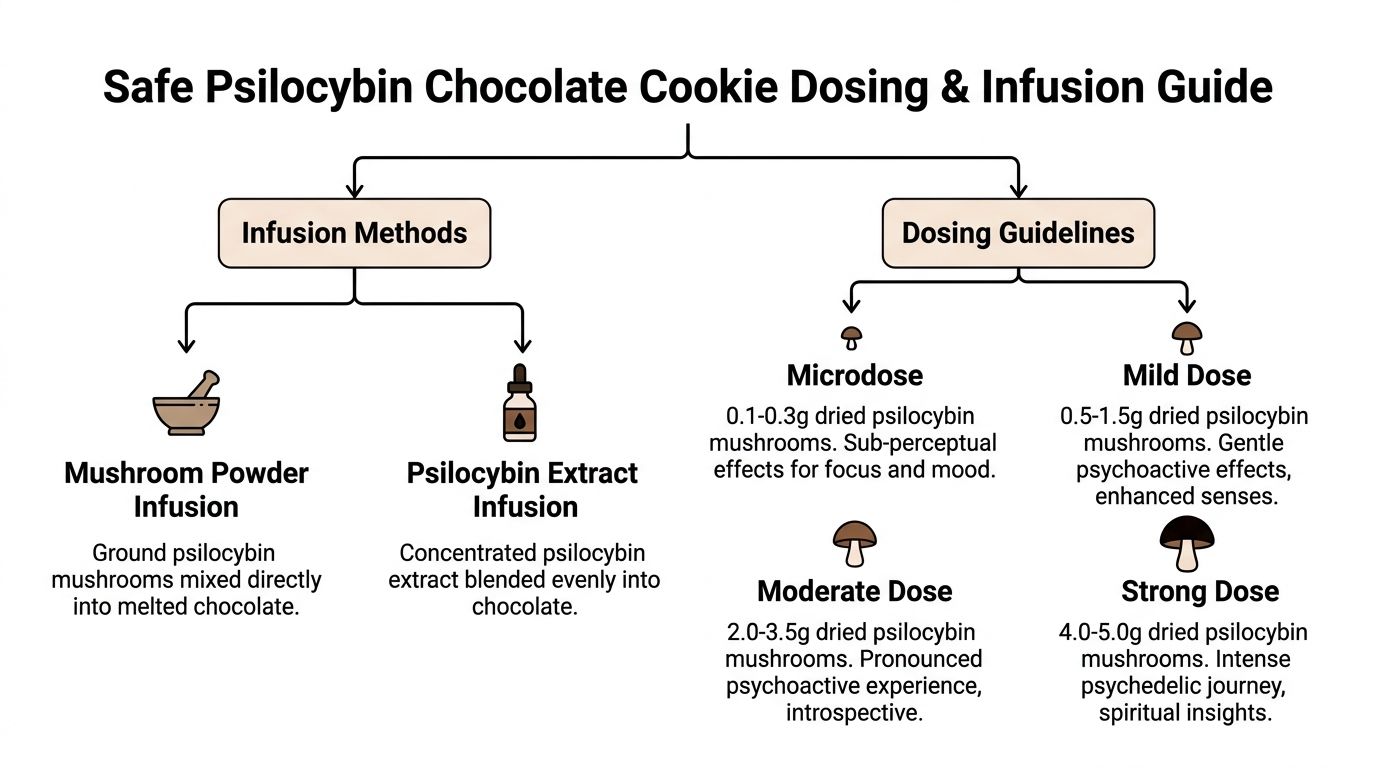
- Mushroom powder infusion uses finely ground dried mushrooms mixed into melted chocolate or the edible itself. This method is straightforward, but consistency depends heavily on mixing and portioning.
- Psilocybin extract infusion uses a concentrated form blended into chocolate. When handled carefully, this can support more even distribution across portions.
If you want a useful example of how edible prep and fat-based infusion logic work in adjacent products, this guide to magical butter gummies with coconut oil shows why uniform mixing matters so much with any infused edible.
Dosing ranges people commonly discuss
The following ranges are commonly used by consumers as a practical frame of reference for dried mushroom equivalents. They’re useful because they help you think in tiers, not just in raw numbers.
| Dose level | Dried mushroom equivalent | What users generally look for |
|---|---|---|
| Microdose | 0.1 to 0.3g | Subtle, often below obvious perception |
| Mild dose | 0.5 to 1.5g | Gentle shift in mood, sensory softness |
| Moderate dose | 2.0 to 3.5g | Clear psychoactive experience, introspection |
| Strong dose | 4.0 to 5.0g | Intense experience that requires preparation |
These ranges are especially helpful when a cookie doesn’t state everything clearly but the seller describes an amount in dried-mushroom terms.
What those levels can feel like
A microdose usually appeals to people who don’t want a full trip. The goal is often subtlety. If a cookie is marketed for this use, portioning has to be precise or the category becomes meaningless.
A mild dose is where many cautious adults start if they want to feel something but stay grounded. This can still be surprisingly noticeable in edible form, especially on an empty stomach.
A moderate dose moves into unmistakably psychedelic territory. People often report stronger emotional depth, altered thinking patterns, and a bigger need for a calm setting.
A strong dose is not a casual add-on to a weekend snack. It calls for intention, a safe environment, and usually previous experience.
Small edible differences matter. Half a cookie isn’t “basically the same” as a whole one if the product is potent.
Questions to ask before you buy
Don’t focus only on the total amount in the package. Focus on how the product is divided.
Ask:
- Is the amount listed per cookie, per half-cookie, or per pack
- Was the product made with powder or extract
- Is the cookie meant to be split
- Does the seller explain how to start low
For first-time edible users, the smartest move is usually to begin below what sounds exciting. You can always take more next time. You can’t untake a cookie that was stronger than expected.
Navigating Your Experience Onset Duration and Safety
Edible psilocybin usually unfolds on a slower timeline than many people expect. That delay is one reason chocolate mushroom cookies can catch users off guard. The product feels familiar, so some people treat it casually, then redose before the first portion has fully arrived.
The usual timeline
With a cookie or chocolate edible, there’s often a waiting period before noticeable effects build. People who are used to faster routes sometimes mistake that quiet beginning for a weak product.
A common pattern looks like this:
- Onset begins gradually rather than all at once
- Peak can feel stronger than expected because the climb was slow
- Duration often lasts long enough to shape the whole evening
- After-effects may include mental fatigue, emotional openness, or lingering sensitivity
Food, metabolism, sleep, stress, and recent meals can all influence the experience. That’s why one person’s “light cookie” can feel very different from another person’s “light cookie,” even before you factor in product quality.
Why waiting is a safety skill
The biggest edible mistake is simple. Taking more too soon.
If the first portion hasn’t fully come on, adding more can stack the experience in a way that feels abrupt later. New users often assume they misjudged the dose. Sometimes the actual issue is timing.
Wait longer than your impatient brain wants to wait.
A calm environment helps too. If you’re testing a new edible, don’t combine it with a busy schedule, social pressure, or a setting where you can’t rest if the experience turns more intense than expected.
What recent safety events tell us
The unregulated mushroom-edible market has shown real quality problems. A 2024 FDA investigation into Diamond Shruumz chocolate bars linked the products to over 100 hospitalizations and found undisclosed substances including acetylpsilocin and muscimol, according to Food Safety Magazine’s summary of the FDA warning. In a separate analysis referenced in the same discussion, 40% of 33 mushroom chocolate products contained no psilocybin at all.
That tells you two important things at once. Some products contain things buyers weren’t told about. Others don’t contain the thing buyers thought they were paying for.
If you want a practical companion to that problem, this article on how to avoid bad trips is useful because mindset, setting, and pacing still matter even when the product itself is legitimate.
A simple filter for safer choices
When evaluating chocolate mushroom cookies, look for evidence of care rather than flashy branding.
Use this checklist:
- Clear ingredient language instead of vague “proprietary blend” wording
- Specific serving guidance rather than a package that leaves all interpretation to the buyer
- Consistent product form so one cookie doesn’t look handmade in a way that suggests uneven distribution
- Seller responsiveness when you ask direct questions about contents and portioning
What to do if a product feels off
Trust your instincts early. If the flavor, effect, or packaging doesn’t match what you were told, stop there. Don’t keep experimenting with the same batch because you “already paid for it.”
If someone experiences severe confusion, intense distress, seizure-like symptoms, chest symptoms, or anything that feels medically urgent, seek professional help right away. The point of caution isn’t fear. It’s preventing a preventable problem from becoming a crisis.
Homemade Cookies vs Store-Bought Edibles
Some people want full control and plan to make their own chocolate mushroom cookies. Others would rather buy a finished edible. Neither choice is automatically right for everyone. The trade-off is between control on one side and consistency on the other.
How the two options differ
The easiest way to compare them is by decision factors that affect the experience.
| Factor | Homemade | Store-Bought (from a trusted source) |
|---|---|---|
| Ingredient control | You choose every ingredient | You rely on the seller’s stated ingredients |
| Effort | Requires prep, measuring, mixing, portioning | Ready to use |
| Dose consistency | Harder to keep uniform without careful process | Often easier if portioned clearly |
| Flavor customization | High | Limited to available product styles |
| Risk of uneven portions | Higher if mixing is inconsistent | Lower when products are pre-portioned |
| Transparency burden | Falls on you | Falls on the seller |
When homemade makes sense
Homemade appeals to people who like baking and want to control ingredients closely. You can choose the cookie style, chocolate type, and portion size. If you’re sensitive to certain flavors or textures, this route can feel more comfortable.
The challenge is consistency. A batch can look uniform without being uniform. If the active material isn’t distributed evenly, one cookie may be much stronger than another.
When store-bought makes sense
Store-bought edibles fit people who care most about convenience, repeatability, and clear portioning. That’s especially useful for first-timers who don’t want the extra variable of home infusion errors.
Public interest in product verification has grown. Following recent safety scares, Google Trends data showed searches for “mushroom chocolate safety” spiked 150% in Midwest states like Michigan and Ohio, as noted in this discussion of mushroom chocolate safety interest. That trend makes sense. People want products that are easier to evaluate before they consume them.
A balanced way to decide
Choose homemade if you’re comfortable with measuring, documenting, and being conservative about portions. Choose store-bought if you value clarity and want the product work done before it reaches you.
Convenience isn’t the opposite of responsibility. For many edible users, buying a clearly portioned product is the more responsible move.
The key isn’t whether you baked it yourself. The key is whether you can answer the basic safety questions with confidence.
Purchasing Safely in Detroit and Ann Arbor
You see a chocolate mushroom cookie on a menu and it looks almost familiar, like the novelty mushroom-shaped snacks sold in gift shops or imported snack aisles. In Detroit and Ann Arbor, that familiar look can hide a very different product category. Some cookies are just themed treats. Others contain psilocybin and need to be treated like psychoactive edibles from the first bite.
That distinction matters even more because local rules can feel easier to understand than they really are. Psilocybin possession and use is decriminalized in Ann Arbor and Detroit, making it the lowest law enforcement priority, but sales remain illegal under Michigan state and federal law, according to Metro Mush’s overview of Ann Arbor magic mushroom laws and access.
For buyers, that creates an unregulated market. Decriminalized does not mean tested, standardized, or state-licensed. A careful shopper should act like a label reader at a farmers market. Ask who made it, what is in it, how it is portioned, and whether the answers stay consistent from one conversation to the next.
What a trustworthy provider should show you
A seller should make the basics plain. If simple questions produce vague replies, missing details, or pressure to buy fast, treat that as a warning.
Look for:
- Clear product names that tell you whether the item is psychoactive or only mushroom-themed
- Serving information that explains dose per cookie or per piece, not just total package strength
- Direct contact details so you can ask follow-up questions before ordering
- Consistent menus and categories instead of blurry claims about blends, extracts, or mystery ingredients
- A visible local presence where adults discuss ordering, product type, and practical expectations
If you want a local reference point, this Detroit and Ann Arbor shroom buying guide shows the kind of location-specific information shoppers often use to compare availability and buying norms.
What to ask before ordering
Good questions do more than gather facts. They show you how organized the seller is.
Ask:
- How much psilocybin is intended per serving
- Is each cookie scored or portioned in a way that makes splitting realistic
- What mushroom ingredient is used, and is it meant to be psychoactive
- What starting portion do you suggest for a first-time edible user
- What do you recommend for someone who tends to be sensitive to edibles
Clear answers matter because chocolate mushroom cookies can blur two very different ideas. One is a fun snack with mushroom branding. The other is an edible that may alter perception, mood, and timing for several hours. Packaging does not tell you which one you have. The seller’s clarity often does.
One local option people may encounter is Metro Mush, which lists product categories, ordering methods, and service details for adult customers in the Detroit and Ann Arbor area. That kind of operational clarity helps you judge risk more effectively than clever branding or trendy design.
For a quick visual overview, this video gives more local context:
The local mindset that helps most
Treat the purchase like a screening process. You are choosing the source as much as the cookie.
That mindset helps first-timers avoid confusion and helps experienced users avoid sloppy assumptions. In Detroit and Ann Arbor, the familiar dessert format can make these products seem more casual than they are. Safe buying starts with recognizing that a mushroom-shaped treat and a psilocybin edible may look similar, while calling for very different levels of caution.
Your Path to Responsible Enjoyment
Chocolate mushroom cookies can look playful, but the right way to approach them is steady and informed. Know what category you’re buying. Pay attention to how the product was infused. Think in servings, not just in package totals.
Respect edible timing. Most trouble starts when people expect fast feedback and redose before the first amount has fully developed. Patience is part of safe use.
Source matters just as much as dose. In a market where some products have shown serious inconsistency, a trustworthy provider, clear answers, and sensible portioning are worth more than clever branding.
The core rule stays simple. Start low and go slow. If you’re new, let caution lead. If you’re experienced, don’t let familiarity make you sloppy. A thoughtful approach doesn’t make the experience smaller. It makes it safer, clearer, and more intentional.
If you’re looking for clear local information on adult psilocybin products in Southeast Michigan, Metro Mush offers menus, ordering details, and location-specific guidance for Detroit and Ann Arbor shoppers.