

You might be reading this after another rough night. Your mind kept running after your body was tired. Maybe you’ve tried prescription medication, thought about it, or decided it isn’t the path you want to start with right now.
That doesn’t mean you’re out of options. It means you need a clearer map.
Natural alternatives to anxiety medication work best when you stop thinking in terms of a single miracle fix and start thinking in layers. Some tools support the body. Some retrain the brain. Some help in the moment. Others change your baseline over time. The safest, most useful approach is usually a combination.
Rethinking Your Approach to Anxiety Relief
Many people get stuck in an all-or-nothing mindset. Either they take medication, or they try to “just relax.” Anxiety rarely responds well to either extreme. A better approach is to build a toolkit.
That toolkit can include sleep changes, movement, steadier eating habits, therapy, breathing work, herbs, supplements, and in some cases newer options that deserve careful discussion. “Natural” doesn’t automatically mean weak, and “medication” doesn’t automatically mean bad. The key question is which tool fits your symptoms, your health history, and your comfort level.
Chamomile is a good example of why evidence matters. Chamomile, one of the most widely used herbal remedies globally, demonstrated effectiveness in 9 out of 10 studies reviewed for reducing anxiety symptoms, including moderate to severe generalized anxiety disorder, with a landmark 2016 clinical trial showing significant reductions in GAD-7 scores after 8 weeks of long-term use, according to GoodRx’s review of over-the-counter anxiety remedies.
That doesn’t mean chamomile will replace therapy or work for everyone. It does mean that some natural approaches deserve to be taken seriously.
Practical rule: Don’t ask, “What’s the best natural remedy?” Ask, “What kind of support does my nervous system need most right now?”
For some people, the answer is better sleep. For others, it’s learning how to interrupt spiraling thoughts. For others, it’s correcting a nutrient deficiency, adding structured therapy, or exploring emerging treatments with professional guidance.
Relief usually starts when anxiety stops feeling mysterious. Once you understand what your body is doing, the options become easier to sort through.
Understanding How Anxiety Works in Your Body
Anxiety isn’t “just in your head.” It’s a full-body state.
When your brain senses danger, your nervous system shifts into fight, flight, or freeze mode. That response is useful when something is wrong. It gets you ready to act. Your heart beats faster, your muscles tighten, your breathing changes, and your attention narrows.
The problem starts when that alarm system becomes too sensitive.

Your smoke detector may be too sensitive
A simple way to understand anxiety is to picture a smoke detector that goes off every time you make toast. The detector isn’t broken because it makes noise. It’s broken because it reacts too strongly to signals that aren’t true emergencies.
That’s what many anxious systems do. They treat uncertainty, conflict, bodily sensations, deadlines, or social situations like smoke.
You then feel symptoms that seem to come out of nowhere:
- Racing heart because your body is preparing for action
- Tight chest because your muscles and breathing patterns change
- Upset stomach because digestion slows when your body prioritizes survival
- Shaky thoughts because your attention locks onto threat
- Trouble sleeping because your system doesn’t fully power down
These symptoms can be frightening, especially when there isn’t an obvious reason for them. That often creates a second layer of anxiety. You become anxious about feeling anxious.
The chemistry is complicated, but the pattern is simple
You don’t need a neuroscience degree to understand the basic loop. Anxiety tends to involve an activated stress response and not enough braking power from the systems that help the brain settle.
One of those calming systems involves GABA, a neurotransmitter often described as the brain’s “slow down” signal. When GABA-related calming is low or stress signaling is high, the nervous system can stay revved up longer than it needs to.
That’s why many natural alternatives to anxiety medication focus on one of three jobs:
- Lowering overall stress load on the body
- Improving regulation of the nervous system
- Changing the meaning your brain assigns to a trigger
Anxiety often feels psychological first, but many people get relief when they treat it as a regulation problem instead of a character flaw.
Why you can feel unsafe when you are safe
Anxiety can be confusing because the body reacts faster than conscious thought. You may notice a pounding heart before you’ve even named the worry. Then your brain tries to explain the sensation after the fact.
This is one reason people misread normal body cues. A stress response becomes “something is wrong with me.” A flutter in the chest becomes “I’m losing control.” A bad night of sleep becomes “I’m going backwards.”
That interpretation matters. If your brain labels a sensation as dangerous, it sends the body more danger signals. The cycle strengthens itself.
What natural tools are actually trying to do
Natural approaches don’t “erase” anxiety in a simplistic way. They target specific parts of the loop.
- Sleep support helps the brain recover and lowers reactivity
- Exercise gives stress chemistry somewhere to go
- Mindfulness helps you notice thoughts without obeying them
- Therapy teaches the brain to stop treating every internal alarm as a fact
- Supplements and herbs may support calming pathways or correct imbalances
- Psilocybin-assisted approaches, where legal and appropriate, are being discussed because they may disrupt rigid patterns in a different way than daily symptom management tools
Once you understand anxiety as a nervous system process, your next step gets clearer. You don’t need to do everything. You need to calm the alarm, strengthen the brakes, and reduce false alerts.
Building a Foundation with Lifestyle Changes
The most overlooked anxiety treatments are often the least glamorous. They don’t come in a bottle, and they don’t promise overnight transformation. Still, they shape the baseline your nervous system has to work with every day.
Start with habits that change your body’s stress load before you chase more advanced options.

Sleep is not a luxury
An anxious brain that’s sleep-deprived becomes easier to trigger. Small problems feel bigger. Physical sensations feel louder. You have less patience for uncertainty, and less ability to challenge a catastrophic thought before it takes over.
A lot of people try to solve daytime anxiety while protecting nighttime habits that keep their nervous system activated. Late scrolling, irregular bedtimes, heavy evening alcohol use, and working in bed all teach the brain that night is still “on” time.
A practical sleep reset often looks like this:
- Choose a repeatable wind-down. Read, stretch, shower, or listen to something calm in the same order each night.
- Dim stimulation before bed. Bright lights, news, arguments, and doomscrolling all tell the brain to stay alert.
- Use the bed for sleep and intimacy. If you do everything there, your brain stops associating it with rest.
- Keep wake time steady. The morning cue often matters more than a perfect bedtime.
- Watch your stimulants. If caffeine or late-day energizers make you jittery, your body may still be carrying that activation at bedtime.
Some people also find sensory supports useful, especially when anxiety feels physical. If you want more practical ideas for calming the body, this guide to natural remedies for stress relief offers additional options that pair well with the basics.
Movement gives stress somewhere to go
Anxiety creates physical readiness. If that energy never gets discharged, it can feel trapped.
Exercise doesn’t need to be intense to help. The goal isn’t athletic performance. The goal is giving your system a clear signal that the stress cycle can complete.
Different kinds of movement help in different ways:
- Walking helps when your thoughts are looping and you need rhythm
- Strength training helps when anxiety feels restless or agitated
- Yoga or mobility work helps when your body feels braced and tight
- Dancing, biking, or swimming help if structured workouts make you resist starting
If your anxiety spikes during exercise, that’s also useful information. Some people are sensitive to increased heart rate and interpret it as danger. Gentler forms of movement can help rebuild trust with bodily sensations.
Here’s a simple visual refresher on the basics of calming routines and healthy daily structure:
Food affects mood more than people think
Diet advice around anxiety often gets messy fast. You don’t need a perfect diet. You do need to notice whether your eating pattern is helping your nervous system stay steady or making it more reactive.
Three patterns matter most.
Blood sugar swings
If you go long periods without eating, then load up on quick carbs, your energy can rise and crash fast. For some people, that crash feels a lot like anxiety. Irritability, shakiness, fogginess, and sudden urgency can all follow.
A steadier pattern helps. Try combining protein, fiber, and regular meals so your body isn’t constantly catching up.
Gut stress
A distressed gut and a distressed mind often travel together. If anxiety worsens when your digestion is off, pay attention. That doesn’t mean every anxious symptom starts in the gut, but it does mean digestive comfort can be part of emotional regulation.
Gentle meals, enough fluids, and fewer foods that leave you feeling inflamed or overstimulated can make a real difference.
Stimulants and coping habits
Caffeine can be useful for some people and awful for others. The same goes for alcohol, which may seem calming at first but often disrupts sleep and leaves the nervous system less stable later.
If a substance helps for one hour and makes you more anxious the next day, it isn’t really helping anxiety. It’s borrowing calm from later.
Build the floor before you build the ceiling
Lifestyle changes don’t sound exciting because they’re familiar. But familiar isn’t the same as optional. If your sleep is fractured, your movement is minimal, and your food pattern is chaotic, even the best supplement or therapy plan has to work uphill.
You don’t need a total life overhaul. Pick one habit that lowers friction. Make it repeatable. Then add the next.
Training Your Brain with Therapy and Mindfulness
Some anxiety tools calm the body first. Others work by changing your relationship to your thoughts. Therapy and mindfulness belong in that second group, though they often help the body settle too.
A lot of anxious suffering comes from fusion. You have a thought, and your mind treats it as a command, a prediction, or a fact. “What if I embarrass myself?” becomes “I probably will.” “My chest feels tight” becomes “Something bad is happening.” Therapy helps loosen that grip.
CBT helps you challenge the story
Cognitive Behavioral Therapy, or CBT, is practical. It looks at the connection between thoughts, feelings, and behaviors. The key insight is simple. Your interpretation of a situation often shapes your anxiety more than the situation itself.
If you get a short email from your boss, your brain might fill in the blanks fast. “I’m in trouble.” “I messed something up.” “This is going to be bad.” CBT teaches you to slow that process down and ask better questions:
- What’s the evidence for this thought?
- What am I assuming?
- Is there another explanation?
- If the feared outcome happened, how would I cope?
This doesn’t mean forcing fake positivity. It means becoming more accurate.
ACT teaches you not to wrestle every thought
Acceptance and Commitment Therapy, or ACT, takes a slightly different route. Instead of arguing with every anxious thought, it helps you stop getting entangled in them.
The goal isn’t to make the mind silent. The goal is to notice, “I’m having the thought that I’m not safe,” rather than “I am not safe.”
That small shift creates room. You can still feel discomfort and choose a grounded action anyway. That matters because anxiety often shrinks life through avoidance. ACT works to reverse that pattern by helping you act from values instead of fear.
Helpful reframe: The mind produces thoughts. Your job isn’t to obey all of them.
Mindfulness is mental strength training
Mindfulness gets oversimplified as “clear your mind,” which makes many anxious people feel like they’re failing. A better definition is paying attention on purpose, without immediately trying to fix, flee, or suppress what you notice.
That can look like meditation, but it can also look like washing dishes while feeling the warm water, noticing your breath in line at the store, or catching the first signs of tension in your shoulders before your whole day spirals.
A few accessible practices help many people:
- Labeling. Name what’s happening. “Worrying.” “Planning.” “Tight chest.” “Fear.”
- Grounding through senses. Notice what you can see, hear, and physically feel around you.
- Urge surfing. Let an anxious wave rise and fall without feeding it with more analysis.
- Timed stillness. Sit for a few minutes and practice returning your attention when it wanders
These aren’t tricks to erase anxiety instantly. They train a different reflex. Instead of immediate reactivity, you build observation first.
Breathwork gives your brain a faster route to calm
Breath is one of the few body functions that is both automatic and voluntary. That makes it useful. When anxiety speeds breathing up, your brain reads that as more evidence of danger. Slower, steadier breathing sends a different message.
Try this in plain language:
- Sit or stand in a comfortable position.
- Inhale gently through your nose.
- Exhale a little longer than you inhaled.
- Repeat for a few minutes without forcing deep breaths.
The point isn’t performance. Over-breathing can make some people feel worse. Think soft, slow, and steady.
Therapy and mindfulness work best together
People sometimes frame therapy as the “serious” option and mindfulness as the lightweight one. In practice, they support each other well.
Therapy gives you language, structure, and feedback. Mindfulness gives you repetition in daily life. One helps you understand the pattern. The other helps you catch it in real time.
If anxiety keeps returning despite your best efforts, that doesn’t mean you’re doing something wrong. It may mean you need a more guided form of brain training, not more self-criticism.
Exploring Evidence-Based Supplements and Herbs
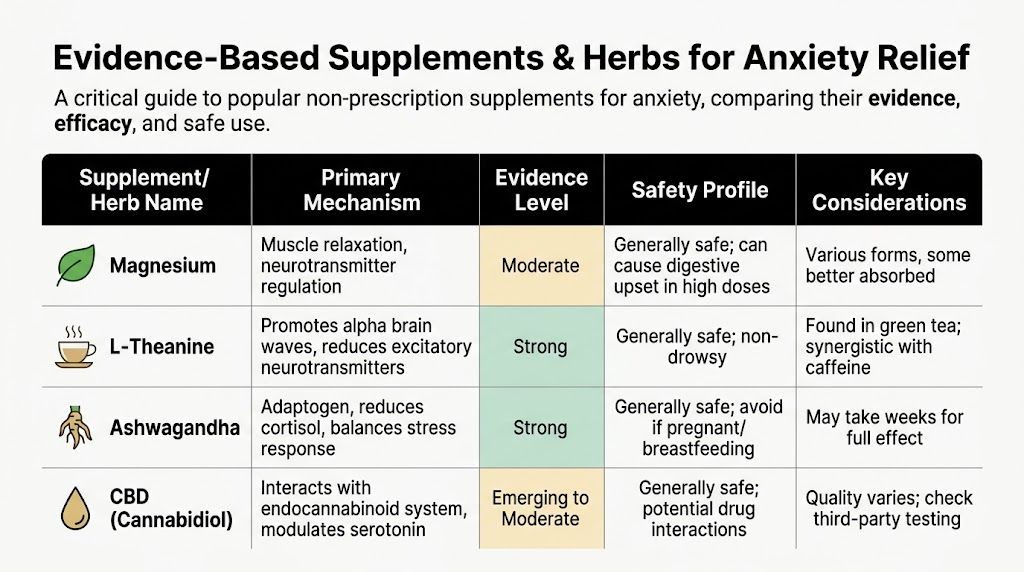
Supplements can be useful, but many people often make expensive or risky choices regarding them. Packaging looks trustworthy. Marketing sounds scientific. Labels promise calm, focus, balance, and mood support all at once.
A better way to shop is to ask four questions. What’s the proposed mechanism? How strong is the evidence? What’s it best suited for? What are the main cautions?
Magnesium and chamomile deserve attention
One of the strongest practical starting points is magnesium, especially if your baseline is tension, poor sleep, or general nervous system irritability. More than 50% of the global population is deficient in magnesium, a mineral essential for over 600 bodily reactions, including neurotransmitter function that directly influences anxiety. A 2017 review in Nutrients found magnesium supplementation reduced anxiety scores by up to 20% in deficient individuals across randomized trials, according to this review of holistic alternatives to anxiety medication.
That’s important because magnesium isn’t just a trendy calming supplement. It’s involved in the body’s ability to regulate stress and support relaxation. If someone is low in it, correcting that deficiency can be more foundational than chasing exotic formulas.
Chamomile also belongs near the top of the conversation. It’s often dismissed because it comes as a tea, but gentle delivery doesn’t mean weak action. As noted earlier, the clinical picture for chamomile is stronger than many people assume.
Comparing natural supplements for anxiety
| Supplement | Evidence Level | Best For | Key Cautions |
|---|---|---|---|
| Magnesium | Moderate | Tension, poor sleep, possible deficiency, general nervous system support | Can cause digestive upset, especially in some forms or higher amounts |
| Chamomile | Moderate | Mild to moderate anxiety, evening calming routines, people who prefer tea or gentle herbal options | Avoid or use caution if you have plant allergies or medication concerns |
| L-theanine | Emerging to moderate | Daytime calm, anxious focus, people who want a non-sedating option | Quality varies by brand, and individual response differs |
| Valerian root | Emerging | Sleep-related anxiety, nighttime restlessness | May feel too sedating for some people, and product quality differs |
| CBD | Emerging to moderate | People exploring cannabis-adjacent options for calm | Potential medication interactions, inconsistent product quality, dose confusion is common |
| Ashwagandha | Emerging to moderate | Stress-heavy patterns, people interested in adaptogens | Not appropriate for everyone, and it’s best discussed with a clinician if you have medical conditions |
If sleep support is part of your bigger anxiety picture, this article on whether mushrooms help you sleep may also be useful background when thinking about nighttime routines and recovery.
How these options may work
Not every supplement does the same job.
Magnesium
Magnesium appears to support relaxation partly through nervous system regulation. Many people use it when anxiety feels muscular, wired, or physically restless. It often makes the most sense when there are signs that basic nutritional support may be missing.
Chamomile
Chamomile is thought to act through calming pathways related to GABA activity. In everyday terms, it may support the “ease off the gas” side of the nervous system. Tea can be a ritual as much as a supplement, which can help some people create a predictable cue for winding down.
L-theanine
L-theanine is popular because people often describe it as calming without making them feel dulled. Many reach for it when they want less mental static but still need to function during the day.
Valerian root
Valerian is usually considered more of a nighttime option. If your anxiety blends into insomnia, it may be more relevant than if your main issue is daytime rumination.
CBD
CBD gets a lot of attention, but the category is messy. Some products are carefully made and third-party tested. Others are inconsistent. It also isn’t risk-free just because it’s widely sold. Drug interactions and mislabeled products are real concerns.
Ashwagandha
Ashwagandha is often grouped with “adaptogens,” a term people use for herbs thought to support stress resilience. Some people like it for a feeling of longer-range support rather than acute calming.
Safety matters more than hype
An evidence-based approach is vital here. Supplements can still interact with prescriptions, affect medical conditions, or create side effects that aren’t obvious from the front of the label.
Use a few basic rules:
- Start one thing at a time so you can determine what it does
- Buy from reputable brands that share testing information
- Keep a simple symptom log with sleep, tension, mood, and side effects
- Don’t combine multiple sedating products casually
- Ask a pharmacist or clinician if you take other medications
Natural products can be helpful. They can also be poorly made, badly matched, or used for the wrong problem.
If you’re choosing where to begin, magnesium and chamomile are often more sensible first experiments than a giant “stress blend” with a dozen ingredients. Simpler makes it easier to notice cause and effect.
The New Frontier of Psilocybin in Southeast Michigan
Psilocybin gets talked about in two very different ways. One is breathless and oversimplified. The other is fearful and dismissive. Neither is very helpful if you want to make informed decisions.
The more grounded view is that psilocybin is an emerging option. It’s not a casual wellness accessory, and it’s not a magic cure. It’s a powerful psychoactive substance with growing interest around mood, perspective shifts, and rigid mental patterns.

Why people are interested in psilocybin
Part of the modern discussion centers on how psilocybin may affect entrenched mental loops. Anxiety often isn’t just “too much fear.” It can also involve repetitive narratives, rigid self-protection, and an inability to see beyond familiar thought grooves.
Researchers and clinicians discussing psychedelic-assisted approaches often focus on changes in perspective, emotional processing, and psychological flexibility. In plain language, some people report that familiar fears loosen their grip long enough for a new pattern to become possible.
That’s different from the role of a nightly tea or a magnesium supplement. Psilocybin is not usually discussed as a daily maintenance tool. It’s more often framed as a profound experience that may shift how a person relates to themselves, their past, or their anxiety.
Decriminalized does not mean fully legal
For readers in Southeast Michigan, clarity matters most.
In Detroit and Ann Arbor, local policy changes have made enforcement around certain entheogenic plants and fungi a very low priority. People often describe that as decriminalization. But decriminalized is not the same thing as broadly legal, and it does not automatically create a conventional retail or medical framework.
That distinction matters because people may assume local tolerance means every form of access, sale, or public use is fully settled and risk-free. It isn’t. Laws, enforcement priorities, and practical realities are not identical things.
If you’re trying to understand the local situation better, this guide to magic mushrooms in Michigan gives more location-specific context for Detroit and Ann Arbor readers.
Set and setting are not clichés
People new to psychedelic conversations sometimes hear “set and setting” and tune it out. That’s a mistake.
Set means your internal state. Your expectations, fears, current stress level, and mental health history all matter. Setting means the environment. Who you’re with, where you are, how safe you feel, and whether you have support all affect how an experience unfolds.
This is especially important for anxiety. A person who is already highly activated, sleep-deprived, overwhelmed, or using psilocybin in a chaotic environment may not get the insight they hoped for. They may get a more intense encounter with the feelings they were trying to escape.
A more responsible lens includes:
- Clear intention rather than impulsive use
- A stable environment with low stress and trusted company
- Attention to mental health history, including any conditions that may raise risk
- Integration afterward, meaning time to process what came up instead of chasing the next intense experience
Psilocybin is not best treated as an escape hatch. If it has value, that value usually comes from preparation, context, and integration.
Therapeutic interest is not the same as self-treatment
Another point that often gets blurred is the difference between therapeutic discussion and unsupervised self-experimentation. Clinical interest in psychedelics generally assumes screening, preparation, support, and follow-up. Real life often doesn’t.
If someone is considering psilocybin because they feel desperate, destabilized, or unable to function, that’s not a sign to go it alone. That’s a sign to bring in qualified help.
For some adults in Detroit and Ann Arbor, psilocybin may feel like part of a wider wellness conversation. That’s understandable. But it deserves the most caution of any option in this article, not the least.
Creating Your Personal Plan and When to Seek Help
If all of this feels like a lot, simplify it. You do not need to test every natural alternative to anxiety medication. You need a sequence.
Start with the question, “What’s most obviously straining my system right now?” If the answer is bad sleep, irregular meals, no movement, or constant overstimulation, begin there. Those aren’t side issues. They shape how well every other intervention works.
A sensible order of operations
For many people, this is a steady path:
- Stabilize the basics with sleep, movement, and more consistent meals.
- Add regulation tools like breathwork, mindfulness, or grounding.
- Bring in therapy if your thoughts spiral fast, avoidance is growing, or past stress keeps getting triggered.
- Consider targeted supplements or herbs if they match your symptoms and health profile.
- Approach higher-intensity options carefully and only with a realistic understanding of legal, medical, and psychological risk.
You don’t need perfect certainty before starting. You do need patience. Anxious people often abandon a good plan because it didn’t produce instant relief. But many useful changes are subtle at first. Better sleep by itself may not feel dramatic on day two. It may feel life-changing after consistent weeks.
When professional help is not optional
There are times when self-directed wellness support isn’t enough.
Please talk with a qualified healthcare professional if:
- You want to stop or reduce prescribed medication
- Your anxiety is getting worse instead of better
- You’re having panic, severe insomnia, or major disruption at work or home
- You’re using alcohol, cannabis, or other substances to get through the day
- You’re considering potent substances, including psilocybin, and you have a complex mental or physical health history
- You feel hopeless, unsafe, or unable to cope
This is not a failure. It’s good judgment.
The strongest plan is usually collaborative. Your own observations matter, and professional guidance helps you use them safely.
Natural approaches can absolutely be part of meaningful anxiety care. For some people, they’re enough. For others, they work best alongside therapy, medication, or both. The goal isn’t to prove anything. The goal is to help you feel steadier, safer, and more able to live your life.
If you’re in Southeast Michigan and want to learn more about locally relevant mushroom education, products, and updates, take a look at Metro Mush. Adult readers in the Detroit and Ann Arbor areas can explore the site for practical information, product menus, and current community offerings.