
Calling 1.5 grams of mushrooms a reliably mild or moderate dose skips the most important question: how much psilocybin does that material contain? A scale measures mushroom weight, not active drug. Without a chemically measured concentration, a precise-looking gram value can create more confidence than the evidence supports.
For adults considering psilocybin, including readers in Detroit and Ann Arbor, the useful distinction isn't between smaller and larger servings alone. It's between measured mass and measured potency. Those aren't interchangeable, and understanding the difference changes how you read product labels, compare experiences, and assess risk.
How Much Psilocybin Is in 1.5 Grams
Arithmetic using reported concentrations puts the psilocybin content of a dried portion this size anywhere from about 0.3 mg to about 26.7 mg across the examples below. That's a comparison of selected measurements, not a complete biological range, a prediction for a product, or a dosing guide.
The Oregon Psilocybin Advisory Board evidence-review material provides context for substantial potency variation, with the accompanying sample findings including Psilocybe cubensis concentrations of 0.208 to 5.344 mg/g. A scientific survey of psychotropic mushrooms reports 15.543 mg/g in a Psilocybe serbica variety and discusses published measurements reaching approximately 17.8 mg/g in Psilocybe azurescens.
Estimated psilocybin in 1.5 grams at measured potency levels
Each estimate below multiplies the reported concentration by the portion's dried weight.
| Potency scenario | Psilocybin per gram | Estimated psilocybin in 1.5 g |
|---|---|---|
| Lowest measured Psilocybe cubensis sample in the cited sample set | 0.208 mg/g | About 0.3 mg |
| Highest measured Psilocybe cubensis sample in the cited sample set | 5.344 mg/g | About 8.0 mg |
| Psilocybe serbica variety | 15.543 mg/g | About 23.3 mg |
| Psilocybe azurescens | About 17.8 mg/g | About 26.7 mg |
The calculation is concentration × dried mass = estimated compound content. Grams cancel against the grams in milligrams per gram, leaving milligrams of psilocybin. Rounding makes the result readable; it doesn't make the underlying sample representative of an entire species.
The first rows describe particular examined samples, not the weakest and strongest cubensis mushrooms that could exist. Likewise, the other species' measurements aren't instructions for substituting one mushroom for another.
Interpretation matters: A correctly calculated estimate can still be irrelevant to an untested product.
These estimates count psilocybin only. They don't include separately present psilocin or other compounds such as baeocystin, and those compounds shouldn't be added together and described as an equivalent amount of psilocybin.
The useful conclusion isn't that a portion will fall neatly somewhere inside this table. It's that mushroom weight alone doesn't identify which concentration belongs in the calculation. You can know the mass accurately while remaining uncertain about the drug content.
Why Weight Alone Cannot Set a Dose
Species is only the beginning of the variability. Within a species, strain differences, individual fruiting bodies, cultivation conditions, drying, storage, and the material selected for processing can all affect the concentration a laboratory measures.
Even a familiar strain name doesn't identify the chemical composition of the particular material in front of you. A whole mushroom, a powder made from selected tissue, and a blended edible also present different sampling questions.
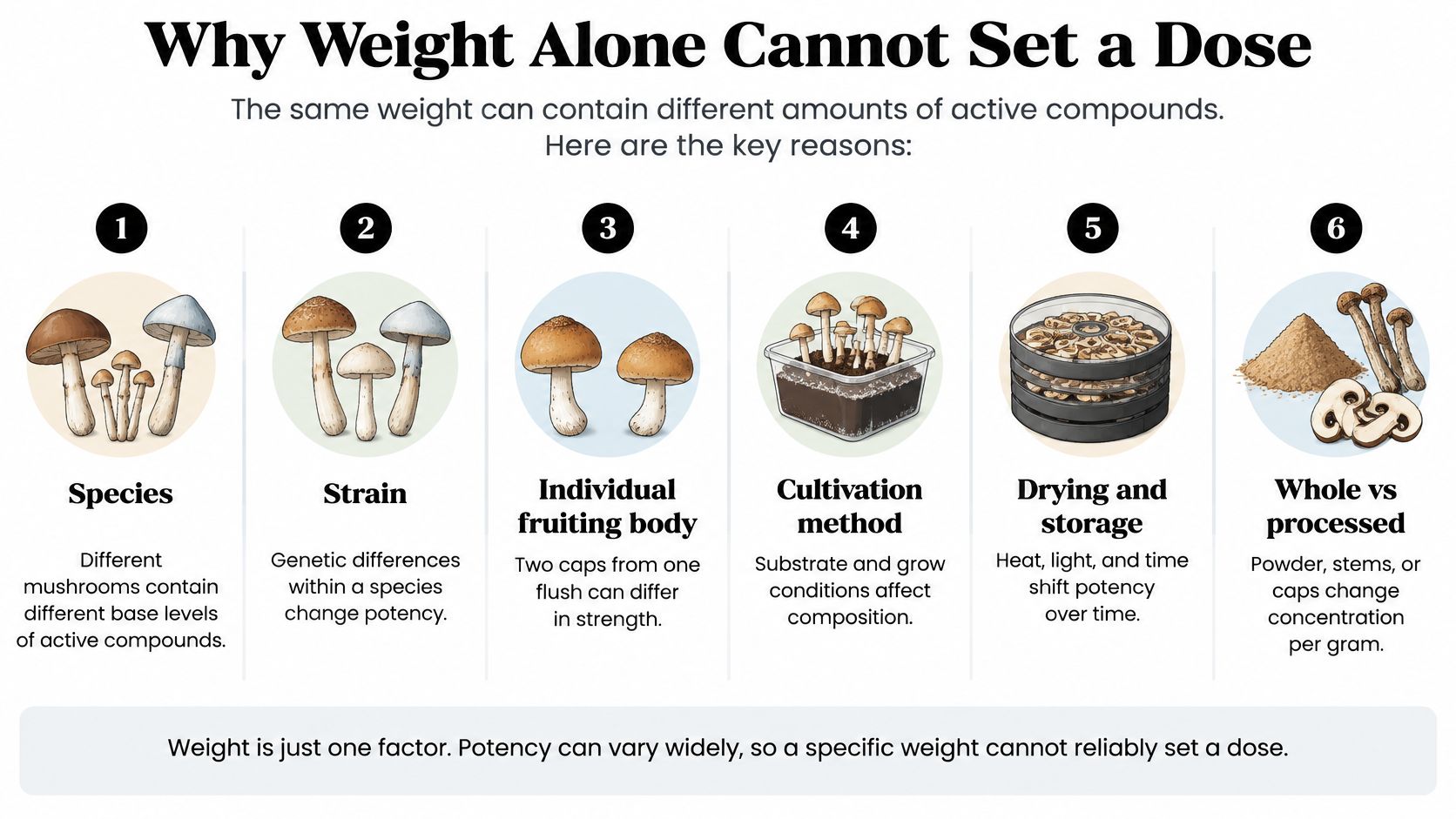
In controlled cultivation research on Psilocybe cubensis, total tryptamine concentrations ranged from 2.62 to 20.65 mg/g, a greater than 7.8-fold difference, while reported within-strain psilocybin coefficients of variation were approximately 12.81% to 23.39%. Multiplying those concentration endpoints by the portion weight gives approximately 3.9 to 31.0 mg of total tryptamines.
Total tryptamines isn't another name for psilocybin. It describes a combined analytical measure, so that range can't be compared directly with a psilocybin-only table or treated as a clinical-equivalent dose. A coefficient of variation also describes statistical dispersion relative to the mean, not a guaranteed percentage difference between any pair of mushrooms.
What a weight label tells you versus lab-tested potency
| Factor | Weight label alone | Lab-tested potency |
|---|---|---|
| What it measures | Dried mass in grams | Psilocybin and psilocin in mg per gram |
| Predicts exact dose | No | Closer, but still batch-specific |
| Comparable between batches | Rarely | Yes, when batches are homogenized and tested |
| Supports a dosing decision | No | Only with validated batch results |
Homogenization means thoroughly mixing material so that a tested sample is more representative of the batch. It doesn't remove the need for sound sampling, a suitable analytical method, or a clear connection between the report and the finished product.
When using our guide to mushroom dosing, distinguish general educational categories from an actual chemical measurement. A category name isn't a substitute for a laboratory report.
Look for psilocybin and psilocin reported separately, a matching batch identifier, and documentation of representative sampling or homogenization. Together, these make a potency figure interpretable. A report for an unrelated batch, or a single combined number with no explanation, doesn't answer the same question.
What Happens in the Hours After Taking 1.5 Grams
Consider someone who takes an untested portion and initially notices little. They may interpret the delay as evidence that the material is weak. That conclusion confuses the stage of absorption with the eventual exposure.
Oral psilocybin is rapidly converted to psilocin, and clinical pharmacokinetic research describes peak concentrations generally occurring between approximately 1.8 and 4 hours, with an approximate psilocin elimination half-life of 3 hours and considerable individual variation. Within clinically studied ranges, subjective intensity and duration increase approximately with dose, but mushroom grams don't reveal that dose.
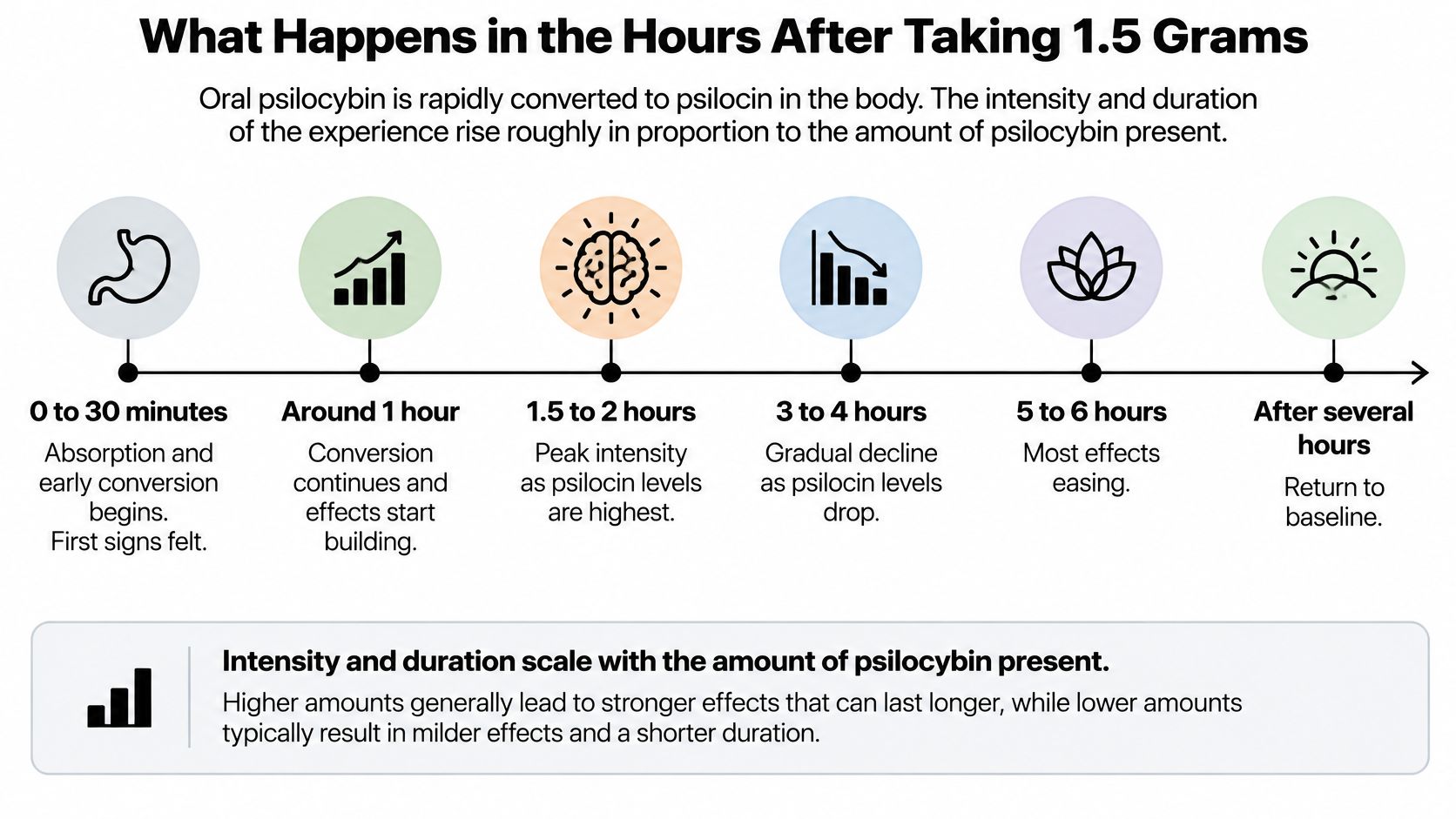
Treat illustrated timelines as schematics, not personal schedules. A blood-concentration peak isn't a guaranteed clock time for the strongest subjective effects.
Timeline after taking dried mushrooms orally
The following stages apply the absorption and elimination measurements above. The final row is a conservative monitoring checkpoint, not a measured promise of recovery.
| Time after oral intake | Typical stage | Safety action |
|---|---|---|
| 0 to 1.8 hours | Absorption under way; effects aren't yet predictable | Take nothing more |
| 1.8 to 4 hours | Typical concentration-peak window; effects may be strongest | Stay put, add nothing, keep a sober companion nearby |
| About 3 hours after peak | During elimination, concentration may fall by about half, with individual variation | Keep avoiding extra material; don't assume you're back to baseline |
| Beyond 6 hours | Residual effects remain possible; recovery isn't established by the clock | Don't drive; rest and monitor |
If someone adds material before absorption has run its course, the later exposure can include both the original portion and the addition. They haven't corrected a known shortfall. They've increased an exposure that wasn't yet fully apparent.
A half-life also doesn't mean complete clearance or the end of impairment. Our explanation of how long psilocybin lasts should be read with that distinction in mind.
Don't add material during early absorption. Reaching the end of an estimated window isn't permission to redose, drive, or assume the experience is over.
Comparing 1.5 Grams to Microdoses and Other Weights
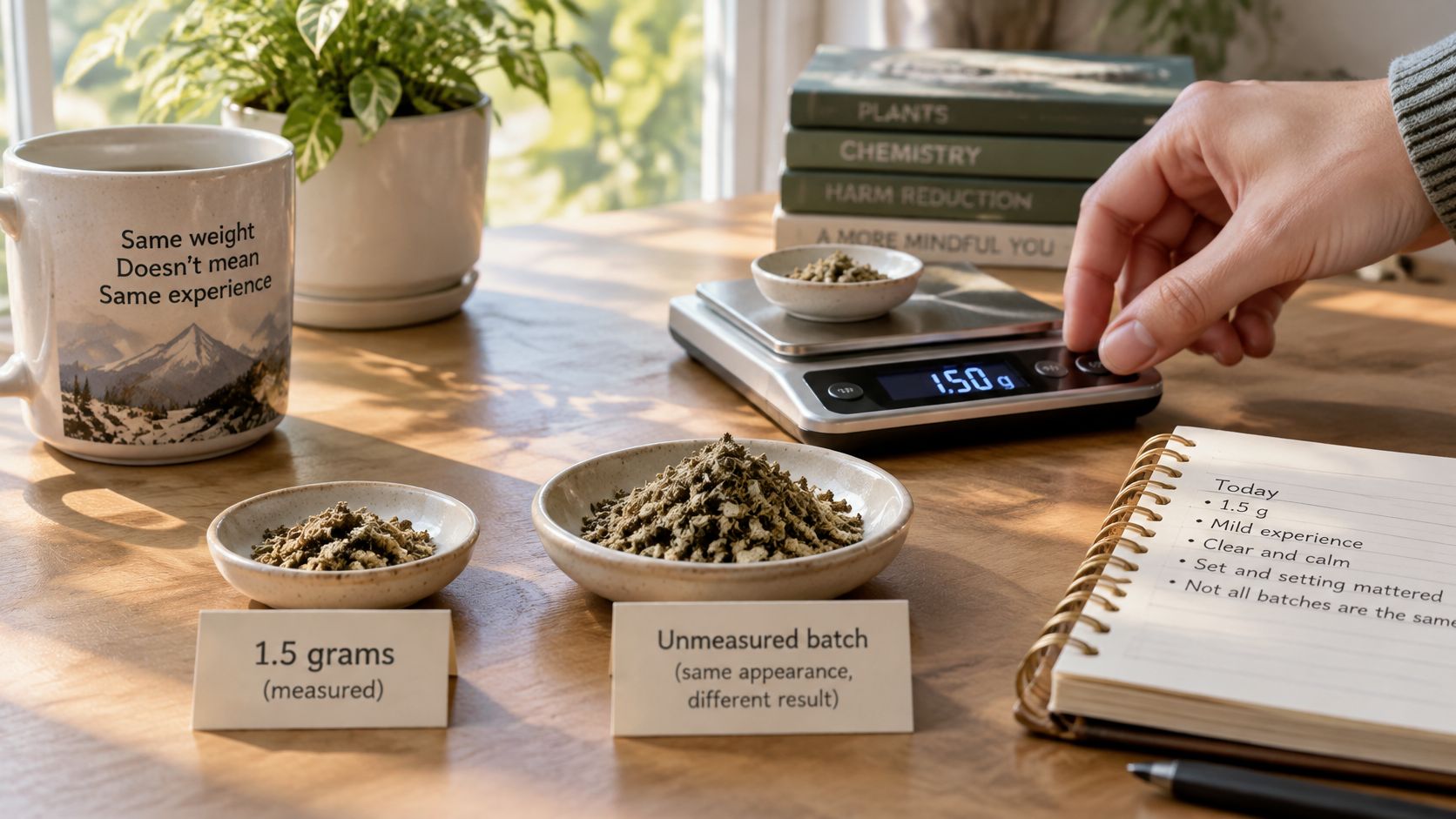
A friend describes their last mushroom experience as mild and suggests using the same weight from a new batch. Their account may be honest and detailed, but it leaves out the information needed to reproduce the exposure: the chemical concentration of each batch.
The comparison also mixes different kinds of evidence. A recollection describes an experience. A scale describes mass. A laboratory report describes measured compounds. None can stand in for all the others.
A smaller weight doesn't define a microdose
Microdose is especially easy to misuse as a product category. Without a defined chemical content, the label doesn't establish that a serving will be imperceptible, non-impairing, or appropriate for a particular person.
A weight comparison becomes more informative when portions come from the same adequately homogenized, tested material. Under that condition, a smaller portion should contain proportionally less of the measured compounds. Comparing unrelated products requires separate concentration measurements, not just arithmetic on their weights.
| Comparison | What it establishes | What remains unknown |
|---|---|---|
| Equal weights from unrelated batches | Equal material mass | Whether compound content matches |
| Smaller portion of a tested, homogenized batch | Proportionally less measured material | The person's subjective response |
| Product labeled as a microdose | The seller's category | Verified potency and impairment |
| Mushroom weight used in a trial | A protocol's material quantity | Equivalence to an unrelated product |
A systematic review published in 2025 identified a U.S. trial involving 30 participants whose dried-mushroom doses included 1 to 1.5 grams monthly during an eight-week Phase 1 period. That finding documents a study protocol, not a universal serving standard.
Research participation also involves a defined context rather than weighing material at home. The existence of a trial using a particular weight doesn't establish that an unrelated retail product has matching composition, comparable effects, or demonstrated therapeutic benefit.
A familiar weight can help describe what happened. It can't, by itself, reproduce what happened.
Legal Status of 1.5 Grams in Michigan
A local decriminalization policy isn't the same thing as legalization. For Detroit and Ann Arbor readers, that distinction matters because a city-level enforcement decision shouldn't be interpreted as blanket permission to possess, sell, distribute, or transport psilocybin.
The timeline of psychedelic legalization and decriminalization records psilocybin's placement in Schedule I under the federal Controlled Substances Act in 1970, alongside the 2018 FDA Breakthrough Therapy designation for a treatment-resistant depression development program. Neither a promising research designation nor a local enforcement policy amounts to general federal authorization for consumer use.
Separate the legal questions
Before relying on any claim about local access, establish which rule applies to the actual conduct and location. A claim about possession doesn't necessarily answer a question about commercial supply.
- Possession and use: Check current Michigan law and the exact scope of any applicable local policy.
- Sale and distribution: Don't assume a policy addressing personal activity authorizes a seller's operations.
- Travel: Don't carry a city's policy assumptions into another jurisdiction.
- Research or treatment access: Distinguish an authorized program from a product marketed with therapeutic language.
For a concrete legal-risk resource, the Law Offices of Attorney Angel Lugo provides legal guidance concerning hallucinogenic-mushroom arrests. It's not a substitute for Michigan-specific advice, but arrest-related legal guidance can help readers recognize why a general statement about decriminalization isn't enough to assess an individual case.
Our Michigan mushroom guide offers local context. Verify consequential decisions against current official rules or advice from a Michigan attorney, rather than treating any commercial guide as legal clearance.
Research status doesn't create a consumer standard
Historical restrictions help explain why informal mushroom-weight categories and clinical psilocybin measurements developed in different settings. They don't establish that any particular informal category is pharmacologically valid.
Likewise, an expedited drug-development designation concerns a treatment's development pathway. It doesn't certify a mushroom strain, validate a retail label, or supply an official conversion chart for an untested serving.
Don't assume that a small-looking quantity creates a legal safe harbor. Legal permission and chemically characterized potency are separate requirements; satisfying either doesn't establish the other.
Safety Checks and When to Walk Away
The first safety decision happens before anyone consumes the product: is there enough reliable information to understand what it is? Attractive packaging, a recognizable strain name, and a carefully measured serving don't resolve missing identity or potency information.
These checks reduce avoidable uncertainty. They don't establish that psilocybin use is safe for a particular person, and they aren't a substitute for medical advice.
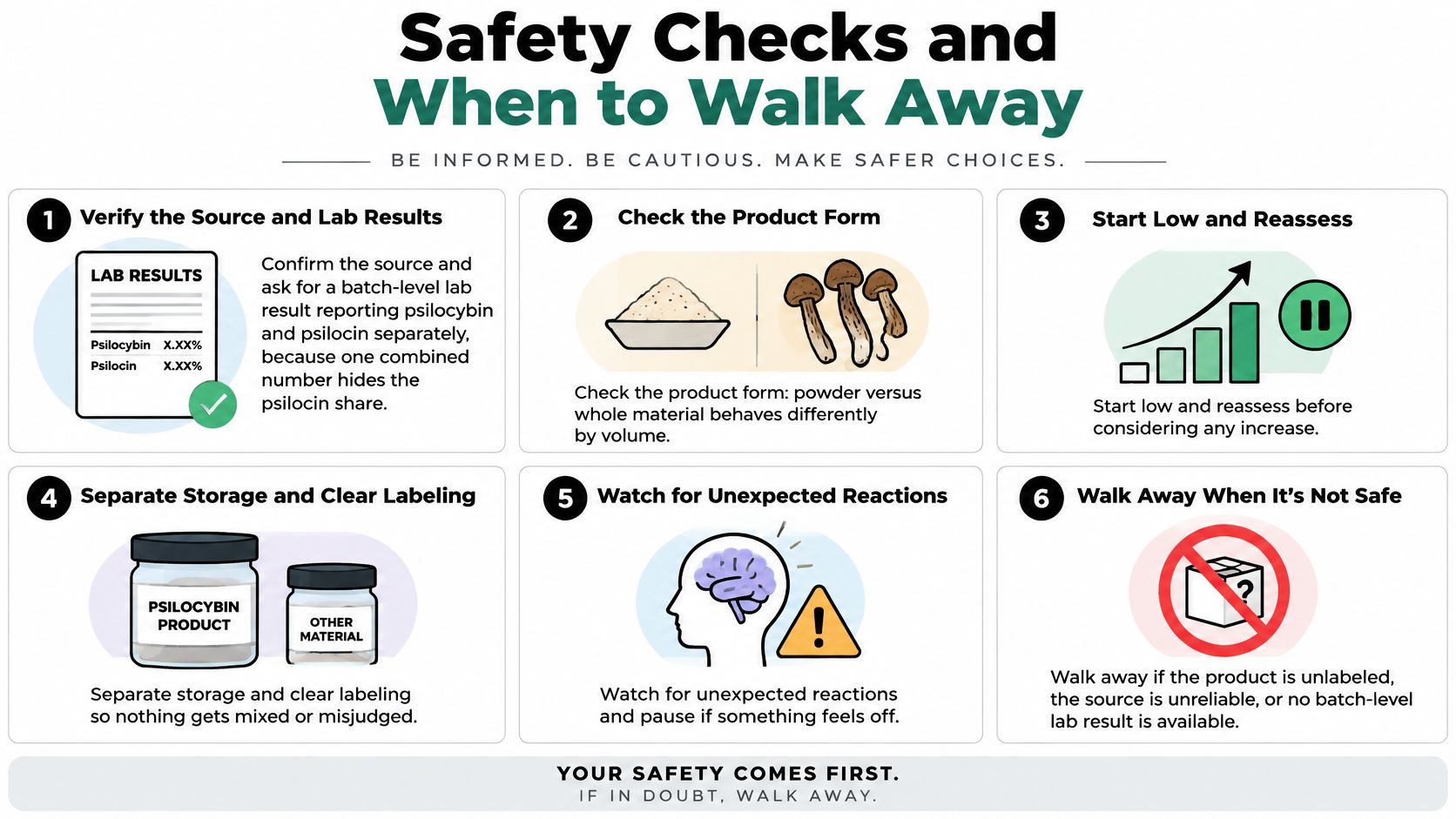
Check the product before considering use
Request a matching batch report because a generic certificate doesn't characterize your product. Look for separately identified psilocybin and psilocin results, units, the tested material, and a batch identifier. At Metro Mush, put those questions to our team directly; don't infer testing or certification from our product descriptions.
Read what the weight describes because finished-product mass isn't necessarily mushroom mass. Dried mushroom powder is still mushroom tissue, but chocolate, capsule shells, fillers, and extracts require different interpretation. Establish whether the label describes the complete item, its mushroom ingredient, or a claimed extract equivalent.
Check your health and medications with a clinician because product testing can't establish personal suitability. Don't stop prescribed medication or alter treatment to accommodate psychedelic use. If you can't obtain appropriate advice, postpone rather than improvise.
Keep material clearly labeled and separated because later uncertainty is preventable. Preserve the original packaging and batch information, and prevent access by children, pets, or anyone who might mistake an edible for ordinary food.
Prepare for uncertainty, not a promised experience
Don't use alone because an impaired person may need practical help. Arrange a sober, trusted companion who knows what was taken and can remain present. A companion should be prepared to seek help, not merely reassure.
Avoid combining substances because doing so makes an unexpected reaction harder to interpret. Don't use alcohol, cannabis, or other drugs to adjust the experience. If you're already dealing with anxiety or sleep disruption after stopping cannabis, Nick Donahue LICSW's discussion of weed withdrawal symptoms and sleep trouble is a separate support resource, not a reason to self-treat with mushrooms.
Choose a calm setting and leave driving and machinery out of the plan because a clock can't certify recovery. Don't add material in response to delayed effects. If distress develops, sit somewhere safe, reduce stimulation, breathe slowly, and keep the sober companion close.
Prepare to seek emergency care because serious symptoms shouldn't be dismissed as part of an experience. Trouble breathing, chest pain, seizures, loss of consciousness, or an inability to keep someone safe warrants urgent help. Keep packaging available for responders and don't delay medical attention while trying to identify the product yourself.
Walk-away rule: Missing documentation is a reason to pause, not a gap to fill with a seller's confidence.
Before considering use, have batch-level compound results, a label that accurately describes the material, and current legal information. Vague answers mean walk away. Even with those items, personal medical suitability remains a separate question.
1.5 grams is a weight. Tested potency makes that weight chemically interpretable; lawful sourcing and individual safety assessment remain necessary, independent checks.
At Metro Mush, we offer dried mushrooms and mushroom edibles for adult consumers in the Detroit–Ann Arbor area. Visit Metro Mush to review product descriptions and ask our team what each weight label means and what batch documentation is available before considering a purchase.