
The most common advice about the Amazonian mushroom strain is also the least dependable: that its name tells you how strong it is. “Amazonian” is a cultivar label, not a potency grade. The product in one package can differ from another, even when both carry that name. To make a safer, better-informed decision, focus on what's known about the batch, the product, and your own circumstances, not on strain mythology.
What the Amazonian Mushroom Strain Actually Is
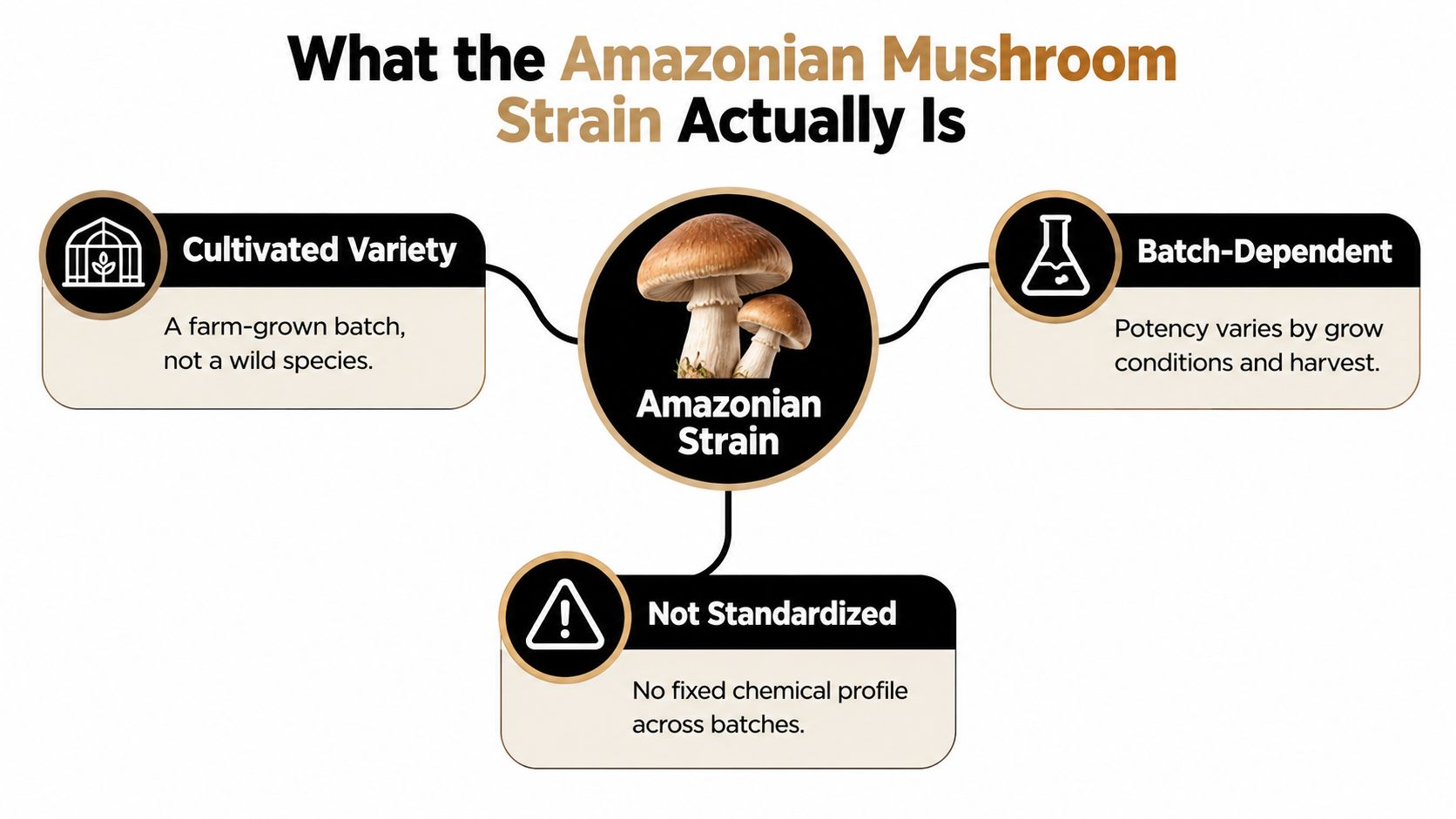
The Amazonian mushroom strain is a marketed name for cultivated Psilocybe cubensis, typically traced to material collected in or near the Amazon basin and later circulated by specialist spore distributors. "Strain" in this trade works like a nickname for a grow line: it identifies what a seller maintains, and it carries no guarantee that two products sharing the name share genetics, appearance, or alkaloid content.
That distinction trips up first-time buyers. In regulated agriculture, a named variety usually implies stable, documented genetics, because someone registered it and someone else verifies it. The mushroom spore market has no equivalent registry. A geographic-sounding name can tell an origin story without verifying where a particular grow began, which is why two packages labeled Amazonian can behave differently in practice.
A name isn't a potency promise
Some sellers present Amazonian as a classic "full-dose" cultivar, which encourages buyers to read the label as a reliable prediction. Composition depends on grow conditions, harvest timing, drying, storage, and the specific material in that batch. Without batch-level testing, the label tells you nothing about the concentration of active compounds in the product in front of you.
A 2025 review reported that a sample labeled "Amazon strain," grown from a spore print collected near Pucallpa, Peru, contained 5.7 mg/g of psilocybin and 0–0.1 mg/g of psilocin under that study's cultivation and testing conditions (2025 review of P. cubensis cultivation and chemistry). One tested sample, one set of conditions. The figure describes that batch. It cannot stand in as a specification for every product sold under the Amazonian name, and the gap between name and contents matters most for a first-time consumer who expects consistency.
Practical rule: Treat "Amazonian" as a product name, not a measurement. A batch report tells you more than a strain's reputation.
Taxonomy and Lineage of the Amazonian Variety
The oldest part of the Amazonian story has nothing to do with the Amazon. It starts with the species name, a formal classification built from collected specimens, then gets tangled with trade names added later by growers and sellers. Three terms keep the tangle straight: a species is a biological grouping, a cultivar is a cultivated variety maintained by people, and a chemotype is a measured chemical profile.
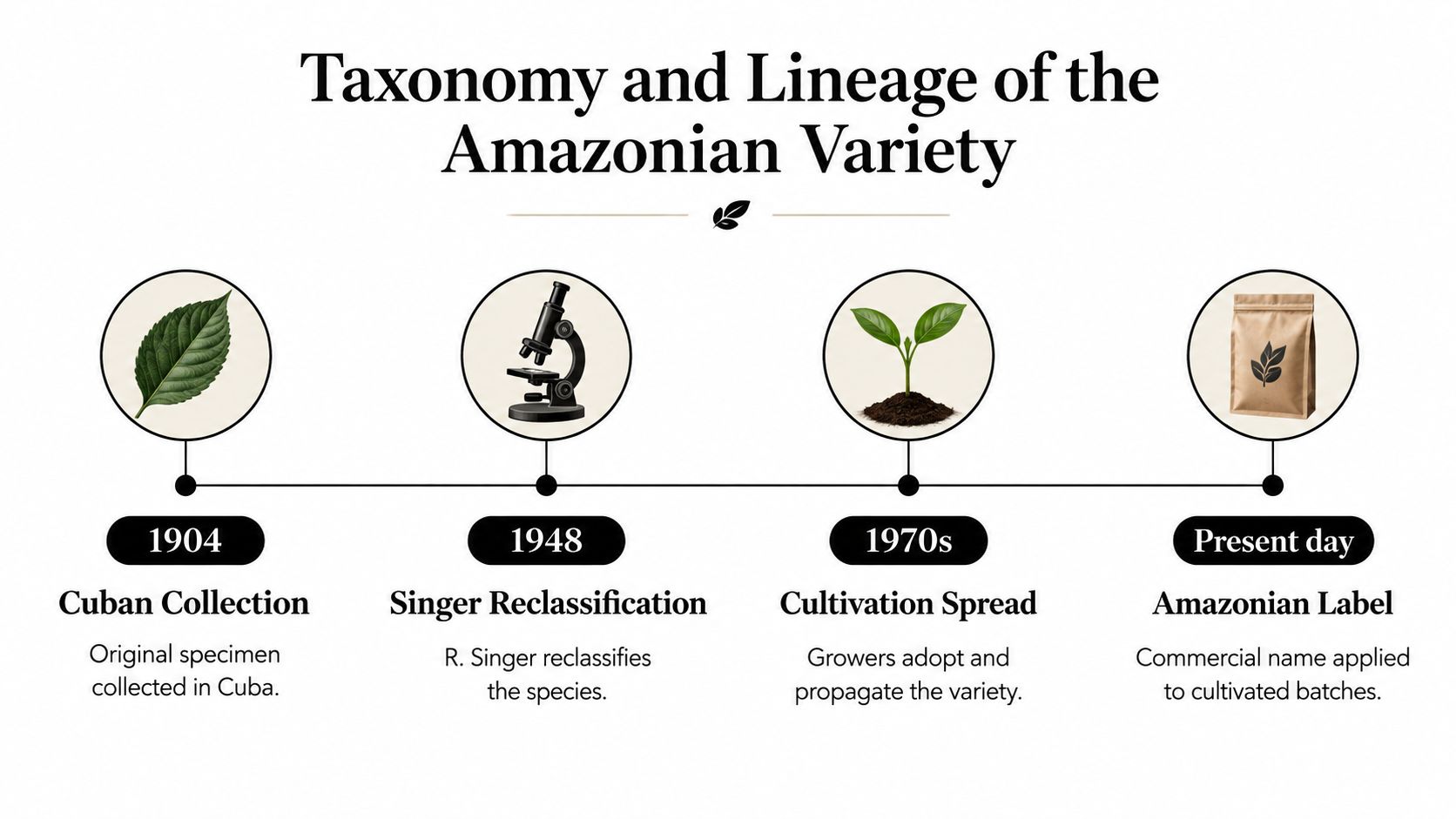
Taxonomic records describe the species now called Psilocybe cubensis through a Cuba collection: Franklin Sumner Earle published Stropharia cubensis in 1906 from material gathered near Santiago de las Vegas on June 19, 1904, and Rolf Singer transferred it to Psilocybe in 1948.
Why the label isn't a species name
Those milestones fix the species lineage; they do not certify every later garden line sold as Amazonian. Cultivar histories often travel through spore vendors, forums, and grow logs, so a shared P. cubensis identity can sit beside very different handling, genetics, and batch chemistry.
That is why DNA can group many marketed names inside one species while lab results still separate one batch from another. For a first-time consumer, that gap argues for caution and for asking what was tested; an experienced consumer may tolerate more uncertainty, but the name still cannot supply the missing numbers.
If you are comparing labels, a guide to commonly marketed Psilocybe cubensis strains helps separate trade vocabulary from taxonomy. Treat "Amazonian" as a seller's label: useful for recognition, silent on chemistry.
Identifying Amazonian Mushrooms by Appearance and Feel
A buyer may want to know whether dried mushrooms look like the Amazonian product described on a menu. Color and shape can offer context, but they can't authenticate a cultivar or establish potency. For dried mushrooms, drying and storage also change how fruiting bodies look and feel.
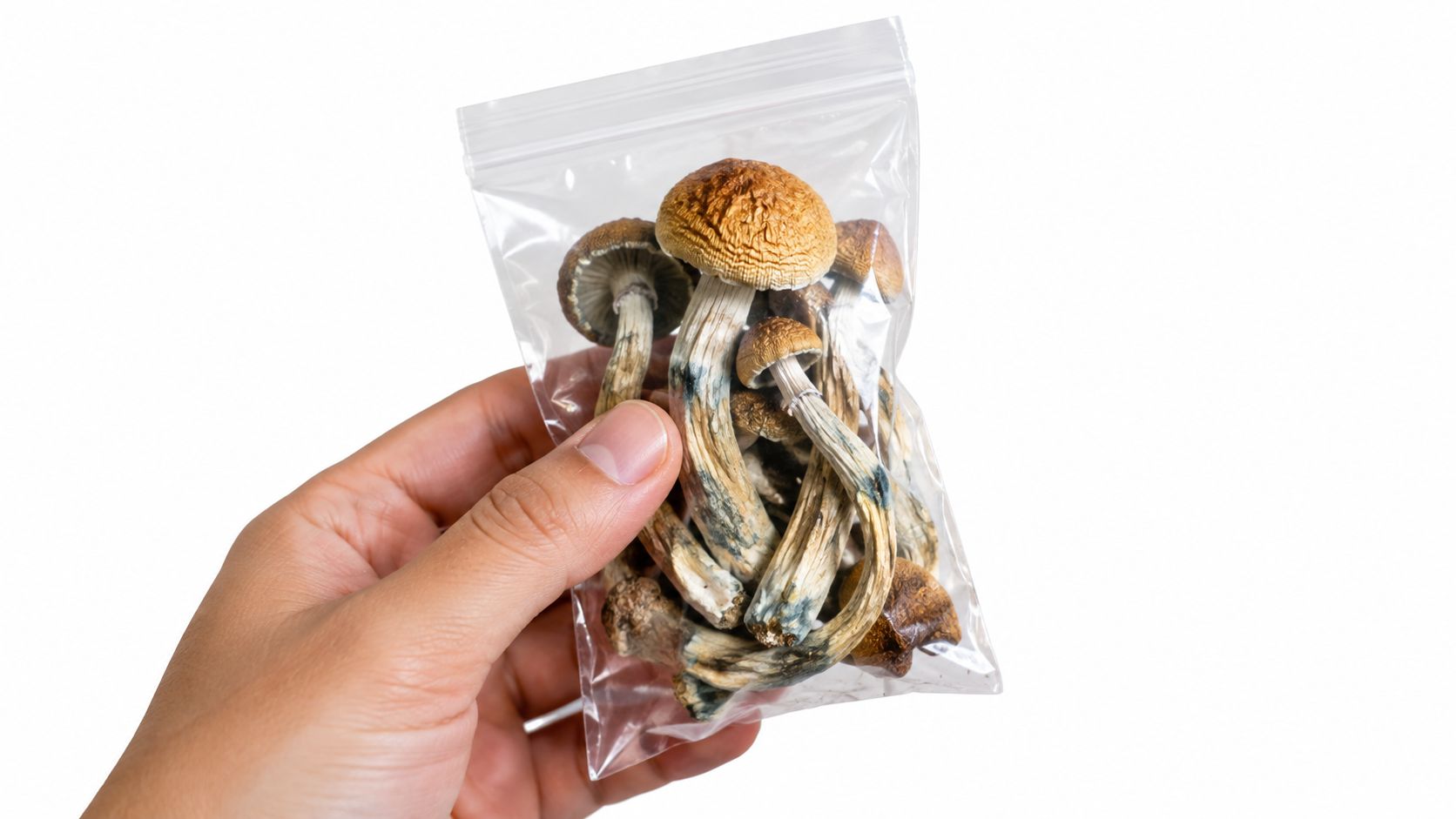
Descriptions of Amazonian cubensis commonly mention caps in caramel, golden, or brown tones, with pale stems. Bluish discoloration can appear where mushroom tissue is bruised; that color change is associated with oxidation of compounds in the tissue, but it isn't a potency meter. Dried stems may feel fibrous, and caps can become brittle depending on how they were dried and stored.
What appearance can and can't tell you
A label and a visual resemblance don't prove that a product is Amazonian, and a bright blue mark doesn't tell you how much psilocybin or psilocin is present. Color and form can vary with growing conditions and handling. In practice, appearance is a limited screening cue, not a reliable way to identify a cultivar or assess strength.
Be cautious about any product that looks visibly moldy, feels damp or unusually degraded, or has a musty or chemical odor. Don't rely on a photo or an informal visual inspection to determine that a questionable product is safe. Ask the seller how the product was stored and whether the batch has been tested, and avoid material that appears contaminated or poorly handled.
A short video can provide another visual reference, but it can't verify a specific batch or show what's inside a package you're considering.
Typical Potency and What the Numbers Mean
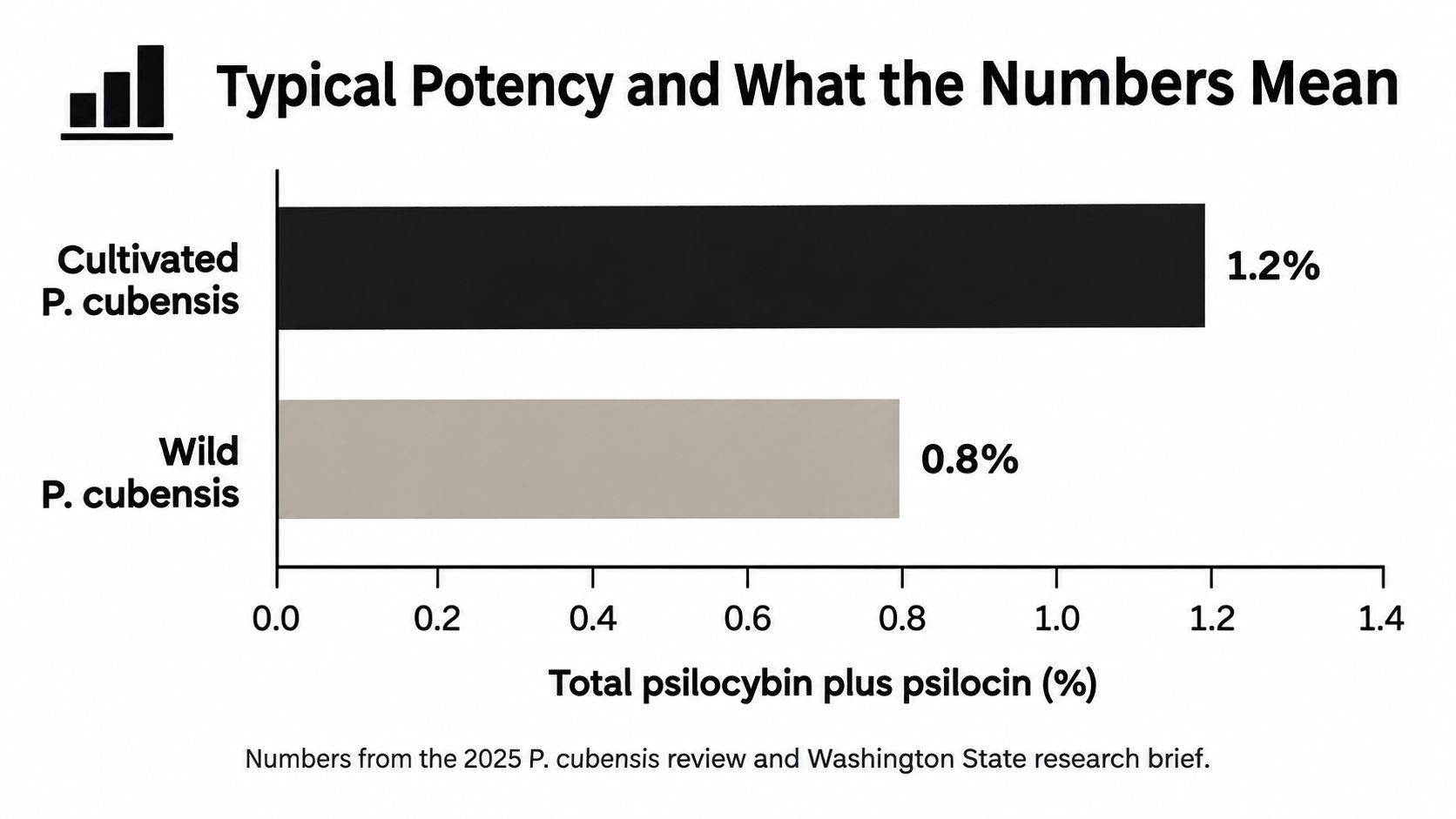
Potency figures are useful only when you know what sample they describe. The single tested Amazon sample mentioned earlier is one data point. To understand what Amazonian might contain, you need population-level analysis of cultivated P. cubensis as a group.
A separate analytical study reported mean combined psilocybin and psilocin content of approximately 1.14% of dry weight, with a standard deviation of 0.17%, across cultivated P. cubensis. The authors calculated that a nominal 3-gram dried dose could contain roughly 19.8–46.2 mg of total psilocybin plus psilocin (Washington State research brief). Those figures describe cultivated cubensis in general, and they are not a dosing recommendation or a validated potency range for Amazonian mushrooms.
Why equal weights can mean different exposures
Read that dose range again: under twenty to over forty-five milligrams on the same nominal weight. That spread is the lesson. A gram scale weighs everything in the bag, including cellulose, moisture residue, and stem tissue, so three grams measures mass rather than active content. Mass and milligrams are different questions.
Two dried products can weigh the same and produce materially different exposures. Borrowing a friend's dose history, or trusting a strain's reputation, doesn't establish what a particular product will do.
A meaningful quality-control approach uses lot-specific laboratory testing. Testing should quantify psilocybin and psilocin, identify the sample using validated fungal methods such as ITS sequencing, and report results on a dry-weight basis. A product name alone can't substitute for those measurements.
For chocolates or drinks, ask about testing of the finished product, not only the mushroom material used to make it. Extraction and mixing can introduce additional variation, so a measurement of raw mushrooms may not establish the contents of each finished serving.
How Amazonian Compares to Penis Envy and Enigma
A side-by-side comparison can be useful, but only if it doesn't turn popular names into false precision. The available evidence here supports a batch-dependent account of Amazonian, not a standardized potency ranking across Amazonian, Penis Envy, and Enigma. Without comparable testing of the specific products being compared, assigning fixed potency tiers or dose amounts would be misleading.
| Strain | Typical Potency Tier | Beginner Suitability | Most Useful Identifier |
|---|---|---|---|
| Amazonian | Not reliably inferred from the name; batch testing matters | Conditional, based on product information and individual risk factors | A batch-specific test, not the regional label |
| Penis Envy | Not established here as a fixed tier across batches | Don't assume suitability from the name | Product-specific identification and testing |
| Enigma | Not established here as a fixed tier across batches | Don't assume suitability from appearance or reputation | Product-specific identification and testing |
How to compare products responsibly
It's common to hear Amazonian described as a classic, full-dose cubensis and other named varieties described as stronger. Those descriptions are marketing shorthand, not a substitute for comparable chemical results. A fair comparison would require reliable testing of the specific batches, using consistent methods and reporting comparable measurements.
Appearance may help you understand how a product is presented, but it can't show its alkaloid concentration. Nor does a strain name determine whether a first-time consumer will find the experience manageable. Individual health factors, medications, setting, and the ability to get support matter more than a product's reputation.
When a menu compares strains but offers no batch-specific testing, treat the ranking as a claim, not a measurement.
Ask whether the seller has lot-level potency results and whether the results apply to the exact product being offered. If the product is an edible, ask whether the finished item has been tested for dose uniformity. If those details aren't available, don't treat the strain name as a reliable shortcut for estimating exposure.
Dosing Ranges and the Set-and-Setting Framework
There isn't a dependable Amazonian-specific dosing range supported by the available evidence. A gram amount can't tell you the actual exposure unless the product's potency is known, and even a measurement can't predict an individual's response. For that reason, a fixed chart of threshold, light, standard, or high amounts would create more confidence than the evidence justifies.
A safer way to assess a planned experience is to consider the conditions around it before deciding whether to proceed. This is especially important for someone who hasn't used psilocybin before.
Check the person and the product
Ask whether you know what the product is, whether its batch has been tested, and whether you're in a situation where you can pause or get help. Consider your mental-health history, current medications, and any advice from a qualified clinician. Oregon's regulated service model highlights screening for psychiatric history, medications, and contraindications, as well as avoiding unsupervised or take-home use in that model (research on Oregon service-provider practices).
A person with a personal or family history of psychotic disorders, or someone taking psychiatric medication, should seek qualified medical advice rather than trying to resolve safety questions through a seller or strain guide. The research doesn't establish an individual's medication risks or identify one universally suitable dose.
Plan the setting
Choose a calm, familiar environment and have a sober support person available, particularly if there's any concern about how the experience may unfold. Don't drive, and don't combine psilocybin with other substances. Think ahead about how to reduce stimulation and contact support if anxiety becomes overwhelming.
A first experience with an Amazonian-labeled product is not an automatic yes or no. It depends on the person's health, medication questions, product testing, surroundings, and access to sober support. If those pieces aren't in place, postponing is a reasonable choice. For general harm-reduction considerations, consult this guide to dosing and planning, while remembering that no guide can replace medical advice or local law.
Legal Considerations for Detroit and Ann Arbor Consumers
The word “decriminalized” doesn't mean the same thing as “legal to buy or sell.” Psilocybin remains federally controlled, while state and local approaches differ. A city policy about enforcement priorities doesn't create a general legal retail market or protect someone from federal enforcement.
For Detroit or Ann Arbor consumers, the practical question is what rules apply where they live and where an activity takes place. Local measures can affect enforcement priorities, but they don't necessarily change state or federal law. The legal status of possession, sales, and distribution can differ, so don't assume a policy in one city applies elsewhere in Michigan.
Different jurisdictions, different models
Oregon, Colorado, and New Mexico have developed materially different approaches to psilocybin regulation. Those models shouldn't be treated as interchangeable, and none automatically governs what's permitted in Michigan. A local decriminalization policy also differs from a regulated service model, which may have specific rules for participation and providers.
Before acting, check current information from authoritative state and local sources, and seek legal advice if you need an interpretation of your situation. This is especially relevant when crossing a county or state boundary. Don't transport psilocybin across state lines on the assumption that a local policy makes it legal.
Sourcing Amazonian From a Local Dispensary
A useful product listing should tell you more than a strain name and weight. Ask whether the seller can provide batch-specific potency testing, how the product was stored, and whether a test applies to the exact item you're considering. For an edible, ask whether the finished product has been tested, since the raw mushroom result alone doesn't establish how evenly compounds are distributed in the final serving.
A buyer's checklist
- Ask about the batch: Request test results for the lot, including psilocybin and psilocin measurements, rather than relying on a general strain description.
- Ask about the finished product: For chocolates or drinks, find out whether the finished item has been tested for consistency and contamination.
- Check storage and condition: Avoid products with signs of moisture, visible contamination, or poor handling.
- Consider the setting and support: Don't use a strain label to make decisions about medical risk, medications, or whether you should be alone.
For delivery and product-menu information, see where to buy mushrooms. For any product, clear answers about testing and handling are more useful than a promise that a named variety has predictable effects.
Is Amazonian suitable for microdosing? The name doesn't establish that a product is suitable for microdosing or reveal its strength. Without reliable testing, even a small portion may not contain a predictable amount. Consider legal and health factors, and ask a qualified clinician about medication or psychiatric concerns.
How might it interact with psychiatric medication? That depends on the medication and the individual. Don't stop or change a prescription to use psilocybin; speak with the prescribing clinician or another qualified medical professional about potential risks.
Does tolerance between sessions make sense? The evidence here doesn't provide a personalized schedule. Avoid using a calendar rule as a safety guarantee, and consider whether a pause, clinical advice, or choosing not to use is appropriate.
What if the experience becomes overwhelming? A sober support person can help reduce stimulation and stay with the person. Don't drive or add another substance to try to change the experience; seek urgent medical help if someone is in immediate danger or needs emergency care.
Follow local law, arrange sober support when needed, and never drive after using psilocybin.
Metro Mush offers a curated selection of dried mushroom varieties and edibles for adult consumers in the Detroit–Ann Arbor area, with menu details and ordering information available online. If you're comparing Amazonian-labeled products, ask about batch testing and product handling before making a decision, and visit Metro Mush to explore the current menu.