

You're standing in the supplement aisle, or maybe scrolling a wellness menu after a friend orders mushroom coffee, and the labels all sound promising in the same vague way. One jar says focus, another says calm, and a gummy claims to support immunity, but the differences aren't obvious unless you already know the category. Functional mushroom products are built around that promise gap, they're foods, drinks, powders, capsules, and extracts made from non-psychoactive mushrooms that people use for specific wellness goals, not for cooking or getting high.
That shift from niche to mainstream isn't random. The category has expanded into foods, beverages, and supplements, and Grand View Research estimates the market was worth USD 31.71 billion in 2023, with a projection of USD 65.83 billion by 2030 and an 11.2% CAGR from 2024 to 2030, which points to sustained category growth rather than a fad Grand View Research. Retail data also show that the conversation has moved well beyond novelty, with U.S. supplement sales and top ingredient rankings reflecting real shopper demand in cognition, immunity, and energy-positioned products Nutritional Outlook and NutraIngredients report on SPINS data.
If you're a first-time buyer, the basic boundary is simple. Culinary mushrooms are for flavor and texture, functional mushroom products are sold for bioactive compounds and wellness positioning, and psychedelic mushrooms belong to a completely different legal and pharmacological category. The buyer is often a curious adult who wants a small, practical ritual, maybe focus in the morning, calmer evenings, or a supplement that feels more food-like than pill-like.
That's why mushrooms keep showing up in coffee, chocolate, protein powders, gummies, and even gas-station wellness shelves. They fit the same cultural lane as adaptogens and gut-health products, but they also come with a friendlier story than a harsh-looking capsule bottle. The challenge is that the label language often runs ahead of the evidence, so the useful skill isn't just recognizing a mushroom name, it's knowing what kind of product you're holding.
What Are Functional Mushroom Products
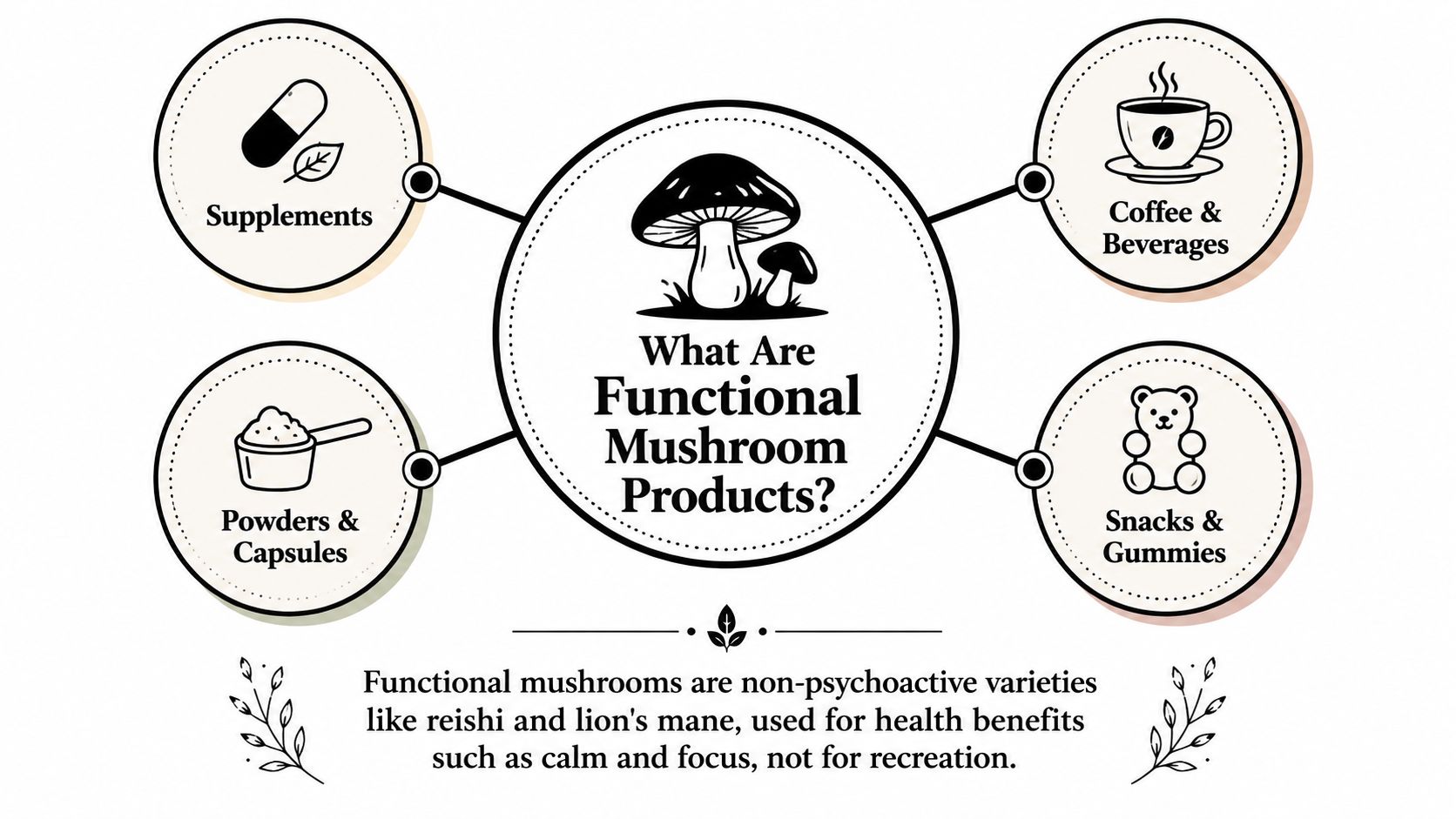
At the simplest level, these are products made from mushrooms that people take for health-oriented effects rather than taste, nutrition alone, or recreation. The mushroom itself may be sold as a powder, extract, capsule, coffee blend, chocolate, gummy, or tincture, but the selling point is usually a functional role like focus, calm, energy, or immune support. In other words, the mushroom is being treated more like an ingredient with a job than a side dish.
The category gets confusing because the word “mushroom” can mean three very different things. A portobello on a grill is a culinary food. A psilocybin mushroom is a psychoactive substance with its own legal and mental-health considerations. Functional mushrooms sit in the middle, as non-psychoactive species such as lion's mane, reishi, cordyceps, chaga, turkey tail, maitake, and shiitake that are used in wellness products for their bioactive compounds.
A practical way to think about them is as the “functional ingredient” version of fungi. They're often included in products because brands want a more natural-looking way to support a routine, whether that means morning focus, post-workout recovery, or a calming evening drink. The category has benefited from the same consumer habits that pushed collagen, probiotic drinks, and adaptogen lattes into everyday life, people want products that feel easy to use and easy to explain.
Practical rule: if a label talks about mood, immunity, cognition, or energy, read past the mushroom name and ask what format you're buying, because the format often matters as much as the species.
The market growth helps explain why these products are everywhere, but demand alone doesn't solve consumer confusion. A lot of buyers don't know whether they're choosing a supplement, a food, or a beverage, and they don't know whether the active part is the whole mushroom, an extract, or a blend. That's why the most useful first question is not “Do mushrooms work?”, it's “What kind of mushroom product is this, and what is it trying to do?”
Common Species and What Each One Is Known For
A good shelf map starts with the species names you're likely to see most often. Lion's mane usually points to cognition. Reishi is usually framed around calm or sleep. Cordyceps is sold for energy and workout support. Chaga tends to show up in antioxidant and immunity positioning. Turkey tail, maitake, and shiitake are also common, usually in immune-support blends or broader wellness formulas.
The four names that matter most
Lion's mane is the one many shoppers reach for when they want a morning routine that feels mentally sharper. The interest centers on compounds called hericenones and erinacines, which are often discussed alongside nerve-growth pathways in the research conversation. Products are commonly sold as powders, capsules, coffee blends, and extracts, which makes lion's mane the most visible entry point for the category.
Reishi is the classic “wind down” mushroom. Its headline bioactives are beta-glucans and triterpenes, and it's commonly sold in capsules, tea blends, tinctures, and mixed drinks. People usually buy it for evening use or for a more calming ritual, although the strongest claims should always be read carefully.
Cordyceps is positioned as the energy mushroom. The compound conversation usually centers on cordycepin and related nucleosides, and the product formats often skew toward powders, capsules, and beverage mixes. It's the species most likely to be linked to pre-workout style use.
Chaga is often marketed for antioxidant and immune support. It's commonly sold as tea, powder, extract, or blend ingredients. The label conversation usually points to polysaccharides and phenolic compounds, but shoppers should still check whether the product is a true extract or just a small amount mixed into a broader formula.
Turkey tail, maitake, and shiitake matter because they're common supporting actors in immune blends. Turkey tail is especially associated with beta-glucans and immune-positioned formulas. Maitake and shiitake are widely used in food and supplement contexts, often because they're familiar, food-like mushrooms that fit wellness products without sounding exotic.
A useful shortcut is to read the mushroom name as the brand's promise, then look for the compound that explains the promise.
| Species | Common Use-Case | Key Bioactive |
|---|---|---|
| Lion's mane | Focus, cognition | Hericenones, erinacines |
| Reishi | Calm, sleep | Beta-glucans, triterpenes |
| Cordyceps | Energy, workout support | Cordycepin, related nucleosides |
| Chaga | Antioxidant, immune positioning | Polysaccharides, phenolic compounds |
| Turkey tail | Immune support | Beta-glucans |
| Maitake | General wellness, immune positioning | Beta-glucans |
| Shiitake | Food-like functional support | Polysaccharides, sterols |
Evidence-Backed Benefits You Can Actually Rely On
The honest answer is that functional mushroom products sit on a spectrum of evidence, not a yes-or-no switch. Some uses are biologically plausible and backed by early human work, while others are still mostly supported by preclinical studies. That means the smart shopper doesn't ask whether a mushroom is “good” or “bad”, but whether the claimed benefit has enough evidence to justify the way the product is being marketed.
Cognitive support and focus
Lion's mane is the species most often paired with cognition claims. The main ingredients of interest are hericenones and erinacines, and the scientific conversation includes preclinical work around nerve growth factor pathways. Human evidence is still limited, so it's fair to treat lion's mane as promising rather than proven, especially when labels promise dramatic nootropic effects.
Calm and sleep
Reishi is the common choice for relaxing products, with beta-glucans and triterpenes doing most of the label work. People often buy it for nighttime use, but the evidence base is still developing. A cautious reading is best, products may fit a calming ritual, but they're not a substitute for real sleep hygiene or treatment for insomnia.
Immunity
Turkey tail, chaga, maitake, and reishi often appear in immune-support blends because of their beta-glucans and other polysaccharides. That chemistry makes sense on paper, but the consumer should separate immune positioning from guaranteed immune outcomes. The products can be reasonable wellness ingredients, yet the strongest claims still outpace the evidence.
Energy and workout support
Cordyceps is the mushroom most often tied to exercise and stamina claims. The compound conversation centers on cordycepin and related bioactives, and the products are often marketed around endurance or recovery. That's a reasonable use-case to explore, but the effect size and consistency aren't strong enough to treat it like a caffeine replacement or a performance supplement with a settled evidence base.
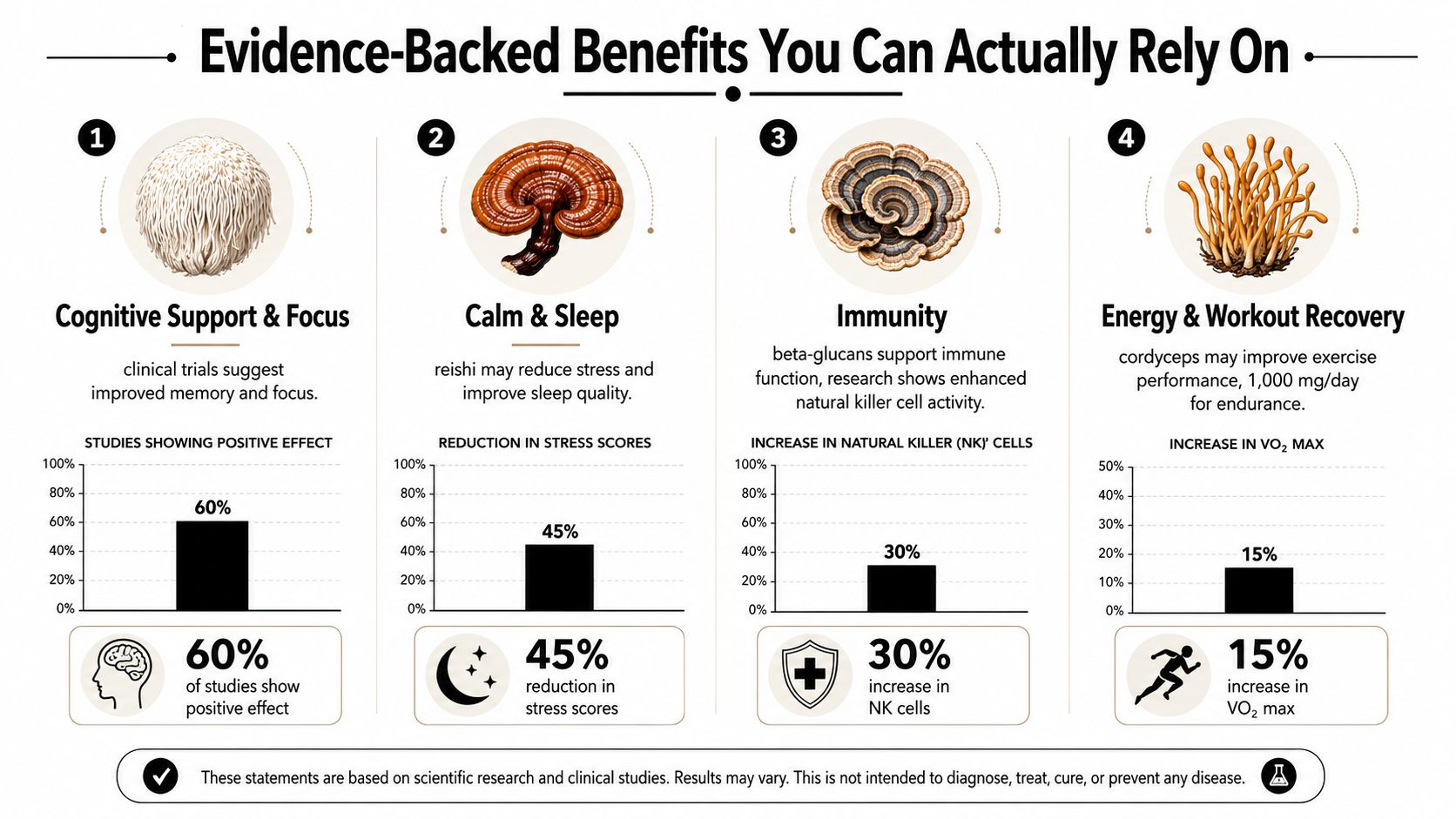
The cleanest way to think about the category is this, mushrooms can be useful ingredients, but the label claim should never be stronger than the human evidence behind it.
For readers who want a reality check, the U.S. Office of Dietary Supplements says there isn't enough scientific evidence to support functional mushrooms for any purpose other than as food, and a 2024 University of Utah review notes that many claimed benefits are still backed mainly by animal studies rather than human trials Office of Dietary Supplements. That doesn't make the category worthless, it means the burden is on brands to show dosage, standardization, and extract quality instead of leaning on buzzwords.
Formats You Can Buy and How They Differ
The format changes the experience more than most packaging copy admits. A powder mixed into coffee behaves differently from a capsule swallowed with breakfast, and both feel different from a gummy you keep on your desk. If you're choosing a product for daily use, start with the form you'll take consistently, not the one that sounds most advanced.
Powders are the flexible option. They mix into coffee, smoothies, soups, and hot chocolate, which makes them appealing for people who already have a morning ritual. The trade-off is taste and dosing precision, because powders can be easy to under-dose or over-scoop, and earthy flavor can become the main thing you notice.
Capsules are the easiest set-and-forget format. They're pre-measured, easy to travel with, and better for people who don't want a mushroom taste in their mouth. They also make it easier to track routine, which matters when you're trying to figure out whether a product is helping or not.
Tinctures and dual-extract liquids give you more dosing flexibility, especially if you want to adjust slowly. Functional drinks, coffees, chocolates, broths, and gummies are more about ritual and adherence than surgical precision. They're also the places where product innovation is moving fastest, especially in beverages and chewables, even though powders and capsules still dominate a lot of purchase behavior.
Practical rule: if you care most about consistency, pick capsules. If you care most about fitting mushrooms into an existing routine, pick powders or a beverage. If you care most about taste, gummies and flavored drinks usually win.
For mushroom tinctures specifically, this buyer's guide to mushroom tinctures is useful because it shows how liquid formats are usually framed around convenience and flexible use rather than flavor masking. The bigger point is that each format solves a different problem, so don't confuse novelty with quality.
The right choice depends on your life, not the shelf display. A commuter may prefer capsules, a home cook may prefer broths or powders, and a taste-sensitive buyer may prefer gummies. Once you know that, the product stops being a trend item and becomes a tool.
How to Read a Label and Spot Quality
Most mushroom labels are designed to sound precise while hiding the part that matters. The first thing to look for is fruiting body versus mycelium on grain, because that tells you what part of the organism is in the jar. Fruiting body products are usually the parts shoppers expect when they think “mushroom”, while mycelium-on-grain products can contain a lot of starch from the growing substrate and much less of the mushroom material people assume they're buying.
The second thing to check is beta-glucan content, not just “polysaccharides.” Those words are not interchangeable. A product can claim a high polysaccharide number and still tell you very little about the amount of mushroom beta-glucans that matter for functional positioning. If a label doesn't separate the numbers clearly, you're looking at marketing language, not real transparency.
Extraction method matters too. Hot-water, alcohol, and dual-extract products don't behave the same way, because different compounds come out under different conditions. A fruiting body powder, a water extract, and an alcohol extract are not interchangeable products, even if they all carry the same mushroom name on the front.
A simple checklist helps more than buzzwords:
- Look for the mushroom part used, and prefer labels that specify fruiting body when that's what you want.
- Check for beta-glucans, not just total polysaccharides.
- Confirm the extraction method, especially if the product is sold as an extract.
- Look for third-party testing or a certificate of analysis, because testing is one of the few quality signals that can be verified.
- Read the serving size and actual mushroom amount, not only the front-panel promise.
Three red flags come up often:
- Proprietary blends that hide how much of each mushroom is included.
- Vague immune or focus claims with no extract details.
- Big polysaccharide numbers with no beta-glucan disclosure.
The reason this matters is simple. Buyers often compare pretty packaging instead of composition, and that can lead to paying more for less mushroom. If you want a deeper checklist for choosing well, this high-quality mushroom products guide covers the same issue from a shopper's point of view.
Dosing, Safety, and the Functional Versus Psychedelic Line
A beginner should think in terms of starting low and watching for tolerance, not chasing a high dose on day one. In general product conversations, lion's mane is often introduced around 500 to 1000 mg/day, reishi around 500 to 1500 mg/day, turkey tail around 1000 to 3000 mg/day, and cordyceps around 1000 to 2000 mg/day, but those figures are best treated as starting references, not personal medical advice. The point is to test one species at a time so you know what changed.
Functional mushrooms can still cause problems for some people. Digestive upset and skin reactions can happen, and people on immunosuppressants, blood thinners, or with mushroom allergies should be careful. If you take medication, or if you're pregnant or nursing, a doctor should be part of the decision.
The legal and pharmacological line matters too. Functional mushroom products are non-psychoactive. They are not intended to create a psychedelic effect, and they are not the same thing as psilocybin-containing mushrooms. That distinction is essential, because the safety profile, intended use, and legal status are different.
Start with one product, one format, one goal. Track how you feel for a couple of weeks, then decide whether the product fits your routine. If it doesn't, stop, switch species, or switch format rather than stacking more ingredients on top.
Putting It All Together for a Beginner Routine
A simple starter routine works better than a shelf full of jars. One practical setup is a morning lion's mane coffee or capsule for focus, an evening reishi tea or capsule for winding down, and an optional cordyceps serving before a workout if energy is the goal. In week one, pay attention to taste, digestion, and whether the routine is realistic. In week two, notice whether the product is easy enough to repeat without effort. By week four, decide whether the product earns a permanent place or just takes up cabinet space.
If you want a purchase filter, keep it to three decisions. Pick the species that matches your goal. Choose a format you will use. Verify that the label shows real beta-glucans from a real fruiting body.
For a cost-check on one common species, this lion's mane pricing overview is a useful reference point before you buy. The bigger takeaway is that functional mushroom products are tools, not miracles, and they work best when they fit an existing habit rather than replacing basic sleep, food, movement, or medical care.
Metro Mush offers a local way to browse mushroom products online and compare edible formats without guessing your way through the aisle. If you're sorting through labels, species, and product styles, visit Metro Mush to see how different mushroom products are presented for adult consumers.