

If you're in the middle of it right now, stop trying to win against the drug. The worst move is usually the one people make first, which is to argue with the experience, pace the room, keep the music on, or ask a dozen anxious questions. Your job is simpler than that, get the situation quieter, get the body calmer, and keep the person safe until the wave drops.
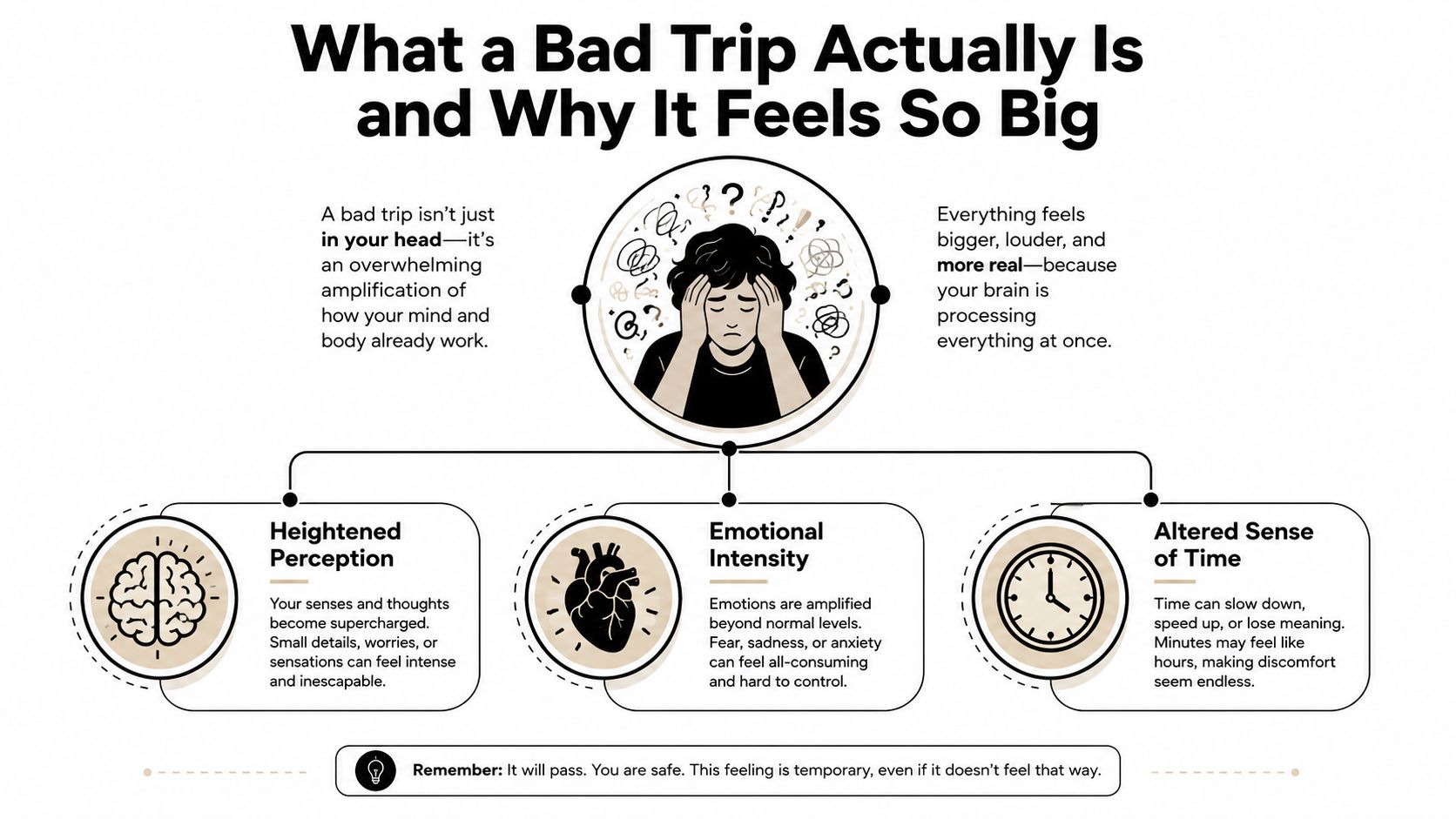
A bad trip feels huge because it is huge inside the mind. Time bends, emotions spike, ordinary objects look charged with meaning, and the person can feel trapped in the thought that this state is permanent. It isn't. The hard part is real, but it's temporary, and the right response is to stop escalation, not to magically erase every intense feeling on command.
For a deeper look at how psilocybin acts in the brain, see this breakdown of psilocybin effects on the brain.
What a Bad Trip Is and Why It Feels So Big
A bad trip is a temporary state where perception, emotion, and meaning get turned up too far at the same time. The person is not weak, broken, or stuck there permanently, they are overloaded. Classic psychedelic experiences are driven by set and setting, meaning mindset and environment are major variables, and that is why the same substance can feel manageable in one context and terrifying in another.
The clearest thing to remember is that the drug usually does not create a lasting physical emergency by itself. In the Johns Hopkins survey summary of nearly 2,000 people with a past negative psilocybin experience, 10.7% said their worst bad trip put themselves or others at risk of physical harm, 2.6% said they acted aggressively or violently, and 2.7% said they sought medical help. Those numbers matter because they show the primary danger is often what happens next, panic, disorientation, unsafe behavior, not the feeling alone. The survey also backs up the point that environment control is not optional, it is the main lever you can use. Johns Hopkins survey summary
The core reframe that keeps people safe
Practical rule: stopping a bad trip usually means stopping the spiral, not deleting the trip.
Clinical review literature says most bad trips self-resolve within 24 hours, which is the most calming fact to hold onto when everything feels wrong. That same review says drug treatment should be reserved for cases that do not respond to non-drug support or where serious harm is becoming likely. In plain language, calm first, medication only when safety is slipping. Clinical review on psychedelic crises
There is a useful distinction here. Uncomfortable does not automatically mean dangerous. Panic, weird thoughts, and time distortion are common in the acute experience, but severe agitation, inability to stay safe, or signs of poisoning belong in a different category.
The mental loop matters because fear feeds fear. A person starts resisting the trip, notices the resistance, gets more scared, and the whole thing intensifies. That is why the first move is never to debate the content of the trip. The first move is to reduce the pressure around it.
Self-help versus medical help
Use self-help when the person is frightened, confused, overwhelmed, or stuck in looping thoughts, but still awake, responsive, and physically safe. That means quieter space, one calm voice, lower stimulation, and close supervision.
Get medical help fast when there is loss of consciousness, breathing trouble, chest pain, seizures, severe overheating, repeated vomiting with collapse, or behavior that cannot be kept safe. Call emergency services if the person is violent, cannot be redirected, may have taken something else, or the situation is no longer containable. That is the line. If you are past it, do not try to tough it out.
Trip killer myths that waste time
A lot of bad advice shows up in the middle of a crisis. Trip killers are not magic. Alcohol is a bad idea because it adds impairment and can make judgment worse. More drugs are a bad idea because you can stack confusion on top of confusion. Chasing a perfect trick, a secret phrase, or a guaranteed off switch usually wastes the window where simple calming steps would help.
The better move is plain and boring. Reduce stimulation. Keep one sober person in charge. Watch for danger. If the person is slipping toward unsafe behavior or medical warning signs, stop improvising and get help.
The First Fifteen Minutes Change the Trajectory
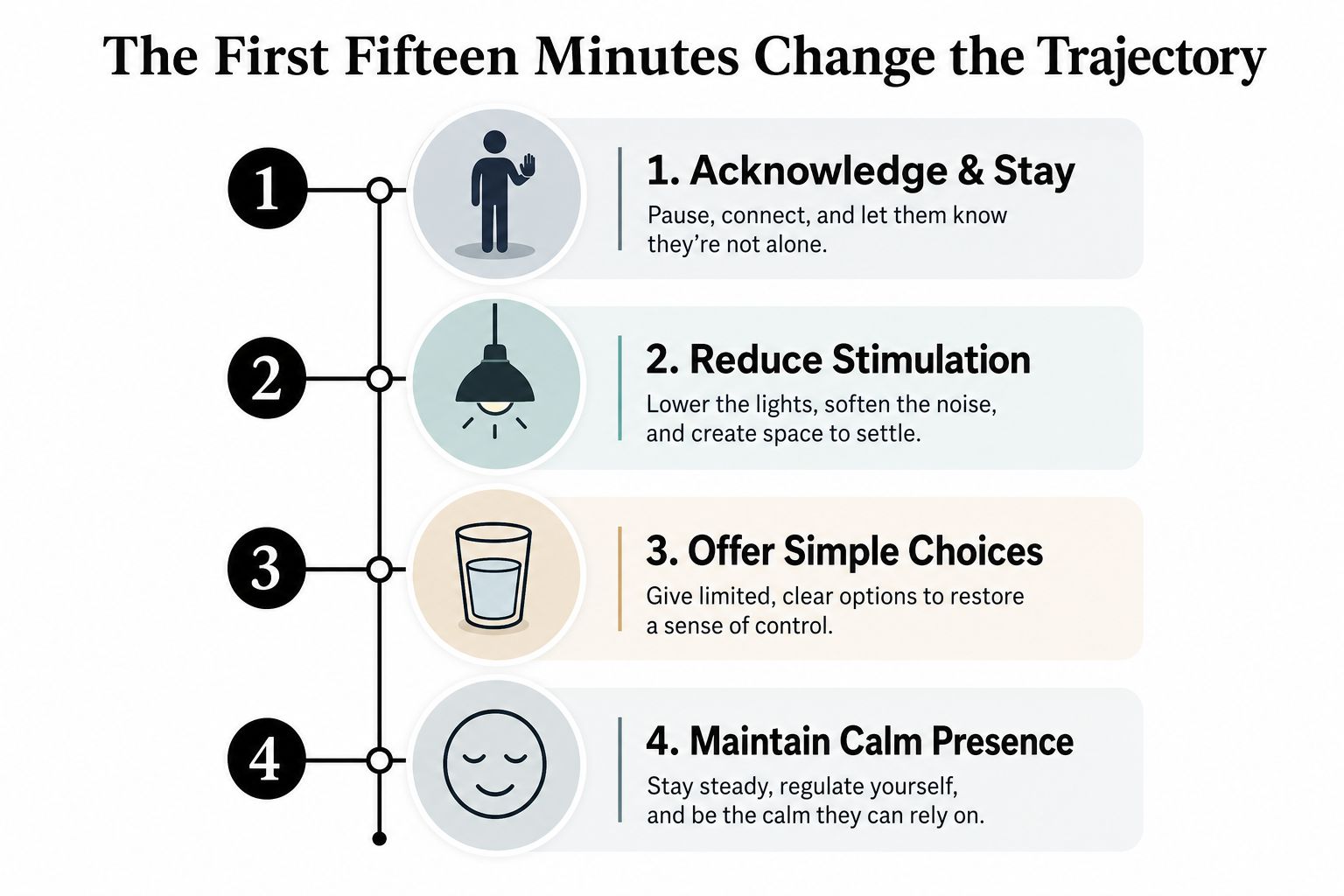
The first fifteen minutes are about changing the room before changing the mind. If the person is still in a loud, bright, crowded, or screen-heavy environment, the experience is much more likely to keep climbing. A quiet room, softer light, and fewer inputs lower the temperature fast, and multiple harm-reduction guides put environment change ahead of everything else. Environmental de-escalation guide
Move the scene, not the argument
Get the person into a quieter, familiar space if you can do that without making them more distressed. Dim the lights. Turn off chaotic music. Put the phone face down or out of sight. If mirrors, bright screens, or too many people are in the room, remove those inputs.
The fastest mistake is hovering and narrating every second. Don't do that. Keep the environment simple, because simplicity is easier for an overwhelmed brain to process.
Keep the room low-friction
Sit them down or have them lie on a couch, bed, or floor space that feels safe. Offer a blanket if it helps. Keep the temperature comfortable. If they're fixating on one room or one person making them uneasy, move away from that trigger cleanly, without drama.
A sober, trusted person should stay nearby. Not five people. Not a rotating audience. One calm presence is better than a crowd trying to help all at once.
Use short lines, not speeches
Say things like, “You're safe.” “This will pass.” “I'm right here.” Those phrases work because they're short enough to land when cognition is scrambled. Avoid saying, “Calm down,” because it usually makes people feel misunderstood and alone.
The goal is to lower sensory load first, because sensory overload keeps panic alive.
If the person is cooperative, offer water in small sips and let them settle without asking them to explain what they're seeing. If they want to move again after the first relocation, make the next move slower, quieter, and more deliberate.
Breathing and Grounding That Actually Works
Once the environment is quieter, use the body to bring the spiral down. Keep it simple. The best protocol is the one you can repeat without thinking, because panic ruins fancy instructions and overcomplicated coaching makes disorientation worse. Breathing and grounding guide
Breathe like a metronome
Have the person inhale through the nose for 4 seconds, hold briefly if that feels okay, then exhale slowly for 4 to 6 seconds. If you're sitting with them, breathe audibly so they can match your pace. The exhale matters most, because it tells the nervous system to back off.
If box breathing feels easier, use that instead. Keep the count steady and boring. The point isn't spiritual performance, it's rhythm.
Ground with the five senses
Use a simple sensory reset, like 5-4-3-2-1 grounding. Ask them to name five things they can see, four things they can feel, three sounds they can hear, two things they can smell, and one thing they can taste. Keep your voice slow and repetitive.
If they're too far gone for a full sequence, shrink it. Ask for one color they see. One texture they feel. One sound in the room. That's enough.
Small practical fixes beat big ones
If they're dizzy or haven't eaten, offer a few sips of water and a light snack. Don't force food. Don't pile on questions. Don't turn the room into a therapy session.
Do this, not that: one calm prompt, one breath cue, one sensory anchor. That's the whole game.
Bright screens, mirrors, and too much conversation often make people more untethered, not less. If the first grounding attempt doesn't land, repeat it. Consistency matters more than novelty.
What a Sober Sitter Does
A good sitter does not try to “fix” the trip. A good sitter keeps the trip from getting worse. That sounds modest, but in the middle of panic it is the difference between a rough stretch and a spiral that turns dangerous. For a broader harm-reduction framing, see this overview of harm reduction.
Take two sitters. One keeps checking their own phone, asks, “What are you seeing now?” and talks too fast because they are nervous. The other sits down, slows their breathing, and says, “You are okay, I am here, and we are going to keep this calm.” The first person adds noise. The second one helps the room settle.
The sitter's job is narrower than people think
Stay calm enough that your breathing can be borrowed. Speak in short sentences. Do not argue with the person's content, because you cannot logic someone out of a hallucination. If they say something scary, answer the feeling, not the belief.
Say, “I know this feels intense.” Say, “You are safe right now.” Say, “I am staying with you.” If they keep repeating the same fear, repeat the same answer. A sitter does not need new material every minute.
Know when to move them and when to stay put
If the current space is chaotic, overstimulating, or full of people the person does not trust, move them to a quieter room. If they are already in a calm place and are only panicking, do not keep relocating them for no reason. Extra motion can make them feel chased by the experience.
Concrete help matters here. Dim bright lights. Silence the TV. Put the loud friend in another room. Hand them a blanket if they want pressure, or a glass of water if their mouth is dry. If they look cold, warm them up. If they look overheated, cool the room a little and remove a layer.
Hovering backfires too. Standing over someone, touching them constantly, or asking them to explain themselves every minute can make them feel trapped. Sit nearby, not on top of them. If they want physical contact, ask before you touch them and keep it simple, like a hand on the shoulder or holding their hand for a minute.
Keep the language plain
A useful sitter sounds like a calm adult, not a motivational poster. “You are safe.” “It is temporary.” “I am not going anywhere.” “Let us take one slow breath.” That is enough.
If the person asks whether they are dying, do not debate them. Say, “You are frightened, and I am watching you closely.” If they want to keep moving, suggest one small change at a time, like sitting down, drinking a sip of water, or putting both feet on the floor. If they start to get more confused, more agitated, or impossible to redirect, stop trying to manage it alone and get medical help. Harm reduction means knowing when support is enough and when it is time to call for real help.
Trip Killers, Sedatives, and When Medical Help Is the Right Call
People love the idea of a trip killer because it sounds clean and decisive. Real life is messy. Unsupervised benzodiazepines, antipsychotics, alcohol, or random sedatives can make things worse, especially when nobody is watching breathing, coordination, or confusion. They can add new risks instead of ending the problem. One guide explicitly warns against using unsupervised “trip killers” and says severe symptoms need professional help, not DIY chemistry. Advice on trip-killer myths and limits
Start with the obvious myth checklist. A drink does not calm a psychedelically overloaded person in any reliable way. Extra weed often worsens panic and paranoia. “A little benzo from a friend” is not a plan, it is a gamble with dose, contamination, and interaction risk. If the person may have taken multiple substances, check psilocybin drug interactions before anyone starts improvising.
Clinical discussion of crisis treatment is more useful than internet bravado. It describes ketanserin as a proposed first-line medication because it blocks the 5-HT2A receptor, the main pathway involved in classic psychedelic effects. It also mentions receptor-blocking options such as pimavanserin and some atypical antipsychotics. That does not make them home remedies. These are clinician tools, used when the situation has crossed from discomfort into real danger. Clinical review on crisis treatment
Use the medical-help line early, not late
Call emergency services if the person becomes aggressive, cannot be redirected away from harm, or starts threatening themselves or someone else. Call if they cannot be woken normally, have a seizure, complain of chest pain, or are acting like they are overheating badly. Call if the confusion keeps intensifying instead of settling down.
Unknown substance changes the calculation fast. If what they took was sold as one thing but the effects feel wildly wrong, or if they mixed substances and now look physically unwell, treat it like a medical problem. Severe agitation that does not calm with a quiet room, water, and a sober sitter is no longer a simple bad trip.
Pride causes people to wait too long.
If the body is sending warning signs, do not sit around hoping the episode will burn itself out. The threshold for self-help is a person who is frightened, restless, and still reachable. The threshold for medical help is a person who is getting more confused, more physical, or less responsive to basic de-escalation. That is the line.
If safety is slipping, the answer is not a smarter mantra, it's medical help.
The other trap is blaming everything on anxiety when the actual problem could be poisoning, a very high dose, or polysubstance use. Independent guidance flags higher doses and unknown combinations as key risk multipliers. Discussion of dose and unknown substances
If you are unsure, call for help. That is not overreacting. That is the correct move when the trip stops being something you can safely contain at home.
Preventing the Next Bad Trip Before It Starts
The easiest bad trip to stop is the one you never set up. Prevention comes down to dose, set, and setting, and people usually mess up one of those three. If you take too much, go in agitated, or drop into a chaotic environment, you've made the ride harder before it begins.
Start lower than your ego wants. That advice sounds boring because it works. If you're unsure how strong something is, assume uncertainty is part of the risk and adjust downward, not upward. Unknown substance, mixed substances, and crowded unfamiliar settings are all common ways people create avoidable trouble.
Build the session like a safety plan
Tell your sitter what you're taking and roughly how much. Don't keep that information to yourself like it's private genius. If something goes sideways, the sober person needs the basics immediately.
Don't trip on an empty stomach if you can avoid it. Don't combine with alcohol or stimulants just because the internet said the mix is “fine.” Don't treat a risky emotional week like a good time to test your tolerance.
Be honest about your headspace
If you're already anxious, angry, grieving, or sleep-deprived, don't pretend you're neutral. Psychedelics don't usually make a messy internal state tidier. They magnify what's already in motion.
The setting should be familiar, low-drama, and easy to leave if needed. If you're in a crowded or socially complicated place, you're volunteering for extra noise and extra variables. That's a bad trade.
A bad trip is less likely when the person has planned for comfort instead of chasing intensity. A blanket, water, one trusted sober person, and a quiet room go a long way. Adult choices work better than wishful thinking.
Aftercare, Integration, and a Checklist You Can Save
After the peak passes, keep things dull on purpose. Sleep, water, light food, and screens off are the right immediate moves. For the next 24 to 72 hours, keep the schedule low-demand, avoid driving decisions if you're still shaken, and don't force big emotional conclusions before your system settles.
Write down what happened once you can think clearly. Talk it through with someone who won't mock you for it. If the experience pointed to a real stressor, relationship issue, or pattern of use, treat that as information, not shame.
Save this checklist
- Reframe the experience as temporary.
- Relocate to a quiet, familiar, low-stimulation space.
- Ground with the senses.
- Breathe slowly, with longer exhales.
- Sit with one sober, steady person.
- Escalate if safety, breathing, consciousness, or physical stability becomes a problem.
- Prevent the next one with better dose, set, and setting.
A bad trip can shake you up without defining you. If you want clearer guidance on safer, more intentional psychedelic use, visit Metro Mush for products, local service details, and a practical way to keep your decisions grounded instead of impulsive.