
You're lying on a couch or sitting in a dim room, and the first change is small. The wall doesn't melt into a cartoon, but the grain in the paint starts to look alive, colors feel cleaner, and the air around a lamp seems to shimmer when you blink. That's the part many people mean when they ask about magic mushroom visual effects, but the story is broader, and a lot more variable, than the internet makes it sound.
Some sessions stay in the realm of subtle enhancement. Others move into vivid internal imagery with eyes closed, geometric patterns, or fully formed scenes. Recent brain research helps explain why that range exists, and it points to a more useful question than “What do the visuals look like?” It's “Why do they change so much from person to person, and from one session to the next?”
What Magic Mushroom Visual Effects Look Like
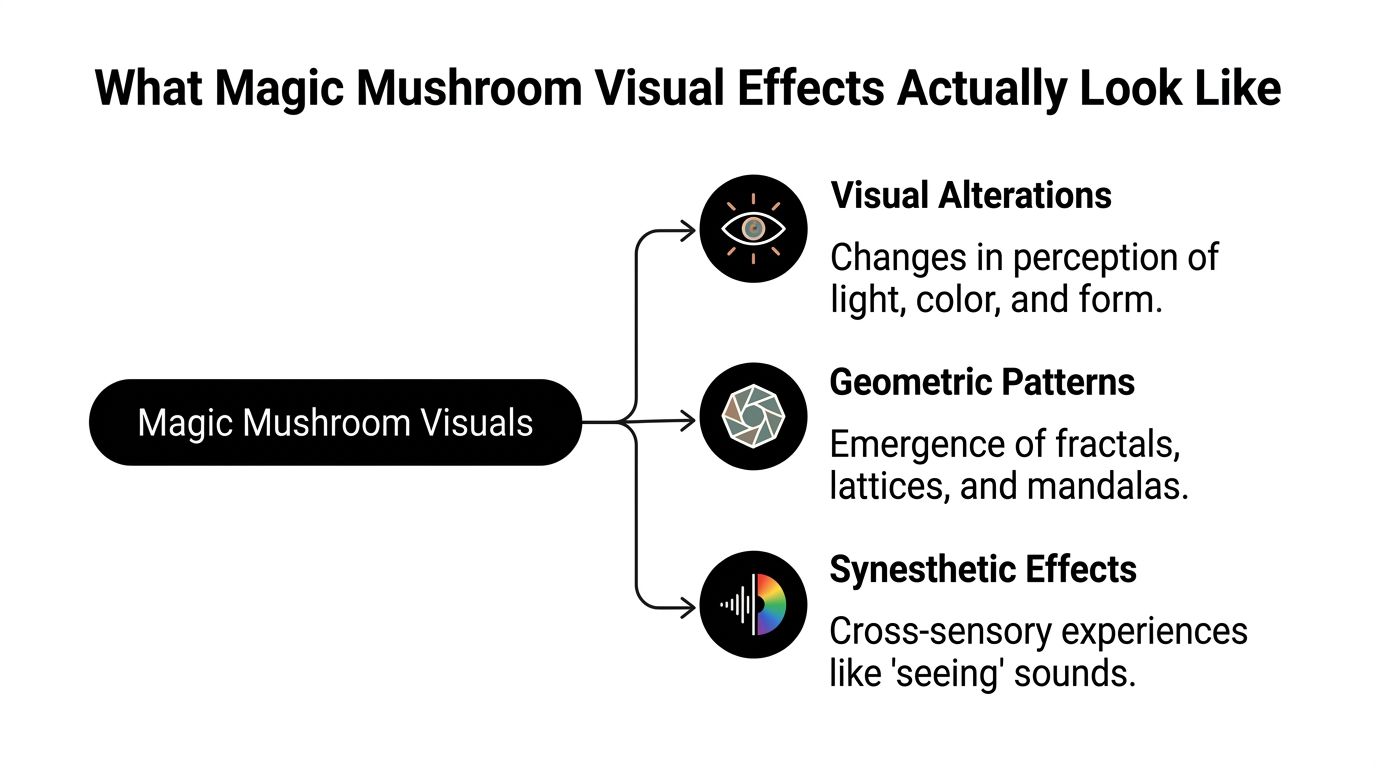
A first psilocybin session often starts with uncertainty before anything looks dramatic. The room may still look like the room, yet edges can seem too sharp, light can pick up extra texture, and familiar surfaces may pulse once attention settles on them. With eyes closed, the experience can shift into something more inward, a moving field of patterns, symbols, or scenes that feel self-generated and intensely real.
That range is why magic mushroom visual effects are better understood as a spectrum than as a single visual style. Some people mainly notice visual alterations, such as richer color, stronger contrast, lingering afterimages, or the sense that still objects are breathing. Others report geometric patterns or full closed-eye imagery, where the mind seems to generate its own images instead of relying only on the outside world.
The variation is the point. The same mushroom material can feel mild in one setting and overwhelming in another, and that does not mean someone used it incorrectly. Psilocybin can change how people see colors, shapes, or scenes, and it can also disrupt the ordinary sense of time and space, according to the National Institute on Drug Abuse. Brain imaging research in Nature, 2024 treated those experiences as a measurable brain response, not just a poetic description.
A U.S. survey also estimated that 2.8% of residents over age 12, about 8 million people, used psilocybin in the past year (Nature, 2024). That number does not explain what any one person will see, but it does show that these experiences are not rare enough to treat as a curiosity on the fringe.
Practical rule: separate mild enhancement, patterned imagery, and full scene-like hallucinations. They are related, but they do not look or feel identical.
Open-Eye Visuals, Closed-Eye Visuals, and Synesthesia
Open your eyes in a bright room after taking psilocybin, and the first changes are often subtle. Colors may look cleaner, textures can seem to move, and straight lines can start to ripple or bow. Some people also notice afterimages that hang around longer than expected, or a faint trail when a hand moves quickly.
Open-Eye Visuals
These changes are easy to overlook if someone expects a movie-style hallucination. A patterned carpet may seem to shimmer, or a face may look more expressive because the contrast around the eyes, lips, and hair feels sharper. When people describe “the walls breathing,” they are usually talking about a slow expansion and contraction of surfaces that are not moving.
Closed-Eye Visuals
Close your eyes, and the experience often shifts inward. The geometric patterns, lattices, fractal-like forms, and dreamlike scenes usually show up more clearly in this state. Recent brain-imaging work helps explain why this can happen, because it suggests psilocybin changes how visual information is organized and how strongly internally generated imagery takes over. The full details belong in the brain imaging section later, but the basic idea is simple, closing the eyes often removes outside input and gives the brain more room to generate its own images.
Synesthesia
Synesthesia comes up less often in casual conversation, but people report it often enough to matter. It means the senses start to overlap, so sound can feel visible, color can feel audible, or a voice can seem to have a shape. That does not mean the brain is broken. It means the usual boundaries between senses are looser than normal, especially during vivid sessions with strong environmental input.
A darker room tends to pull the experience inward. Brighter light, conversation, and movement keep more of the trip tied to the outside world.
The contrast matters. Open-eye effects are often shaped by the room, the music, and whatever the person is looking at. Closed-eye effects usually grow stronger when someone rests still and lets sensory input drop away. Synesthetic effects can appear in either state, but they are easier to notice when attention is calm and not being pulled in several directions at once.
How Dose, Tolerance, Strain, and Setting Shape the Visuals
The mushroom variety is often the first thing blamed, because it's the easiest label to see on a jar or menu. In practice, dose, tolerance, and setting usually matter more than a strain name. The idea that one label automatically means “visual” and another means “body-heavy” is too neat to be useful.
The controls that actually change the session
A low amount may bring color enhancement, slight motion in textures, or a sense that objects are more vivid than usual. A stronger amount is more likely to produce sustained patterning, deep internal imagery, and stronger disconnection from ordinary visual filters. Tolerance matters too, because repeated use can blunt the response for a while, even if the material itself hasn't changed.
Set and setting change the entire visual profile. A calm afternoon with soft lighting, familiar music, and no interruptions can make the same material feel spacious and absorbable. A crowded party, a harshly lit room, or an anxious mindset can make the same dose feel jagged, overstimulating, and harder to manage.
| Dose Band | Typical Visual Effects | Best For |
|---|---|---|
| Low | Mild color shift, texture enhancement, gentle movement in surfaces | Curious adults who want a softer visual profile |
| Moderate | Clearer patterning, stronger edge changes, more noticeable closed-eye imagery | People looking for a fuller psychedelic visual state |
| Higher | Vivid geometry, intense internal scenes, stronger distortion of ordinary objects | Experienced users in a controlled setting |
That table is only a rough map, not a promise. Two people can take the same amount and report very different visuals because their mood, attention, room, and expectations aren't the same. One of the most useful contrarian truths here is that the strain label is a weak predictor compared with what's happening in the body and the environment.
A calm room doesn't guarantee a gentle trip, but it gives the brain less noise to work with.
That's also why product form can matter in a practical sense. A chocolate bar or drink may be chosen for convenience and smoother pacing, while dried mushrooms can feel more direct and variable depending on the session. The visual outcome still depends on the same core levers, especially dose and context.
A Realistic Timeline of the Visual Experience
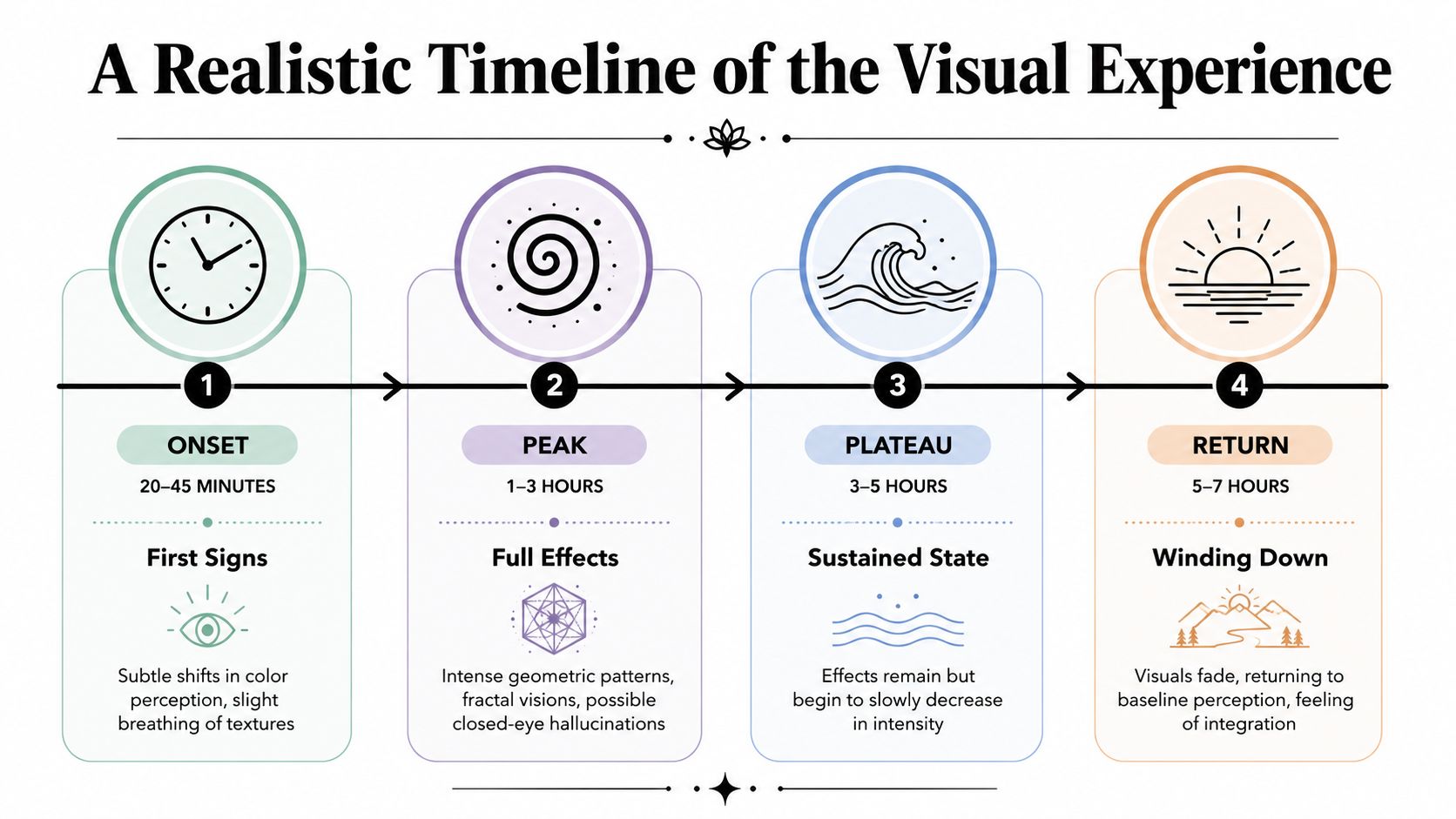
The visual side of a session usually unfolds gradually, not all at once. The first clue may be tiny, a slight shift in contrast or a sense that surfaces are less fixed than they were a few minutes earlier. Then the experience gathers momentum, peaks, and slowly softens rather than stopping abruptly.
The rough arc
The onset often brings the first perceptual shifts, usually subtle enough that someone may question whether anything is happening yet. The come-up is where visuals tend to become easier to notice, especially if the person is still, listening to music, or paying attention to surfaces and light. Around the peak, closed-eye imagery is often most vivid, and the visual world can feel fully transformed.
As the experience eases into the plateau and then the return, the most intense distortions fade first, but residual visual sensitivity can linger. That's why people often feel emotionally calmer before their vision feels completely normal again. The next day may bring a soft afterglow or a sense that the mind is still settling, especially after a more intense session.
For planning, a 4 to 6 hour window is a practical expectation for many psilocybin experiences, with variation based on product form and dose. This guide on how long psilocybin lasts is useful if you want a more operational view of timing and spacing. Drinks and edibles can feel smoother or slower to rise, so the early part of the timeline may be less predictable than people expect.
The main thing to remember is that visuals don't always peak at the same time as emotion. Someone can feel mentally grounded while still seeing strong patterning, or feel emotionally overwhelmed while the visuals are only moderate. Those timelines don't always match.
What Brain Imaging Tells Us About Why Visuals Happen
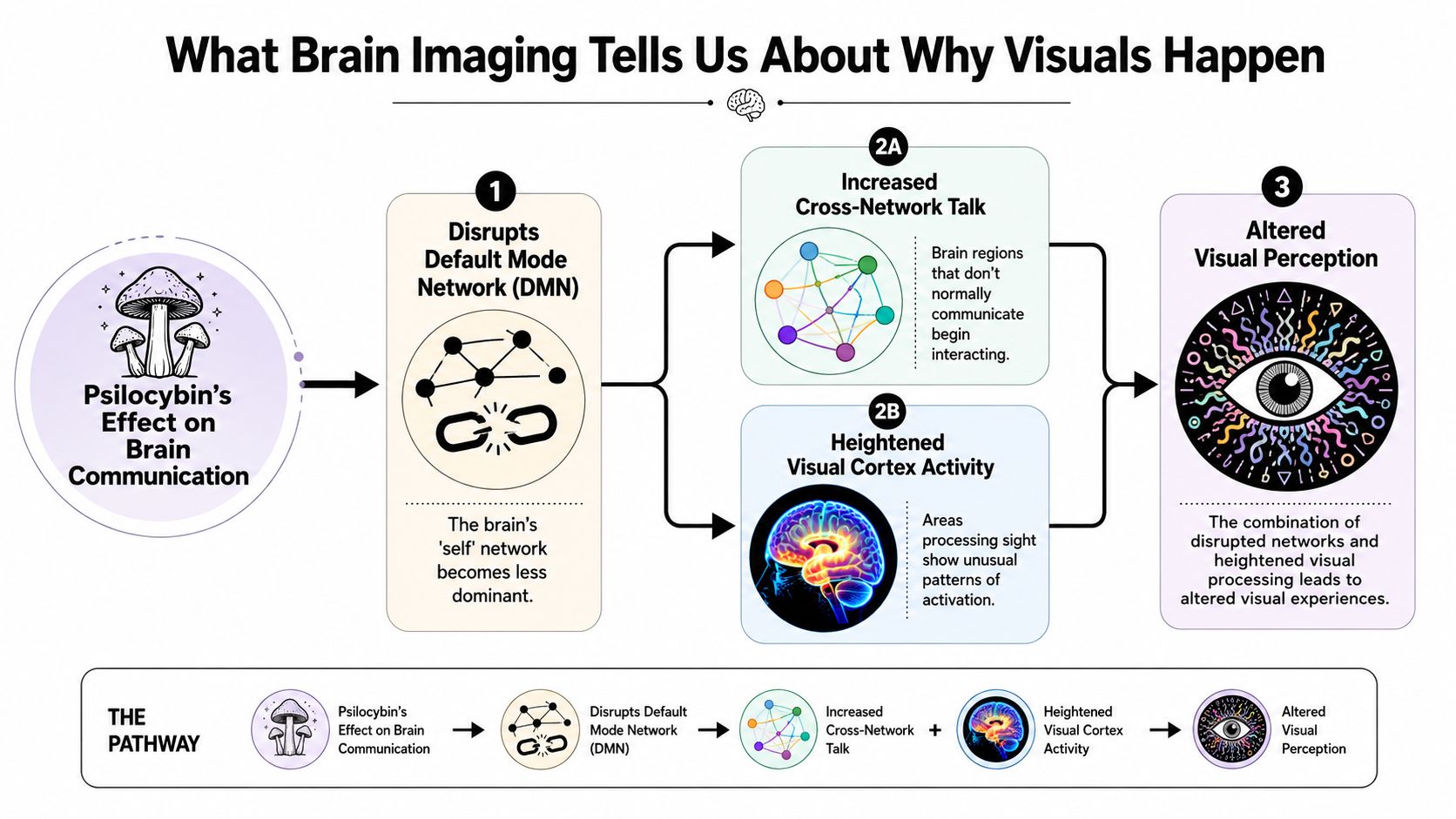
Brain imaging research from 2024 shows that psilocybin loosens coordination between networks that normally filter sensory input and keep the sense of self steady. That helps explain why visuals can feel less like a fixed picture and more like something the brain is assembling in real time. A fuller look at how psilocybin affects the brain helps connect those scan results to the experience people notice.
What the scans point to
The scan findings point to a brain that is responding differently to input, especially in the visual system. In psilocybin research, this shows up as weaker filtering of incoming signals and looser coordination between visual regions. The practical result is easier to describe than the technical terms. Edges can seem to shimmer, patterns can feel unusually alive, and closed-eye imagery can become much more detailed.
That also helps explain why two sessions can look very different from each other. If the brain is relying less on ordinary sensory filtering, a room may seem busier, brighter, or more textured than usual. If internally generated activity has more influence, closed-eye scenes can become vivid enough to feel almost like a dream unfolding while awake.
The controlled vision study highlighted by UC Berkeley and published in the Journal of Vision points in the same direction. In that pilot randomized controlled trial of 6 healthy volunteers, a high dose of psilocybin increased contrast surround suppression by about 7% versus placebo (Journal of Vision). UC Berkeley describes that finding as an important step toward explaining psychedelic visual effects because surround suppression is one way the brain decides which visual signals stand out and which ones get blended into the background (UC Berkeley).
This is why the question is not just what the visuals look like. It is why they vary so much. Dose changes how strongly the system is affected, eyes-open and eyes-closed states change what kind of input the brain has to work with, and recent imaging work suggests that psilocybin shifts the balance between outside sensory data and the brain's own internal predictions. When that balance moves, the same person can have a subtle patterning session one time and a much more immersive visual session another time.
That is also why strain myths do not explain much on their own. The experience is shaped more by dose, context, and the brain's current state than by a simple promise that one mushroom type will always produce one exact kind of visual effect. Variability is part of the effect itself, not a side issue.
The visual system is not just showing pictures. It is changing how it decides what counts as signal.
Preparing for and Managing Visual Effects Safely
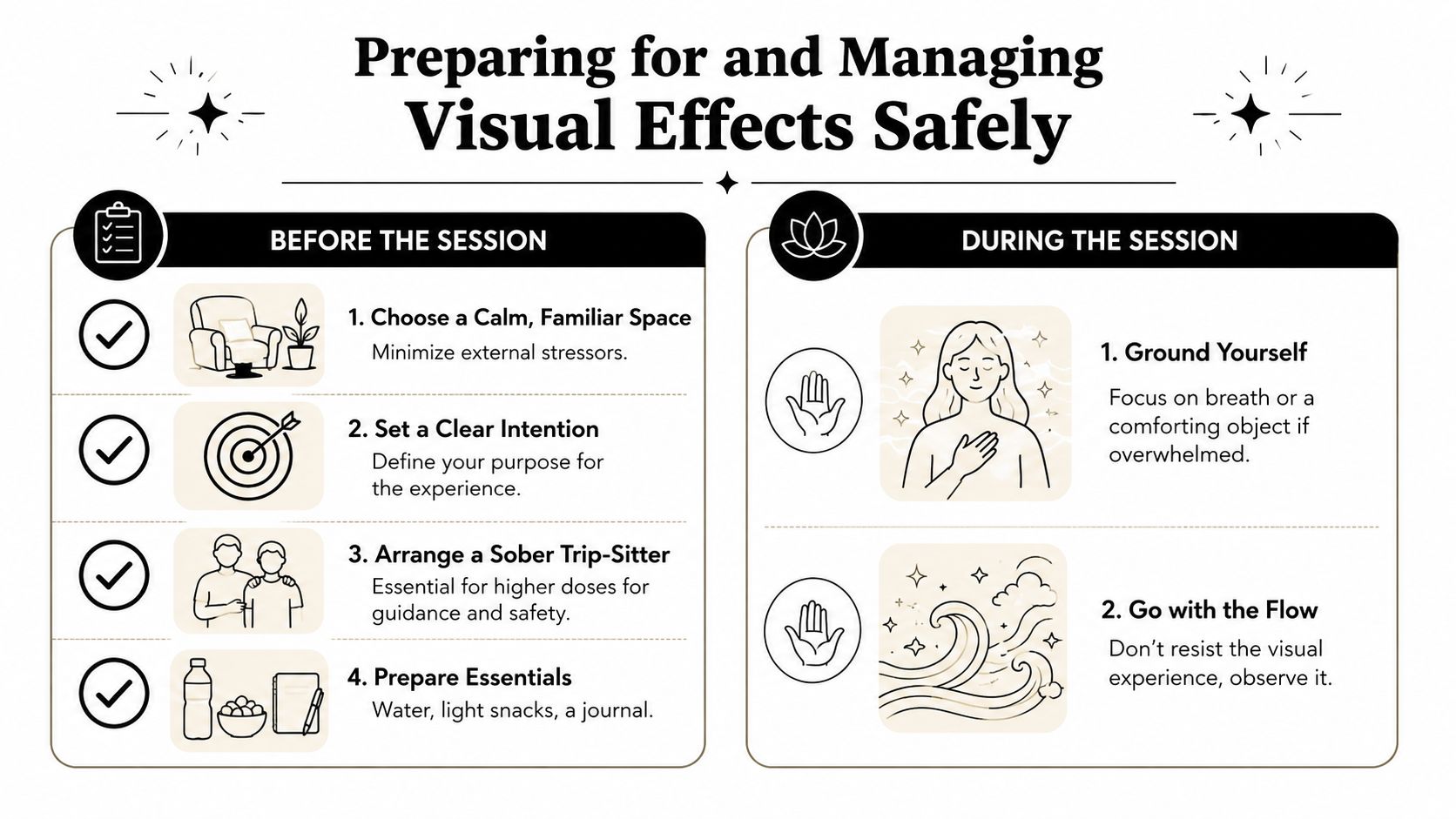
A calm setup reduces the odds that visuals become overwhelming. Start with a familiar room, good hydration, and enough time that nobody needs to drive or handle responsibilities afterward. If the dose is higher, a sober or experienced trip-sitter can help with orientation, reassurance, and basic safety if the visuals get intense.
Before the session
- Choose a calm, familiar space. Lower the chance that outside noise, strangers, or clutter will hijack attention.
- Set a clear intention. Keep it simple, like rest, curiosity, or personal reflection.
- Arrange a sober trip-sitter for higher doses. A calm person nearby can make a big difference if the room starts to feel strange.
- Prepare essentials. Water, light snacks, and a soft eye mask are worth having close by.
During the session
- Ground yourself. Slow breathing, a familiar object, or changing rooms can soften a spike in intensity.
- Adjust the sensory load. Dim the lights, change the music, or close the eyes if the room feels too busy.
- Don't fight the visuals. Resistance often makes them feel louder. Observation is usually easier than control.
If the visuals turn distressing, shift the body first. Sit down, change posture, or move to a quieter space. If you want a deeper harm-reduction checklist, this guide on avoiding bad trips is a useful companion.
Afterward, keep the rest of the day light. Water, food, sleep, and some quiet time are usually better than trying to process everything immediately. Strong sessions can leave the mind feeling porous for a while, so gentle aftercare helps the experience settle.
Common Myths About Magic Mushroom Visual Effects
One of the biggest myths is that a stronger strain automatically means stronger visuals. That framing is too crude, because dose and setting do more of the work than the label on the container. Strain names can be useful shorthand, but they're not destiny.
Another myth says that if someone doesn't see fractals, the mushroom didn't work. That's not true. Visual effects can start with richer color, sharper edges, or a mild sense of motion before they ever become geometric or scene-like.
Edibles and drinks get dismissed too often, as if only dried mushrooms can create visuals. In reality, product form changes the pace and feel, not the basic ability to produce visuals. A smoother onset can even make the visual changes easier to notice because the rise feels less abrupt.
Tolerance gets misunderstood in a similar way. People assume a day or two is enough for a full reset, but psilocybin tolerance can build quickly, and the body doesn't always return to baseline that fast. That's one reason repeated sessions can feel flatter than expected, even when the amount seems similar.
The accurate mental model is simpler. Visuals vary because brain state, dose, environment, and the type of sensory input all change together. Once you accept that, the experience becomes easier to plan for and less likely to be explained by mushroom folklore.
Frequently Asked Questions About Psilocybin Visuals
How long do the visuals last? Usually they rise, peak, and fade over the course of the broader session rather than disappearing suddenly. The visual part can linger a bit after the emotional intensity starts easing.
Can a microdose cause visuals? It can cause subtle changes for some people, like brighter color or mild texture enhancement, but it usually doesn't produce the intense geometric imagery people associate with a full trip.
Are visuals the same every time? No. The same person can have a very different session depending on dose, mood, light level, and whether the eyes stay open or closed.
What should a first-timer expect? Expect variation, not a single guaranteed look. The earliest changes are often gentle, then the visuals can become more noticeable if the environment is quiet and the dose is strong enough.
Adults in the Detroit and Ann Arbor area who want to compare low-dose chocolates, drinks, and traditional strains can browse Metro Mush's menu, text an order, and check current promotions through the brand's local service options.
If you want a practical next step, visit Metro Mush to browse adult-use psilocybin options, compare low-dose chocolates and drinks with traditional strains, and place an order by text with local Detroit and Ann Arbor support. If you're trying to match product choice to the kind of visuals you want, their menu gives you a straightforward way to explore those differences without the guesswork.