

You're back home in Ann Arbor. The lights are normal again. The music is off. Maybe you had a chocolate bar, maybe a drink, maybe a modest dose that didn't send you into another universe but still left you feeling different in a way you can't quite explain.
Maybe you feel softer. Maybe more emotional. Maybe weirdly clear. Maybe nothing dramatic happened at all, but the next morning you noticed you were less reactive with your partner, more tuned in during a walk through the Arb, or suddenly aware that you've been avoiding a hard truth for a long time.
That in-between state is where a lot of people get stuck.
Most psilocybin integration advice is written for clinical therapy or high-dose ceremonial experiences, not for people using lower-dose edibles and drinks. That gap matters. Harm-reduction organizations report that 60–70% of psychedelic support line callers feel confused about what to do after even mild experiences, according to ADAA's discussion of the psychedelic therapy journey. If that sounds familiar, you're not doing anything wrong. You're running into a real blind spot in the current conversation.
The Journey After the Journey Begins
A lot of people expect psilocybin to work like a movie scene. You have one big realization, cry, hug somebody, and wake up transformed.
Real life is usually quieter than that.
For many non-clinical users, especially people trying low-to-moderate dose products, the experience doesn't arrive as one huge revelation. It shows up sideways. You feel unusually patient in traffic on Washtenaw. You notice your phone habits suddenly feel gross. You realize your body relaxes for the first time in months. Or you feel tender and unsettled without knowing why.
That's where psilocybin integration starts. It's the process of helping your everyday mind catch up with what your experience stirred up.
Why mild experiences still need care
People often assume integration is only for intense journeys. But subtle experiences can be harder to work with because they don't come with a neat story. If you saw vivid imagery for hours, you know something happened. If you just feel “a little different,” it's easier to dismiss.
Mild doesn't mean meaningless. A small shift in how you relate to stress, sleep, grief, or self-talk can matter more than a dramatic night.
This is especially relevant for people using edibles and drinks outside a formal therapeutic setting. You may not have a clinician helping you process what came up. You may not even know whether what you felt “counts.”
It counts if it changed how you feel, think, or behave.
What integration looks like in ordinary life
Integration isn't about forcing deep spiritual language onto every experience. It's about asking simple questions:
- What changed: Did anything feel different in your mood, body, or perspective?
- What stayed with you: Was there one thought, image, memory, or feeling that kept returning?
- What needs attention: Did the experience highlight rest, boundaries, grief, creativity, or relationships?
- What belongs in action: Is there one small thing you want to do differently this week?
For someone in Southeast Michigan, integration might look less like “decoding a mystical vision” and more like taking a quiet walk by the Huron River, journaling at a coffee shop, speaking openly with a trusted friend, or noticing that your nervous system finally slowed down enough to tell you the truth.
What Exactly Is Psilocybin Integration
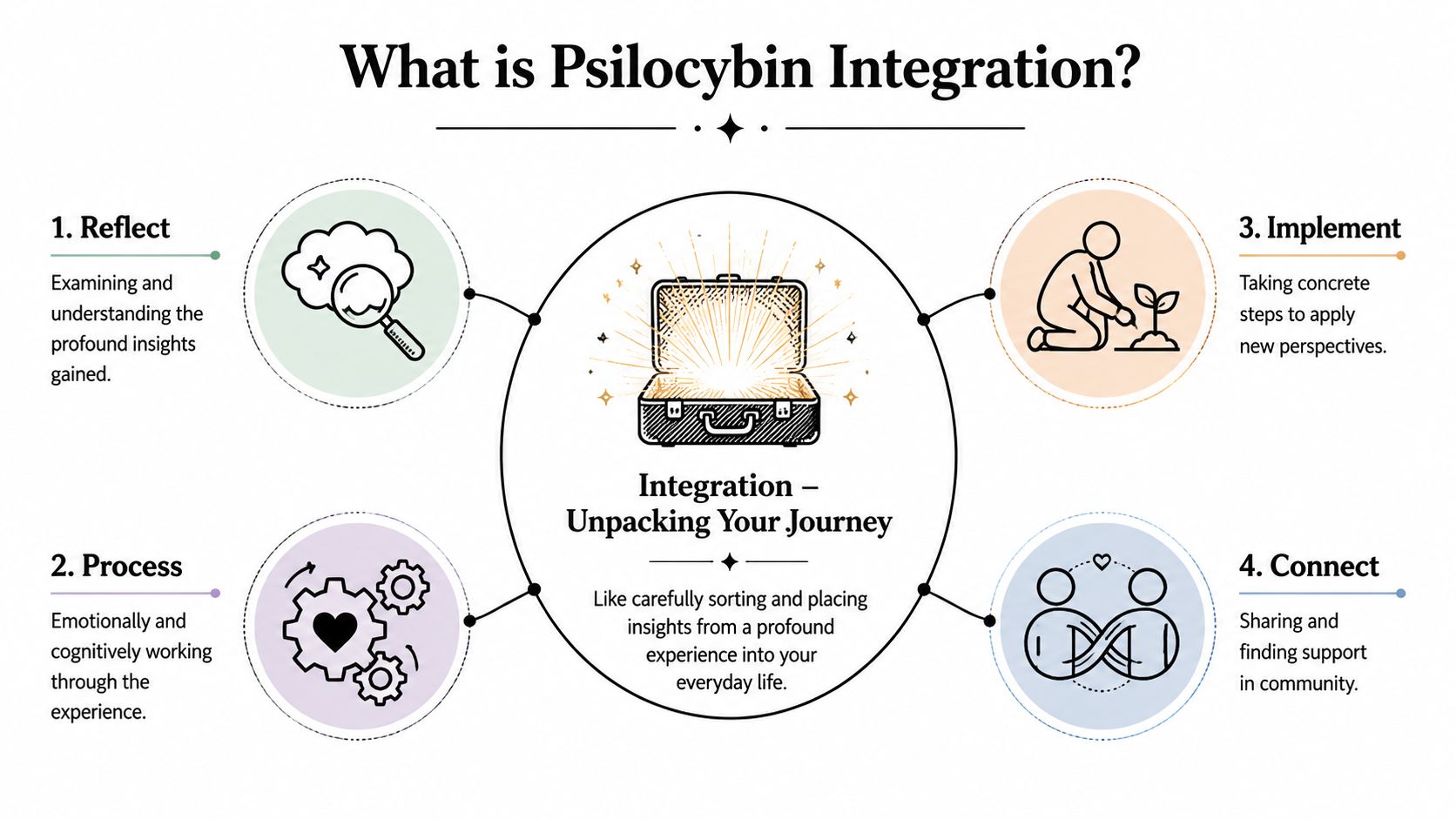
The easiest way to understand integration is this. You've come home from a meaningful trip, and now your suitcase is open on the floor.
Inside it are memories, emotions, little souvenirs, and a few things you don't fully understand yet. Integration is the process of unpacking that suitcase carefully instead of leaving everything crumpled inside until the experience fades.
It's not just thinking about the trip
People sometimes reduce integration to journaling once and moving on. Reflection helps, but integration is broader than that. It includes emotional processing, body awareness, behavior change, and support from other people when needed.
In clinical settings, this phase is taken seriously. A review of psilocybin-assisted psychotherapy describes integration as part of a structured protocol that includes at least one session within 24–72 hours after dosing, with the goal of turning acute insights into lasting behavioral change. The same review notes that outcomes are linked to the quality of this post-dose processing, as described in this clinical overview published in PMC.
That doesn't mean you need a formal therapist session every time. It means the principle is solid. What happens after the experience matters.
Four simple parts of integration
You can think of psilocybin integration as four connected moves.
Reflect
Slow down enough to notice what happened. Not what you hoped would happen, and not what social media says should have happened.Process
Let feelings, memories, or confusion become more coherent. This may happen through writing, talking, drawing, walking, or through quiet sitting.Implement
Translate the experience into one concrete shift. Better sleep boundaries. A harder conversation. Less doomscrolling. More time outside.Connect
Bring the experience into relationship. That could mean a trusted friend, a therapist, a meditation group, or a grounded community space.
Practical rule: If an insight can't survive contact with your calendar, your habits, and your relationships, it hasn't been integrated yet.
Why people get confused
A lot of users expect integration to feel profound and polished. Often it feels ordinary. You might realize you've been exhausted. You might stop tolerating something that drains you. You might notice that your body says “no” before your mind catches up.
That's still real work. In fact, for low-to-moderate dose users, that kind of quiet clarity is often the whole point.
Why Integration Is Critical for Lasting Change
Psilocybin can open a door. Integration determines whether that opening changes your life or becomes a vivid memory you talk about once and never use.
The clearest reason to take integration seriously comes from clinical work. In a Johns Hopkins trial, 71% of participants who received two doses of psilocybin showed a clinically significant response one month later, and 54% achieved remission, according to Johns Hopkins' history of psychedelic research. Those kinds of outcomes didn't happen in a vacuum. They came in a setting where support and post-experience processing were part of the treatment.
For a broader look at how psilocybin affects the mind and why post-experience habits matter, this overview of psilocybin effects on the brain is a useful companion.
A state change isn't the same as a life change
A psilocybin experience can temporarily make you feel more open, less defended, or more connected. But temporary openness doesn't automatically become a new way of living.
Without follow-through, people often lose the thread. They remember that they “realized something important,” but the insight fades because nothing in daily life changed around it.
That's why integration matters so much. It helps convert a brief altered state into a stable pattern.
Psychological flexibility is part of the story
Researchers have also found lasting increases in psychological flexibility after psilocybin. Johns Hopkins reports significant improvement at 2 weeks and that this effect was maintained for 3 months compared with placebo, with 50% of participants in one major depression trial reaching remission at the 4-week follow-up. The same research summary notes substantial antidepressant effects that persisted for at least one year in long-term follow-ups, as described by Johns Hopkins Medicine psychedelic research.
In plain language, psychological flexibility means you're less trapped by rigid habits of thought. You may have a little more room to respond instead of react.
That room is precious. Integration is how you use it.
What lasting change usually looks like
It rarely looks dramatic at first. More often, it shows up like this:
- A pause before an old pattern: You notice you're about to spiral, shut down, or people-please.
- More honesty: You can admit what you feel without immediately defending against it.
- Better alignment: Your choices start matching what you said mattered during the experience.
- More consistency: You don't need to keep chasing the feeling because you're building the lesson into ordinary life.
The experience may be the spark. Integration is the part that keeps the fire from going out.
Your Practical Framework for Integration
If you're on your own after a low-to-moderate dose experience, structure helps. Not rigid structure. Just enough shape that you don't lose what was meaningful or overwhelm yourself by trying to “figure it all out” in one sitting.
A harm-reduction mindset helps here. If you want a grounded primer on that approach, this guide on what harm reduction means in practice is worth reading alongside your integration work.
Immediate aftercare
The first stretch after the experience is for settling, not solving.
Your job is simple. Reduce noise. Get hydrated. Rest. Let the dust settle before you decide what it all meant.
A few helpful moves:
- Write raw notes: Jot down phrases, images, body sensations, or feelings before they disappear.
- Keep stimulation low: Less scrolling, less group chat analysis, less pressure to explain yourself.
- Eat and sleep normally: Basic regulation supports clear reflection.
- Notice your body: Tension, softness, fatigue, relief, and tears can all be information.
If the experience felt subtle, don't force profundity. “I felt calmer than usual” is a valid thing to record.
Weekly integration work
After the immediate aftercare phase, it helps to give your reflections a container. Not every day has to be deep. What matters is repeated contact with what surfaced.
Here are practices that work well for non-clinical users.
Journaling that actually helps
Skip the pressure to write something beautiful. Answer one or two direct prompts:
- What stayed with me?
- What felt newly true?
- What felt unfinished?
- What part of my life did this point toward?
- What am I avoiding now that feels harder to ignore?
Creative expression
Some experiences don't become clear through analysis. Try sketching shapes or scenes, building a playlist, moving your body to music, or describing the experience in colors instead of arguments.
This is especially useful when the shift was more emotional than verbal.
Somatic practices
Body-based work can anchor insights that otherwise stay abstract. Gentle stretching, walking, slower breathing, and body scans can help connect the experience to your nervous system rather than keeping it stuck in your head.
If you can name the insight but your body is still living the old pattern, keep working at the body level too.
Sample Psilocybin Integration Timeline
| Timeframe | Focus | Suggested Activities |
|---|---|---|
| First few days | Rest and capture | Sleep, hydrate, short notes, quiet walks, low stimulation |
| First couple of weeks | Meaning making | Journal prompts, talk with a trusted person, creative reflection, body awareness |
| Later in the month | Behavior change | Choose one habit shift, one boundary, or one honest conversation |
| Ongoing | Reinforcement | Revisit notes, continue supportive practices, check whether actions match insights |
Ongoing integration
The best long-term integration is modest and repeatable.
Try picking one thread from the experience and living with it for a while. Maybe the thread is rest. Maybe it's honesty. Maybe it's grief, self-respect, or play.
A useful check-in is to ask yourself once a week:
- What from that experience still feels alive?
- What action have I taken because of it?
- What am I pretending not to know?
If nothing feels clear yet, that's okay. Integration isn't a performance. Some experiences ripen slowly.
Navigating Common Integration Challenges
A lot of integration advice sounds too clean. It suggests that after psilocybin, you feel open, grateful, and steadily improved.
That's not how it works for everyone.

Researchers report that 30–40% of users experience a temporary worsening of mood or identity confusion 2–4 weeks after a journey. This period is often called the integration dip. The same source notes that somatic practices such as body scans can reduce the duration of that dip, according to True North Psychology's article on integration beyond the journey.
The dip doesn't mean you failed
The integration dip can feel like emotional whiplash. At first you may feel open or inspired. Then, later, you feel flat, confused, irritable, or uncertain about who you are becoming.
That doesn't mean the experience was fake. Often it means the afterglow wore off and the actual work became visible.
Common signs include:
- Mood wobble: You feel more sensitive, teary, or discouraged than expected.
- Identity friction: Old roles no longer fit, but new clarity hasn't settled yet.
- Insight overload: You saw too much at once and don't know where to begin.
- Impatience: You want lasting change immediately and judge yourself when it's slower.
What helps when you feel unsteady
When people hit this phase, they often make things harder by over-interpreting every emotion. Simpler is better.
Try this short response plan:
- Return to basics: Sleep, food, hydration, and routine first.
- Use grounding over analysis: Feel your feet, scan the body, step outside, slow your breath.
- Shrink the task: Don't integrate your whole life. Work with one issue.
- Lower the storytelling: “I'm having a rough patch” is often more accurate than “I broke my brain.”
This short video can also help frame the emotional side of post-journey processing.
When to seek extra support
If you feel persistently overwhelmed, frightened by what surfaced, or unable to function in daily life, get support from a qualified mental health professional. Integration is not supposed to be solitary suffering.
Some discomfort is part of growth. Ongoing destabilization deserves care.
For many people, especially low-dose users, the challenge isn't a crisis. It's ambiguity. You don't know whether what you felt was important. That uncertainty itself can be integrated. Stay curious, stay gentle, and let the experience become clearer over time.
Local Integration Resources for Detroit and Ann Arbor
Integration gets easier when it leaves your head and enters a real place with real people. For readers in Southeast Michigan, that means building support close to home.
Start with grounded community
You don't need a dramatic “psychedelic scene” to integrate well. Many people do better with ordinary, steady spaces where reflection is welcome.
Look for:
- Meditation groups: Ann Arbor has plenty of mindfulness-oriented spaces where you can practice sitting with experience without overreacting to it.
- Yoga studios: Body-based classes can help if your experience left you emotionally stirred up or physically tense.
- Nature-based routines: Regular walks in Nichols Arboretum, Gallup Park, or along the river can support slower processing.
- Peer conversation: One thoughtful friend can be more useful than ten strangers with opinions.
Find professional support when needed
If your experience brought up grief, anxiety, identity confusion, or relationship issues, an integration-informed therapist can help. You don't need someone to validate every symbolic detail. You need someone who can help you connect the experience to your actual life.
When searching, terms like “psychedelic integration,” “harm reduction,” “somatic therapy,” and “trauma-informed” can help narrow the field.
If you're also looking for a local starting point for the broader mushroom conversation in Southeast Michigan, this guide to mycology near me in Detroit and Ann Arbor can help you orient yourself to the area's mushroom culture.
Use online spaces carefully
Online communities can be helpful, especially when you want to compare notes or ask practical questions. They can also be noisy. The best spaces support reflection, safety, and personal responsibility. The worst ones push bigger doses, oversimplified advice, or spiritual one-upmanship.
A good local community space should help you do three things:
- Ask honest questions.
- Normalize mixed feelings.
- Turn insight into action.
That's the true test.
Weaving Your Insights into Daily Life
The primary aim of psilocybin integration isn't to preserve a special mood. It's to let your experience improve how you live when nothing psychedelic is happening.
That matters whether your session was intense or barely noticeable. A deep journey can change you. So can a gentle chocolate experience that helps you finally notice your exhaustion, your tenderness, or your need for a different pace.
What matters is what you do next.
If you felt more compassion, practice it when you mess up. If you saw that your schedule is crushing you, change something on Tuesday, not just in your journal. If you touched grief, make room for it in a way your body can tolerate. If you sensed more connection to nature, bring that into your week in a concrete way.
Psilocybin integration works best when it gets small enough to live.
You don't need to become a different person overnight. You need to become a little more honest, a little more embodied, and a little more aligned with what you already know.
That's why the process matters so much for non-clinical users. Lower-dose edibles and drinks can produce experiences that are easy to minimize because they don't always arrive with fireworks. But subtle doesn't mean shallow. Sometimes the smallest shift is the one that lasts because you can build a life around it.
A meaningful journey doesn't end when the sensation fades. It continues in your habits, your relationships, your choices, and your willingness to listen when something inside you whispers, this matters.
If you're looking for a thoughtful place to begin, Metro Mush offers adult consumers in the Detroit and Ann Arbor area access to curated psilocybin products, including approachable edibles and drinks that many people use for lower-intensity experiences. Browse the menu, learn the basics, and start with the same mindset that supports good integration afterward. Intention, quality, and care matter from the first step.