

You might be reading this because you're curious, but not casual about it. Maybe you're considering psilocybin for the first time. Maybe you've had one strong experience already and don't want to stumble into a frightening second one. Or maybe a friend used the phrase "bad trip," and now your mind is filling in the blanks.
That reaction makes sense. Psychedelics can bring wonder, insight, beauty, and emotional release. They can also bring fear, confusion, and a feeling that your own mind has become unfamiliar. Knowing that before you begin isn't pessimistic. It's responsible.
A calm, informed approach lowers risk. It also gives you something better than blind confidence. It gives you orientation. If a difficult moment happens, you'll be more likely to recognize it, respond safely, and avoid making it worse through panic.
The Question on Every Explorer's Mind
Many asking what is a bad trip aren't only asking for a definition. They're asking something more personal.
They want to know, "What could happen to me?"
They want to know, "How would I tell the difference between a hard moment and a dangerous one?"
And often, they want to know, "Can I prepare in a way that makes this less likely?"
Those are good questions. Psychedelic education works best when it treats people as capable adults who need clear information, not scare tactics. A bad trip isn't proof that someone is reckless, weak, or "can't handle it." More often, it's a sign that a powerful experience met a vulnerable mind, a stressful environment, or an unpredictable dose.
That matters because it shifts the conversation from shame to safety.
Practical rule: The safest people aren't the ones who assume they'll be fine. They're the ones who prepare for the possibility that they might not feel fine for a while.
A lot of confusion comes from how loose the term is. Some people use "bad trip" to mean any uncomfortable moment. Others reserve it for experiences that feel overwhelming, traumatic, or hard to recover from. Those aren't the same thing. If you lump them together, you either overreact to normal difficulty or underestimate something serious.
There's another piece many guides skip. A difficult psychedelic experience doesn't always end when the acute effects wear off. Some people feel shaken, emotionally raw, detached, or anxious afterward. At the same time, not every frightening experience is meaningless. In the right setting, with the right support, distress can sometimes reveal something important.
That tension is worth understanding. A bad trip can be both a safety issue and, sometimes, a turning point. Both can be true.
Defining a Challenging Psychedelic Experience
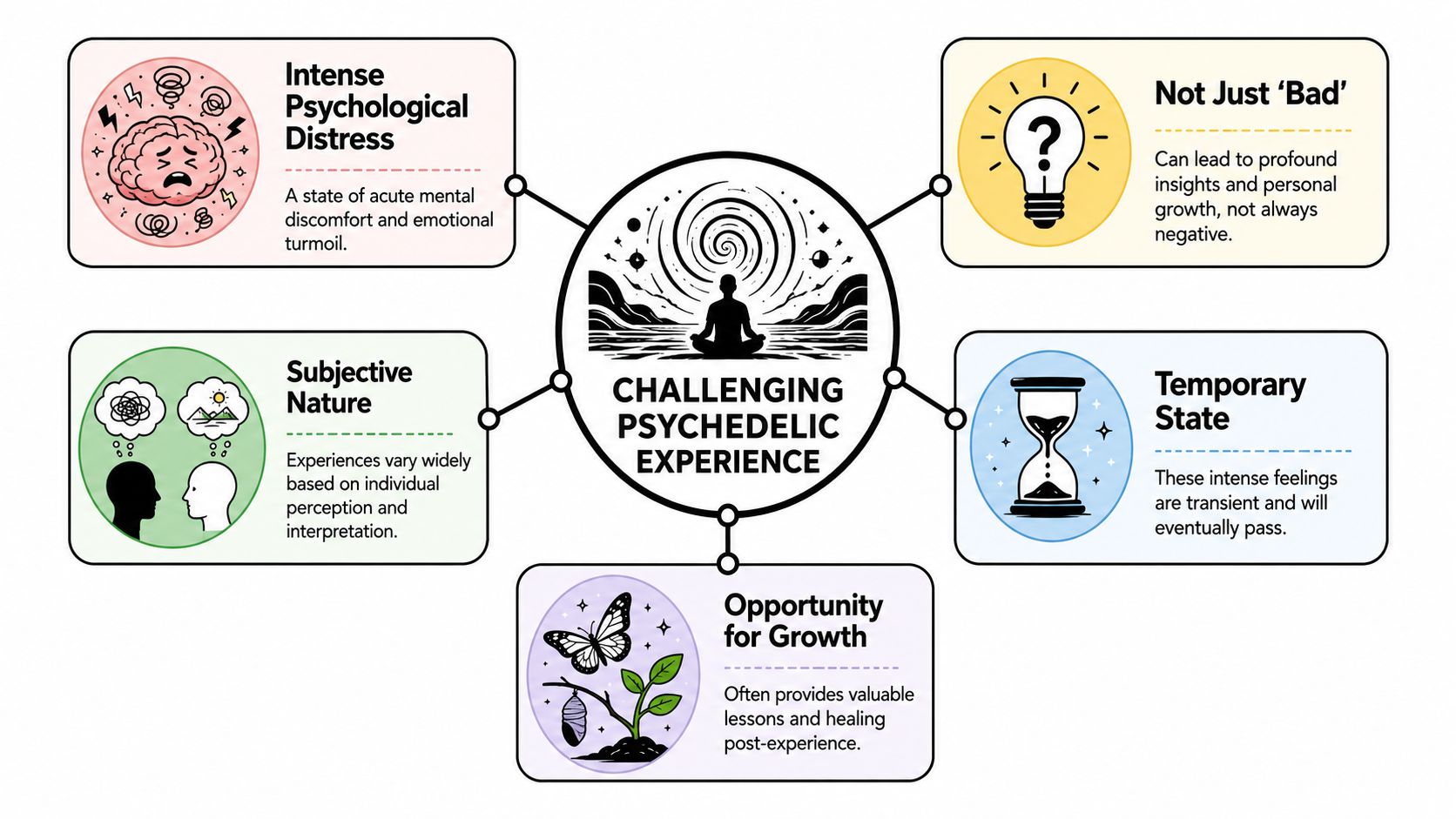
A bad trip is best understood as a period of intense psychological distress during a psychedelic experience. The person may feel terrified, trapped, suspicious, emotionally flooded, or unable to regain a sense of stability. The core problem isn't that unusual things are happening. Psychedelics often bring unusual thoughts and perceptions. The problem is that those changes start to feel unmanageable.
Challenging doesn't always mean harmful
It helps to think of psychedelic difficulty on a spectrum.
A challenging trip can involve crying, confronting painful memories, feeling temporary confusion, or moving through fear that eventually softens into insight. A bad trip, in the more serious sense, tends to feel overwhelming rather than workable. The person may lose the ability to stay oriented, trust the people around them, or remember that the state is temporary.
A simple analogy helps. Turbulence on a flight can be upsetting, even intense, but the plane is still flying. A more severe bad trip feels like the passenger is convinced the plane is going down, even if the situation is still recoverable with support.
It's a state, not a fixed category
Readers often get tangled in the belief that a trip is either good or bad from the start. In reality, the same experience can shift over time.
Someone might begin with awe, then slide into fear, then recover into calm. Another person might start anxious, settle after reassurance, and later describe the whole experience as valuable. The label often gets assigned afterward, once the person has made meaning of what happened.
That subjectivity is important. Two people can take the same substance in the same room and have very different reactions. One person sees dissolving boundaries and feels peace. Another feels panic because their normal sense of self is fading.
A difficult psychedelic experience is often less about what appears and more about whether the person can relate to it with enough safety, support, and trust.
Why language matters
Some educators prefer the phrase challenging psychedelic experience because it leaves room for nuance. That's useful. But plain language matters too, and people do search for what is a bad trip because they're scared and want direct answers.
So the honest answer is this. A bad trip is a psychedelic experience marked by distress that feels too intense, too confusing, or too destabilizing to manage comfortably in the moment. Sometimes it passes cleanly. Sometimes it leaves emotional residue. Sometimes, with careful support, it becomes a source of insight later.
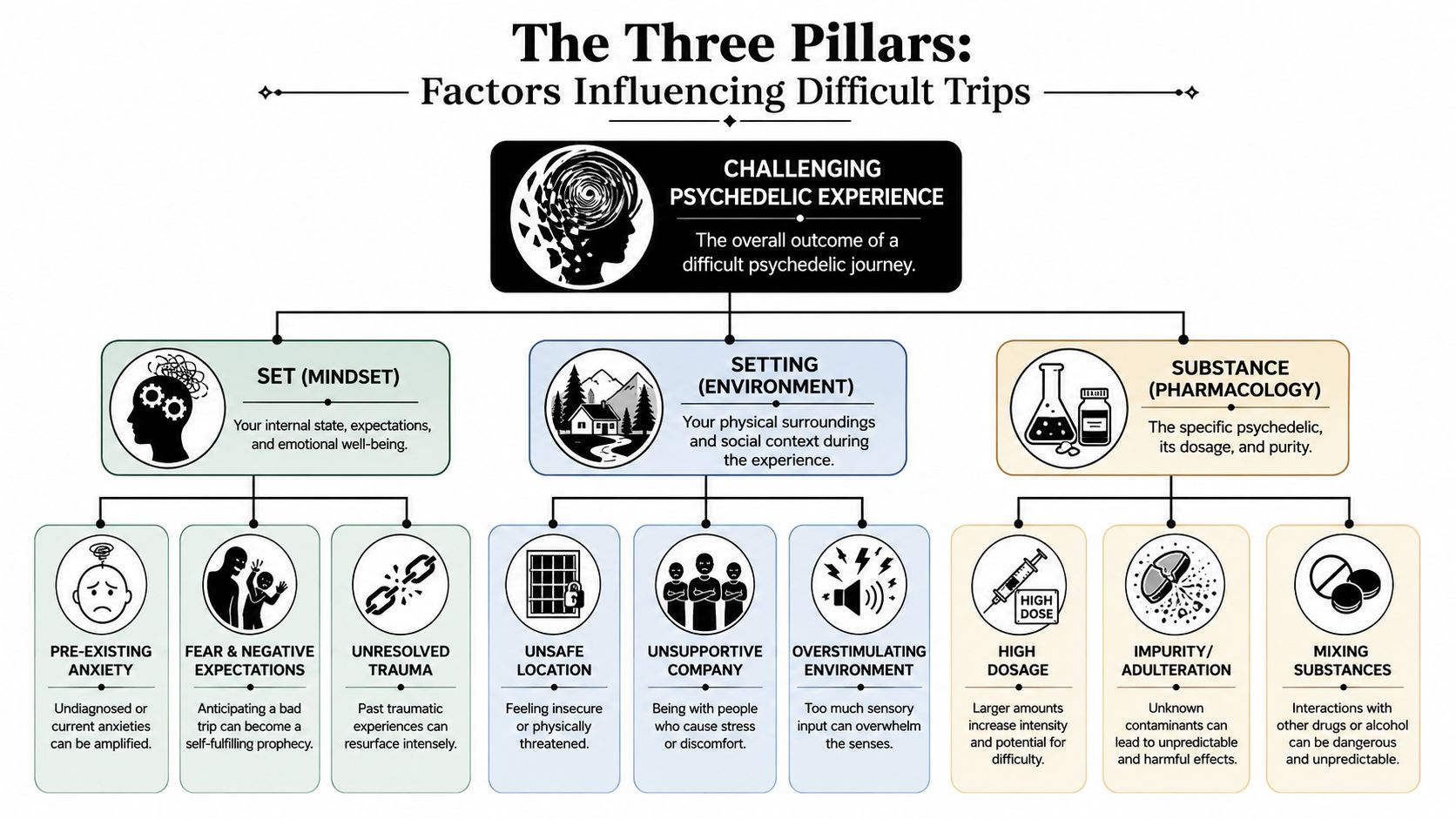
The Three Pillars What Causes a Bad Trip
A difficult trip usually develops the way a storm does. One factor may be manageable on its own. But if your inner state is strained, the environment feels unsafe, and the dose is stronger than expected, the mind can lose its footing fast.
That is why harm reduction often comes back to three pillars: set, setting, and substance. Together, they explain why one experience feels meaningful and contained, while another becomes frightening or confusing. They also help explain something many people miss. The hard part is not always limited to the 4 to 8 hours of the acute trip. If the experience feels overwhelming or destabilizing, the aftereffects can linger and need care afterward.
Set means your inner state
"Set" is the psychological weather you bring in with you. It includes mood, stress, expectations, recent losses, unresolved fear, and how safe you feel in your own mind before anything starts.
Psychedelics often loosen ordinary mental filters. Thoughts can feel louder. Emotions can feel less contained. A guide to how psilocybin affects the brain can help explain why perception, emotion, and self-awareness may become more fluid during the experience.
If someone starts out exhausted, ashamed, grief-stricken, or terrified of losing control, those states may become the material of the trip. Fear of a bad trip can also feed the experience itself. A racing heartbeat becomes "proof" that something is terribly wrong. Confusion becomes "proof" that the person is breaking. The mind starts interpreting normal psychedelic effects through a threat lens.
A better preparation question is simple: What am I already carrying today?
Setting means the room, the people, and the tone
Setting is the container. It includes the physical space, the people present, the noise level, privacy, lighting, and whether the person feels watched, rushed, or interrupted.
A crowded party can be too much. So can a tense conversation, a stranger's stare, constant phone alerts, or the sense that you might have to act sober at any moment. Under a psychedelic, small discomforts can expand quickly. The room feels brighter, voices feel sharper, and uncertainty spreads.
A calm setting does not guarantee an easy trip. It does reduce avoidable pressure and gives the person fewer threats to organize around.
This short video explains how environment and mindset affect the experience:
Substance means what you took and how much
The third pillar is the drug itself. What was taken, how much was taken, whether the dose was understood correctly, and whether anything else was mixed in all matter.
Dose is a common turning point. A person may feel prepared for "stronger visuals" and not realize that a higher dose can also bring ego dissolution, confusion, time distortion, and much less ability to reassure themselves. That can feel less like insight and more like free-fall if it arrives too fast.
Unknown potency adds uncertainty. Mixed substances add more. Alcohol, cannabis, stimulants, or other drugs can make the experience harder to predict and harder to settle.
Here is a simple way to view the three pillars together:
| Pillar | Main question | Example risk |
|---|---|---|
| Set | How am I doing internally? | Fresh stress, dread, grief, shame, or unresolved fear |
| Setting | Do I feel safe where I am? | Chaotic room, conflict, overstimulation, lack of privacy |
| Substance | Do I know what and how much I took? | Unclear dose, high potency, mixed substances |
These pillars are useful because they shift the conversation away from blame. A bad trip is rarely about being weak or "doing psychedelics wrong." It is usually an interaction between a vulnerable mind, a demanding environment, and a powerful substance.
That understanding also leaves room for nuance. Some challenging experiences remain painful and disruptive. Others, with good support and careful integration, later become meaningful. The difference often depends less on whether fear appeared and more on whether there was enough safety, preparation, and support to work through what surfaced.
Symptoms and Stages of a Difficult Trip
A difficult trip often begins in a small, almost ordinary way. The room feels too bright. Your body feels strange. A passing thought lands harder than it should. Then your mind starts trying to explain the discomfort, and that explanation can become the problem.
Early signs that often get misread
Many people don't realize a difficult trip is building because the first signs can look like simple nervousness.
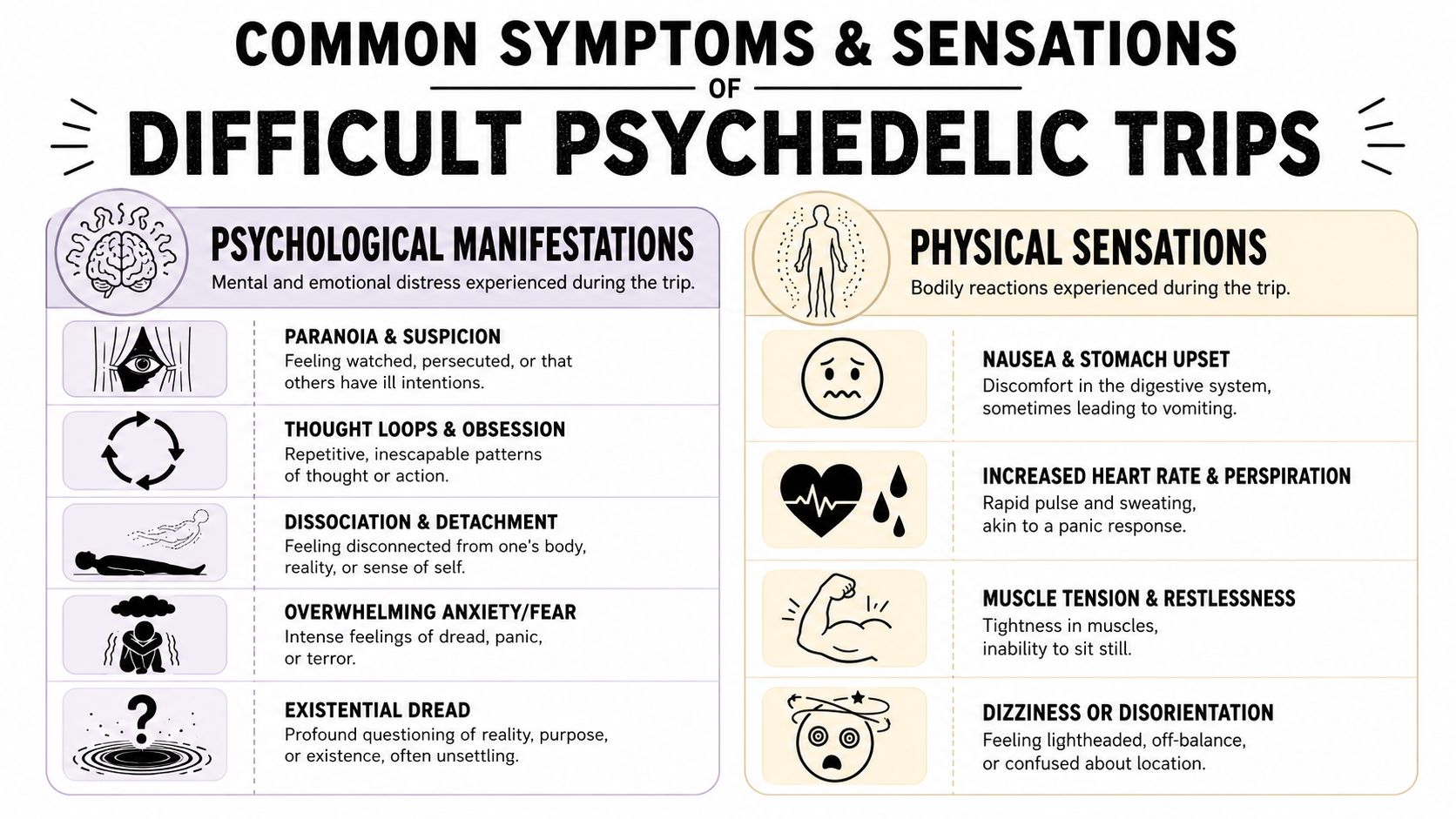
You might notice:
- Rising unease that doesn't settle after a few minutes
- Hyperfocus on bodily sensations like heartbeat, nausea, or temperature
- Suspicion that other people know something you don't
- A strong need to "get back to normal" right away
None of those automatically means danger. But they can become fuel for panic if the person starts resisting every sensation.
What the middle of it can feel like
Once fear takes hold, the experience can become circular. A person feels scared, notices they're scared, becomes scared of that fear, and starts chasing certainty they can't access. That often creates thought loops.
A thought loop might sound like this in the mind: "Something is wrong. Why is this happening? I need it to stop. Why can't I stop this? Maybe I've gone too far. What if I stay like this?" The content changes, but the structure repeats.
Perception can also become emotionally loaded. Music may feel ominous. A mirror may feel unsettling. A friend's neutral expression may seem hostile. Time can stretch so much that a short period feels endless.
When a person says, "It felt like forever," they're not being dramatic. Psychedelics can distort time in a way that makes distress feel much larger and harder to outlast.
Some people also experience dissociation. They may feel detached from their body, from reality, or from the usual sense of "me." In a supported context, that can sometimes be explored. In a frightened state, it can feel like annihilation.
Physical symptoms can intensify the fear
The body often joins the loop.
Common physical sensations include:
- Nausea or stomach discomfort
- Sweating or chills
- A faster heartbeat
- Restlessness or muscle tension
- Dizziness or disorientation
These sensations don't just happen alongside fear. They can become evidence for it. A person notices their pulse, interprets it as danger, then gets more afraid, which raises arousal further.
That cycle is one reason difficult trips can become serious. In a Johns Hopkins survey of nearly 2,000 people who reported a bad trip with psilocybin-containing mushrooms, 10.7% said their worst episode put themselves or others at risk of physical harm, and 62% rated it among the top 10 most difficult experiences of their lives.
A simple stage map
Not every bad trip follows a clean sequence, but many move through a pattern like this:
Destabilization
Something feels off. The person gets uneasy.Interpretation
The mind starts assigning meaning. "This is bad."Escalation
Fear, body sensations, and thought loops feed each other.Either support or struggle
Reassurance and environmental shifts help, or resistance deepens the distress.
Recognizing the pattern can reduce helplessness. If you know what phase you're in, you're less likely to mistake a temporary altered state for permanent collapse.
How to Prevent a Bad Trip with Preparation
Preparation works best when you treat a psychedelic session like something that deserves planning, not spontaneity. A lot of harm reduction is simple, practical, and unglamorous. That's good news, because simple things are easier to repeat.
Use a pre-flight checklist
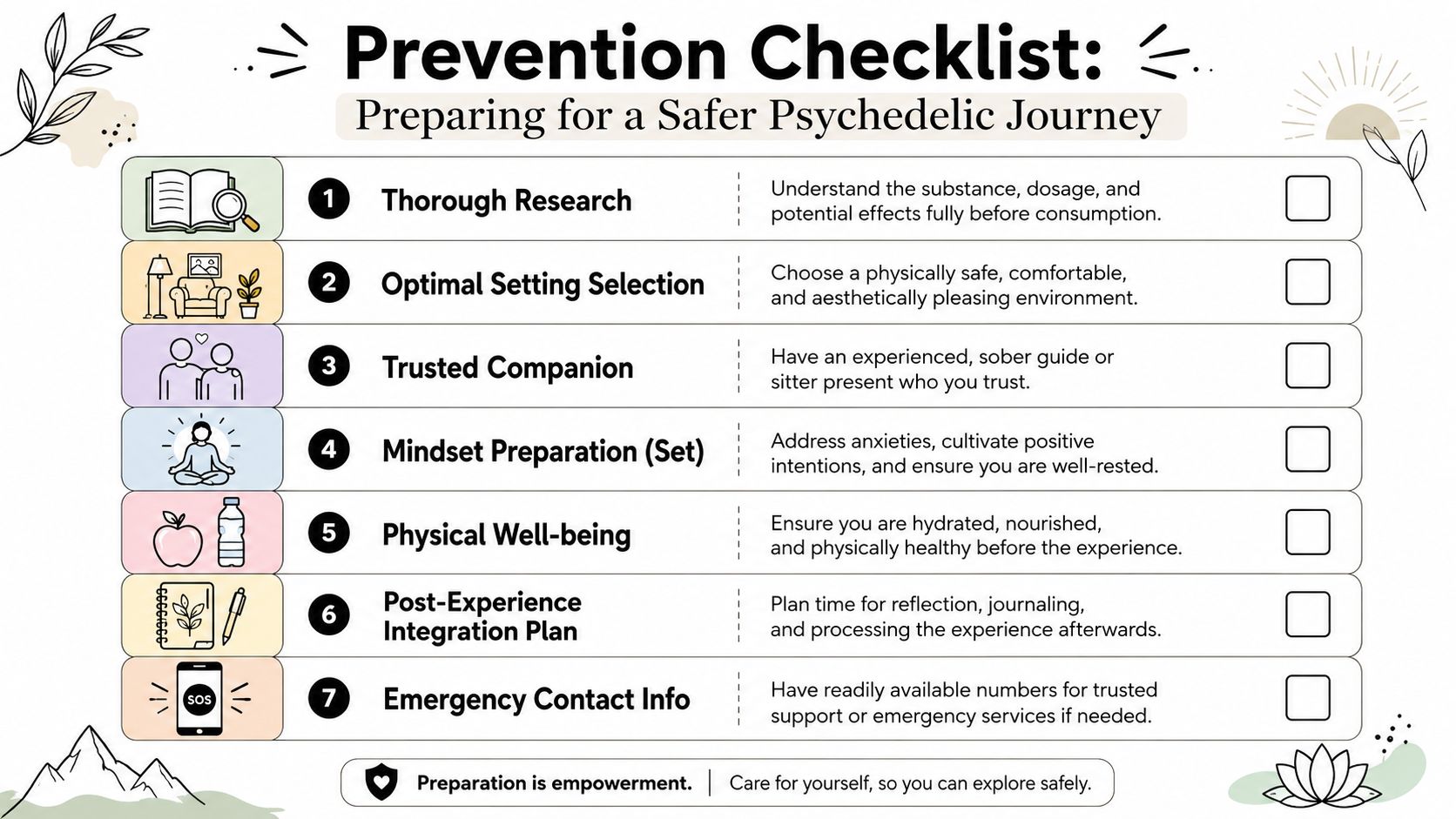
The most reliable prevention strategy is to slow down and check the basics before anything starts. A more detailed harm reduction guide on how to avoid bad trips can support that planning.
Here are the essentials:
- Know your dose: Don't guess. Don't rely on "it looked small." Psychedelic intensity can shift sharply with dose.
- Choose your space carefully: Pick a place that feels private, calm, familiar, and physically comfortable.
- Choose people even more carefully: If someone's presence makes you self-conscious, guarded, or tense, they don't belong in the room.
- Have a sober sitter if the dose is meaningful: A grounded person can make simple interventions when your own judgment is impaired.
- Clear the calendar: Don't schedule obligations, driving, family demands, or stressful calls around the experience.
- Prepare comforts in advance: Water, simple snacks, blankets, low lighting, and a calming playlist reduce friction when you're vulnerable.
- Turn down stimulation: Phones, loud media, clutter, and unexpected visitors can all become stress multipliers.
Prepare your mind, not just your room
Physical setup matters, but mindset preparation is just as important.
Ask yourself a few blunt questions:
| Question | Why it matters |
|---|---|
| Am I under unusual stress today? | Psychedelics tend to amplify what is already active |
| Am I trying to escape a feeling? | Escape motives often backfire when emotions intensify |
| Do I feel pressured to do this now? | Pressure erodes consent and inner steadiness |
| What support do I have afterward? | The experience may need processing, not just endurance |
If your honest answers don't feel steady, postponing is not failure. It's good judgment.
Grounding advice: The best time to reduce panic is before it starts. Build the environment so your future self doesn't have to improvise while overwhelmed.
Plan for aftercare before you begin
Many people prepare for the peak and forget the landing. That's a mistake.
Give yourself quiet time afterward. Keep a notebook nearby. Avoid stacking a psychedelic experience right before work, travel, conflict, or emotionally demanding plans. If strong feelings surface, you'll want room to process them, not suppress them.
Prevention isn't about controlling every outcome. It's about removing obvious avoidable risks so that if intensity arrives, it has less chaos to attach itself to.
Navigating a Difficult Experience in the Moment
When a trip turns hard, an understandable mistake is to try and force it to stop immediately. The struggle itself often increases the fear.
A better goal is to stabilize and move through it safely.
Stop trying to win an argument with the experience
The mind in panic wants guarantees. It wants someone to say, with total certainty, that this will end in five minutes and everything will be exactly normal. Psychedelic states rarely give that kind of reassurance on demand.
What helps more is a softer stance: "This is intense. I don't like it. But I can let the wave pass through without feeding it." That isn't passive. It's a skill.
A sitter can support this by speaking plainly. Short sentences help. "You're safe." "You took a substance." "This will pass." "Let's breathe together." Long explanations often bounce off an overwhelmed mind.
Change one variable at a time
The nervous system responds to small shifts. If things feel wrong, don't make ten changes at once. Start with one.
Useful in-the-moment moves include:
- Change rooms: A new space can interrupt an escalating association.
- Lower stimulation: Soften lights, reduce noise, turn off screens.
- Adjust music: If the soundtrack feels threatening, switch to something gentler or go quiet.
- Use an anchor: Hold a blanket, pillow, smooth object, or repeat a short phrase like "I'm here, and this will pass."
- Breathe with structure: Slow exhale breathing can reduce panic better than telling yourself to "calm down."
Sometimes going outside helps. Sometimes it makes a person feel more exposed. The right move depends on whether the current environment feels trapping or containing.
Curiosity can soften fear
This part can sound strange, but it matters. Some difficult experiences become less terrifying when the person stops treating every emotion as an enemy.
Emerging evidence discussed in this article on the possible benefits of a bad trip suggests that intense fear during a challenging trip can, in some cases, externalize harsh inner self-talk and potentially open therapeutic possibilities. In supported settings, a crisis can shift into what that article describes as a more therapeutic trip.
That doesn't mean suffering is automatically healing. It means the question in the moment may be less "How do I crush this?" and more "What happens if I stop wrestling it for one minute?"
Sometimes the most stabilizing sentence is not "Make it stop." It's "Show me only what I can handle right now."
If the person becomes physically unsafe, severely disoriented, or unable to be redirected, outside help may be needed. Harm reduction includes humility. You don't have to prove you can manage every situation alone.
After the Storm Integration and Seeking Support
The trip may end before the experience is over. That's one of the most important things to understand.
Some people wake up the next day relieved and clear. Others feel tender, confused, embarrassed, spiritually shaken, or emotionally cracked open. None of that automatically means something has gone terribly wrong. It does mean the aftermath deserves care.
Integration turns memory into meaning
Integration means making sense of what happened instead of either glorifying it or burying it.
That can look like:
- Journaling the experience: Write what happened, what you felt, and what still feels unresolved.
- Drawing or creative expression: Some experiences make more sense in images than in tidy language.
- Talking with a trusted person: Choose someone calm, nonjudgmental, and able to listen without forcing an interpretation.
- Working with a therapist: This matters even more if the experience touched trauma, identity, depression, or fear of losing control.
Medication questions can also matter in the aftermath or before any future use. If that's relevant, this article on shrooms and antidepressants is a useful starting point for thinking carefully about interactions and support needs.
When the hard part lingers
This is the area many guides barely mention. Some people don't just have an acute bad trip. They have extended difficulties afterward.
A 2023 survey discussed in Psychology Today on adverse psychedelic events found that 26% of respondents experienced anxiety and fear for over three years, while 16% reported depersonalization and 15% reported derealization. Those numbers are a reminder that post-trip support isn't optional for everyone.
Watch for signs like persistent panic, feeling unreal, feeling detached from your body, depressed mood that doesn't lift, or ongoing inability to function normally. If those show up, professional help is appropriate.
Support is part of harm reduction
You don't need to wait until you're in crisis to reach out. Peer support lines, psychedelic integration therapists, and trusted mental health professionals can all help you process what happened.
The healthiest frame is often this: a difficult experience may contain information, but you should not have to decode it alone.
If you're an adult in Southeast Michigan looking for carefully selected psilocybin products, Metro Mush offers a local menu for Detroit and Ann Arbor consumers, including dried mushrooms, chocolates, and drinks. You can browse products, check current deals, and order through their site if you're looking for a more informed, intentional way to approach your next experience.