
You saw a headline that mushrooms were “decriminalized” in part of California. Then you heard they're still illegal. Then you found a website selling spores and another warning that spores can bring criminal charges. If that feels contradictory, that's because California mushroom laws are a patchwork, and most quick explainers flatten important differences.
For a resident or visitor, the key question isn't just “Are mushrooms legal?” It's where you are, what you have, what you're doing with it, and whether local policy changes protect you. Personal possession in one city can be treated very differently from selling, transporting, or cultivating. A local vote may lower enforcement priority, but it doesn't erase state law.
That gap between headlines and reality is where people get into trouble. Someone hears “legal in Santa Cruz” and assumes retail sales are fine. Another person thinks spores are harmless because they don't contain psilocybin, then learns California treats them differently from most states. A traveler assumes local decriminalization applies everywhere, including federal land. It doesn't.
This guide is built to clear that up in plain English. No hype. No legal jargon for its own sake. Just a practical explanation of what California mushroom laws mean on the ground in 2026, especially the difference between statewide illegality, local decriminalization, and failed statewide reform efforts.
Navigating the Maze of California Mushroom Laws
A common situation goes like this. Someone visits Oakland or Santa Cruz, hears that mushrooms are “basically legal,” and assumes California has shifted its stance. Then they drive to another city, or talk to a lawyer, or read a state statute, and realize the answer is much narrower.
That confusion makes sense because several things can be true at once. A city can tell police to treat adult personal possession as a low priority. California can still keep psilocybin illegal under state law. Federal law can still apply on top of both.
Bottom line: In California, “decriminalized” usually means reduced local enforcement for certain conduct. It does not mean a general right to buy, sell, or carry mushrooms everywhere.
Why people get this wrong
The biggest source of confusion is that people use decriminalization and legalization as if they mean the same thing. They don't.
- Decriminalization means a city may reduce enforcement priority for some adult personal use conduct.
- Legalization means the law affirmatively allows conduct under a regulated system.
- State illegality means California can still prosecute conduct even if a city has a softer local policy.
Another trap is assuming all mushroom-related items are treated alike. They aren't. California takes a notably strict view of spores and mycelium tied to psilocybin mushroom production.
The question to ask first
Before you ask whether mushrooms are “legal,” ask these questions instead:
- Where am I right now? City policy matters.
- Is this personal possession or something that looks commercial? Sale and transport create different risks.
- Am I dealing with spores or mycelium? California treats those separately.
- Am I on federal land or in a federal setting? Local city policy won't control there.
If you keep those four questions in mind, the rest of California mushroom laws start making a lot more sense.
The Foundation California's Statewide Psilocybin Ban
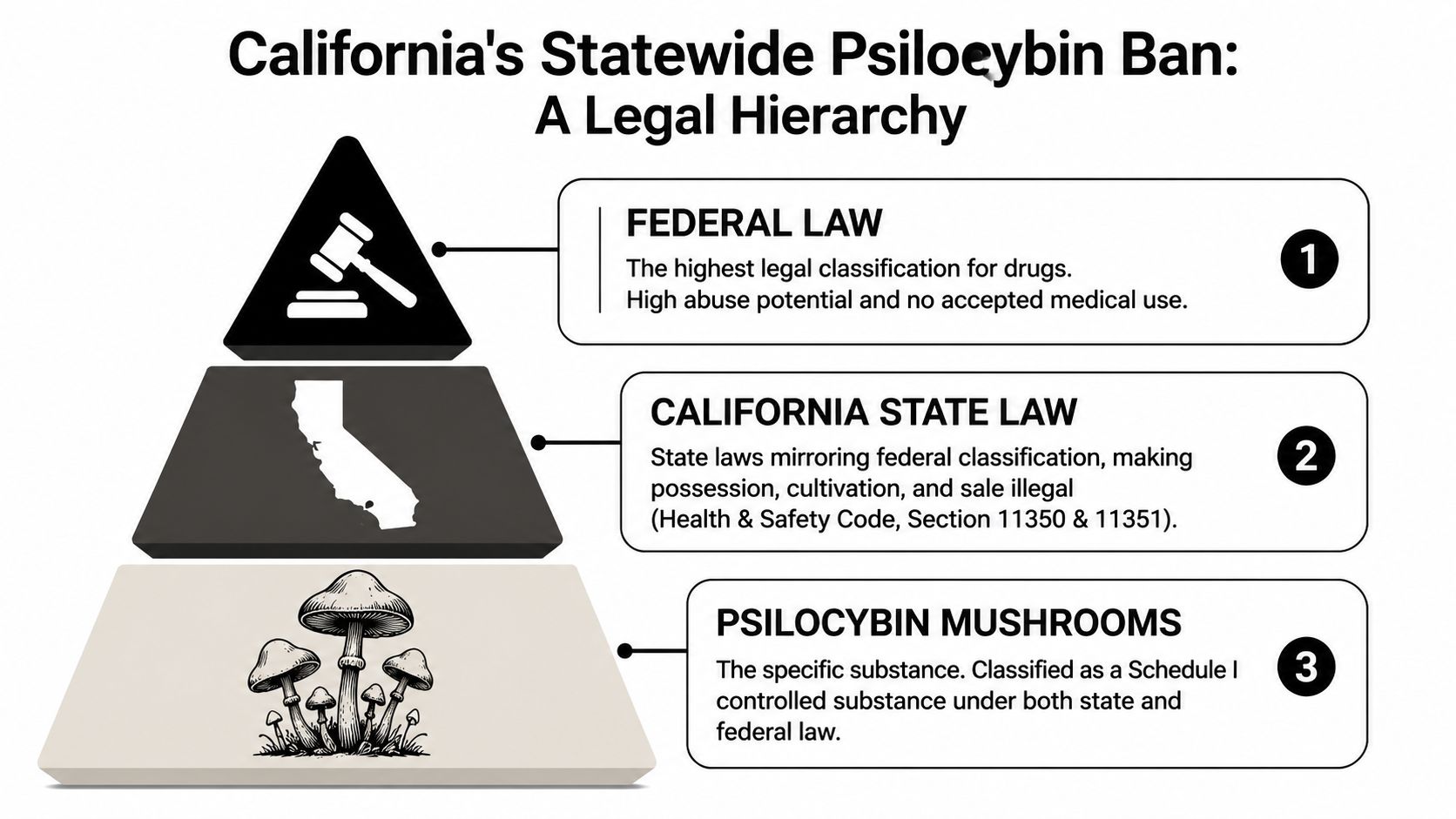
A lot of confusion starts here. A city may treat personal use as a low priority, yet California can still treat psilocybin as illegal statewide. If you miss that starting rule, local policy can look far broader than it really is.
What statewide illegality means in practice
Under California law, psilocybin sits inside the state's controlled substance system. Federal law also classifies psilocybin as a Schedule I substance. For a resident or visitor, the practical point is simple. A city council cannot erase a state ban.
A helpful comparison is a building with house rules and city rules. A city can tell its own police to spend less time on certain low-level conduct, but it cannot rewrite California's criminal code. That is the difference between local decriminalization and legalization, and it is why "low local enforcement" should never be read as "allowed everywhere in the state."
This matters most when conduct goes beyond simple personal possession. Transport, sharing, cultivation, and anything that looks commercial can trigger a very different level of risk under state law.
California is unusually strict about spores
California also takes a stricter approach than many people expect with spores and mycelium tied to psilocybin mushroom production.
That catches people off guard because spores are often discussed online as if they are legally harmless. In California, that is a risky assumption. The law does not only focus on a finished psychedelic product. It also reaches materials connected to producing it.
For the public, the safe takeaway is narrow and clear. Do not assume that something sold online, shipped from another state, or described as a "collector's item" is lawful to possess in California.
The narrow research exception
California law does contain a limited exception for bona fide research, instruction, or analysis approved by the state's Research Advisory Panel. That exception is small and specialized. It does not give ordinary consumers a personal-use loophole.
So if you are asking the everyday question, "Can I legally have psilocybin mushrooms in California?", the statewide answer is still no. Local policies may reduce the chance of city-level enforcement in some places. They do not turn psilocybin into a legal retail product, and they do not cancel California's stricter treatment of spores or mycelium.
If you want one rule to remember, use this one. State law is still the floor under everything else. Local decriminalization may change the risk in a specific city, but it does not create statewide permission.
City by City A Look at Local Decriminalization
You are in Oakland for the weekend. A friend says mushrooms are "basically legal there." Then you drive to another California city and assume the same rule follows you. That is the mistake this part of the law punishes.
Local decriminalization changes risk by location. It does not create statewide permission, and it does not mean mushrooms are legal in the ordinary sense.
What Santa Cruz actually changed
Santa Cruz approved a local policy that reduced enforcement priority for adult possession and cultivation of psilocybin mushrooms. The age limit matters. The personal-use focus matters. The missing piece matters too. The city did not create a lawful commercial market.
That last point causes the most confusion. A resident may hear "decriminalized" and picture licensed shops, delivery menus, or a safe legal zone for buying and selling. Santa Cruz did not do that.
What local decriminalization means in real life
A local decriminalization measure usually works like a city-level instruction about priorities. It signals that local police and prosecutors may treat certain adult personal-use conduct as a low enforcement concern.
That is very different from legalization.
Legalization usually means the law affirmatively allows conduct under stated rules. Decriminalization usually means the conduct still violates state law, but city officials choose to spend less time and fewer resources enforcing it in some situations.
For a resident or visitor, the practical questions are simple:
- Is this city known for a local decriminalization policy?
- Does that policy appear limited to adult personal possession or cultivation?
- Are you doing anything that looks like sale, transport, or distribution?
- Are you assuming a city policy protects you from state law?
If the answer to the last two questions is yes, your risk rises fast.
A city-by-city reality check
Here is the clearest way to read the current patchwork.
| City | Local posture | What that means for you |
|---|---|---|
| Oakland | Local decriminalization | Personal use may face lower local enforcement priority, but state law still exists |
| Santa Cruz | Local decriminalization | Adult possession and cultivation received local relief, but commercial activity was not legalized |
| Los Angeles | No citywide rule noted here | Treat state law as the practical baseline |
| San Diego | No citywide rule noted here | Treat state law as the practical baseline |
The table shows why people get tripped up. California does not have one uniform street-level reality. It has a statewide ban sitting on top of different local enforcement choices.
A good analogy is speed limits and local policing priorities. The posted rule stays on the books statewide. One city may enforce it aggressively, another may not focus on minor violations, but neither city rewrites the state rule for everyone.
The biggest misunderstanding to avoid
Oakland and Santa Cruz are often discussed as if they changed California law. They did not. They changed local response.
That distinction matters most for visitors, for people crossing city lines, and for anyone tempted to treat decriminalization as permission to buy or sell. A city can lower the chance of local enforcement for personal use and still leave you exposed under state law.
The safe takeaway is narrow. Local decriminalization can reduce practical risk in a specific place. It does not make mushrooms legal, and it does not turn an unlicensed seller into a lawful business.
Understanding the Penalties for Possession and Sale
The legal risk rises sharply when conduct moves from personal use into anything that looks like supply, transport, or distribution.
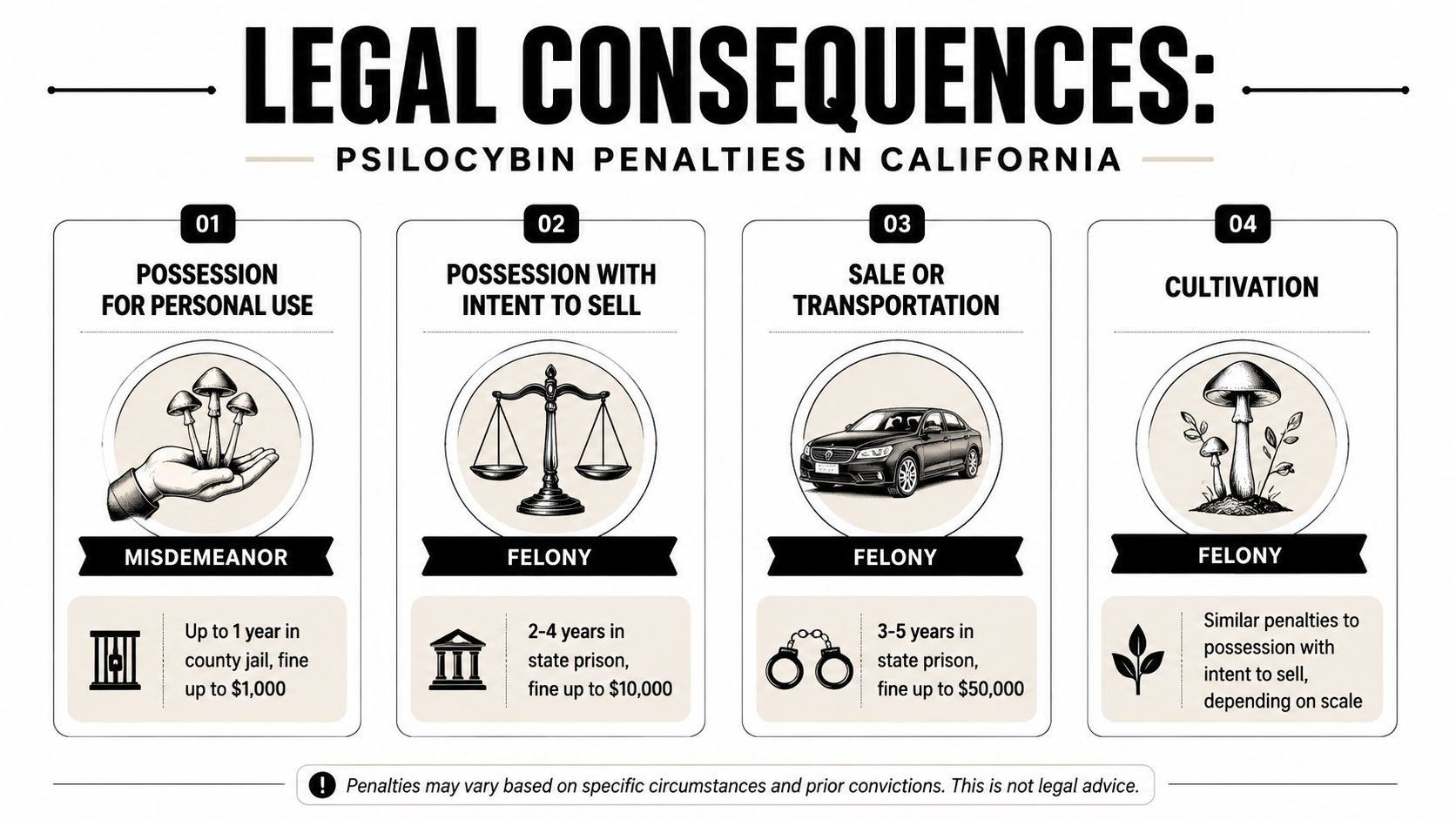
The clearest verified penalty in the material for this article involves spores and mycelium. Under California Health & Safety Code §§ 11390 and 11391, any individual who transports, imports, sells, furnishes, or gives away spores or mycelium capable of producing psilocybin mushrooms is subject to criminal punishment of up to one year in county jail or state prison, according to this discussion of California spore law.
Why commercial behavior changes the picture
Even where local officials take a softer approach to personal possession, commercial conduct creates a different kind of exposure. Law enforcement and prosecutors often distinguish between:
- Personal possession
- Personal cultivation
- Transport
- Sale or furnishing to others
That distinction matters because the public often collapses them into one category. California law does not.
A person keeping something for personal use may face one level of scrutiny. A person moving product, advertising it, packaging it for sale, or giving away cultivation materials may look like they're facilitating distribution.
Spores are a separate risk category
California's spore rule catches people off guard because it reaches conduct that some other states treat more casually. If you transport, import, sell, furnish, or give away spores or mycelium capable of producing psilocybin mushrooms, you're in a specifically prohibited category under the verified statute summary above.
That means someone can avoid handling finished mushrooms and still create legal risk through cultivation materials alone.
Here's a practical way to rank exposure:
- Lower relative risk: Quiet personal conduct in a city with local decriminalization
- Higher relative risk: Public conduct, travel with materials, or activity outside a decriminalized city
- Highest practical risk: Anything that looks commercial, organized, repeated, or tied to spores and mycelium transfer
This video gives additional legal context on the issue:
What residents and visitors should take from this
You don't need to memorize statute numbers to use good judgment. The safer reading of California mushroom laws is that commercial activity attracts the greatest danger, and California has made that especially clear in the spore context.
A common mistake is treating “I'm not selling mushrooms themselves” as a defense. When spores or mycelium are involved, that assumption can fail fast in California.
If your conduct could be described as transport, furnishing, or enabling cultivation, your risk profile is very different from someone relying on a local low-priority possession policy.
The Status of Statewide Legalization Efforts
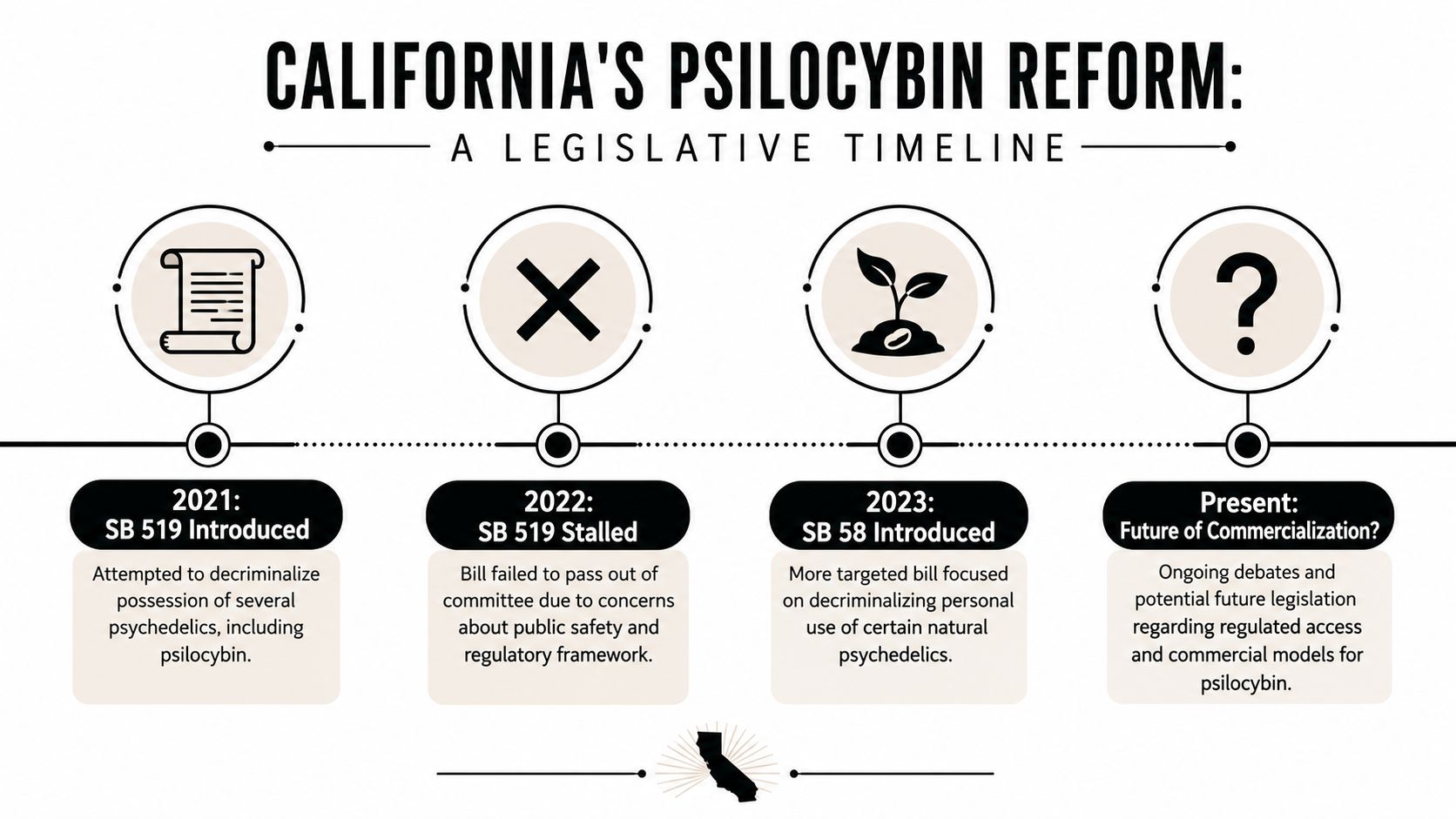
A visitor reads that psilocybin sales were supposed to start in California in 2025 and assumes storefront access must be legal by now. That is the kind of mistake this section is meant to prevent. In California, proposed dates and active law are two different things.
The failed statewide push
California has had serious reform efforts, but none created a statewide adult-use psilocybin system. One 2024 ballot initiative would have gone much further than city-level decriminalization. It did not qualify for the ballot because it failed to collect enough valid signatures, according to the California ballot and policy summary from the Legislative Analyst's Office.
That point matters because online discussion often blurs three separate ideas: a proposal, a local low-enforcement policy, and actual statewide legality. They are not interchangeable. A bill can be introduced and fail. A city can deprioritize enforcement without changing state law. A ballot measure can describe a future retail system and still never take effect.
Why the dates still confuse people
Part of the confusion comes from the initiative's own design. It included future rollout dates for cultivation and retail sales under a regulated system. Readers who see those dates without the rest of the story may assume California approved the plan.
It did not.
A proposal works like a blueprint for a house that was never built. The blueprint may show where the doors and windows would go, but you still cannot move in. In the same way, a failed initiative can describe stores, licensing, and timelines without creating any legal right to buy, possess, or sell under state law.
What this means in real life
For residents and visitors, the practical rule is simple. Do not treat reform momentum as legal protection.
State law still controls statewide. Local decriminalization in some cities may reduce day-to-day enforcement risk for limited personal conduct, but it does not create a legal retail market and does not erase state criminal law. That gap is the core issue many articles miss.
California also appears to be debating narrower models more seriously than broad adult-use sales. The public discussion has shifted toward supervised therapeutic access rather than general commercial access. If you want a comparison point, this overview of Massachusetts magic mushrooms policy shows how public expectations can drift ahead of actual law in another state too.
The safe takeaway is straightforward. California has seen repeated attempts at reform, but no statewide psilocybin legalization is in effect today.
A Practical Guide to Legal Risks and Personal Safety
Individuals don't require a theory of drug policy. They need to know how to avoid obvious mistakes. In California, that starts with respecting the gap between local politics and actual legal protection.
The safest way to read the landscape
Use the most conservative rule that applies to your situation. If you're unsure whether a city has a decriminalization policy, assume state law controls. If you're crossing jurisdictions, assume the friendlier local rule may disappear the moment you leave city boundaries.
That mindset is especially important for visitors. Travel tends to mix together city streets, county areas, airports, parks, and other places with different enforcement realities.
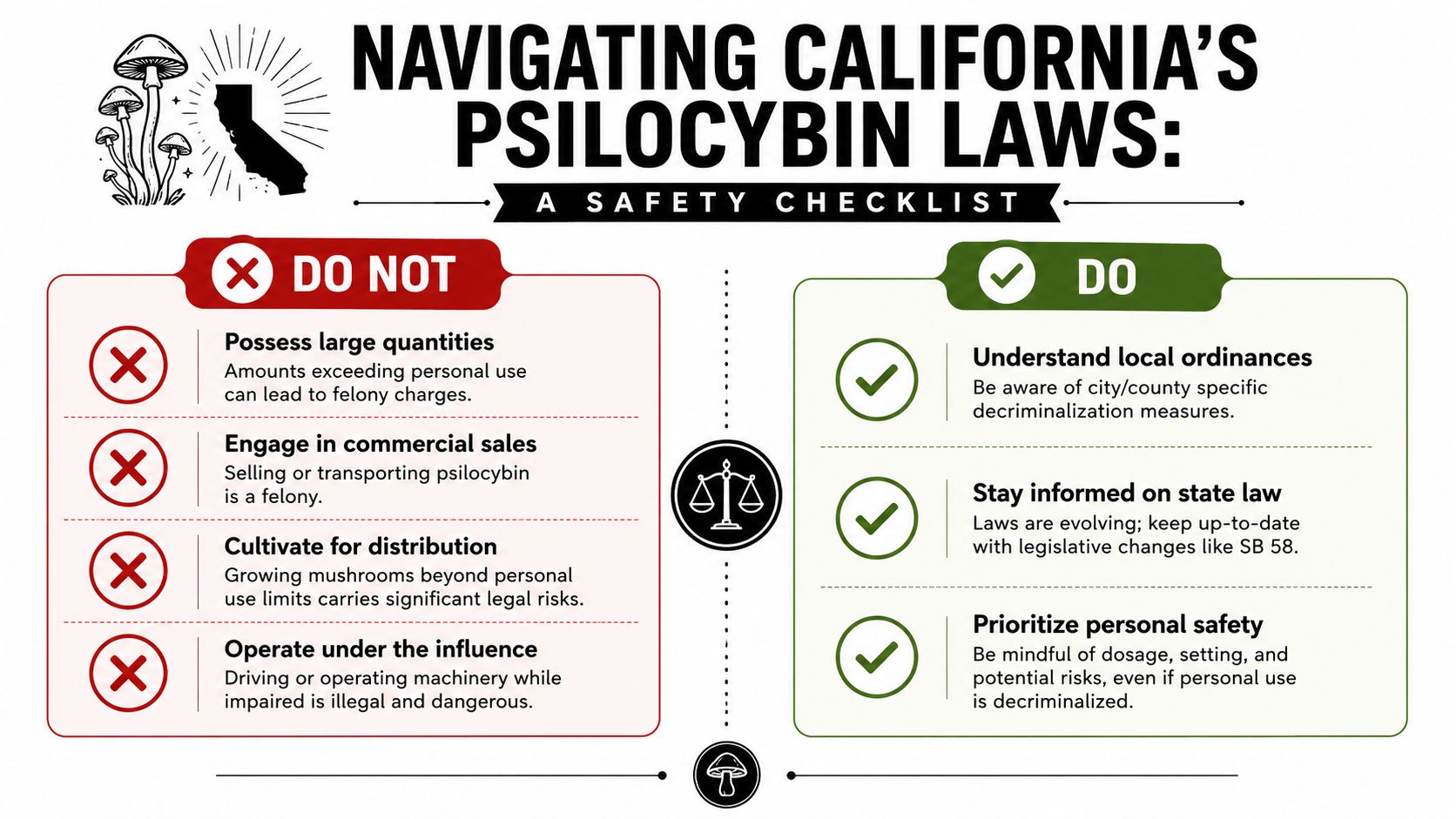
Practical do's and don'ts
- Don't treat decriminalization as legalization. A lower local enforcement priority doesn't make retail buying and selling lawful.
- Don't carry materials that suggest distribution. Quantity, packaging, transport, or repeated transfers can change how conduct is viewed.
- Don't assume spores are harmless legally. California's spore rules are stricter than many people expect.
- Don't drive while impaired. Even where attitudes toward possession are changing, impaired driving remains a serious and obvious risk.
- Do check the local ordinance culture before acting. Oakland and Santa Cruz are not proxies for the whole state.
- Do stay off autopilot on federal land. Local city policy won't control federal enforcement settings.
- Do think in harm-reduction terms as well as legal terms. Good legal judgment and good safety judgment usually overlap. This guide to harm reduction basics is a useful companion for anyone navigating the space carefully.
Public behavior creates unnecessary exposure
A lot of legal trouble starts with visibility. Public consumption, open display, social media promotion, roadside travel, and transactions with strangers all make a situation easier for law enforcement to interpret as more than quiet personal use.
Public behavior often creates more risk than the substance question by itself.
If your goal is to stay safe, the rule is simple. Avoid conduct that invites interpretation, especially conduct that looks commercial, organized, or careless.
The Path Forward for Psilocybin in California
The cleanest summary of California mushroom laws is that they are not a yes-or-no system. They're a layered system. State law still prohibits psilocybin. Some cities have chosen to decriminalize certain adult personal conduct. Commercial sale remains a very different category. Statewide legalization efforts have not yet produced a broad, stable consumer market.
That means residents and visitors should resist shortcut answers. “Legal in California” is wrong. “Illegal everywhere in exactly the same way” is also incomplete. The truth sits in the middle, and that middle is where people need the most guidance.
A good next step is to keep following policy changes with a critical eye. If you're exploring the therapeutic side of the conversation, this overview of psychedelic therapy helps frame where public debate is going, even though therapy discussions are separate from broad personal-use legalization.
If you need legal advice for a real situation, talk to a California lawyer who handles controlled-substance and criminal-law matters. General articles can help you understand the map. They can't defend a case or evaluate facts unique to you.
The practical takeaway is steady and simple. Don't rely on headlines. Don't confuse local decriminalization with statewide permission. And don't assume tomorrow's reform talk protects you today.
Metro Mush serves adults looking for clear information and a more informed approach to the mushroom space. If you want to learn more about products, updates, and educational resources, visit Metro Mush.