
The most popular advice about magic mushroom strains is also the easiest to misunderstand: choose a familiar name for a gentle experience, or a premium name for a stronger one. That's a shopping shortcut, not a dependable way to judge what's in a product.
Golden Teacher, Penis Envy, and Enigma can help you recognize the labels sellers use. But batch testing, stated serving content, and your circumstances deserve more attention than the nickname. A useful comparison starts with reputation and ends with evidence, including an honest willingness to leave a product alone when its contents aren't clear.
Popular Magic Mushroom Strains at a Glance
A strain name is a shopping label, not a guaranteed intensity. The descriptions below summarize consumer anecdotes and retail positioning, not clinically validated profiles. Read the situation column as what people commonly seek, not a recommendation or a promise that the product will deliver it.
Popular strain labels and what they are chosen for
| Strain label | Commonly reported character | Potency reputation | Usual situation | What the name cannot tell you |
|---|---|---|---|---|
| Golden Teacher | Gentle, visual, introspective | Marketed as moderate | A first fuller experience or learning session | A fixed milligram dose or identical batch |
| B+ | Balanced mood and body | Marketed as moderate | Social or creative afternoons | That this batch matches another B+ |
| Penis Envy | Intense, sometimes described as longer-lasting | Marketed as strong | Experienced adults seeking stronger material | A proven multiple of Golden Teacher |
| Albino Penis Envy | Very strong, with reports of unexpectedly intense effects | Marketed as very strong | Inward sessions sought by experienced adults | Potency from the pale appearance |
| Enigma | Unusual blob form, heavy reputation | Marketed as strong or premium | Deliberately planned sessions sought by experienced adults | That a rare look equals tested milligrams |
| Treasure Coast | Clear-headed or energetic reports | Marketed as moderate | Daytime creativity | A repeatable energizing effect |
| Mazatapec | Reflective or visual reports | Marketed as moderate | Quiet evening reflection | A spiritual effect guaranteed by the name |
The important distinction is between what a buyer hopes for and what a label establishes. Someone might choose B+ because they've heard it described as sociable. That description doesn't establish that they'll feel comfortable around other people, remain conversational, or avoid anxiety.
Likewise, a seller's strong designation doesn't establish a consistent relationship between Penis Envy and Golden Teacher. Claims that a named product is a fixed multiple of another need actual comparative testing. A confident description isn't a substitute.
Flavor isn't a potency test
Buyers also compare taste. Descriptions such as earthy, bitter, nutty, or mushroom-like are anecdotes, and there's no strain-specific tested flavor evidence here that supports a reliable comparison.
Flavor is a weak proxy for potency. An earthy taste doesn't establish strength, and a sweeter chocolate coating doesn't establish a gentler experience. Flavoring can make a product easier to eat without telling you anything useful about its active content.
Batches carrying the same name can differ substantially, while products carrying different names may overlap chemically.
Use the table to identify the reputation you're curious about, rather than to choose an amount. Before treating any label as suitable, examine its measured content, serving information, and the limits of what the seller can document.
What a Strain Name Really Means
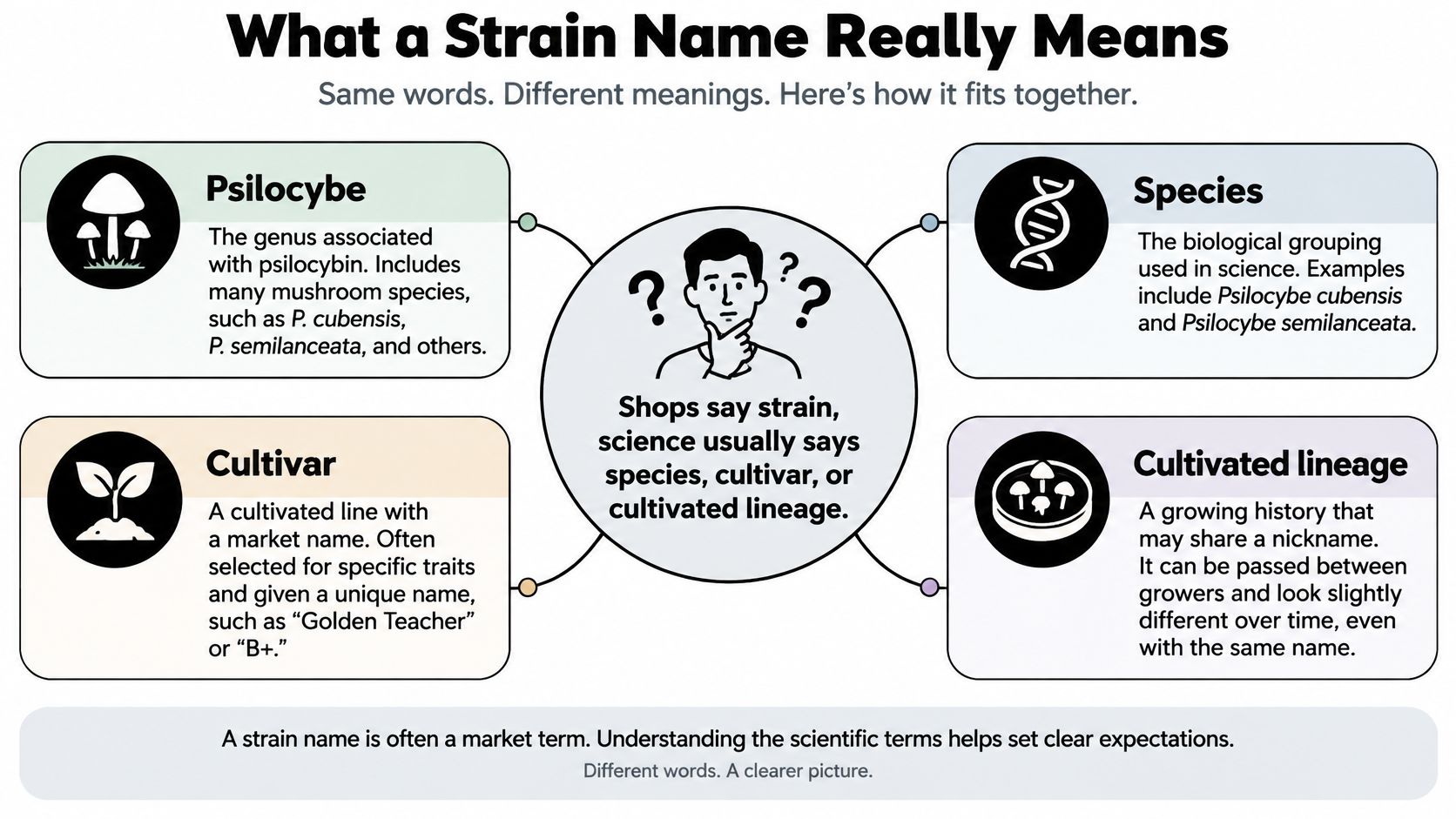
Shops say strain. Scientists more often need to distinguish species, cultivar, and cultivated lineage. Those terms answer different questions, and treating them as interchangeable creates much of the confusion around mushroom shopping.
Psilocybe is a genus associated with psilocybin-producing mushrooms. Psilocybe cubensis is a species, and many familiar commercial names refer to cultivated lines described as belonging to that species. A cultivar name can communicate a growing history or selected appearance without establishing a universally standardized chemical composition.
Biological identity takes more than a nickname
A 2024 phylogenomic study published in PNAS analyzed 71 fungarium metagenomes using 2,983 single-copy gene families and confirmed only 52 specimens as true Psilocybe. The remaining specimens belonged to other genera, illustrating why scientific identification requires more than accepting a historical label.
The study also identified distinct arrangements of the genes involved in psilocybin production, associated with a deep evolutionary division in the genus. In plain language, the chemistry has a biological history that researchers can investigate. A retail nickname doesn't map neatly onto that evolutionary tree.
That doesn't make names such as Penis Envy or Enigma meaningless. Growers may use them to describe recognizable cultivated lineages. It means their usefulness has boundaries: a recognizable lineage isn't automatically a formally standardized variety with a fixed chemical recipe.
Ask what the documentation establishes
Different documents serve different purposes:
- Documented genetics can support a claim about identity or lineage.
- A batch-specific laboratory report can describe the compounds measured in the submitted sample.
- A stated dry-weight basis helps make concentration comparisons meaningful.
- Sampling information helps you judge how well the tested material represents the product.
A genetic record doesn't replace chemical testing. A photograph doesn't replace either, and a laboratory report for an unrelated batch doesn't establish the contents of the package in front of you.
The practical distinction is simple: identity tells you what the material is represented to be; measurement tells you more about what the tested sample contains. Neither should be stretched beyond its scope.
Measured Potency Behind the Labels
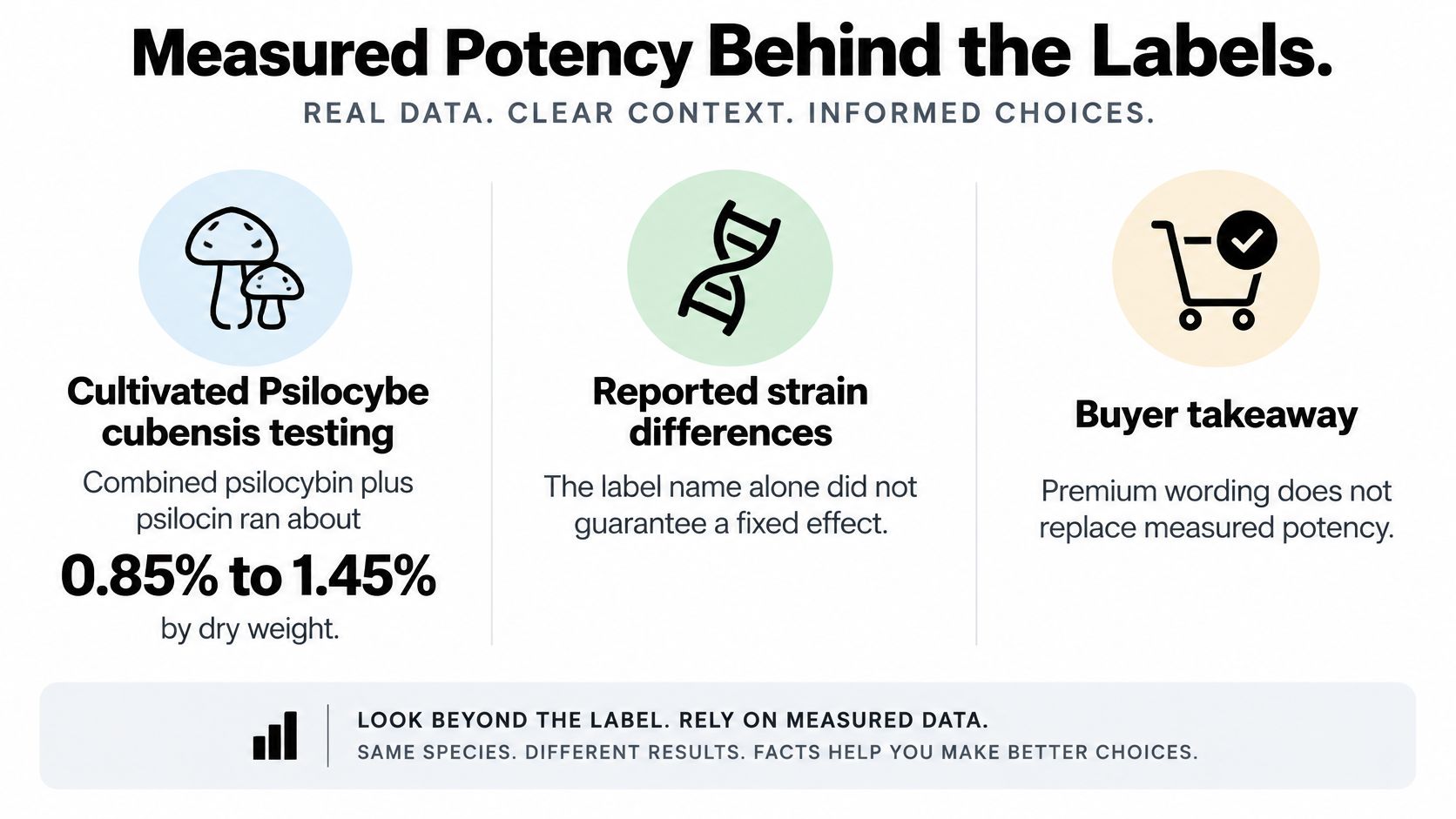
A strain name is a shopping label, not a dose. Measured compounds in tested material offer a better comparison, but results depend on what was measured and which sample went to the lab. In a peer-reviewed LC-MS/MS analysis of cultivated Psilocybe cubensis, combined psilocybin-plus-psilocin concentrations ranged from 0.85% to 1.45% by dry weight.
A multi-strain analysis of cultivated P. cubensis reported 2.62 to 20.65 mg/g total tryptamines across 14 strains, a difference of more than 7.8-fold. Within selected strains, psilocybin coefficients of variation in individual fruiting bodies ranged from 12.81% to 23.39%. These are distinct measures, not parts of one universal potency scale.
Measured potency ranges across cultivated mushrooms
| Measure | Reported value |
|---|---|
| Combined psilocybin and psilocin in cultivated P. cubensis | 0.85% to 1.45% by dry weight |
| Total tryptamines across 14 tested strains | 2.62 to 20.65 mg/g |
| Difference in total tryptamines across those strains | More than 7.8-fold |
| Within-strain psilocybin variation in selected fruiting bodies | Coefficients of variation from 12.81% to 23.39% |
Read the units before comparing products
A percentage by dry weight describes the share of dried material attributed to the measured compounds. Milligrams per gram expresses concentration in a form that's easier to compare across tested dried products.
The compound names matter too. A report listing psilocybin alone cannot be directly compared with one listing combined psilocybin and psilocin. Total tryptamines is a broader measure, so check what the lab counted before comparing results.
High-performance liquid chromatography with tandem mass spectrometry, commonly abbreviated HPLC-MS/MS, can measure specific compounds. An advanced method still cannot fix poor sampling or a report tied to a different batch.
What a useful COA should answer
A certificate of analysis, or COA, should identify the laboratory, sample, measured compounds, units, and relevant batch. Check that the report connects to the product being considered, rather than serving as a generic certificate for multiple listings.
Ask how the sample was handled:
- Individual or pooled material shows whether results describe separate mushrooms or an averaged mixture.
- Replicate testing gives more support to a consistency claim than a single result.
- Sample selection helps show whether the tested material represents the batch.
- Finished-product testing matters for chocolate, drinks, or other processed servings.
Practical rule: Look for compound-specific measurements from the relevant batch, not a cultivar name alone.
A comparison of strains marketed as the strongest can help identify claims to check. Reputation and appearance don't establish measured content; batch documentation does.
Safety and the Michigan Legal Line
Local decriminalization isn't the same as legalization. Psilocybin remains illegal under federal law and Michigan state law, and local enforcement priorities don't create a general authorization to sell or distribute it.
Ann Arbor and Detroit have adopted local approaches that deprioritize certain entheogenic activities. Those approaches shouldn't be interpreted as permission that applies across Michigan, protection from every enforcement agency, or approval of commercial products.
Lower enforcement priority is not a license to sell, a product-safety certification, or a guarantee against legal consequences.
Check current official local and state information before making legal decisions. A Michigan magic mushroom overview can help identify questions to investigate, but a retailer's explanation isn't legal advice.
Personal circumstances can rule out use
A product description can't screen medical risk. The cautious choice may be not to use psilocybin at all, particularly when health history, medications, or responsibilities make impairment unsafe.
- Mental health history: Avoid self-directed use with a personal or family history of psychosis, and discuss psychiatric conditions with a qualified clinician.
- Pregnancy and caregiving: Don't use while pregnant or while responsible for someone who needs your attention.
- Medication questions: Ask a clinician or pharmacist about your actual medication list. Don't stop prescribed treatment to accommodate a psychedelic experience.
- Other substances: Avoid combining psilocybin with alcohol, cannabis, or other drugs.
- Impairment hazards: Don't drive, swim, climb, or operate equipment while impaired.
A trusted sober person and a familiar, secure place can reduce avoidable environmental hazards. They don't make an unknown product predictable, and previous experience doesn't eliminate the possibility of severe distress.
Strong branding deserves caution rather than confidence. If effects are unexpected, don't add more material in an attempt to steer the experience. Seek urgent medical help for chest pain, severe or persistent distress, loss of consciousness, or danger to yourself or someone else.
Matching a Strain Reputation to the Day
The situation you're considering can reveal a mismatch before the strain name does. A social afternoon, an inward evening, and a day when you need to remain functional place very different demands on you.
A 2025 public-health review of psilocybin outside clinical settings reported more than 20-fold variation in psilocybin potency in testing from decriminalized regions, alongside inconsistent concentrations of minor tryptamines. That evidence doesn't establish predictable, strain-specific human experiences.
A social or creative afternoon
Golden Teacher, B+, and Treasure Coast are often discussed in approachable or creative terms. Those reputations may explain someone's interest, but they don't establish that the person will remain comfortable in company or capable of completing a project.
The failure mode is treating moderate as a synonym for mild. If the day includes driving, work, public responsibilities, or looking after someone else, the relevant decision isn't which nickname fits. It's whether impairment belongs in the day at all.
A quiet, inward evening
Mazatapec and Golden Teacher often appear in reflective descriptions. A quiet setting may fit someone's intention better than a crowded venue, but the name can't guarantee insight, emotional ease, or a spiritually meaningful result.
Someone seeking relief from depression, anxiety, trauma, or addiction shouldn't treat these descriptions as treatment advice. A product marketed for reflection isn't equivalent to professionally supervised care.
Interest in stronger material
Penis Envy, Albino Penis Envy, and Enigma attract attention partly because sellers describe them as unusually strong. Experience with another product doesn't establish familiarity with an untested batch carrying one of these names.
The failure mode is assuming a fixed potency multiplier, then using that assumption to make an amount seem precise. Without relevant testing, the honest description is unknown potency, not reliably stronger by a known margin.
Wanting function rather than a trip
Someone interested in microdosing may be seeking subtle changes rather than obvious intoxication. A small-looking portion, however, doesn't establish a non-impairing effect, and a microdose label doesn't prove better concentration or mood.
If clear functioning is essential, don't rely on a strain name or microdose claim to preserve it. Uncertainty matters more when you need to drive, work safely, or make consequential decisions.
Different names can overlap chemically, and the same name can describe materially different products. Chemical diversity also doesn't establish that each cultivar has a distinct, repeatable psychological signature. A stated serving with verified contents provides more useful information than a bigger reputation.
From Dried Grams to a Stated Serving
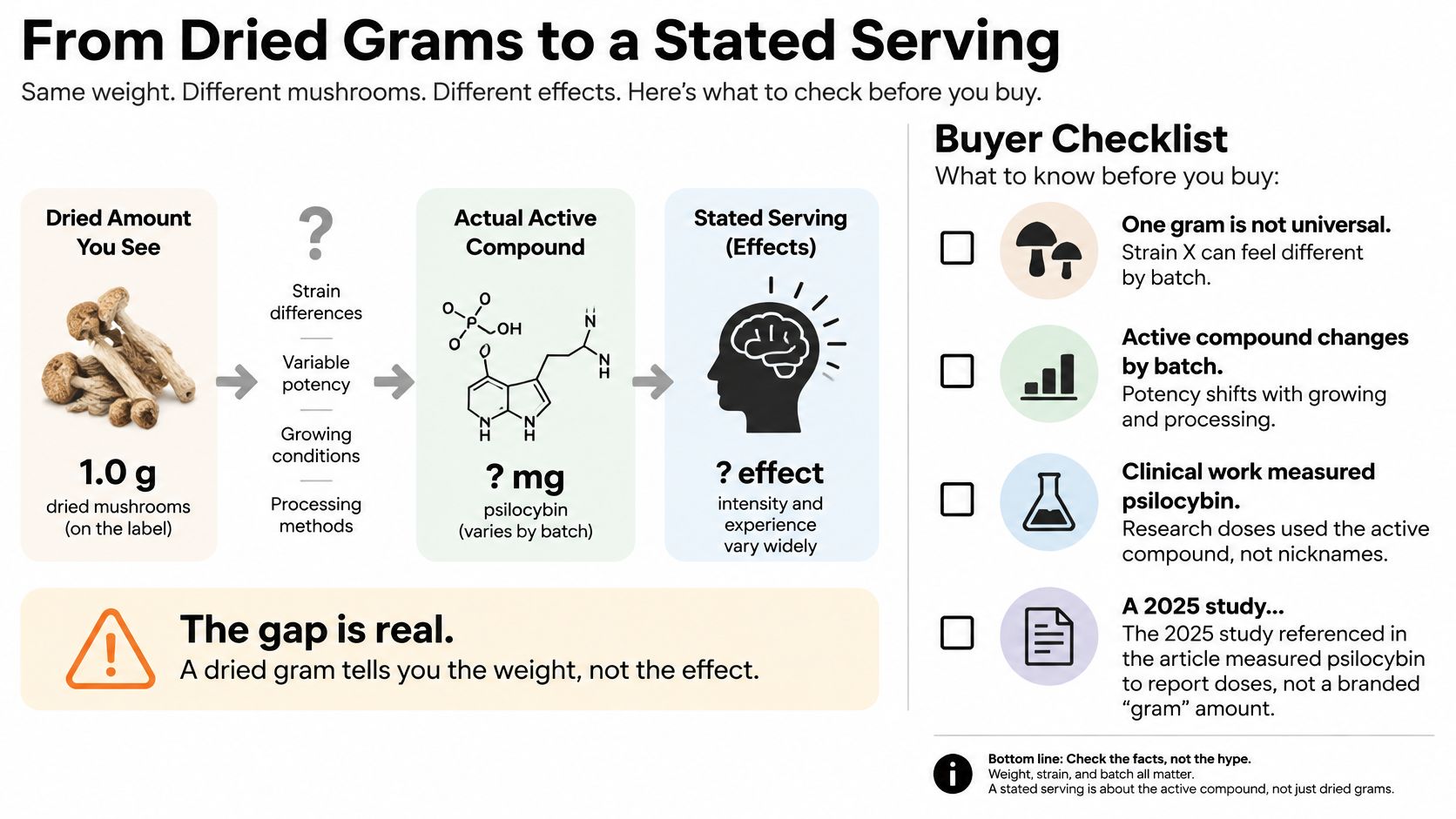
Mushroom weight and active-compound content aren't interchangeable. A dried amount tells you how much material is present; it doesn't, by itself, tell you the measured psilocybin or psilocin content.
A 2025 Washington State research brief on psilocybin describes both fixed and weight-adjusted clinical dosing, with mixed evidence about which approach is preferable. That's a reason not to treat body weight alone as a dependable ruler for an individual experience.
Read what the serving actually contains
Clinical research generally works with measured psilocybin rather than retail nicknames. Consumer packaging needs equally careful interpretation: mushroom material, an extract, and an isolated ingredient aren't interchangeable label descriptions.
How to read a serving across product formats
| Format | What to read | Cautious start | Why grams mislead |
|---|---|---|---|
| Dried mushrooms | Compound-specific milligrams per gram, batch identity, and dry-weight basis | Establish what was tested before considering use | Individual fruits may differ chemically |
| Chocolate bar square | Stated mushroom material or measured active content per square | Don't assume a square is an appropriate serving merely because it's scored | Chocolate weight doesn't establish active content |
| Ready-to-drink | Serving definition, ingredient identity, and measured content for the container | Confirm whether the container contains multiple labeled servings | Liquid volume doesn't establish concentration |
| Microdose portion | Measured active content, ingredients, and batch information | Don't assume the label guarantees non-impairment | A small material weight can still contain unexpected active content |
A chocolate square isn't a universal equivalent to a familiar dried portion. The same applies to beverages: a can or bottle is a package, not necessarily a meaningful unit of active content.
Check the finished item, not only its input
Mixing mushroom material thoroughly can help distribute it through an edible. But homogenization isn't proof of serving accuracy. A laboratory result for the source mushrooms doesn't establish that each finished square or drink contains the stated amount.
Food intake, individual metabolism, medications, and setting can also affect the experience. Storage and handling deserve attention because the condition of the tested sample may not match a poorly stored product.
Use a mushroom dosing and label-reading guide to identify questions, not to turn an untested product into a precise clinical dose.
- Find the units: Distinguish grams of mushroom material from milligrams of a named active compound.
- Identify the ingredient: Check whether the product contains mushroom material, an extract, or an isolated ingredient.
- Resolve uncertainty: If the contents or serving definition remain unclear, don't improvise an equivalence or rapidly add more.
Choose a Product with Metro Mush
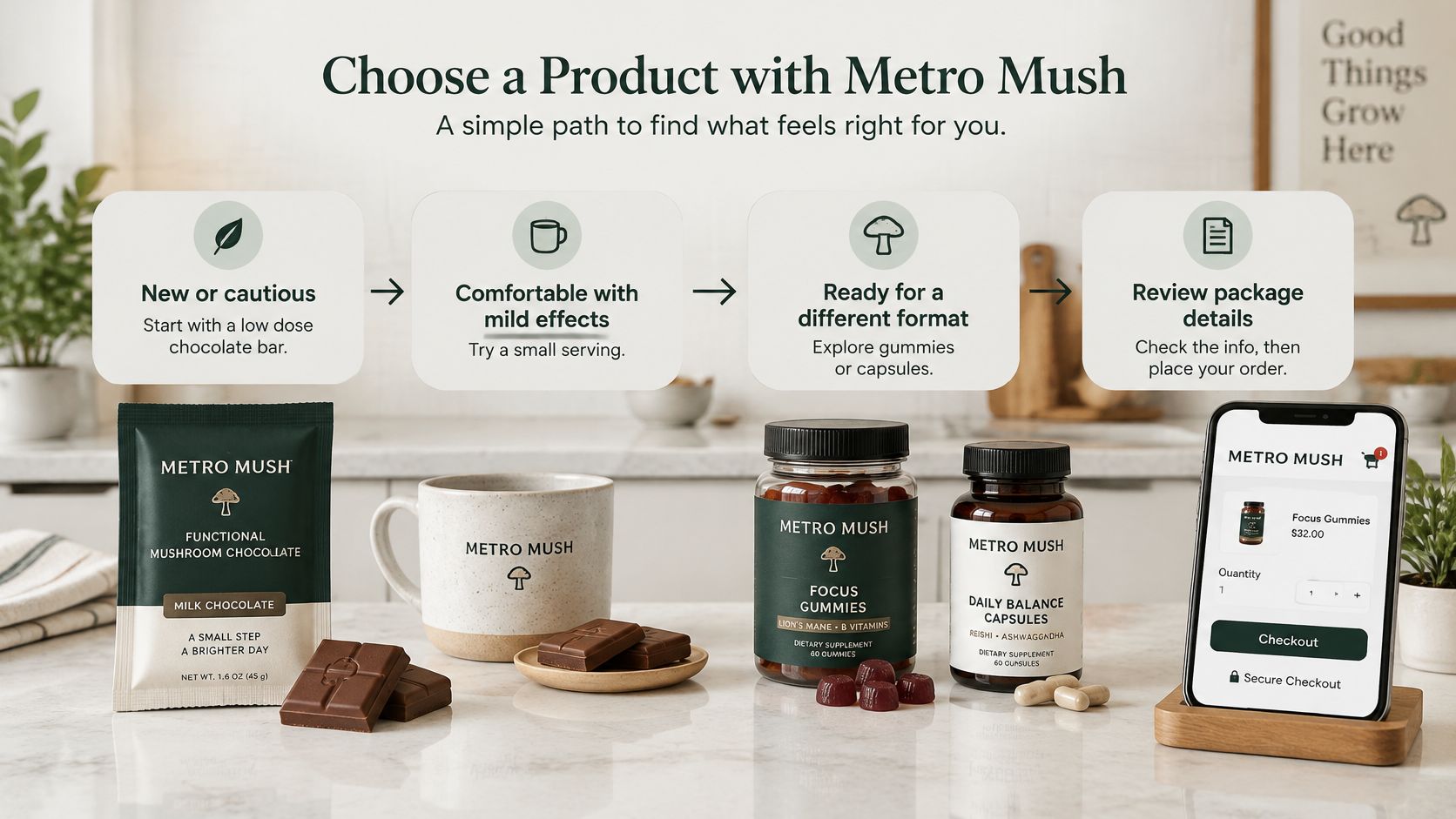
A strain name is a shopping label, not a measured dose. Metro Mush lists dried Penis Envy and Enigma, along with OuterSpore Milk Chocolate Bars, Mush Love Chocolate Bars, Moon Bars, and Rocket Fuel drinks. The format and label matter as much as the name.
Before considering a product, ask what its label measures and whether a lab report matches the specific batch. For an edible or drink, check whether testing covers the finished product, not only its mushroom ingredients.
Questions worth resolving before considering any product
For dried mushrooms, look for a compound-specific concentration and a batch identifier that matches the report. A strain's reputation cannot fill gaps in that information.
For chocolates and drinks, find out whether the stated content refers to mushroom weight or measured active compounds. Check how the maker defines a serving and whether testing supports consistency across finished portions.
- Request the relevant lab sheet: Confirm that the report matches the product and batch.
- Clarify the ingredient: Ask whether the item contains mushroom material, an extract, or an isolated ingredient.
- Check the claim: Packaging language alone does not establish testing, therapeutic benefit, or non-impairment.
- Separate legality from availability: An advertised product is not necessarily lawful to possess, supply, or transport.
If you live in Illinois, Ohio, or Indiana, don't assume Michigan's local enforcement context applies where you are. Crossing a state line can raise legal questions that a strain guide cannot resolve.
A more exotic strain name does not make a product easier to assess. Clear documentation and realistic expectations help you judge what is known, and whether remaining uncertainty makes the product unsuitable.
Metro Mush's dried mushroom labels, chocolates, and drinks show why strain reputation and product format need separate scrutiny. Visit Metro Mush to review its published product information and prepare questions about ingredients, batch documentation, and serving labels. Check current law and medical suitability independently.