


You're probably here because you saw Shakti on a menu, in a group chat, or in a dispensary conversation and thought, “What is that one?” It stands out fast. Most mushroom strains get described in the usual way. Earthy, tan, blue bruising, familiar cubensis look. Shakti tends to stop people because it looks almost ghostlike.
That first reaction is common around Detroit and Ann Arbor right now. Someone comes in already knowing names like Penis Envy or Enigma, then spots Shakti and assumes the pale look must mean it's either extra strong, extra rare, or somehow a completely different kind of mushroom. Sometimes that's where the confusion starts.
Facts are more useful than the hype. Shakti is interesting because of its lineage, its appearance, and the way people talk about it. But if you're trying to make a smart choice as an adult consumer, the essential questions are simpler. What is it, what should you expect, how careful should you be with dose, and how does it compare with the heavyweight strains people already know?
Introducing the Enigmatic Shakti Mushroom
A lot of strain names sound dramatic. Shakti looks the part.
If you're browsing a local menu and comparing dried mushrooms side by side, Shakti often catches your eye before you even read the label. It tends to look pale, creamy, or almost white, which gives it a very different presence than the more familiar golden-brown cubensis types. For some people, that visual difference creates instant curiosity. For others, it creates an assumption that the experience must also be completely different.
That's understandable, but it helps to slow down and separate appearance, lineage, and potency.
Why people get curious about Shakti
In local conversations, Shakti often comes up in the same breath as “specialty” strains. That doesn't necessarily mean it belongs in its own species category. It means people notice it, talk about it, and often expect it to behave like a premium or unusually intense option.
That expectation can cut in two directions:
- Newer consumers may think the white appearance means it's too advanced for them.
- Experienced consumers may assume the strain name alone tells them how hard it will hit.
- Cautious shoppers may just want to know whether it's closer to a balanced cubensis experience or closer to the stronger reputations surrounding PE-style products.
If you're still building your strain literacy, reading a broader Psilocybe cubensis strain guide can help place Shakti inside the larger cubensis family instead of treating it like a mystery object.
Practical rule: A striking mushroom can be visually unique and still require the same careful, adult harm-reduction mindset as any other cubensis product.
What matters more than the name
For Detroit and Ann Arbor adults, the most grounded way to think about Shakti is this. It's a named cubensis variety with a distinct look and a growing reputation, but your actual experience still depends on familiar variables: batch, dose, setting, mindset, whether you've eaten, and whether the product has any trustworthy testing or handling information behind it.
That matters locally because strain chatter moves fast. One person says Shakti felt visual and euphoric. Another says it was meditative and inward. A third says it surprised them. All of those reports can be true without making the strain predictable in a pharmacy-style way.
So if Shakti has been sitting in your mental “maybe” pile, the right move isn't to chase a dramatic story about it. The right move is to understand what it is, where it comes from, how to compare it with better-known names, and how to approach it without overconfidence.
Unpacking the Shakti Lineage and Genetics
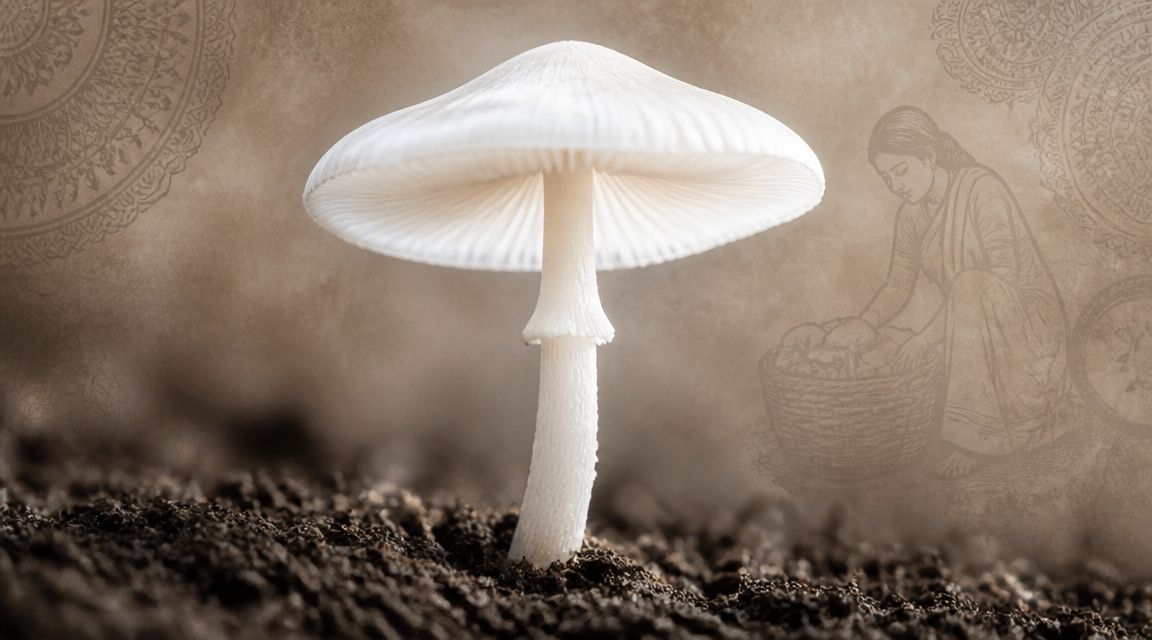
Shakti is generally described as an albino isolation tied to the Indian Malabar line within Psilocybe cubensis. For Detroit and Ann Arbor adults, that matters less as trivia and more as a translation tool. It tells you Shakti belongs in the cubensis family people already know, even if it looks unusual on the shelf.
What albino isolation means in plain English
“Albino isolation” refers to a selected expression that keeps a pale or white appearance across generations. A good everyday comparison is dog breeding. Two dogs can belong to the same breed, while one line is known for a very specific coat color or body shape. Shakti works in a similar way inside the broader cubensis family.
That helps clear up a common point of confusion. Shakti is usually discussed as a named cubensis variety, not as a separate mushroom species. Its standout look is part of its identity, especially for shoppers who are used to the more familiar golden-brown cubensis profile.
If you like seeing how named cubensis varieties branch and differ, comparing Shakti with other strains such as Z-Strain mushrooms can make the family tree easier to follow.
Why the Malabar connection matters
The Malabar reference points to strain history and inherited traits. For a local customer in Metro Detroit or Ann Arbor, that is useful because it places Shakti closer to a known cubensis lineage instead of treating it like a mystery category.
That context also helps when you compare local menus and community chatter. A vendor might list Shakti beside Penis Envy or Enigma, and those names can make it sound like all three sit in the same bucket. They do not. Shakti is usually framed through cubensis lineage, while its reputation often gets inflated by its unusual appearance and limited availability.
Genetics shape looks more reliably than outcomes
Here is the practical takeaway. Genetics can strongly influence how a mushroom looks, while experience strength still varies from batch to batch.
That difference matters for harm reduction. A white, rare-looking mushroom can feel more intense before you even take it, because the presentation carries a reputation. In real use, cultivation, storage, age, and dose still play a major role in how any given batch lands.
So biologically, what makes Shakti recognizable is its lineage and phenotype. For a shopper trying to make a smart local comparison, that means Shakti's genetics tell you more about its place in the cubensis family than they do about exactly how strong your personal experience will be.
Understanding Shakti Potency and Effects
A common Metro Detroit scenario goes like this. Someone sees Shakti on a local menu, notices the striking white look, hears that it is rare, and assumes the experience will be automatically stronger than other options. That assumption can lead people to dose with more confidence than the batch deserves.
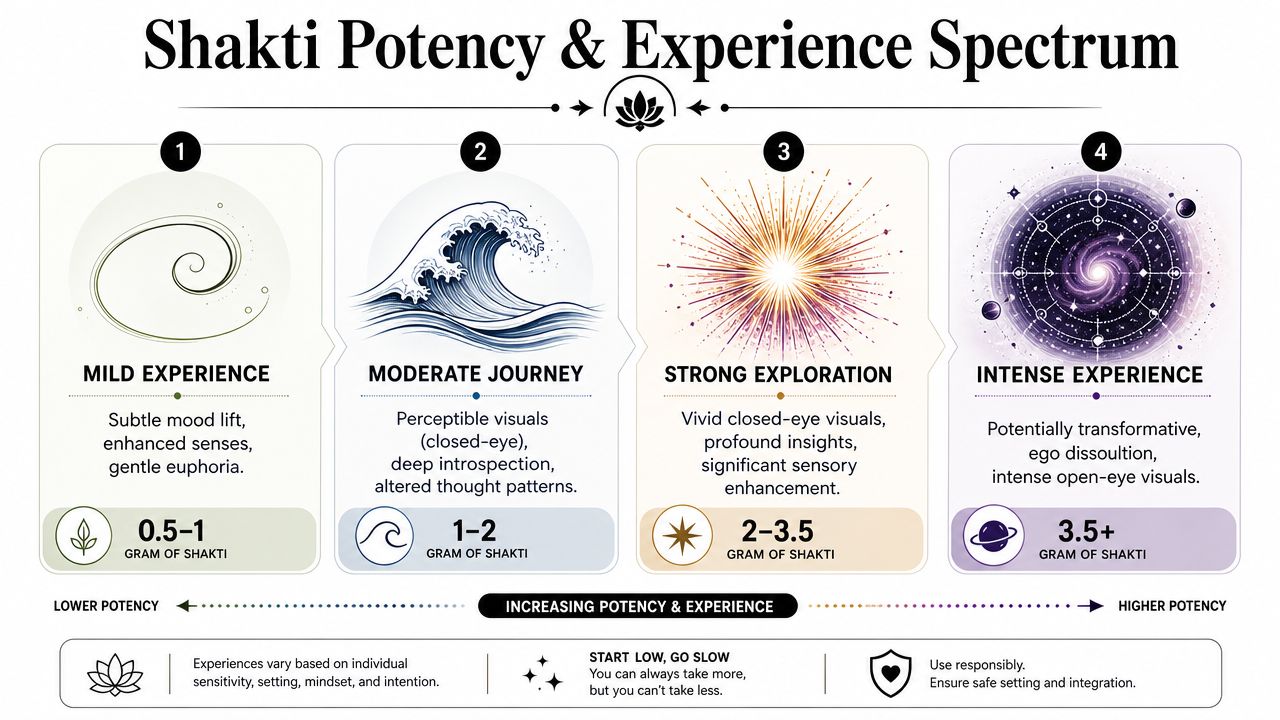
A safer read is simpler. Shakti can produce meaningful effects, but the name alone does not tell you exactly how intense your personal experience will be.
Near the start of that conversation, this infographic helps frame the common dose labels people see online. Treat it as a rough orientation tool, not a promise.
Why the name doesn't tell the whole story
Consider craft beer. A label tells you the style, but it does not tell you the exact ABV of the can in your hand, and one batch can hit differently from another. Mushroom strain names work similarly. They give context, not certainty.
For practical dosing, it helps to treat Shakti as a cubensis strain with potency variation from batch to batch. Analysts at Miraculix found wide potency variability in Psilocybe cubensis, with differences tied to genetics, cultivation conditions, substrate, and post-harvest handling. For an adult shopper in Ann Arbor or Detroit, the takeaway is straightforward. A well-grown, well-stored batch matters more than the mythology around the strain name.
That point becomes even more useful locally, where shoppers often compare Shakti with high-reputation options such as Penis Envy 6. In real use, local availability and handling can shape the outcome as much as the label.
What effects people often look for
Adults who choose Shakti are often hoping for a mix of a few common effects:
- Visual texture such as enhanced pattern recognition or richer closed-eye imagery
- Emotional openness that can feel warm, reflective, or cathartic
- Cognitive shift where thoughts feel looser, more associative, and less linear
- Sensory amplification in music, light, touch, and atmosphere
Those effects do not arrive in a vacuum.
The same amount can feel gentle in a quiet living room with a trusted sitter and much more disorienting in a loud social setting. Mood, sleep, recent food intake, and general comfort all shape the experience. That is why harm reduction starts before ingestion, not after.
This video gets at that broader harm-reduction mindset around strain reputation and user expectations.
A better question is, “How confident am I about this batch, this setting, and this dose?”
A grounded way to think about intensity
If you are trying to predict Shakti, use a dimmer-switch model instead of a fixed script. Dose changes intensity. Batch quality changes intensity. Your environment changes intensity too.
A lighter batch at a modest amount may feel thoughtful and manageable. A stronger batch at that same weighed amount may feel far more immersive, with stronger visuals, more emotional movement, and less interest in conversation or errands. That is where adults get caught off guard. They recognize the strain name, then forget that mushrooms are an agricultural product, not a factory-made tablet.
For local shoppers comparing Shakti with Penis Envy or Enigma, that framing helps. Reputation tells you where a strain sits in community conversation. It does not tell you exactly what tonight will feel like.
Safe Dosing Guidelines for the Shakti Strain
Safe use starts with a simple idea. Start lower than your confidence wants to. That's especially important with a strain like Shakti, where the name can create false certainty.
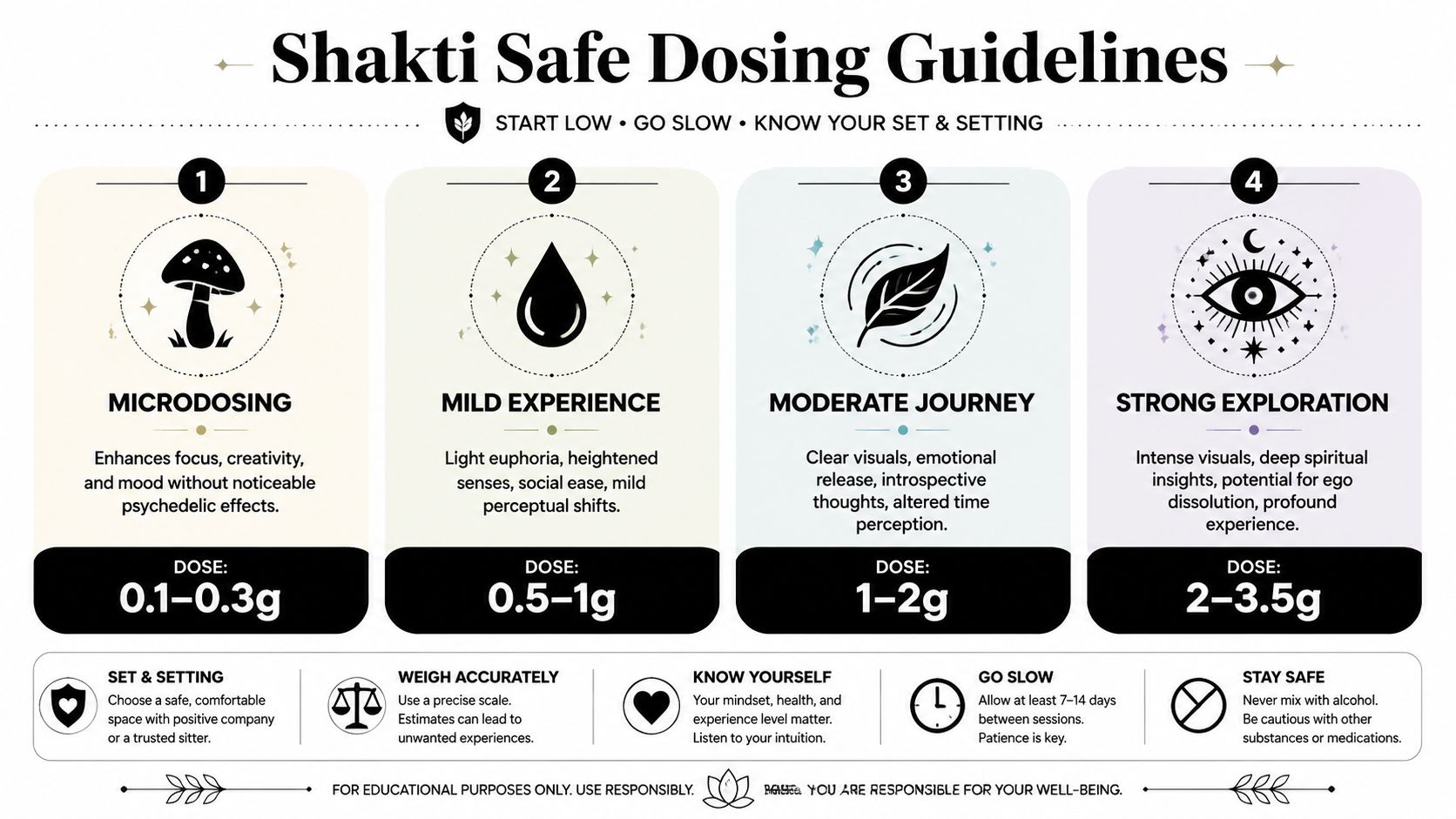
The guide below is useful as a practical visual, but keep the earlier variability point in mind. A chart can organize expectations. It can't test the batch in your hand.
How to think about dose tiers
A smart dosing plan begins with your intention, not your ego. Ask what kind of day you want, what environment you'll be in, and whether you've had recent experience with mushrooms that felt stable and manageable.
Here's a practical framework many adults use:
Micro range
Within this range, people usually want subtlety, not a trip. The goal is often to stay functional and avoid obvious psychedelic effects. If you notice yourself feeling distinctly altered, you may already be outside the range you intended.Low or museum-style range
This is often the sweet spot for cautious adults who want to feel something real without diving deep. Colors may seem a little brighter, music may feel fuller, and your mood may loosen. It's still a range where environment matters a lot.Moderate range
At this range, introspection, perceptual shifts, and stronger emotional movement can become the main event. If your apartment is chaotic, your phone is blowing up, or you've got unresolved stress humming in the background, you'll feel that.Strong range
This is not where you “see what happens” on a whim. It calls for planning, a safe setting, no urgent responsibilities, and ideally a trusted sober person nearby.
Simple harm-reduction rules that help
A lot of difficult mushroom experiences don't come from the strain. They come from rushed choices.
- Use a scale. Eyeballing dried mushrooms is a bad habit.
- Wait before redosing. Early impatience creates many over-intense nights.
- Don't stack substances casually. Alcohol, cannabis, and other substances can change the tone and intensity.
- Protect the setting. Clean room, water nearby, comfortable clothes, easy bathroom access, no obligations.
- Have an exit plan. Silence notifications, tell one trusted person what you're doing, and keep your night simple.
Local-shop advice: If you're asking whether Shakti is “strong,” treat that question as a sign to choose the lower end of your planned range.
What cautious adults often do right
The people who handle Shakti well usually aren't the bravest. They're the most methodical. They don't chase a strain reputation. They choose a manageable amount, respect the timeline, and leave room for the batch to be stronger than expected.
That approach may sound less exciting than strain mythology, but it's what keeps the experience useful instead of chaotic.
Shakti vs Penis Envy and Enigma
This is the comparison many Metro Detroit and Ann Arbor shoppers want. Not “Is Shakti cool?” but “How does it sit next to the names everybody already knows?”
The key caution is that current strain talk often overstates certainty. Another underserved angle is comparative potency and risk counseling versus more familiar high-potency strains. Current content often says Shakti is “powerful” or “potent,” but doesn't fully answer the practical comparison question. The more useful perspective is that adults need batch-level harm-reduction framing, not just strain names, because standardized potency data for many branded cubensis types still isn't there, as discussed in this video on comparative strain risk framing.
A practical comparison table
| Attribute | Shakti | Penis Envy (PE) | Enigma |
|---|---|---|---|
| General reputation | Visually distinct cubensis with a pale, albino-style look and a “specialty strain” reputation | Commonly treated by consumers as a heavy-hitter cubensis option | Often discussed as a premium, conversation-dominating strain |
| What shoppers often assume | That the unusual appearance must predict intensity | That it will be stronger and more serious than average cubensis | That it will be unusually intense or advanced |
| Best safety mindset | Don't equate white appearance with a reliable potency level | Don't let familiarity make you careless | Don't let rarity talk push you into overestimating your comfort level |
| How to compare locally | Evaluate the actual batch, not just the name | Useful benchmark if you already know how PE tends to affect you | Useful benchmark if you're already comfortable with stronger specialty products |
| Who should be cautious | First-timers, infrequent users, anyone assuming it's “gentle” because it's cubensis | Anyone stepping up too fast from basic cubensis experience | Anyone choosing based on hype rather than preparation |
How this helps with real decisions
If you've handled Penis Envy before, you might be tempted to use that memory as a measuring stick for Shakti. That can help a little, but only as a rough gut-check. It should not become a formula.
If PE felt physically heavy or mentally forceful for you, you may be looking at Shakti hoping for something more visual, cleaner, or easier to steer. Sometimes adults describe it that way. Sometimes they don't. That's exactly why comparison should stay qualitative unless the batch is tested.
If Enigma is the strain that lives in your head as the “serious one,” Shakti may seem like the more approachable middle option. Maybe. But that judgment still belongs to the actual material in front of you, not the mythology around the label.
A better question than which one is strongest
Instead of asking “Which of these wins on potency?” ask:
- Which one do I have the most trustworthy information about?
- Which one fits my current experience level?
- Which one am I least likely to overdo because of hype or confidence?
That framing is more useful than forum-style ranking lists. It also matches how careful adult consumers tend to find what's available locally. In the Detroit and Ann Arbor area, what's on hand can change. Your standards shouldn't.
Sourcing Shakti Safely in Detroit and Ann Arbor
You are standing in Detroit or Ann Arbor, scrolling a menu or reading a text thread, and two sellers both claim they have Shakti. The photos look similar. The prices are close. At that point, the question is less about the strain name and more about the hands it passed through before it reached you.
That matters with Shakti because appearance can mislead people. An albino-style mushroom may look clean, unusual, and high-end while still being old, poorly dried, or stored with very little care. A strain label works like a wine label. It tells you what the product is supposed to be, but it does not prove how well it was handled.
What to look for in a local source
A reliable local source should give you enough information to make a calm decision, not pressure you into guessing.
Here are a few practical signs to check:
- Clear menu naming so you can tell whether you are buying dried mushrooms, edibles, or another product type
- Consistent handling and presentation that suggest the product was stored carefully
- Direct communication so you can ask basic questions before ordering
- Local presence and accountability so the seller is still reachable if something seems off
For adults in Southeast Michigan, Metro Mush is one local example people may come across because it publishes a menu, lists Detroit and Ann Arbor service details, and uses text-based ordering. That kind of transparency gives you more to evaluate than a disappearing social account or a vague reposted menu.
Why local accountability matters
With a faceless seller, you often lose the basics that support safer decisions. You may have no clear sense of product age, storage conditions, batch consistency, or whether “Shakti” is being used carefully or casually.
That uncertainty affects more than expected strength. It affects how confidently you can plan your setting, your dose, and your timing.
A good rule is simple. Buy from people you can contact again.
For Detroit and Ann Arbor adults, that usually means choosing sources that communicate like real businesses and treat strain names as one piece of product information, not the whole story. In a local market where availability can change week to week, that standard helps you compare Shakti against options like Penis Envy or Enigma with a clearer head and fewer assumptions.
Final Thoughts for Your Shakti Journey
Shakti earns attention because it looks unusual and carries a strong reputation. That's fine. Just don't let the mystique do your thinking for you.
The safest way to approach the Shakti mushroom strain is to treat it as a visually distinct cubensis variety with variable real-world potency. Respect the batch. Use a scale. Keep your setting calm. Don't make dose decisions based on hype, photos, or what someone else said a different batch felt like.
If you're comparing Shakti with names like Penis Envy or Enigma, the most important takeaway is surprisingly simple. The label can guide your expectations, but it can't replace careful sourcing and conservative dosing.
That's the adult way to do this in Detroit and Ann Arbor. Stay curious, but stay methodical. A better experience usually comes from good preparation, not bravado.
If you're exploring options for mushrooms, chocolates, or drinks in Southeast Michigan, Metro Mush lets adult customers browse the menu, check local availability, and place orders by text for the Detroit and Ann Arbor areas.