
You open a browser, type “magic mushroom spores,” and suddenly land in a maze of syringe photos, microscopy disclaimers, strain names, and legal warnings that seem to contradict each other. One site says spores are legal. Another says cultivation isn’t. A third talks about genetics as if you need a lab coat to understand what you’re buying.
That confusion is normal.
For those interested in magic mushroom spores, a few simple questions often arise. What are spores, exactly? Are they the same thing as mushrooms? Why can you buy them in many places if psilocybin itself is so tightly controlled? And if all of this feels legally and practically messy, is there a safer path for adults who just want a predictable, compliant option?
A good answer starts with biology, not hype. Spores are tiny. They’re fascinating. They matter. But they also sit at the center of one of the most misunderstood corners of mushroom culture, because the thing you can legally buy in many places is not the same thing as the final mushroom product, and the step between those two is where many people get into trouble.
The Curious World of Magic Mushroom Spores
A cautious first-time reader usually runs into spores the same way. They see a listing online for a spore syringe or a spore print, notice a phrase like “for microscopy and taxonomic purposes only,” and wonder if that’s a legal loophole or just coded language.
It helps to slow the whole picture down.
Magic mushroom spores are the microscopic reproductive units of certain fungi. They aren’t dried mushrooms. They aren’t edibles. They aren’t active in the way many people assume. They’re more like the starting material of a fungal life cycle, interesting to study and easy to misunderstand.
That misunderstanding gets bigger because sellers, hobbyists, and consumers often talk past one another. A hobby mycologist might care about spore shape, color, and species traits under a microscope. A curious consumer might be thinking about final effects, strain names, and legality. Those are related conversations, but they are not the same conversation.
Many readers don’t need more jargon. They need a clean line between what a spore is, what a mushroom is, and what the law treats differently.
The other source of confusion is practical. Even if someone learns that spores themselves are not psychoactive, they still have to sort out what buying them means, what using them means, and why that distinction matters so much. That’s where people tend to mix up scientific interest with legal risk.
If you treat spores like a mysterious shortcut, you’ll stay confused. If you treat them like a biological starting point with very specific legal and practical limits, the subject becomes much easier to understand.
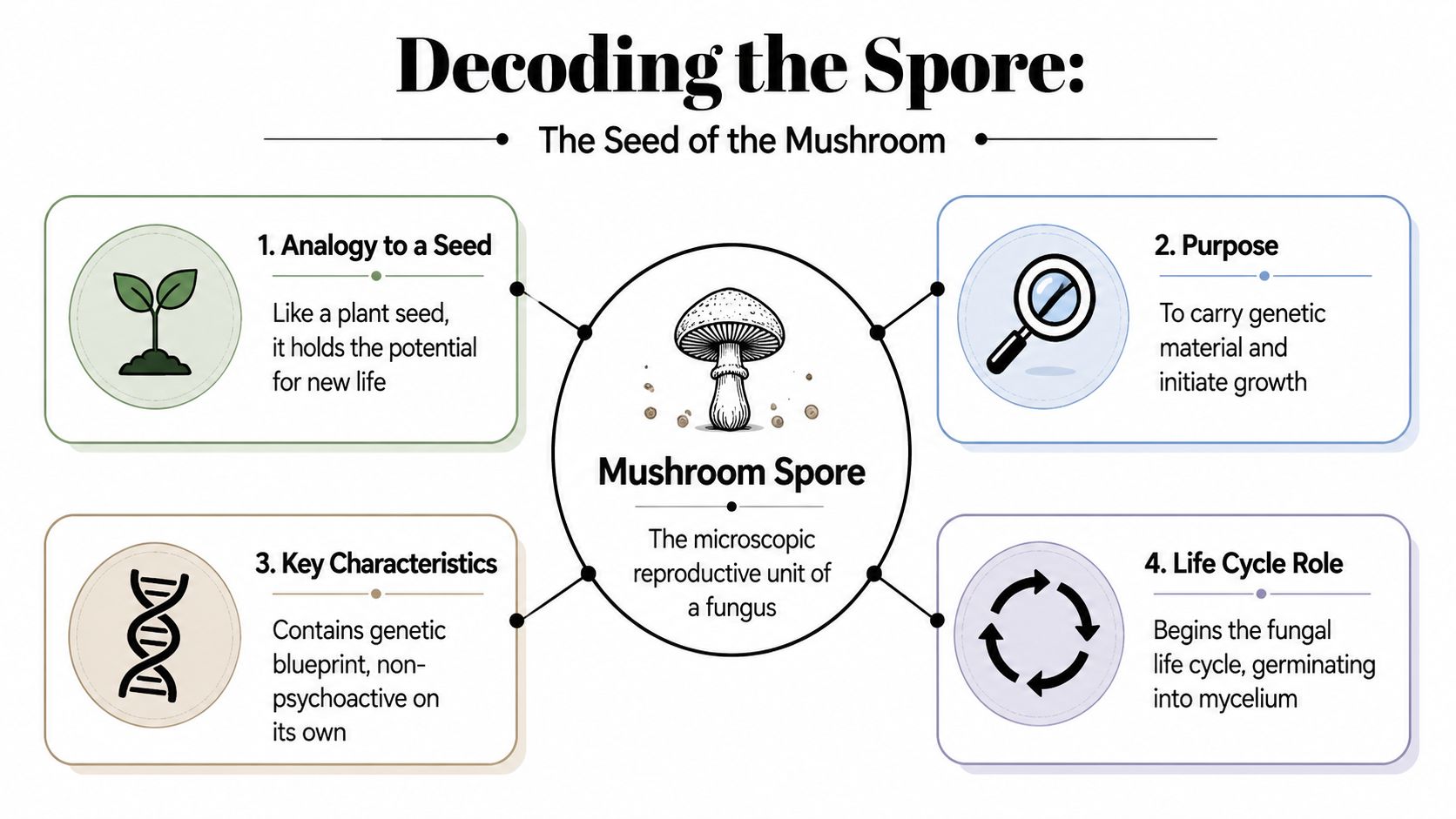
Decoding the Spore The Seed of the Mushroom
The simplest way to understand a mushroom spore is to compare it to a seed.
A seed isn’t the apple tree. It carries the potential for one. A spore works similarly for fungi. It’s the tiny reproductive unit that carries genetic information and can begin the process that eventually leads to fungal growth under the right conditions.
That analogy isn’t perfect, but it’s useful because it clears up the biggest beginner mistake. A spore is not the mushroom itself.
Three stages people often mix up
When people talk about mushrooms casually, they often collapse the whole fungal life cycle into one word. That makes the science feel harder than it is. In plain language, it helps to separate the process into three parts:
The spore
This is the microscopic starting point. It carries genetic material.The mycelium
This is the thread-like fungal network that develops after germination. If you want a plant comparison, think of it loosely like the hidden structure that spreads before the visible part appears.The fruiting body
This is the mushroom you can see.
If you only remember one image, remember this: spore first, hidden network second, visible mushroom last.
What spores are for
Spores exist to spread fungal genetics. They’re built for reproduction and identification, not for immediate psychoactive effect. That’s why microscopy has become such a common and legitimate context for talking about spores. Under magnification, mycologists can study traits that help distinguish one species from another.
You’ll see this reflected in products such as Psilocybe spore syringes, which are commonly discussed in relation to observation and classification. For a curious reader, that’s a better starting lens than jumping straight to assumptions about use.
A beginner-friendly mental model
Here’s the easiest way I know to explain it to a friend:
| Part | What it is | Simple analogy |
|---|---|---|
| Spore | Microscopic reproductive cell | Seed |
| Mycelium | Growing fungal network | Root-like hidden web |
| Fruiting body | Visible mushroom | The plant above ground |
Practical rule: If you’re looking at a spore product, you’re looking at the blueprint stage, not the finished mushroom.
That one distinction removes a lot of confusion. It also sets up the next issue, because once you understand spores as a starting point, you can finally make sense of why microscopy and cultivation are treated so differently.
Microscopy Versus Cultivation The Two Paths for Spores
Most of the confusion around magic mushroom spores comes from the fact that people use the same product for two very different purposes.
One path is microscopy. The other is cultivation.
They may begin with the same spore syringe or print, but they lead to very different legal and practical territory. That’s why you keep seeing the phrase “for microscopy and taxonomic purposes only” on spore listings. It isn’t random wording. It points to the lawful scientific use that many vendors rely on when discussing spores.
Path one means observation and classification
Microscopy is straightforward. A person studies spores under magnification to observe characteristics such as shape, texture, pigmentation, and species differences. For a hobby mycologist, this is part science and part collection practice. It’s comparable to birdwatchers noting field marks or botanists comparing seed structures.
This path focuses on what the spores are, not on producing mushrooms from them.
That’s also why taxonomy matters. Different species and strains can show visual differences that make spores interesting to catalog, compare, and learn from. For some readers, that’s the whole hobby.
Path two means trying to germinate and grow
Cultivation is the fork in the road where legal risk enters. Once someone moves from viewing spores as microscopic specimens to trying to develop them into mycelium and eventually fruiting bodies, they are no longer in the same category of activity.
The confusion grows because online discussions often blur these boundaries. A consumer may think, “If the spores are legal to buy, doesn’t that make the next step okay too?” In many places, the answer is no.
That’s one reason some people start looking at alternatives like mushroom liquid culture, because they hear it discussed as more dependable in research settings. But reliability is a separate question from legality. A more dependable format does not erase the legal issue that comes from what someone intends to do with it.
A side-by-side view helps
| Use of spores | What the person is doing | Why the distinction matters |
|---|---|---|
| Microscopy | Observing and identifying spores | Fits a scientific or educational context |
| Cultivation | Attempting to germinate and grow mushrooms | Can cross into illegal activity depending on jurisdiction |
Vendors use careful language because intent matters. Looking at spores under a microscope is not the same act as trying to produce mushrooms from them.
That difference can feel frustrating to beginners because the product looks the same at the start. But the law often cares less about what an item looks like and more about what it contains, what stage it is in, and what a person is doing with it.
If you keep those two paths separate in your mind, a lot of the industry’s strange wording suddenly makes sense.
The Genetic Blueprint How Spores Determine Potency
Spores don’t contain the active compounds people associate with psychedelic mushrooms, but they still matter greatly because they carry the genetic blueprint that shapes what a mature mushroom can become.
Think of a spore as a tiny packet of inherited instructions. Those instructions influence visible traits such as color, form, and resilience. They also influence less visible outcomes tied to alkaloid production in the mature fruiting body.

Genetics shape the final mushroom
Research described in this guide to psilocybin mushroom spores and species notes that psilocybin concentration ranges from 0.2% to 1.0% of dry weight, while psilocin ranges from 0.1% to 0.5%. The same source explains that this variability depends on species genetics, growing conditions, and storage methodology.
That matters because strain names are not just decorative labels. They point to lineages with inherited traits. The same source explains that the genetic profile in each mushroom spore contains the complete genetic code of its parent strain, which helps determine characteristics that influence the alkaloid production capacity of the mature fruiting body.
In plain English, the spore is non-active, but it still carries instructions that can affect how a mature mushroom turns out later.
Why potency can’t be treated as universal
A lot of beginners assume a mushroom is a mushroom. That’s too simple.
Even within psilocybin mushrooms, composition can vary. The same source notes that mature mushrooms may contain not only psilocybin and psilocin, but also norpsilocin, baeocystin, norbaeocystin, and aeruginascin, which may contribute to an entourage effect that modifies the overall experience. That means two mushrooms with similar names or appearances may not feel identical in practice.
Here’s the key takeaway:
- Genetics matter: The strain lineage affects what traits are passed forward.
- Environment matters too: Growing conditions and storage can influence outcomes.
- Batch assumptions are risky: You can’t assume perfect consistency across strains or even across different batches of the same strain.
The safest mindset is to treat strain names as meaningful, but not as guarantees of a perfectly standardized outcome.
Why this matters to cautious adults
If you’re trying to understand why some strains build a strong reputation, genetics are part of the answer. Some lineages are sought after because people associate them with distinct characteristics, not just because the names sound memorable.
But the bigger lesson is about humility. Spores tell you something important about origin and inherited potential. They do not let you skip the reality that mature mushroom chemistry is variable and complex. That’s one reason informed consumers place so much value on clear product information and predictable preparation rather than guesswork.
Navigating the Legal Landscape of Mushroom Spores
The legal status of magic mushroom spores confuses people because the law treats the starting material differently from the active end product.
That sounds technical, but the basic idea is simple. A spore is one thing. A mature psilocybin mushroom is another. The line between them carries most of the legal tension.
Why spores are treated differently
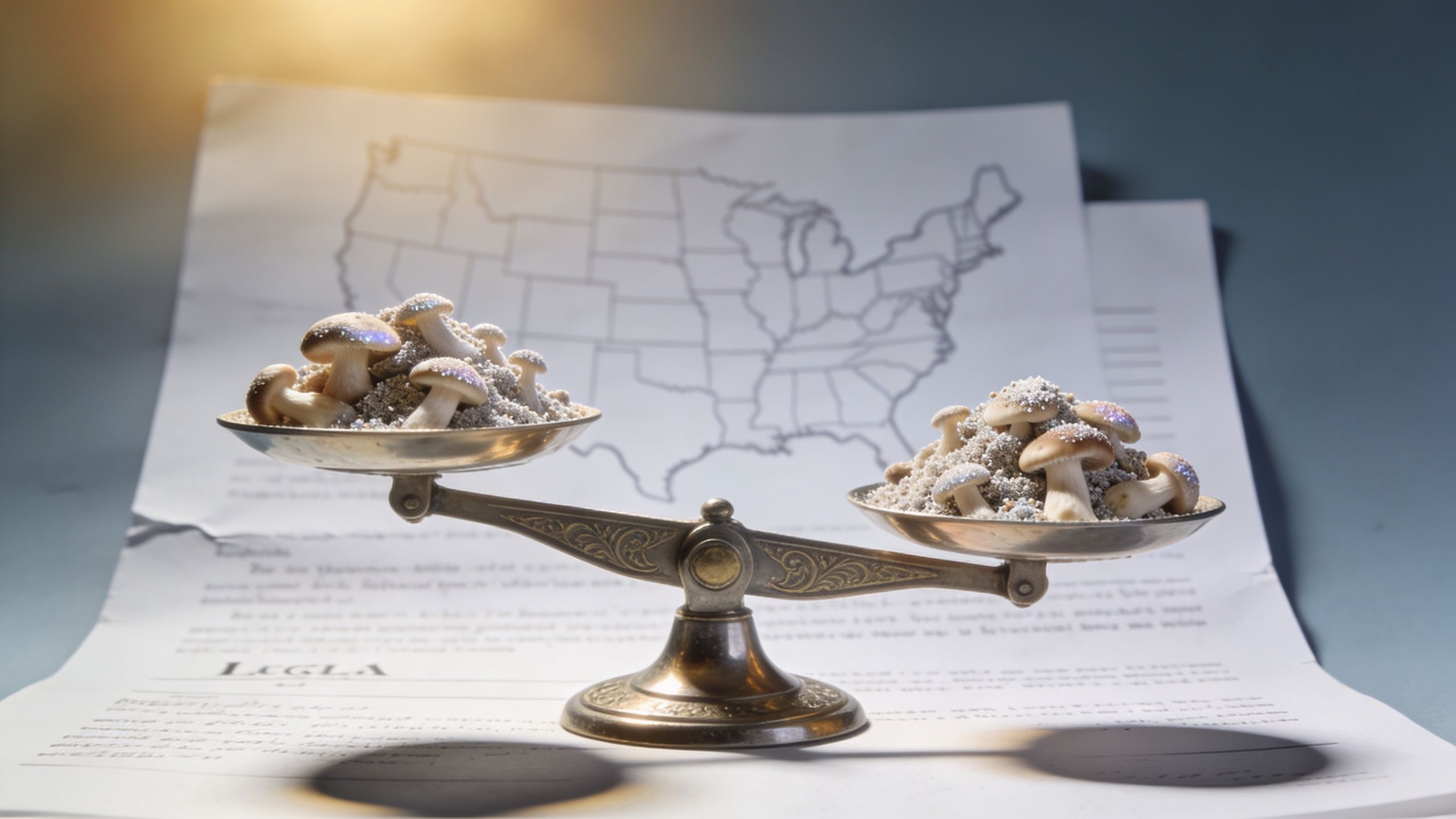
According to this legal and educational mycology guide, magic mushroom spores are entirely non-psychoactive because they do not contain psilocybin or psilocin until the mycelium develops into mature fruiting bodies. The same source says that psilocybin mushroom spores are legally permitted in most U.S. states, with exceptions limited to California, Georgia, and Idaho.
That’s the core of the paradox. In many places, a person can legally possess the non-active reproductive material, but crossing into cultivation can trigger a different legal analysis.
The part that trips people up
People often hear “legal to buy” and mentally convert it into “legal to use however I want.” That’s the mistake.
The law often looks at what the material contains at a given stage and what a person intends to do with it. Since spores themselves don’t contain psilocybin or psilocin, they may be sold for microscopy and educational purposes in many states. But trying to turn them into active mushrooms can create a very different legal situation.
A short explainer can help here:
| Question | Short answer |
|---|---|
| Are spores active? | No, not at the spore stage |
| Can spores be purchased in most U.S. states? | Yes, except California, Georgia, and Idaho in the cited source |
| Does that make cultivation legal? | No, those are separate issues |
Buying a legally sold item and using it for an unlawful purpose are not the same thing.
How local readers should think about risk
For adults in Michigan and nearby states such as Ohio, Indiana, and Illinois, the hardest part isn’t usually finding opinions online. It’s sorting solid distinctions from casual forum talk.
Local policy, state law, prosecutorial priorities, and municipal enforcement can differ. Some cities may have decriminalization policies or lower enforcement priorities related to entheogenic plants and fungi. That still doesn’t mean every act involving spores, cultivation, possession, or distribution is automatically lawful. It means the legal situation is layered and context matters.
That’s why broad internet advice can be dangerous. A post written for one state, or even one city, may not fit your situation at all.
The legal ambiguity is easier to grasp when you hear it explained aloud:
Why the paradox pushes people toward compliant options
The practical problem isn’t just whether spores can be purchased. It’s what comes next. If a person is mainly interested in a finished mushroom experience rather than microscopy, spores often create more confusion than value.
That’s where products framed as educational tools, such as a magic mushroom spore kit, can attract attention while still leaving beginners with unanswered questions about what is and isn’t allowed. The kit itself doesn’t remove the legal line around cultivation.
For a cautious adult, the safest habit is simple:
- Check your jurisdiction carefully
- Separate possession questions from cultivation questions
- Don’t assume neighboring states or cities follow the same rules
- Treat vague online advice as unreliable
If the legal picture feels muddy, that’s because it often is. And when the law is muddy, guessing is a poor strategy.
Evaluating Spore Quality and Avoiding Common Pitfalls
Once people get past the legal questions, they usually run into a second problem. Not all spore products are equally useful, equally clean, or equally appropriate for what they’re trying to do.
A beginner often sees three terms and assumes they’re interchangeable: spore syringe, spore print, and liquid culture. They’re related, but they are not the same thing.
The main formats at a glance
A quick comparison makes this easier:
| Format | What it usually offers | Common issue |
|---|---|---|
| Spore syringe | Easy handling, suspended spores | Contamination concerns |
| Spore print | Good for visual study and archiving mindset | Requires more care to work with |
| Liquid culture | Favored for reliability in research contexts | Not the same thing as a simple spore product |
The most important practical distinction in this group is reliability. According to this mycology reference from Myyco, mycologists consider liquid cultures more reliable than spores for research, as spore syringes are notorious for becoming contaminated. The same source notes that many consumer-facing explanations focus on spore identification but don’t spend enough time on contamination risk and reliability.
That gap matters because beginners often judge a product by how polished the listing looks, not by how fragile the material may be.
What to watch for when evaluating a product
If someone is studying spores for microscopy or handling them for legal educational purposes, quality still matters. A poor product can create confusion, waste money, or give misleading observations.
A practical checklist helps:
- Packaging clarity: A serious seller explains what the product is and what it is for, instead of relying on wink-and-nod language.
- Clean presentation: If a syringe looks visibly questionable or poorly stored, caution is wise.
- Strain labeling: Clear labeling matters because genetics and identification go together.
- Handling guidance: Good sellers explain storage and care in plain language.
The bigger trap is assuming that “popular” means “clean.” In mycology, contamination can spoil the usefulness of a sample fast. Reliability has more to do with preparation and handling than with flashy branding.
Field note: If a product description avoids practical handling details altogether, that’s a sign to slow down and ask harder questions.
Common mistakes beginners make
Some mistakes show up over and over:
Buying based on strain hype alone
A famous strain name can attract attention, but it doesn’t tell you whether the sample was handled well.Ignoring format differences
People often treat prints, syringes, and liquid cultures as if they serve the same purpose. They don’t.Storing carelessly
Heat, light, and rough handling can reduce usefulness over time.Confusing reliability with legality
A more dependable research material does not change what’s permitted in your jurisdiction.
A more careful way to think about quality
If your interest is educational, choose the format that matches that purpose. If your main goal is a final-use product rather than microscopy, then spores may not be the right lane at all.
That may sound obvious, but it saves people a lot of frustration. The deeper you go into spores, the more you realize they reward patience, clean technique, and realistic expectations. They’re not a shortcut. They’re a specialized starting point, and they demand that you understand what you’re holding before you decide what to do next.
The Metro Mush Alternative Safe Legal and Ready for You
The biggest reason people get stuck on magic mushroom spores is that spores seem like an easy entry point. They’re listed online. They look accessible. They come wrapped in scientific language that sounds legitimate and low-risk.
But that apparent simplicity hides three separate problems.
First, there’s the legal confusion. As noted in this discussion of local distributors and consumer confusion, the legal-to-purchase but illegal-to-cultivate paradox creates confusion for consumers, and many existing explanations don’t clearly spell out the practical difference. For a first-time or cautious buyer, that means spores can feel permitted and forbidden at the same time.
Second, there’s the reliability issue. A person may buy spores thinking they’ve solved the problem, only to learn that the format they chose can be fussy, contamination-prone, or poorly suited to what they wanted.
Third, there’s the outcome issue. Even when someone understands spores biologically, they may still be far from what they were looking for, which is a prepared, usable product with clearer expectations.
Why ready-to-use products appeal to cautious adults
For many adults, spores are interesting to learn about but not ideal to rely on. If what you want is microscopy, spores make sense. If what you want is a finished consumer product, spores can pull you into a legal and practical gray zone that doesn’t match your real goal.
That’s why professionally prepared, ready-to-use options have a completely different value proposition. They remove the need to interpret microscopy disclaimers, compare formats, or pretend an educational specimen solves a consumer need.
A person who wants something approachable may prefer a product category that feels familiar, such as chocolates or drinks. Someone more experienced may prefer dried mushroom options with recognizable strain names. In both cases, the appeal is the same: less guesswork, clearer choices, and no need to cross the spore-to-cultivation gap.
What people are really buying when they avoid the spore route
They’re buying clarity.
They’re avoiding the awkward position of owning a legally sold biological material while wondering whether the next step is allowed. They’re avoiding the mismatch between scientific specimen language and consumer intent. And they’re avoiding the quality headaches that can come with poorly understood spore products.
That matters especially for people who are cautious by nature. A first-time adult consumer doesn’t usually want to become an amateur mycologist overnight. They want a local, straightforward option that aligns with their actual purpose and doesn’t require decoding legal disclaimers.
If you’re drawn to spores because they seem easier, it’s worth asking whether they’re actually easier for your goal, or just easier to click on.
The practical local advantage
A local dispensary model solves a different problem than a spore vendor solves.
A spore vendor serves microscopy and taxonomy interest. A ready-product dispensary serves adults who want access to prepared mushroom products without stepping into the cultivation question at all. Those are different lanes, and confusing them is where many people lose time or take unnecessary risks.
For adults in the Detroit and Ann Arbor area, that difference is especially useful. Local access means you can browse actual product categories, compare formats that fit different comfort levels, and choose something that meets your needs more directly than a microscope-oriented starter product ever could.
A person looking for a low-barrier entry point may gravitate toward options like OuterSpore Milk Chocolate Bars, Mush Love Chocolate Bars, Rocket Fuel shroom drinks, or Moon Bars. A more experienced consumer may look for dried strains such as Penis Envy or Enigma. The common thread is that these are prepared product choices, not do-it-yourself biology projects.
The calmest conclusion
Spores deserve respect. They’re biologically elegant and scientifically interesting. But they also attract people who are really looking for something else.
If your interest is true microscopy, learn the science and stay on the right side of the law. If your interest is an adult-use mushroom product, a compliant local option is often the clearer, safer answer than trying to force spores into a role they weren’t meant to play for you.
If you’re in Southeast Michigan and want a simpler path than sorting through magic mushroom spores, browse Metro Mush for prepared options like dried strains, chocolates, and drinks. You can order by text through the Detroit Metro line at 734-691-6122 or the Ann Arbor Metro line at 734-280-2868, with a $75 minimum order. Regular specials include Mix & Match Saturdays, where you can combine any three chocolate bars or drinks for $100, with savings of up to $40. Fire, police, and veterans receive 10% off, and joining the Discord offers 20% off plus updates on new drops and promotions.