


Ask any seasoned forager in Michigan when morel season starts, and they won't point to a date on the calendar. They’ll tell you to watch the soil, the trees, and the rain. Officially, the hunt typically begins in late April down south and can stretch all the way to mid-June up in the U.P.
But the real season follows a "green wave" of warmth and moisture, a slow-motion bloom that creeps north across the state. It's less about a schedule and more about a set of natural cues.
When Is Morel Season in Michigan Really?
Trying to nail down the exact first day of morel season in Michigan is a fool's errand. It’s a moving target, completely at the mercy of Mother Nature. The whole thing unfolds as a slow, northbound wave, starting near the Ohio border and not finishing until it laps the shores of Lake Superior.
This crawl is what makes Michigan's season so incredible. It means hunters near Detroit and Ann Arbor are often filling their bags weeks before folks in the Keweenaw Peninsula have even dusted off their boots. The trick is to stop thinking about dates and start thinking like a morel, paying close attention to the environmental triggers that tell them it's time to pop.
The Northward March of the Morels
It all kicks off in the state's southernmost counties. Once daytime temperatures are consistently hitting the 60s and nighttime lows stay above 40°F, the ground warms up to the magic number: right around 50-55°F. That's the green light for the first black morels to push through the leaf litter.
From there, the hunt moves north. A week or two later, the season is in full swing around Grand Rapids and Lansing. The peak then travels through the northern Lower Peninsula, hitting honey holes near Cadillac and Traverse City before finally making its way to the Upper Peninsula.
This timeline gives you a good visual for how the season generally plays out.
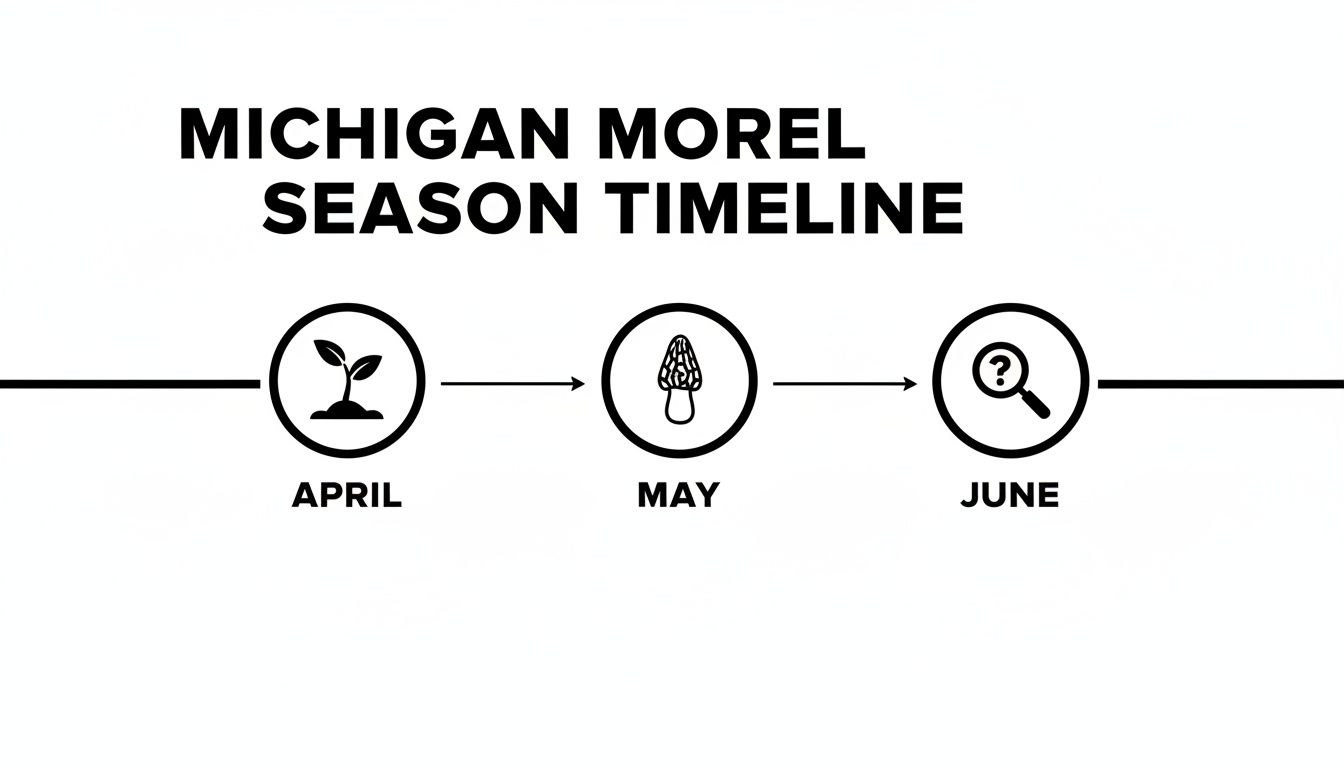
As you can see, April gets things started, but May is prime time for most of the state. June is a bonus round reserved for the die-hards hunting in the farthest northern reaches.
To help you plan, here's a quick breakdown of the typical timing across the state.
Michigan Morel Season Timing by Region
| Region | Typical Start | Peak Season |
|---|---|---|
| Southern Lower Peninsula (Detroit, Ann Arbor, Jackson) | Late April | Early to Mid-May |
| Central Lower Peninsula (Grand Rapids, Lansing, Flint) | Early May | Mid-May |
| Northern Lower Peninsula (Traverse City, Gaylord) | Mid-May | Late May |
| Upper Peninsula (U.P.) | Late May | Early to Mid-June |
Remember, these are just guidelines. An unusually warm spring can shift everything earlier, while a late cold snap can push it all back.
Michigan's Unique Morel Window
Our state's sheer size from top to bottom gives us a real advantage. While May is officially celebrated as Morel Mushroom Month, the real hunting season is a generous six- to eight-week affair. It's a much longer window than what many other states get to enjoy.
This unique spread, from the first pops in Washtenaw County to the final finds in the U.P., is part of what makes foraging here so special. If you want to get a better handle on this seasonal timing, it helps to learn more about Michigan's famous fungi.
Pro Tip: Stop watching the calendar and start watching the forecast. The perfect trigger is a few days of warm, 60-degree weather followed by a gentle spring rain. Those conditions are your signal to grab your bag and hit the woods.
This variability is why connecting with local hunters is so valuable. Getting plugged into local foraging groups can give you the real-time intel you need to get a jump on the season. To broaden your fungal knowledge, check out our other guides on Michigan mushrooms.
How to Read the Signs from the Forest Floor
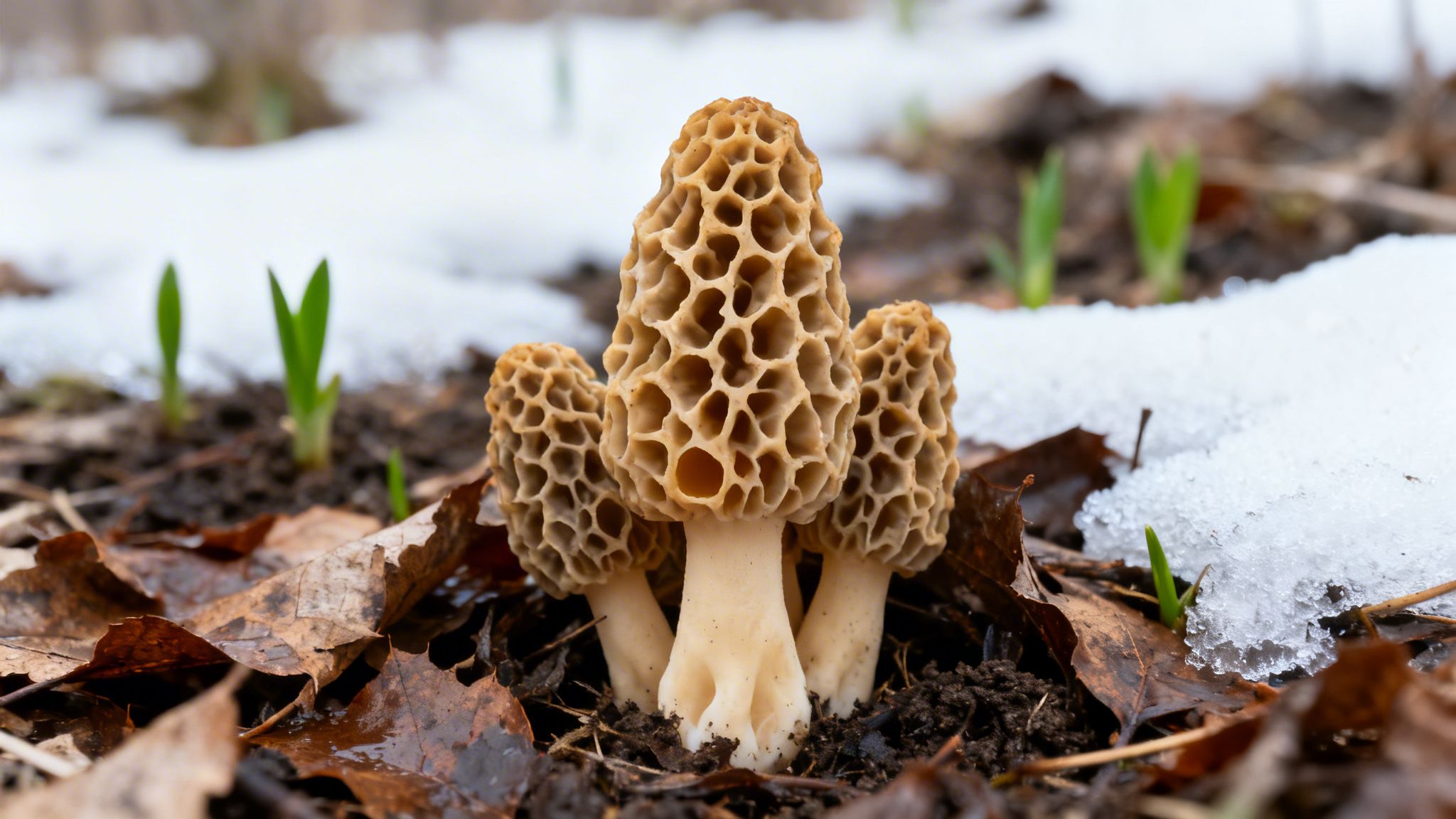
Sure, a calendar gives you a ballpark idea of when to start looking, but the forest plays by its own rules. Any seasoned hunter will tell you the real secret to a killer morel season in Michigan isn’t memorizing dates—it’s learning to read the woods. Think of it like being a nature detective, piecing together clues from the soil, the plants, and the trees.
Morels are notoriously picky about when they show up, and the single biggest trigger is soil temperature. They simply won’t pop until the ground hits a very specific sweet spot. This isn't just a casual preference; it's a biological command that kicks off their entire fruiting cycle.
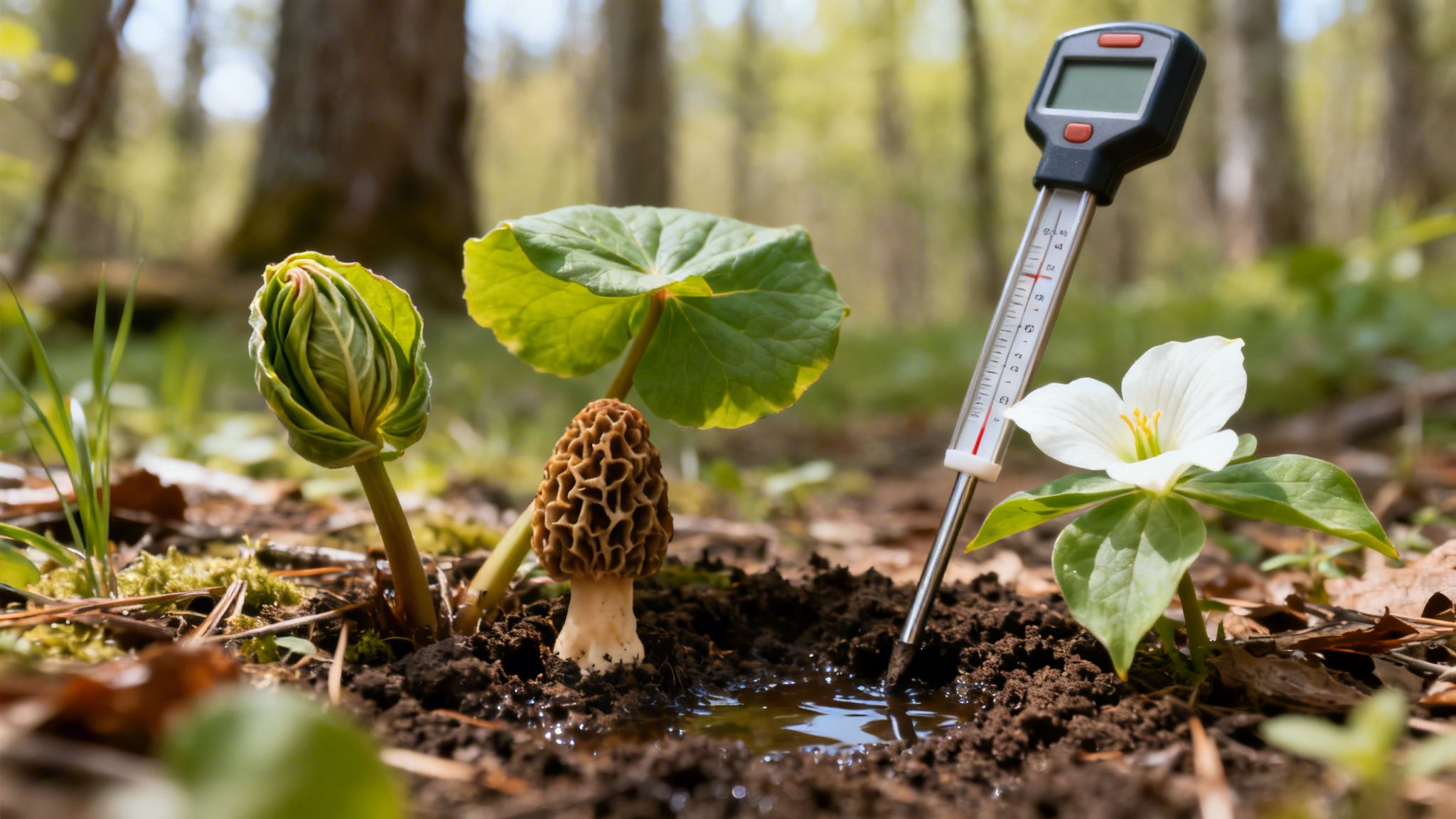
For morels, that magic number is right around 55°F. A cheap soil thermometer is your best friend here, as it takes all the guesswork out of the equation. Once the top few inches of dirt hold steady in the low- to mid-50s for a few days in a row, you can bet that underground mycelium is getting ready to send up the goods.
Nature's Green Flags
Long before you spot your first morel, the forest floor gives you a heads-up with what we call "indicator species." These are specific plants that pop up under the exact same conditions morels love, basically acting as living signposts telling you it's go-time.
When you start seeing these plants emerge, you know the conditions are getting just right:
- Mayapples: Keep an eye out for their distinctive, umbrella-like leaves unfolding. If the mayapples are up, morels are often not far behind.
- Trilliums: The bloom of a white trillium, a classic Michigan wildflower, is a dead giveaway that the soil is warm enough.
- Fiddlehead Ferns: As these coiled-up ferns begin to unfurl and straighten out, it's another signal that the season is officially on.
These plants are like the opening act at a concert. When they show up, you know the main event—the morels—is about to hit the stage. It's an alert system that’s way more reliable than any date on a calendar.
Morels are masters of camouflage, and they love to hide in plain sight. You have to train your eyes to scan for patterns and shapes, not just a mushroom. That unique, honeycombed texture is what will eventually jump out at you from the chaos of leaves and twigs on the ground.
The Right Trees Tell the Tale
Morels don't just grow randomly; they form a symbiotic relationship with certain trees. Honestly, learning to spot these trees is probably the single most important skill for finding consistent hunting spots year after year.
In Michigan, you want to beeline it for these key tree species:
- Ash Trees: Live ash trees are good, but dying ones are even better. The stress on the tree's root system often triggers a huge flush of morels.
- Elm Trees: Dead and dying elms, especially the ones that have lost their bark, are legendary hotspots. A true hunter is always scanning the canopy for these "bark-slip" elms.
- Poplar Trees (Aspen): Big, mature poplars are another go-to, especially for those large yellow morels that come up later in the season.
Once you nail down these tree associations, you're no longer just taking a random walk in the woods. You're moving with purpose, strategically checking one high-probability habitat after another, and that's how you come home with a full bag. These same principles of reading the environment apply to other fungi, too; for example, you can learn about the best time to harvest blue oyster mushrooms in our other guide.
Finding Your Own Morel Hunting Hotspots
Knowing when the morel season in Michigan hits is a great start, but it's only half the puzzle. The other half is knowing exactly where to look.
Finding your own secret spots is what separates the casual walker from the seasoned forager. It’s less about blind luck and way more about understanding what makes morels tick. Think of yourself as a detective, reading the clues the forest gives you—from the types of trees overhead to how the sun warms the ground.
Follow the Fire for Bountiful Harvests
One of the best-kept secrets for finding an absolute explosion of morels is to follow the fire. Morels have a wild, phoenix-like relationship with forest fires. The spring after a major burn, especially in pine and conifer forests, creates the perfect storm for a massive fruiting.
The fire clears away the undergrowth, alters the soil chemistry, and puts stress on tree root systems. All of this signals the morel mycelium below ground to fruit like crazy. These are called “burn morels,” and they can pop up in unbelievable numbers, making last year's burn sites some of the hottest tickets in the state.
Luckily, you don’t have to guess. The Michigan Department of Natural Resources (DNR) keeps detailed records of burn sites. They point out that large wildfires or prescribed burns in conifer forests—think old jack, white, or red pine stands—are prime territory.
Even better, their interactive map shows dozens of these spots, with some surprisingly good ones in southern counties like Oakland, St. Clair, and Washtenaw. You can check out their interactive map and find more info on hunting on state land.
Debunking the “Up North” Myth
There’s this stubborn myth that you have to drive "Up North" to find any decent morels. While the northern Lower Peninsula and the U.P. have amazing forests, you'd be making a huge mistake to ignore Southern Michigan.
Productive habitats are scattered all over the state, often just a quick trip from major cities. Foragers around Detroit and Ann Arbor can find incredible success by exploring local state recreation areas and metroparks.
The trick is to apply the same principles:
- Find the right trees: Zero in on dying elms, old apple orchards, and mature ash and poplar stands.
- Hunt the micro-climates: South-facing hills get the most sun and warm up first, making them perfect for early-season finds.
- Check disturbed ground: Areas with recent, low-impact logging or even just soil that's been turned over can trigger morels to pop.
Don't write off the woods in your own backyard. Counties like Oakland, Washtenaw, Livingston, and Macomb are full of public lands with the exact ecosystems morels love.
Forager's Field Note: Always know the rules before you go. Most Michigan state forests are open for personal-use foraging. However, state parks and recreation areas can have their own set of rules. And it should go without saying, but never hunt on private land without getting clear permission first.
Understanding these different habitats is the key to unlocking consistent success. The table below breaks down some of the most common spots to find morels across Michigan.
Comparing Morel Habitats
This table compares a few key environments so you know what to look for and when.
| Habitat Type | Key Tree Species | Best Time to Check | Likely Morel Variety |
|---|---|---|---|
| Dying Hardwoods | Elm, Ash | Early to Mid-Season | Grays, Yellows |
| Old Orchards | Apple | Early Season | Yellows |
| Mature Forests | Poplar, Tulip Poplar | Mid to Late Season | Large Yellows |
| Post-Burn Sites | Jack Pine, Red Pine | The following Spring | Blacks (Burn Morels) |
Once you learn to spot these key habitats, you can stop following the crowds and start forging your own path. You’ll be well on your way to a successful and rewarding morel season in Michigan, no matter what part of the state you call home.
True Morels vs Dangerous Lookalikes
Confidence is everything when you're out in the woods, especially during the morel season in Michigan. Getting an ID wrong is the biggest mistake any beginner can make. The good news? True morels have a few key features that are dead giveaways once you know what to look for.
This isn't about memorizing a hundred different mushrooms. It's about mastering a simple, three-part check. Nailing this process turns that flicker of fear into pure confidence, guaranteeing every mushroom you bring home is a safe and delicious prize. Let's break down the foolproof signs of a true morel.
The Three Pillars of Morel Identification
Think of these as your non-negotiable safety checklist. A real morel has to pass all three tests. If it fails even one, you leave it right where you found it. It’s that simple.
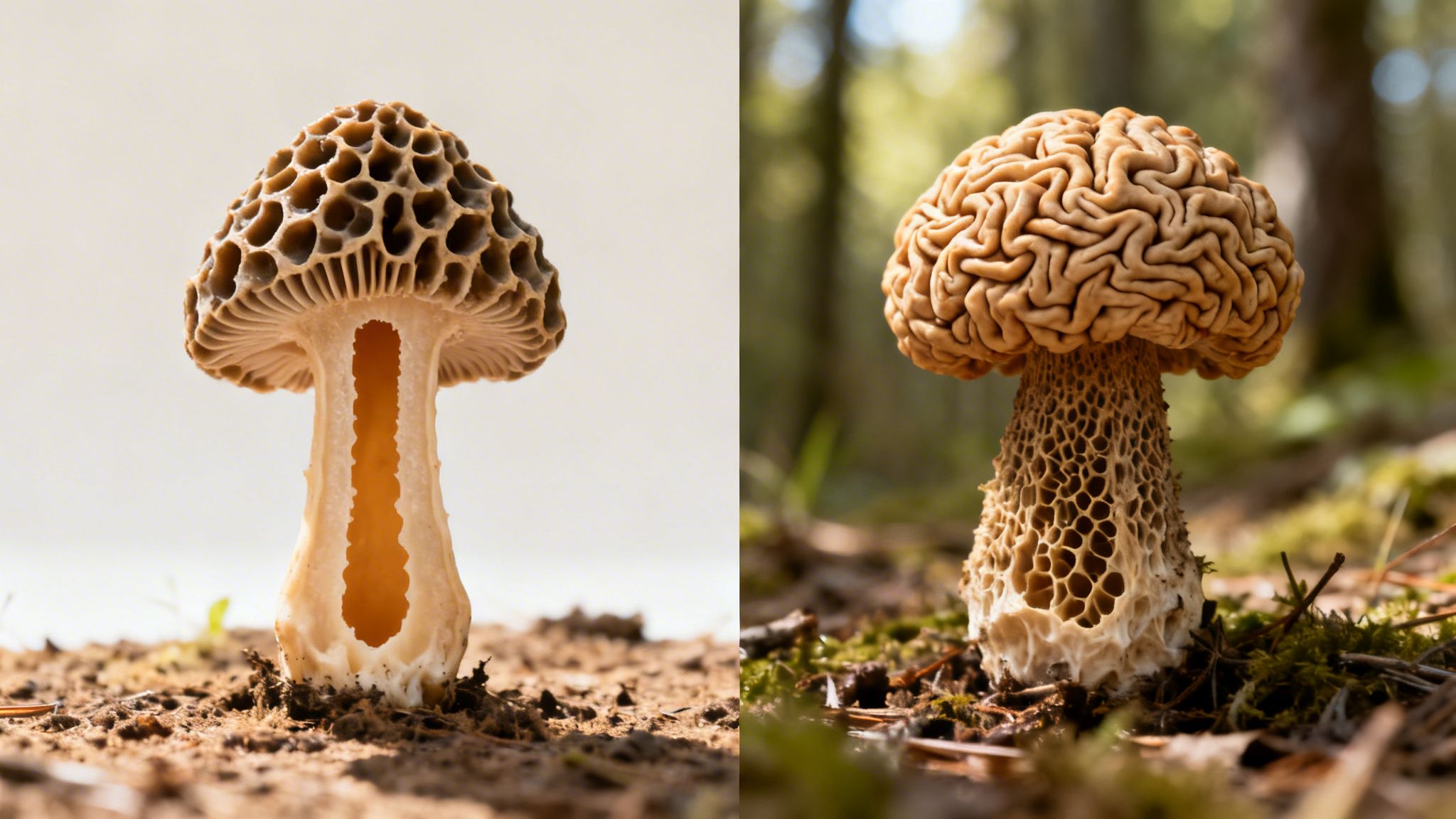
Fully Attached Cap: Look closely where the cap meets the stem. On a true morel, the cap is fused directly to the stem with no gaps. It looks like one continuous piece, flowing seamlessly from the stem right into the base of the cap.
Pitted and Ridged Cap: A true morel’s cap looks like a natural sea sponge or a honeycomb. It's covered in deep pits and ridges. It should never look wavy, lumpy, or folded in on itself like a brain.
Completely Hollow Inside: This is the golden rule. When you slice a true morel clean in half from the tip of the cap to the bottom of the stem, it has to be completely hollow. The entire thing should look like an empty cone from top to bottom.
This final check is so important it's become a mantra for foragers everywhere. It's the ultimate confirmation that you're holding the real deal.
The Ultimate Rule of Morel Hunting: "If it ain't hollow, don't swallow." This single phrase is the most important piece of safety advice you can carry into the woods.
Common Imposters and How They Fail the Test
Now that you have the checklist, let's see how the most common dangerous lookalikes in Michigan stack up. These "false morels" can cause anything from severe stomach upset to serious neurological issues, so learning to spot them is non-negotiable.
The two main culprits you'll run into are species from the Gyromitra and Verpa genera. To an untrained eye, they might look vaguely like a morel, but they fail our three-point inspection every single time.
Gyromitra Species (False Morels)
People often call these "beefsteak" or "brain" mushrooms, and for good reason. Their caps aren't pitted and ridged. Instead, they’re a gnarly mass of wrinkles and lobes that look disturbingly like a brain.
- Cap Appearance: Wavy, folded, and brain-like, not honeycombed.
- Cap Attachment: The cap often drapes over the stem, but it isn't fused at the bottom like a true morel.
- Hollow Test: This is where they fail spectacularly. When you slice a Gyromitra open, it is not hollow. You'll find a series of chambers, folds, and even a cottony-looking fiber filling the inside.
Verpa Species (Early Morels or Thimble Caps)
These tricky imposters pop up early in the season, often fooling eager hunters. They get their nickname "thimble caps" from the way the cap sits on the stem.
- Cap Appearance: Their caps are more wrinkly and folded than truly pitted.
- Cap Attachment: This is the dead giveaway. A Verpa's cap is attached only at the very top of the stem. It hangs down freely around the stem like a skirt or a thimble, completely unattached at the sides.
- Hollow Test: While the cap and stem might be mostly hollow, they aren't one single, continuous chamber. You'll often find a cotton-like substance inside the stem, too.
By methodically running through these checks, you take all the guesswork out of the hunt. Every find becomes a simple process of elimination, building your confidence with each mushroom you correctly identify. While Michigan is a prime spot for morels, these same ID principles work in neighboring areas. For instance, you can learn more about fungi just one state over by checking out our guide to the mushrooms of Illinois.
Sustainable Harvesting Tools and Etiquette
Finding that first honey-hole of morels is a feeling you’ll never forget. But how you pick them is what really matters. A truly successful morel season in Michigan isn’t just about filling your bag; it's about what you leave behind for the forest, for next year, and for other hunters.
Think of it less like a set of rules and more like becoming a guardian of the woods. By using the right gear and techniques, you’re helping ensure these amazing fungi keep popping up for years to come.
The Right Tools for a Clean Harvest
You don’t need a bunch of expensive gear to find morels, but a few specific items will make all the difference for your haul and the health of the woods. Out of everything, your choice of bag is the most critical.
Your bag has a direct impact on future morel patches. You’re essentially seeding the forest as you walk, giving back to the ecosystem with every step.
Make sure your foraging kit includes these essentials:
- A Mesh Bag: This is the one thing you can't skip. An old onion sack or a proper foraging bag with mesh sides is perfect. It lets the spores from your mushrooms drop to the ground as you move, planting future morels. A plastic bag or a bucket traps those spores, taking them right out of the woods.
- A Small Knife: A simple pocket knife or a mushroom knife (the ones with a little brush on the end) is ideal. It helps you make a clean cut that doesn’t harm the fungus or its underground network.
- A GPS or Compass: When your eyes are glued to the forest floor, it's incredibly easy to get turned around. A reliable navigation tool isn't just a good idea—it’s a safety must-have.
Switching to a mesh bag is the single easiest and most impactful thing you can do as a responsible forager. It’s a tiny change that makes a huge difference.
The Art of the Harvest
Once you spot a morel, fight the urge to just yank it out of the ground. Pulling it up can tear the mycelium—the delicate, web-like root system that the mushroom grows from. Damaging the mycelium is like killing the apple tree just to pick an apple.
Instead, stick to the "pinch or cut" rule. Use your knife to slice the stem cleanly right at ground level. You can also just gently pinch it off with your fingers. This leaves the base and the all-important mycelial network safe in the soil, ready to fruit again next spring.
It’s not just a hobby, either. Every year, thousands of pounds of wild morels are picked by hand across Michigan, often selling for over $30 per pound. While most folks only hunt for a couple of weeks, research shows that serious sellers can average almost 30 pounds sold each season. You can learn more about the state's morel economy in this MSU extension report.
Know the Rules and Be a Good Neighbor
Good foraging etiquette also means following the law and being respectful of other people. You can harvest mushrooms for personal use on most Michigan state lands, but always check the specific rules for the park or forest you plan to visit.
If you want to sell your morels, you have to get certified through a state-approved expert identification program. This is a legal requirement in Michigan and ensures everyone stays safe.
Finally, just follow the golden rule of the woods: leave no trace, stay off private property unless you have permission, and never, ever clean out an entire patch. Leave some for the wildlife and for the next person to enjoy.
From Forest Floor to Dinner Plate
You’ve done it. After a great day in the woods, you've got a bag full of Michigan’s most sought-after culinary treasure. Now comes the final, and most important, part of the journey: getting them from the forest floor to your dinner plate without ruining them.
Proper handling is everything. It’s what preserves that incredible, earthy flavor you worked so hard to find.
The number one rule with morels is to be gentle. These mushrooms are incredibly delicate and mostly hollow. The worst thing you can do is give them a long, aggressive soak in water. This will just turn them into a waterlogged, mushy mess and dilute that prized nutty taste.
Your main job is to get rid of any dirt, forest debris, or tiny critters hiding in those signature honeycomb pits. The best way to start is with a dry brush. A soft mushroom brush or even a new, soft-bristle toothbrush works perfectly to gently whisk away any visible dirt from the cap and stem.
The Right Way to Clean and Store Morels
Even with a good brushing, sometimes a quick rinse is needed for the extra-gritty ones. If that's the case, here’s a simple process to get them perfectly clean.
- Slice Them: Cut every morel in half, from tip to stem. This is non-negotiable. It lets you inspect the inside for hidden dirt and confirm you've got a true, hollow morel.
- Give Them a Quick Swish: Place the halves into a bowl of cool, lightly salted water. Gently swish them around for just 15-30 seconds. Any longer is too long.
- Dry Immediately: Get them out of the water right away and lay them out on a paper towel or a clean dish towel. Let them air dry completely.
Once they're clean and totally dry, it's time to think about storage. If you're cooking them in the next day or two, never put them in a plastic bag. Plastic traps moisture and will turn your beautiful haul into a slimy disaster. The best short-term home for them is a simple paper bag in the fridge. The paper lets them breathe, keeping them fresh and firm.
Preserving Your Haul for Later
But what if you hit the jackpot and have way more morels than you can eat this week? You have two fantastic options for enjoying the taste of a Michigan spring all year long: dehydrating and freezing.
Dehydrating concentrates the morel's flavor, making it deeper and smokier, while freezing preserves its original texture and delicate taste. Your choice depends entirely on how you plan to use them later.
If you’re dreaming of rich soups, savory sauces, or a deeply flavorful risotto, dehydrating is the superior method. Once dried, they’ll keep in an airtight jar for years. Just rehydrate them in warm water before using, and don't forget—that leftover soaking liquid is pure gold, a perfect mushroom broth.
On the other hand, if you love the simple perfection of a fresh morel sautéed in butter, freezing is your best bet. To do it right, you have to sauté the morels in butter or oil until they've released their liquid. After they cool, pack them into freezer-safe bags. This pre-cooking step is vital. Freezing them raw will only leave you with a rubbery, disappointing texture when they thaw.
When it's finally time to cook, keep it simple. Let the morel be the star by sautéing it in butter with a little garlic and a pinch of salt. From there, you can add a splash of cream for a decadent sauce, toss them with pasta, or serve them right next to a perfectly grilled steak.
Answering Your Michigan Morel Questions
As you get ready to hit the woods, you’ve probably got a few questions bouncing around in your head. Every forager has them, whether it’s your first season or your twentieth. We’re here to give you some straight answers on the common stuff that comes up during the morel season in Michigan.
Think of this as the final run-through before you head out. We’ll cover the practical questions that pop up once you know the basics, so you can hunt with confidence.
Can I Find Morels in the Same Spot Every Year?
Sometimes, but don't ever count on it. Morels can be creatures of habit, and if the conditions are just right, they’ll often pop up in the same general area—especially around their favorite trees like dying elms and ash. A spot that was good to you last spring could definitely be good to you again.
Then again, morels are notoriously fickle. A patch that was loaded one year might be a total bust the next, even if everything seems perfect. The best approach? Always check your honey holes, but make sure you spend some time exploring new ground on every hunt. It’s the perfect mix of relying on what you know and chasing the thrill of a brand-new discovery.
Are Black Morels or Yellow Morels Better?
This is the age-old debate among mushroom hunters, and honestly, you can't go wrong. Both are incredible finds, and which one is "better" is all about personal taste.
- Black Morels: These are usually the first to show up. They have a firmer bite and a flavor that’s more deep, earthy, and sometimes even a little smoky. You'll often find them around conifers or in last year's burn sites.
- Yellow Morels: These are the big, classic-looking morels that arrive a bit later in the season. People love them for their delicate, nutty taste and softer texture. Look for them near hardwoods.
Most of us are just happy to find either one. But after a few seasons, don't be surprised if you pick a favorite.
What If I Am Not 100% Sure It Is a Real Morel?
The answer to this is simple and non-negotiable: when in doubt, throw it out. There is no mushroom in the world worth the risk of getting sick. The number one rule of foraging is being absolutely certain of what you’ve picked before it even thinks about going in your pan.
If you have even a sliver of doubt, leave it be. Take a few good pictures—get the top, the stem, and one sliced right down the middle to show if it’s hollow. Then, ask an expert. A local mushroom club or a trusted online identification group can be a huge help.
Is It Better to Cut or Pinch Morels When Harvesting?
You can do either, but the mission is the same: take the mushroom but leave its underground network (the mycelium) totally undisturbed. That’s the "root" system that will hopefully give you more morels next year.
A lot of old-timers swear by using a small knife to slice the stem just above the ground. This keeps your mushroom way cleaner, since dirt won't get packed into the hollow stem and all those little pits. If you’re without a knife, a gentle pinch and twist at the base works too. Just be careful not to yank up a big chunk of soil and roots with it.