

Illinois is a goldmine for mushroom lovers. From the mad dash for morels in the spring to spotting a brilliant flush of Chicken of the Woods in the fall, the mushrooms of Illinois offer something for every forager, photographer, and nature enthusiast. This guide is your starting point for getting to know the common edible, poisonous, and other noteworthy species you'll find across the state.
Exploring the Fungal Kingdom of Illinois
The terrain of Illinois is incredibly diverse, from the sprawling hardwood forests of the Shawnee National Forest all the way to the pocket parks of Chicago. This variety creates fertile ground for an unbelievable array of fungi. These organisms aren't just fascinating to look at; they're the bedrock of the environment, responsible for decomposition, nutrient cycling, and forming vital partnerships with trees.
At least 2,000 species of fungi have been documented in Illinois, making it a true fungal hotspot. But it's not all good news. Researchers have been tracking some concerning declines in certain forest mushroom populations. You can dive deeper into these findings by checking out the Illinois mushroom study guide to understand the bigger ecological picture.
What This Guide Covers
We’ve organized this reference to make it easy to find what you're looking for. The profiles and identification keys are designed to help you confidently tell one mushroom from another.
- Choice Edible Mushrooms: We'll teach you how to spot prized edibles like morels, chanterelles, and oyster mushrooms, including our best tips on where and when they pop up.
- Dangerous Poisonous Mushrooms: This is the critical knowledge you need to recognize and steer clear of toxic lookalikes, including the deadly Destroying Angel and tricky False Morels.
- Notable and Psychoactive Species: For educational and identification purposes, this guide also covers unique fungi like psilocybin-containing species, along with the essential legal context you need to be aware of.
Successful foraging isn’t just about what you can take home—it's about reading the entire ecosystem. Every mushroom tells you a story about the soil, the trees, and the time of year.
Using the detailed profiles, seasonal maps, and safety rules in this article, you'll be ready to start your own journey into the fascinating world of Illinois mushrooms.
The Forager's Essential Toolkit and Ethics
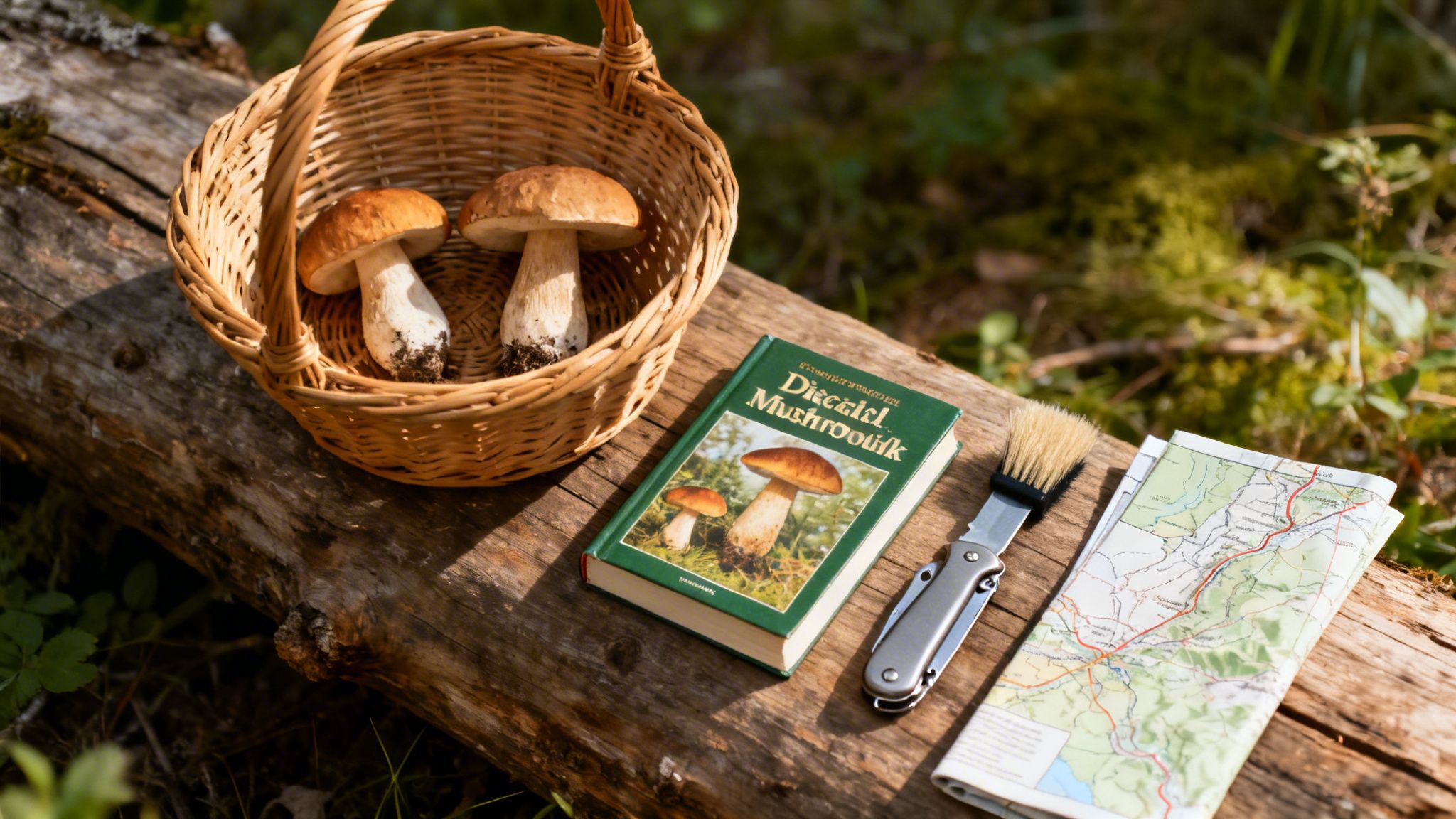
Heading out into the Illinois woods for mushrooms is about more than just finding them. A successful and responsible foray starts with having the right gear and, more importantly, the right mindset.
Getting yourself properly equipped doesn't just make the hunt easier; it makes you a better steward of the forests we all love. Every tool in a forager's kit has a job to do, from helping you identify your finds to protecting the fungal ecosystem for years to come.
Assembling Your Gear
Your toolkit doesn't need to be fancy, but a few items are absolutely essential for a safe, sustainable, and successful day of foraging.
- A Wicker or Mesh Basket: This is non-negotiable. A plastic bag will make your mushrooms sweat and turn to mush. A proper basket lets air circulate around your finds and, just as crucially, allows spores to drop through the bottom as you walk, seeding the forest for future flushes.
- A Reliable Field Guide: Apps can be useful, but nothing beats a physical, Midwest-specific field guide. You can’t always count on cell service in the woods, and a good book provides the detailed photos and descriptions you need for a positive ID.
- A Mushroom Knife and Brush: You can use a regular pocket knife, but a specialized mushroom knife is a game-changer. They typically have a curved blade to easily slice the stipe and a soft brush on the end for cleaning dirt and forest debris off your mushrooms right there on the spot. This keeps your basket—and later, your kitchen—much cleaner.
Of course, having the right gear is only part of the equation. How you act in the wild is what really counts.
The Core Ethics of Foraging
Respect for nature and for the law is what separates a true forager from a casual collector. Following these simple guidelines ensures mushroom populations stay healthy and that foragers remain welcome.
The golden rule of foraging is simple: 'When in doubt, throw it out.' A close second, though, is to leave the woods a little better than you found them, ensuring the fungi and their habitat can thrive long after you've gone.
You must be 100% certain of a mushroom's identity before you even think about eating it. Take only what you can actually use, and always leave plenty behind for wildlife and to allow the fungus to reproduce. Finally, know your location. Foraging on private land requires explicit permission from the owner, and many public parks or nature preserves have strict rules prohibiting collection.
And for when you get your harvest home, you might enjoy learning how to prepare them with our simple shroom tea recipe.
A Quick Reference Guide to Illinois Mushrooms
Think of this as your field-side cheat sheet for Illinois mushrooms. When you’re out on a foray and find something interesting, this is the place to start. It’s designed to help you quickly narrow down what you might be looking at before you dive into the finer details.
This quick-reference guide covers some of the most common and important fungi you'll encounter across the state. It’s a fast way to check a mushroom's basic type, when it typically grows, and where you’re most likely to find it.
Your First Step in Identification
Before you go any further, it’s crucial to understand the three main categories we use in this guide. Getting this right is the most important step for staying safe.
- Edible: These are the species you're looking for. They're safe to eat after you've made a 100% positive identification and cooked them properly.
- Poisonous: These mushrooms are toxic and must be avoided at all costs. Some can cause serious illness or even death.
- Psilocybin: These are psychoactive species. We include them for identification and educational purposes only, so you know what they are if you see them.
CRITICAL: This table is only a starting point. It is absolutely not a substitute for a complete, positive identification. Always use the detailed profiles and multiple reliable sources before you even consider consuming a wild mushroom.
Use the table below to get your bearings. Once you have a potential match, click the link in the last column to jump straight to the in-depth profile. There, you’ll find the detailed photos, key features, and look-alike warnings you need to be certain.
Illinois Mushroom Quick Identification Guide
This table is your launchpad for identifying some of the most notable mushrooms found in Illinois. Use it to quickly sort species by type, season, and habitat.
| Mushroom Name | Type (Edible/Poisonous/Psilocybin) | Peak Season | Common Habitat | Detailed Profile Link |
|---|---|---|---|---|
| Morel | Edible | Spring | Near elm, ash, and apple trees | View Morel Profile |
| Chicken of the Woods | Edible | Summer/Fall | On hardwood trees, especially oaks | View C.O.W. Profile |
| Oyster Mushroom | Edible | Year-round | On decaying logs and hardwoods | View Oyster Profile |
| Destroying Angel | Poisonous | Summer/Fall | Mixed hardwood forests | View D. Angel Profile |
| False Morel | Poisonous | Spring | Forest floors, near hardwoods | View False Morel Profile |
| Psilocybe ovoideocystidiata | Psilocybin | Spring/Fall | Wood chip beds, floodplains | View Psilocybe Profile |
Learning these key species is a fantastic way to build your confidence as a forager. By familiarizing yourself with their seasons and habitats, you’ll know exactly what to look for—and what to look out for—on your next walk in the woods.
Identifying Choice Edible Mushrooms in Illinois
The forests and woodlands of Illinois hide some of North America's tastiest wild mushrooms. Getting to know these choice edibles is an incredible skill, but it’s one that demands your full attention. This isn't just about matching a picture from a book.
To forage for mushrooms of Illinois successfully, you have to get hands-on. You’ll need to learn how to inspect the cap, stem, the spore-bearing surface (whether it has gills or pores), and its habitat. Each mushroom has a totally unique set of features, and nailing the identification is the only way to stay safe out there.
The Prized Morel Mushroom (Morchella species)
For a lot of us foragers, the season doesn't really kick off until the morel hunt begins. These mushrooms are legendary for their deep, nutty, and earthy flavor, making them a true wild delicacy and the star of spring foraging in Illinois.
Morels have a few dead giveaways: a distinct, honeycomb-like cap that's completely attached to the stem and a hollow structure. If you slice a real morel right down the middle, it will be hollow from the very tip of the cap to the base of the stem.
- Cap: Shaped like a cone or a bell, with a web of pits and ridges that looks like a natural honeycomb. Colors can range from gray and tan to a rich yellow.
- Stem: Usually a pale cream or white color. Just like the cap, it's completely hollow.
- Season: Look for them in spring, usually late March through May. They love to pop up after a good rain once the soil temperature hits that sweet spot of 50-60°F.
- Habitat: Check around dying elm trees, old apple orchards, and near ash and sycamore trees. They have a thing for disturbed ground and river bottoms.
- Critical Warning: You must learn to avoid False Morels (Gyromitra species). These are toxic mushrooms with a reddish, brain-like cap. Inside, they are chambered or filled with a cottony fuzz, not hollow like a true morel.
Chicken of the Woods (Laetiporus sulphureus)
Stumbling upon a big flush of Chicken of the Woods is a day you won't forget. This brilliant mushroom grows in huge, overlapping shelves and has a dense, meaty texture. The flavor is so much like chicken that it makes for an incredible meat substitute.
It's a polypore, which means it has a smooth underside with tiny pores instead of gills. That bright, sulfur-yellow to orange color is one of its most defining features.
When it's young and fresh, Chicken of the Woods is tender and juicy. But as it gets older, it can turn brittle and chalky. Harvesting it at the right moment is everything if you want the best texture and flavor.
Keep an eye out for it on hardwood trees, especially oaks. It's a parasite that causes brown rot, so you’ll find it on trees that are either still living or have recently died. Only take the ones that feel soft and moist to the touch; if they look faded and dry, they're already past their prime.
The Versatile Oyster Mushroom (Pleurotus ostreatus)
Oyster mushrooms are a great find for foragers at any level because they're easy to spot and can be found almost year-round. They grow in beautiful, shelf-like clusters on decaying wood and have a mild, savory taste that's perfect for just about any recipe. In fact, they're so popular they're a huge part of the specialty mushroom market.
Speaking of the market, the commercial mushroom industry is a massive economic driver. Production of the common Agaricus mushroom alone was valued at $1.00 billion for the 2024-2025 season, with specialty mushrooms like Shiitakes and Oysters making up another huge slice. You can dig into the numbers by reading the full USDA report.
Their most important features are the fan-shaped cap and gills that run right down the stem.
| Identification Feature | Description |
|---|---|
| Cap | Fan- or oyster-shaped. Can be white, gray, or tan. |
| Gills | White to cream-colored. They run noticeably down the short, off-center stem (this is called decurrent). |
| Habitat | Found on dead or dying hardwood trees like maples, oaks, and poplars. |
| Spore Print | White to a faint lilac-gray. |
Poisonous Mushrooms You Must Avoid
Getting out in the woods and finding a basket full of choice edibles is an incredible feeling. But a seasoned forager knows the real expertise isn't just in what you find, but in what you know to leave behind. Your safety hinges entirely on your ability to spot and steer clear of the dangerous mushrooms of Illinois.
Some of these toxic fungi will just ruin your weekend, but others can be lethal. This section is built around the single most important rule in mycology: "When in doubt, throw it out." We'll go over the most common and hazardous poisonous mushrooms in the state, focusing on the critical features that separate them from their edible look-alikes.
The Deadly Destroying Angel (Amanita bisporigera)
The Destroying Angel isn't a single mushroom; it’s a group of all-white Amanita species. They are responsible for the overwhelming majority of fatal mushroom poisonings across the globe. You'll find them in Illinois's mixed hardwood forests in summer and fall, where their pure white, almost elegant look can tragically fool a new forager.
The danger lies in their amatoxins, which are notoriously insidious. Someone who eats one might feel perfectly fine for 6 to 24 hours. All the while, the toxins are silently shutting down their liver and kidneys.
- Key Features: Look for a pure white cap, a skirt-like ring (annulus) on the stem, and a very distinct cup-like sac (volva) at the base. This volva is often buried just beneath the soil, so you have to dig to see it.
- Dangerous Look-Alike: It's easily mistaken for edible field mushrooms (Agaricus) or even young puffballs. You should never eat a small, white "button" mushroom unless you've sliced it clean in half to confirm what it is and are absolutely certain it's not a baby Amanita.
Jack-O’-Lantern Mushroom (Omphalotus illudens)
The Jack-O'-Lantern is a classic toxic look-alike, and it's the mushroom most often confused with delicious Chanterelles. These bright orange mushrooms pop up in big, impressive clusters right on wood or buried roots—a key difference from Chanterelles, which grow on the forest floor.
While not as deadly as a Destroying Angel, eating a Jack-O'-Lantern will land you with a severe case of gastrointestinal distress, from cramps to vomiting and diarrhea. What's really fascinating about them is their bioluminescence. A fresh cluster can give off a faint, spooky glow in total darkness.
If you find a vibrant orange mushroom, the first thing you should check is its gills. True Chanterelles have false gills or blunt ridges that are forked, while the Jack-O'-Lantern has true, sharp, non-forking gills. This single feature is a critical differentiator.
False Morels (Gyromitra species)
These show up in spring, right when everyone is out hunting for true morels, which makes them a serious hazard. False Morels contain a toxin called gyromitrin, which your body converts into monomethylhydrazine—yes, a component found in rocket fuel.
Just inhaling the cooking fumes can be toxic. Eating them can cause anything from nausea and dizziness to, in the worst cases, liver failure or even death.
To be confident in your identification, you have to slice the mushroom in half, top to bottom. This simple decision tree can help you start thinking through the basic features.
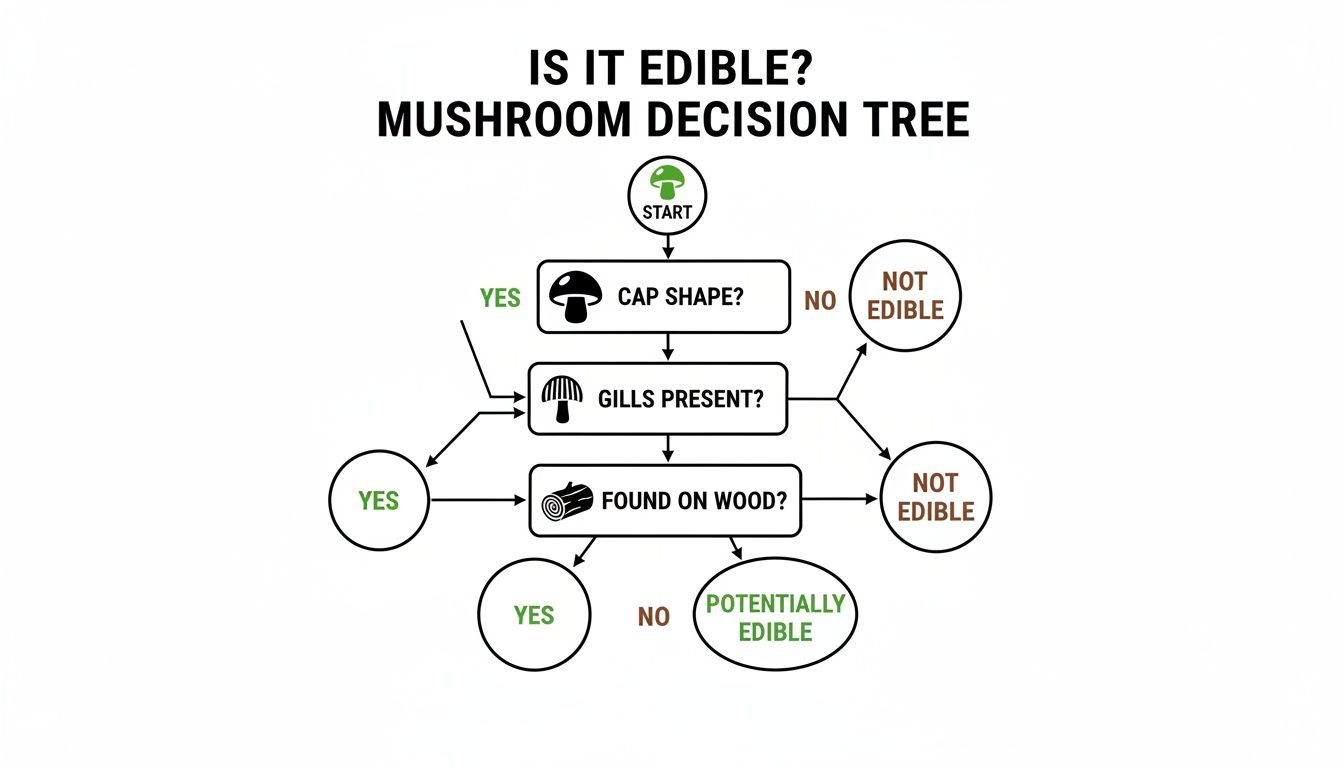
This visual guide shows how simple questions about cap shape, gills, and habitat are the first steps in narrowing down an identification.
- True Morels (Morchella): Are completely hollow inside, from the very tip of the cap all the way down to the bottom of the stem. The cap is fully attached to the stem.
- False Morels (Gyromitra): Are not hollow. When you cut them open, you'll see they are filled with a cottony-looking fiber or have a complex, chambered interior. The cap itself often looks wrinkled and brain-like, and it may hang loosely around the stem instead of being fully attached.
Mistaking a False Morel for a real one is a common and incredibly dangerous mistake. The "hollow test" is the most reliable check you can do in the field. Never eat a "morel" that isn't completely hollow.
An Educational Guide to Psilocybin Mushrooms
While hunting for choice edibles in Illinois, you're bound to come across more than just Morels and Chanterelles. The state’s diverse ecosystems are also home to species with psychoactive properties. This section is a strictly educational and botanical guide, designed to help you identify these fungi for harm reduction and scientific interest.
Before we go any further, it’s critical to talk about the law. As of 2026, psilocybin is still a Schedule I controlled substance under both Illinois state and United States federal law. That means possessing, growing, or distributing any mushroom containing psilocybin is illegal. The information here is for identification purposes only, and every forager needs to respect and follow current laws.
Identifying Psilocybe ovoideocystidiata
One of the more well-known psychoactive species you might encounter in Illinois is Psilocybe ovoideocystidiata. Known more commonly as "ovoids," these mushrooms have some very distinct features that help with identification. They are a saprobic species, which just means they get their nutrients from decaying organic matter like wood chips.
- Habitat: You'll most often find ovoids in wood chip beds, mulched gardens, and along river floodplains. They seem to prefer disturbed, urban, or suburban spots rather than deep, old-growth forests.
- Season: These mushrooms have a pretty wide fruiting window. Look for them in the spring from April to June, but they can also make a second appearance in the fall between September and November, especially after a good rain.
- Bruising Reaction: One of the most telling signs for many psilocybin-containing mushrooms is how they react to being handled. When bruised or damaged, the flesh of P. ovoideocystidiata will stain a very noticeable bluish or blue-green color.
A quick but important warning: blue bruising alone is not a foolproof sign of a psilocybin mushroom. Some toxic mushrooms, including certain Boletus species, also stain blue. You should never, ever rely on just one feature to make an ID.
Key Physical Characteristics
To properly identify any mushroom, you have to look at the whole picture. That means getting up close and personal with its cap, gills, and stem.
The cap of P. ovoideocystidiata is usually between 1 and 4.5 cm wide. It starts out conical or bell-shaped and tends to flatten as it gets older. The color can range from a caramel-brown to a yellowish-brown, and it often gets paler as it dries out—a trait mycologists call hygrophanous. Its stem is whitish and sometimes has a delicate ring (or annulus) that can wash away or disappear with age.
If you’re curious to learn more about the broader world of these fungi, our beginner's guide to magic mushrooms covers a variety of species and concepts. Remember, this guide is purely for educational purposes and does not endorse any illegal activity. Always be aware of and respect the laws in your area as you explore the fascinating world of mycology.
Local Mycology Resources and Communities
Identifying the mushrooms of Illinois is a skill you build over time, and nothing beats learning from other people. A good field guide is your best friend, but there’s no substitute for getting hands-on advice from seasoned mycologists and fellow foragers.
Getting plugged into local groups is the fastest and safest way to confirm what you’ve found, pick up new ID tricks, and just share the excitement with people who get it. This directory will point you to the key groups and institutions that can help you take your mushroom hunting to the next level.
Illinois Mycological Association
If you're serious about fungi in Illinois, your first stop should be the Illinois Mycological Association (IMA). This is the state's top organization for mushroom lovers, and it’s a fantastic hub for both total beginners and seasoned experts.
Joining the IMA gives you access to a ton of resources designed to get you up to speed quickly and safely.
- Guided Forays: This is where the magic happens. You get to join expert-led mushroom hunts in different forests and parks, which is an invaluable way to learn in the field.
- Educational Meetings: The IMA hosts monthly presentations from guest speakers who cover everything from fungal ecology and mushroom ID to cultivation techniques.
- Mushroom Shows: You have to see one of these to believe it. The IMA's annual shows display hundreds of local species, all identified and laid out for you to study. It’s an incredible visual learning experience.
Most importantly, the IMA is where you can get your questionable finds identified by people who really know their stuff—a critical step for any forager. It's truly the single best way to connect with the local mycology community.
Joining a local mycology club is the fastest way to level up your foraging skills. The collective knowledge of a group is your greatest safety net and educational tool.
Scientific and Academic Resources
For those who want to go beyond just identification and dig into the science, Illinois is home to some world-class institutions. These resources offer a deeper, data-driven understanding that perfectly complements what you learn out in the woods.
The Illinois Natural History Survey (INHS) is a major player here. It's a critical research center that maintains one of the country's most impressive fungal collections, holding over 172,000 specimens. That puts its fungarium in the top 10 nationwide. You can dive into their work by exploring the research about Illinois fungi on their site.
You should also check out your local University of Illinois Extension office. They provide publications, workshops, and often identification help. They're a fantastic, reliable source for information tailored to our state's specific ecosystems, helping you understand the "why" behind where and when different mushrooms decide to pop up.
Your Illinois Mushroom Foraging Questions, Answered
Heading out to forage for mushrooms of Illinois for the first time? Even if you're an old hand at it, you've probably got questions. Getting solid, trustworthy answers is the single most important part of making sure your hunts are safe, legal, and rewarding.
We’ve put together the answers to the questions we hear most often, from where you can legally forage to the biggest mistake you can't afford to make. Let this be your go-to reference for foraging with confidence.
When Is the Best Time of Year to Find Mushrooms in Illinois?
There isn’t just one "mushroom season" in Illinois. Instead, think of it as a series of overlapping seasons that change with the weather. Your success really hinges on things like recent rain, humidity, and temperature, so you have to be ready to go when the time is right.
- Spring (April-May): This is prime time for the legendary Morel. The hunt is on as soon as the soil stays at a steady 50-60°F.
- Summer (June-August): Once the summer rains hit, start looking for fantastic edibles like Chanterelles and the easy-to-spot Chicken of the Woods.
- Fall (September-November): This is the other major peak season. Cooler temperatures bring out Hen of the Woods (Maitake) at the base of oak trees, along with Lion's Mane and new flushes of Oyster Mushrooms.
- Winter (December-February): Don't hang up your boots just yet. You can still find tough, cold-loving species like the Velvet Foot on decaying logs, sometimes right in the snow.
Where Can I Legally Forage for Mushrooms in Illinois?
This is critical. You have to know where you're allowed to collect mushrooms. The rules can be completely different from one park to the next, and getting caught trespassing or harvesting illegally can lead to some hefty fines. Always, always check the specific rules for a location before you set foot there.
As a general rule, you can forage for personal use (not for selling) in many Illinois state parks and state forests. The massive Shawnee National Forest in southern Illinois is another fantastic and legal spot for mushroom hunters.
But here's the catch: collection is almost universally prohibited in designated Illinois Nature Preserves, even if they're inside a state park. County forest preserves and local conservation districts have their own set of rules, and they often ban foraging entirely. And it should go without saying, but foraging on private land is only legal if you have direct, explicit permission from the owner.
What Is the Most Dangerous Mistake Foragers Make?
The single most dangerous mistake anyone can make is misidentification from incomplete evidence. This usually happens when someone gets excited and relies on just one picture or a single feature, ignoring all the other clues. It’s a deadly gamble, because many poisonous mushrooms have evolved to look uncannily like choice edibles.
Take the lethal Destroying Angel (Amanita bisporigera), for instance. To a beginner, it can easily be mistaken for an edible field mushroom (Agaricus). A complete, thorough identification is non-negotiable. That means you absolutely must check:
- The cap's shape, color, and texture.
- The underside—does it have gills, pores, or teeth?
- The stem, looking for any rings or a cup-like structure (volva) at the base.
- Where it's growing—on the ground, on wood, under certain trees?
- The color of the spore print.
Never, ever eat a wild mushroom unless you are 100% certain of what it is. Ideally, you've had it confirmed by a local expert or your mycology club.
"When in doubt, throw it out." This isn't just a catchy phrase—it's the golden rule of foraging that will keep you safe.
Is It Legal to Forage for Psilocybin Mushrooms in Illinois?
No. As of 2026, psilocybin is still a Schedule I controlled substance under both Illinois and federal law. It is illegal to have, grow, or sell any mushrooms that contain psilocybin. If you’re just looking for natural ways to improve your well-being, you might be interested in reading our other articles on how certain edible mushrooms can help you sleep.
While some cities and states are moving toward decriminalization, Illinois has not. Any information you find in this guide on psilocybin-containing species is for educational and harm-reduction purposes only—to help you identify them and avoid accidental ingestion. You must follow all current laws.
At Metro Mush, we are dedicated to providing adults in the Detroit–Ann Arbor area with safe, convenient access to high-quality psilocybin products. Explore our curated menu of dried mushrooms and edibles online at https://metromush.com.