

Search for Golden Teacher and you'll meet the same advice in a hundred places: it's the gentle one, the beginner strain, the safe place to start. That line gets repeated so often it reads like a fact about the mushroom. It isn't a fact. It's a reputation, and reputation doesn't survive contact with a laboratory.
Golden Teacher is a name for a cultivated line of Psilocybe cubensis, the species behind most cultivated psilocybin mushrooms. A name is a label, not a measurement. Three separate questions get folded into that one label, and they have very different answers: what the organism is (well documented), what it looks like (partially informative), and how much psilocybin sits inside the package in front of you (unknowable without a test). Pull those apart and the marketing becomes much easier to read.
What Golden Teacher Is and Where the Name Comes From
Golden Teacher is a cultivated line, or market label, used for Psilocybe cubensis. The name describes a line in cultivation and trade, not a separate species or a chemical specification.
The distinction resembles the one between a plant variety and its species. A cultivar name can identify a line growers recognize, but it does not certify a genotype or guarantee that every batch is identical. For Golden Teacher, three layers matter:
- Species: Psilocybe cubensis, a formally described taxon.
- Cultivar or line: Golden Teacher, a cultivation label applied to some cubensis mushrooms.
- Batch: the individual mushrooms in a particular package, whose alkaloid content can vary.
The Species Has a Clean Paper Trail
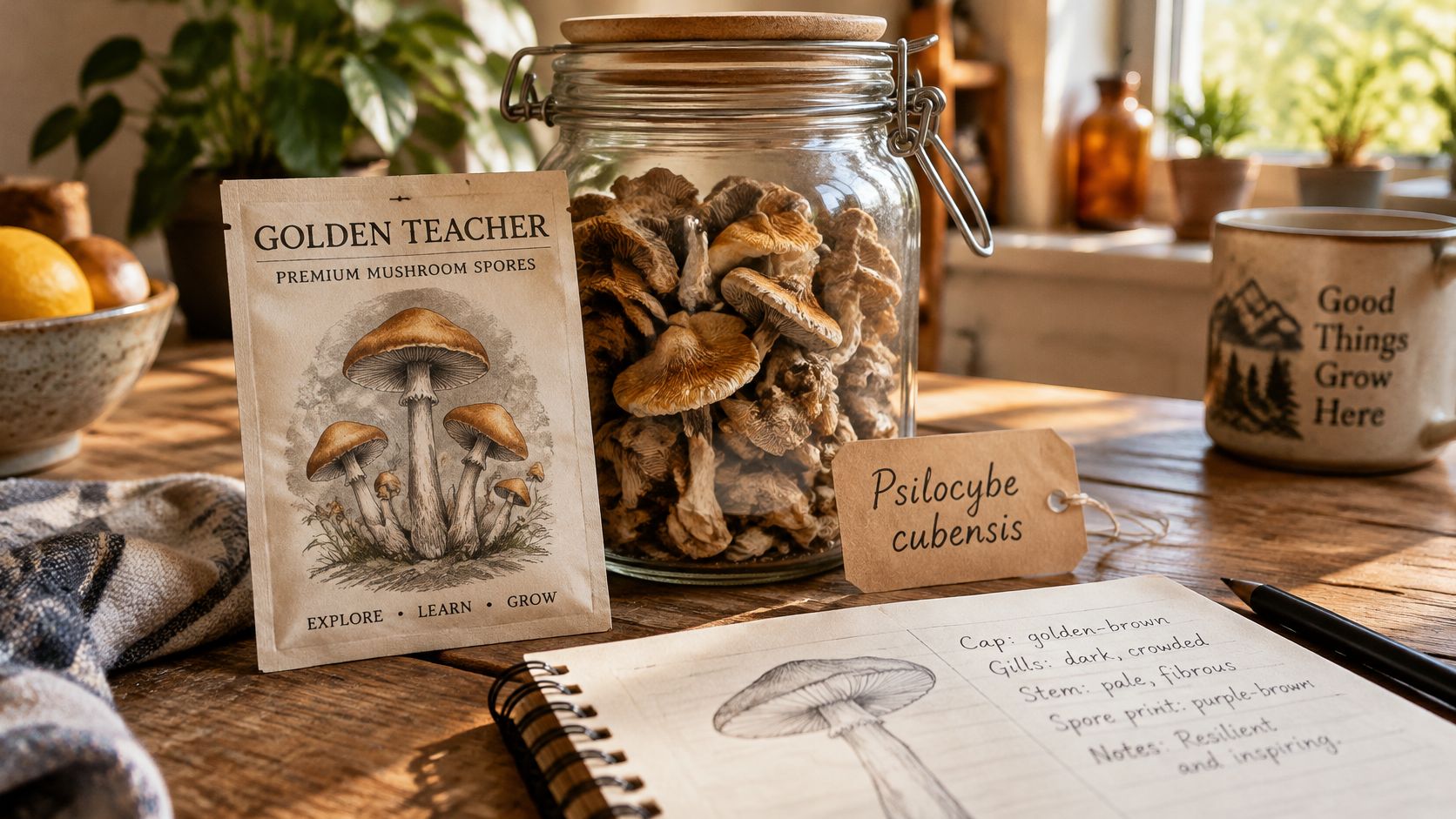
The species record is unusually tidy. A specimen was collected in Santiago de las Vegas, Cuba, on June 19, 1904, and Franklin Sumner Earle described it in 1906 as Stropharia cubensis. Rolf Singer later moved it into the genus Psilocybe in 1949. The epithet means “from Cuba,” referring to the type locality, as recorded in the GBIF species record.
The Cultivar Does Not
Golden Teacher emerged during the modern home-cultivation era, but its specific origin is unclear. The available record does not establish a verified breeder, a single source population, or a genetically uniform lineage shared by every mushroom sold under the name.
That gap matters: a cultivar label can help identify a familiar line in circulation, but it cannot establish a specimen's ancestry or chemistry. The Psilocybe cubensis strain guide explains the distinction between the species and the named lines associated with it.
Practical rule: a Golden Teacher label identifies a cultivated line within P. cubensis. It does not specify the contents of a particular batch.
Commonly Reported Traits and What They Can Show
Identification guides describe the same handful of features for typical cubensis: a pale to golden cap, gills that darken as spores mature, a membranous ring on the stem, blue bruising where the flesh is handled, and a habit of fruiting in clusters on dung or rich pasture soil. Those descriptions are accurate as far as they go. The trouble is what readers do with them.
A golden cap doesn't authenticate anything. DNA work on fungal collections has turned up widespread misdeterminations alongside inconsistent metabolite profiles, which means even a labelled specimen in a herbarium can be wrong, and appearance alone can't establish psychoactive content, as Rosehill's survey of psilocybin mushroom types notes. The traits below are worth knowing. None of them is a quality-control test.
The Trait List and Its Limits
| Trait | How it is usually described | What it can and cannot tell you |
|---|---|---|
| Cap colour | Pale to golden | Suggests a cubensis-type appearance; does not confirm species, potency or lineage |
| Gill colour | Darkens as spores mature | Reflects maturity and handling; says nothing about psilocybin content |
| Stem ring | Present on many mature specimens | A common cubensis feature; a ring alone does not authenticate a mushroom |
| Blue bruising | Blue discolouration when handled | Reported with cubensis; bruising varies with handling and is not a measure of strength |
| Growth habit | Clustered, often on cattle dung or rich soil | Describes conditions where the species is found; does not identify a specific line |
Read the third column slowly. Each trait narrows the field a little, then stops.
What Changes the Picture
Age and processing move these features around more than commonly expected. A fresh specimen with a deep golden cap and an intact ring can arrive dried, shrivelled and dark, the ring broken off in transit. Bruising that blooms blue on one mushroom may barely register on another from the same cluster. Drying method and storage shift colour as much as genetics does, and a few reported features overlap with other species entirely, which is why field guides ask for spore prints and habitat notes rather than a single photograph.
What a visual check cannot do:
- Confirm identity: a lookalike can share cap colour, ring and habitat.
- Measure dose: no cap shade or bruise intensity maps to a psilocybin figure.
- Detect contamination: mould, microbial growth and adulterants are invisible in a photo and often invisible in person.
- Predict your response: reaction depends on dose, metabolism and setting, none of which the mushroom's appearance reports.
That gap is where most confident internet answers fall apart. Screening and chromatographic analysis are the only routes to chemical information about a Golden Teacher Psilocybe cubensis product, and neither one happens in a photograph.
What Makes Potency Vary Between Batches
The Golden Teacher name does not specify a fixed chemical profile. Psilocybe cubensis grows across a broad range of tropical and subtropical regions, and its adaptability helped make it a foundation for cultivated lines. A review of the species' ecology and chemistry describes its distribution and growing conditions, along with reported fruiting periods of February through December in the Northern Hemisphere and November through April in the Southern Hemisphere (ecology and chemistry review).
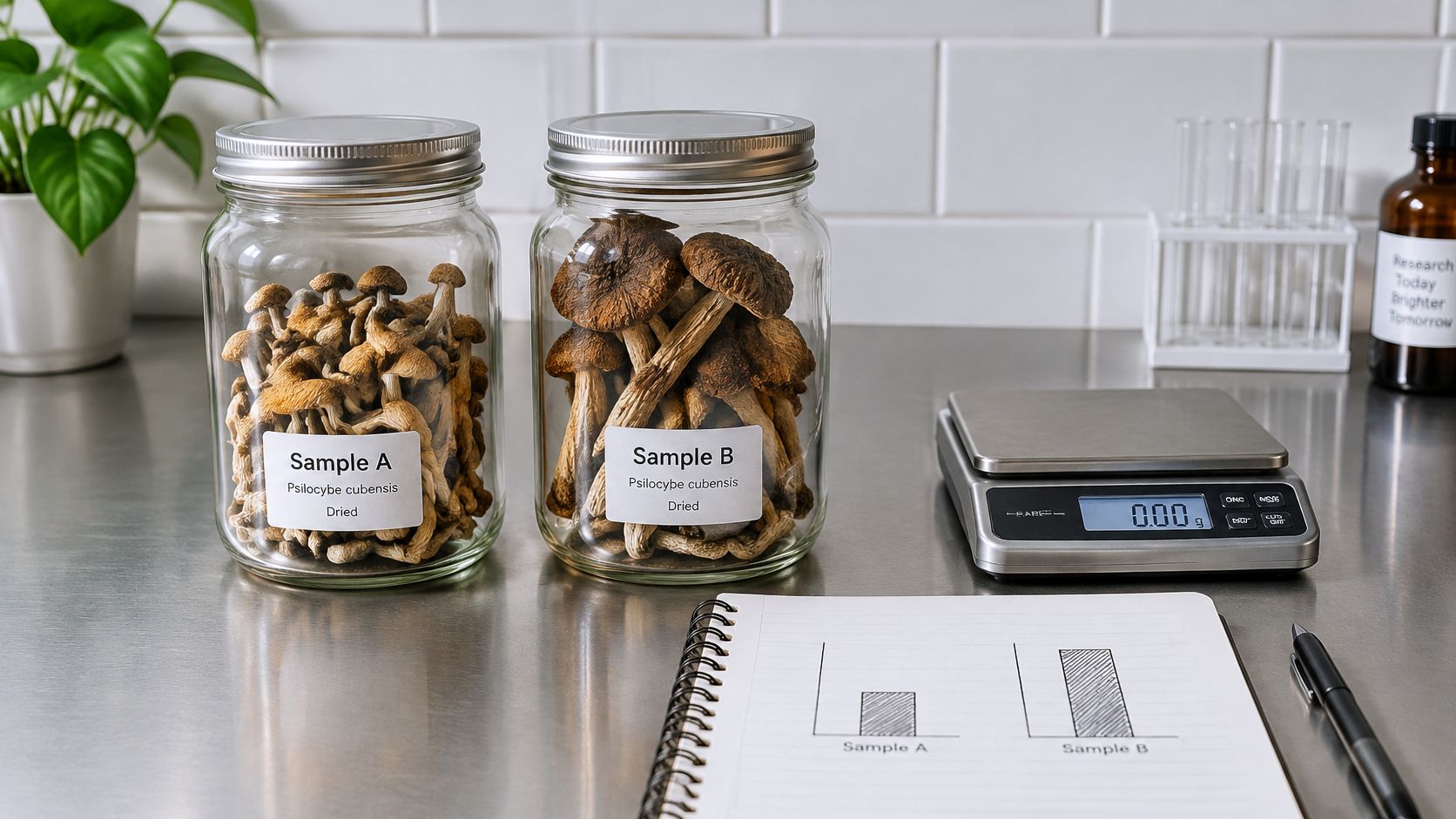
Cultivation can preserve a name while the chemistry varies. The label alone cannot show how much of any compound a particular batch contains.
Chemistry Moves More Than the Names Suggest
The same review describes a controlled study that measured six tryptamines in 14 distinct P. cubensis strains: psilocybin, psilocin, baeocystin, norbaeocystin, aeruginascin and norpsilocin. Profiles differed between strains and among fruiting bodies within a strain. That finding supports a limited conclusion: a strain name does not guarantee a uniform chemical profile. It does not establish a specific potency for Golden Teacher.
The Variables That Move Alkaloid Levels
Batch chemistry can reflect several factors:
- Genetics of the line: a culture may have a characteristic range, not a fixed chemical value.
- Substrate and nutrition: growing conditions can affect yield and chemistry.
- Fruiting conditions: temperature, humidity and fresh-air exchange shape development.
- Maturity at harvest: fruiting bodies picked at different stages may differ.
- Drying and storage: handling affects the material's condition over time.
- Testing method: extraction, instruments and reference standards affect reported measurements.
A comparison is meaningful only when the material and testing methods are sufficiently alike.
| Measure | Reported figure | What it does not tell you |
|---|---|---|
| Psilocybin variation within one strain | Variation is reported, but no specific range is given here | The spread for a particular Golden Teacher batch |
| Psilocybin plus psilocin in five P. cubensis labels | 0.879%–1.36% of dry weight, according to Zamnesia's summary of an analytical study | A range across labels, not a Golden Teacher measure |
| Psilocybin content across 42 strains | The comparison is described, but no specific ranking or figure is given here | The chemistry of Golden Teacher |
The available figures describe variation across labels, not a universal value for Golden Teacher. A comparison of reported figures for named psilocybin strains can provide context, but it cannot substitute for a measurement of the batch in question.
The video below discusses the same question from the growing side.
Two packages can carry the same label and differ chemically. A strain name identifies a claimed line, not a batch-level potency result.
How Often Golden Teacher Shows Up in Studies
Research on psilocybin mushrooms rarely reports strain names at all. When a paper does, the name usually comes from what a participant said they took, not from a laboratory identification of the material. That makes strain-level data rarer and softer than readers assume.
A 2024 prospective Canadian study is one of the cases where the name appears. Of five participants who consumed dried psilocybin mushrooms, two used the Golden Teacher Psilocybe cubensis strain, according to the study published in Scientific Reports.
Two out of five sounds like a finding about popularity. Walk through what that sample supports:
- The count: 2 of 5 participants in one small prospective cohort.
- The scope: a single Canadian study, not a national survey or a market estimate.
- The label: the strain was recorded as Golden Teacher, a reported name rather than a verified genotype.
- The inference: the paper documents that the name appeared in that group. It says nothing about how common the line is outside it, and nothing about the chemistry of what those two people consumed.
Five participants is a sample you can describe and cannot generalize from. A study that mentions a Golden Teacher user also tells you nothing about potency, because nobody measured those mushrooms to a strain-level standard.
Prevalence and chemistry are separate questions. The first asks how often a name appears. The second asks whether the thing behind the name behaves consistently. A study answering the first leaves the second untouched.
Claims About Strength and Effects to Check
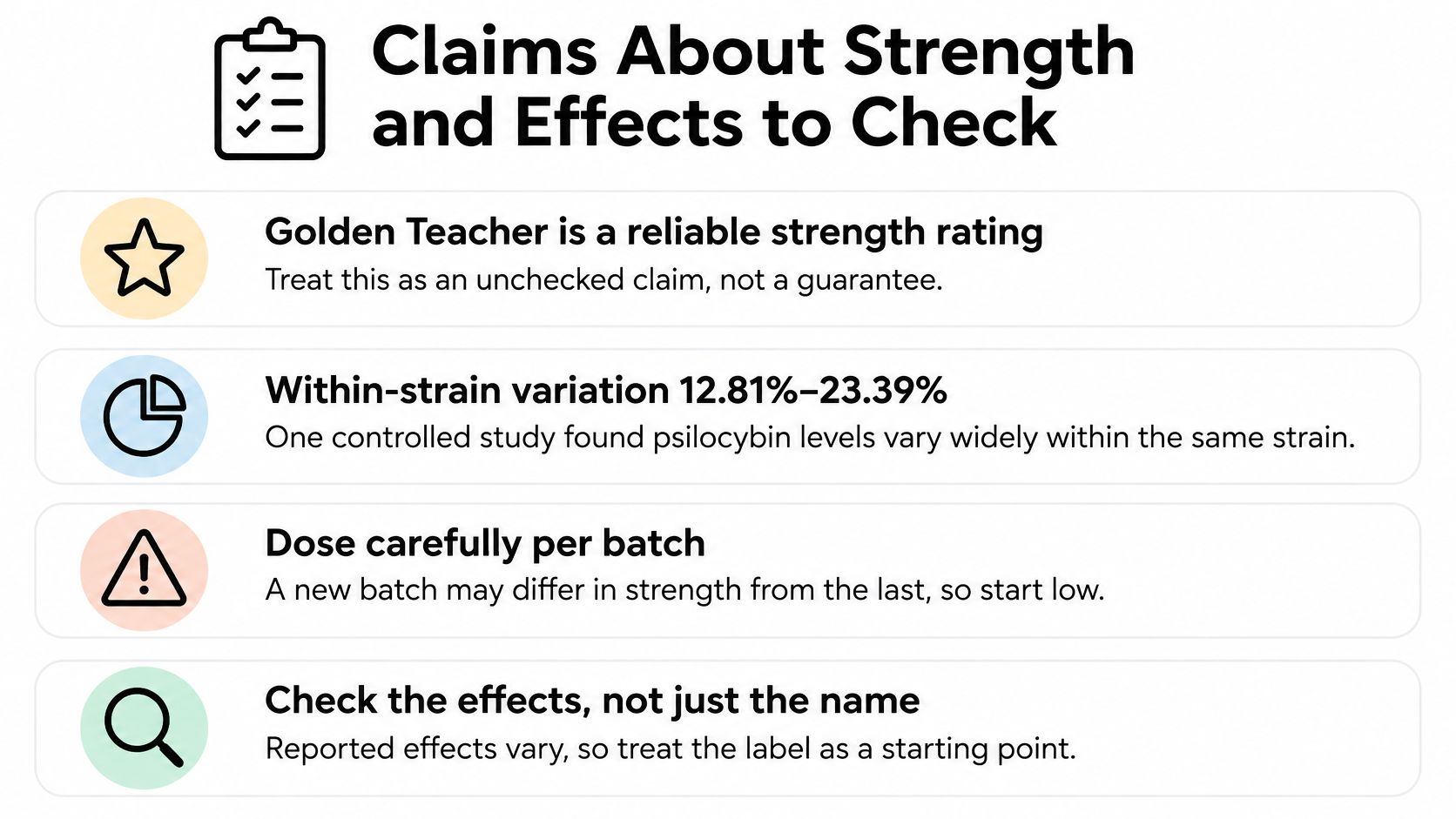
The belief that Golden Teacher is a dependable strength rating is the most consequential claim in this entire subject, because people dose against it. The name is a cultivation label, not a standardized taxon or genotype. Research on cultivated P. cubensis shows meaningful chemical variation between named lines and among individual mushrooms from the same line, as Rosehill's analysis of cubensis strain names sets out. DNA-authentication and metabolomic work arrives at the same place from another direction: the name alone can't establish a fixed genotype, pedigree or predictable alkaloid concentration, per the authentication and metabolite study in PMC.
The checklist below collects the claims worth interrogating before you buy.
Where the Claims Come From
Strain rankings are mostly built from accumulated user reports. A cultivator grows a line, a handful of people try it, someone writes "gentle and visual," and that phrase outlives the batch it was coined from. Nothing in the chain involves a measurement, and the chemistry shifts every time somebody grows the line again from a different culture.
| Claim | What the evidence supports |
|---|---|
| Golden Teacher is consistently milder | Not supported; reported chemical variation is large between and within named lines |
| The strain name predicts strength | Not supported; the name is a cultivation label, not a standardized potency category |
| All products sold under the name are comparable | Not supported without independent, batch-specific analysis of that product |
| Effects are identical from one dose to the next | Not supported; reported effects vary with dose, individual response and setting |
| Strength is the only thing that matters | Not supported; contamination, labelling accuracy and serving consistency also matter |
The Question Worth Asking
The useful question isn't "how strong is Golden Teacher." It's "how much uncertainty remains when this product has no independent, batch-specific analysis?" Reframing it changes what you look for. For chocolates and drinks, where a bar or a bottle gets divided into servings, extraction and serving-size consistency can matter more than which line went into it.
What stays unknown: without a test on the specific batch, nobody can tell you the psilocybin or psilocin content of what you're holding, and no strain reputation fills that gap.
Effects also depend on dose, on the individual and on setting, and a name settles none of those three. A shop sign, a forum thread and a star rating are all claims about a label. A test result is a claim about a product.
Verify the Batch Before You Trust the Name
A strain name cannot establish what a particular batch contains. Before buying, check what documentation is available and whether it applies to the product you will receive.
- Ask for batch-specific analysis. Independent results reporting identity and potency on a dry-weight basis can provide a measurable account of that batch. Without them, treat its strength as unknown.
- Check serving information. For an edible or drink, look for a stated amount per serving, not only a total for the package. Uneven distribution can make individual portions differ.
- Ask about contaminant screening. Mould, microbial growth and adulterants cannot be assessed from a photo or a strain name.
- Check local law. Laws governing psilocybin vary by location. Confirm the rules that apply where you are before making a decision.
- Consult a clinician if you have a medical condition, take regular medication, or have a personal or family history of mental health conditions. These concerns depend on your health circumstances, not the strain label.
- Plan the setting. Avoid mixing substances, and do not plan to drive.
Batch consistency depends on cultivation, handling and how a product is prepared. A seller's general account of its products does not establish the chemistry of an individual batch. For shoppers comparing Metro Mush's high-quality mushroom products, the useful questions are what documentation exists and whether it describes the specific product on offer.
The decision: What evidence is available for this batch, and does it address your circumstances? If there is no batch-specific evidence, the label alone cannot answer those questions.
Metro Mush offers dried strains and edibles to adult customers in the Detroit and Ann Arbor areas. If you are considering Golden Teacher or comparing it with Penis Envy or Enigma, check the current menu and ask what information is available for the specific product. Visit Metro Mush to browse listings, locations and delivery options.