
How can a list of the best mushroom drinks help you choose if it treats lion's mane coffee and a psilocybin beverage as interchangeable? They may share a mushroom ingredient, but they don't share the same purpose, risks, or evidence.
A useful comparison starts with what's in the drink, then asks whether the label and testing support an informed decision. Taste matters, but it can't tell you the mushroom species, active-compound content, or whether the finished beverage passed contaminant testing.
Quick Picks by Mushroom Drink Type
The best mushroom drink depends on the category, not a single winning brand. The global mushroom drinks market was valued at $3.9 billion in 2024, according to Grand View Research, but products within that category can serve very different purposes.
Start by deciding whether you want a familiar daily beverage without psychedelic effects or information about a psychoactive product. Someone replacing morning coffee has a different buying problem from someone evaluating a psilocybin drink.
| Drink Type | Best For | Main Ingredient | Dose Clarity | Price Band |
|---|---|---|---|---|
| Functional mushroom coffee | Daily coffee swap without psychedelic intoxication | Lion's mane, chaga, or reishi blended with coffee | Low when only a blend weight is disclosed | Compare current price per labeled serving |
| Ready-to-drink functional beverage | Convenient flavored daily drink | Mushroom extract, sometimes with botanicals | Low to moderate unless active amounts are measured | Compare bottle price and servings per container |
| Psilocybin mushroom drink | Adults evaluating a planned psychoactive experience where legally permitted | Psilocybin-containing mushroom material or extract | Requires finished-batch potency testing | Listed beverage examples span $40.00 to $55.00 at Metro Mush |
| Microdose-oriented psilocybin drink | Adults evaluating products marketed for low-dose use | Psilocybin intended to be measured per serving | Clear only with a stated, verified per-serving amount | Compare tested servings, not the microdose label |
Microdose-oriented isn't a separate mushroom species or a guarantee of no impairment. It describes intended use. A product with that positioning still belongs to the psychoactive category and needs the same scrutiny as another psilocybin beverage.
Choose the format after the category
Functional mushroom coffee suits someone who wants a coffee-based routine, but it isn't automatically caffeine-free or lower in caffeine. A powder mix may offer flexible preparation, while a sealed ready-to-drink beverage removes the measuring and mixing step.
Tea is a preparation format, not a potency standard. Our mushroom tea preparation guide provides context on that format, but a recipe doesn't establish the active-compound content of a finished cup.
Buying priority: Choose the category that fits your goal before comparing flavors, packaging, or wellness language.
If you want no psychedelic effects, keep your shortlist within clearly identified non-psychedelic functional products. If a label doesn't make that distinction clear, don't guess from the word mushroom.
What Goes Into a Mushroom Drink
A mushroom beverage can contain several ingredient families, and each deserves a separate reading. The mushroom ingredient, the beverage base, and supporting ingredients shouldn't be treated as a single source of effects.
In NBJ's 2024 consumer survey, 37% said they eat or drink functional mushroom foods and beverages, compared with 27% who take functional mushroom supplements, according to New Hope Network. That finding describes consumer use, not proof that a particular drink delivers a health benefit.
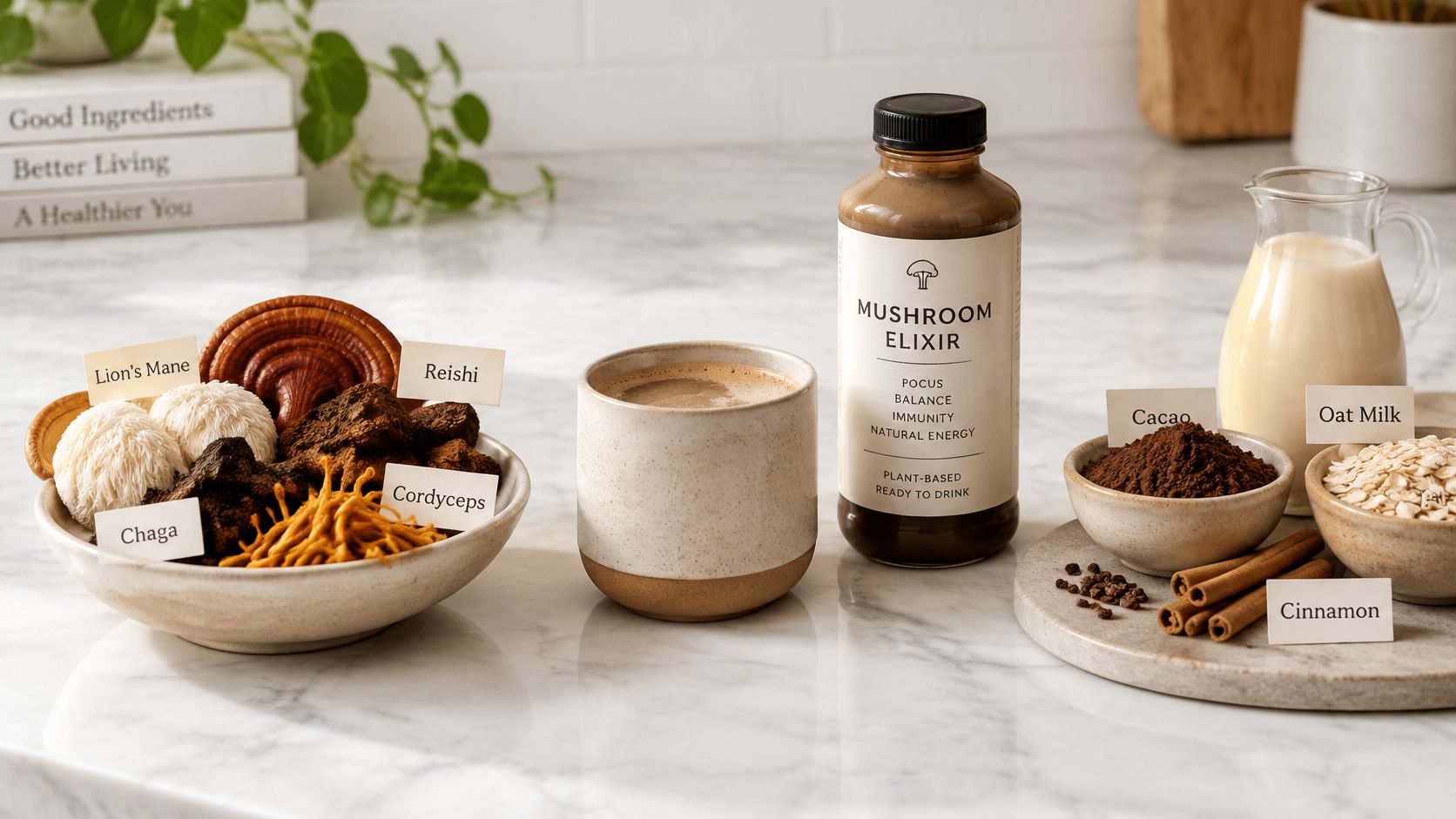
This ingredient illustration shows how many components can appear in an elixir.
Separate the mushroom from the beverage base
Functional species include lion's mane, reishi, chaga, and cordyceps. Their presence doesn't make a drink psychedelic, and marketing terms such as focus or balance aren't substitutes for evidence about the finished product.
Psilocybin-containing mushrooms belong in a different category. Don't assume psilocybin is the only potentially mind-altering ingredient in a beverage, though. Read the complete ingredient list for caffeine, cannabis-derived ingredients, or other added substances.
Supporting ingredients include sweeteners, milk alternatives, botanicals, acids, and flavorings. These affect the overall product, so check sugar, caffeine, and allergens independently of the mushroom content.
Understand the form and the measured compound
The fruiting body is the recognizable mushroom structure. Mycelium is the fungus's branching growth network. Neither term alone tells you the amount of a particular compound in your serving.
An extract and a whole-mushroom powder also aren't interchangeable. An extract ratio describes a manufacturing relationship, not a measured active-compound amount or a clinically validated dose.
For functional drinks, beta-glucans can provide a measurable formulation characteristic. A review in Beverages reports that chaga beta-glucan content remained stable at −20°C and 25°C, but declined significantly after six weeks at 35–45°C. The same review reports that refrigerated storage at 5°C better preserves Hericium erinaceus quality and limits microbial growth than warmer conditions.
Those findings support paying attention to storage, not assuming every beverage needs the same refrigeration instructions. Use the finished product's tested storage conditions.
Before comparing drinks, answer:
- Which species? Look for an identifiable mushroom, not just a blend name.
- How much material? Find the extract or mushroom quantity per serving.
- Which compound is measured? Distinguish ingredient weight from quantified active content.
Label Checks That Separate Good Products
Mushroom blend isn't a performance specification. It doesn't establish composition, potency, or shelf life. A useful label gives you information you can check against a batch report.
| Criterion | What to Look For | Red Flag |
|---|---|---|
| Species | Named species such as lion's mane, reishi, or an identified Psilocybe species | Only the words mushroom blend |
| Extract or fruiting-body amount | Stated quantity and, where relevant, extract ratio per serving | No amount given |
| Active compound per serving | Measured psilocybin or beta-glucan amount, appropriate to the category | Potency described only as strong or microdose |
| Batch certificate of analysis | Current certificate tied to the batch and sample identifier | No certificate or generic lab report |
| Contaminant and microbial screen | Results for pesticides, heavy metals, mold, E. coli, and Salmonella | Testing not mentioned |
| Storage and expiry testing | Recommended storage temperature and tested shelf life | Shelf life claimed without supporting information |
Use this visual checklist to identify the basic label information before examining laboratory documents.
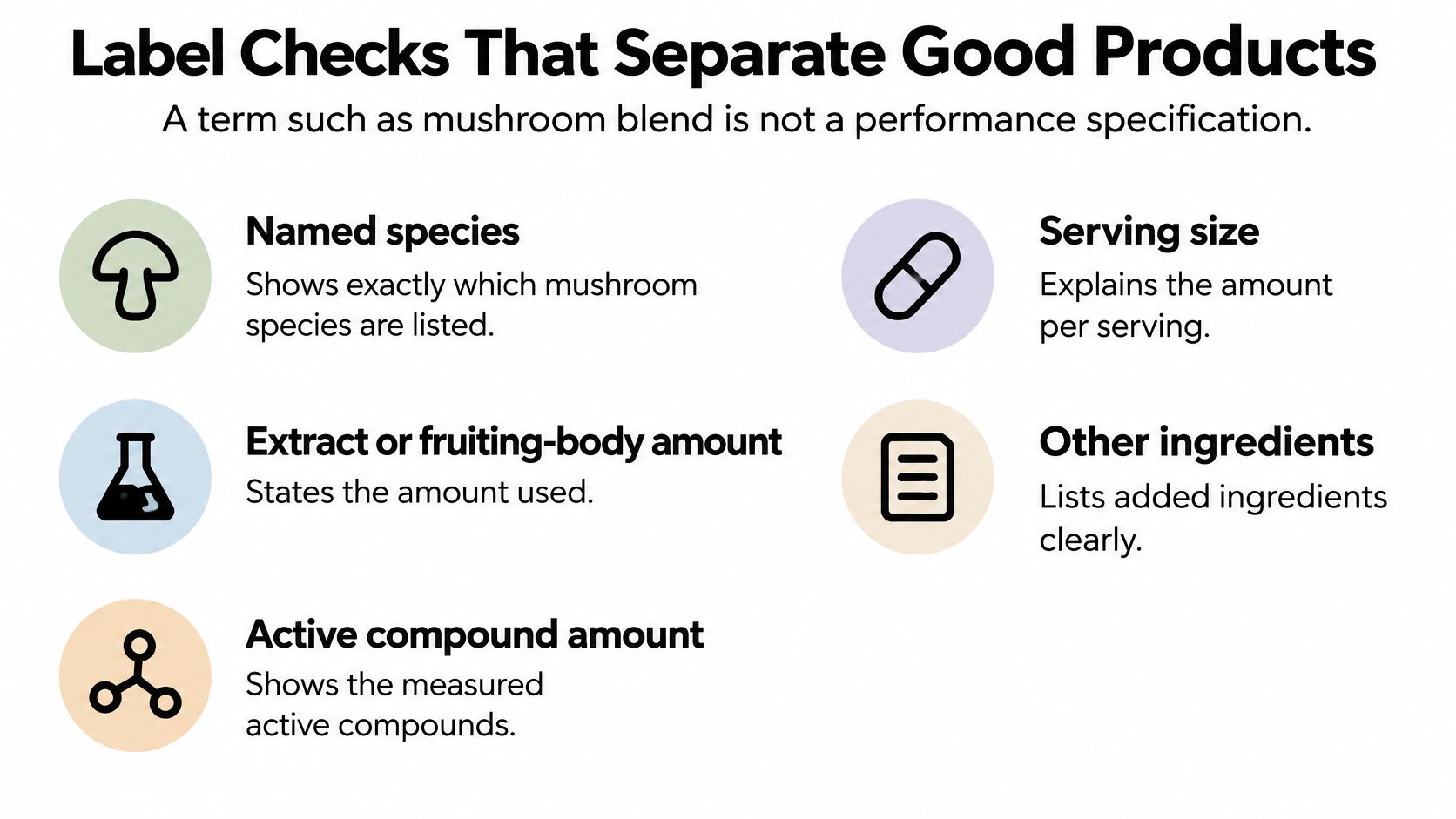
Read the certificate as a product record
For a psilocybin beverage, look for quantified psilocybin and psilocin, contaminant results, a testing date, a sample identifier, and a clear connection to the finished drink. A report for dried mushrooms doesn't establish what remained in a bottled beverage after formulation and storage.
SCIEX's natural-toxin testing information describes analytical methods capable of detecting psilocybin and psilocin in mushroom extracts below 1 part per billion, with reported analysis times of about five minutes. Precise measurement is technically feasible, although a method's detection limit doesn't by itself validate a particular commercial drink.
Check the units carefully. A concentration in the laboratory sample isn't automatically the amount in a serving, and a laboratory's existence isn't evidence that it tested your bottle.
Keep safety measurements separate
Potency describes measured active content. Microbial testing assesses specified organisms. Water activity measures water available to support microbial growth, not merely how much liquid the bottle contains.
A beverage's acidity, sugars, preservatives, and packaging can differ from dried mushroom material. Shelf-life work therefore needs to address the finished formulation under defined storage conditions.
Our guide to spotting unverifiable mushroom products offers additional product-authenticity context.
The following video is supplementary material, not a replacement for a product-specific report.
Reject a product that can't provide a current, relevant batch certificate. Attractive packaging and a laboratory logo don't resolve missing results.
Onset, Duration and Safety for Psilocybin Drinks
A psilocybin experience unfolds in stages: an onset, a period of stronger effects, and a gradual return toward baseline. Don't treat a generic clock estimate as permission to take more or resume driving. A liquid format shouldn't be assumed to act faster, wear off sooner, or feel milder than other preparations, because no general timeline can predict what a specific product will do in a specific person.
The stages below describe what to expect at each point rather than promising numbers a label can't back up.
| Stage | What to Expect | What to Do |
|---|---|---|
| Onset | An initial waiting period that isn't predictable from flavor or bottle size | Don't take more because effects haven't appeared |
| Peak | After effects develop, with timing that cannot be guaranteed | Remain in a familiar setting with sober support |
| Full duration | Until acute effects have fully resolved | Avoid driving, work, and decisions about changing medication |
| After-effects | Residual effects may continue after the strongest effects subside | Rest, drink water normally, and monitor lingering distress |
A Washington State Liquor and Cannabis Board research brief identifies headache, nausea, anxiety, dizziness, and increased blood pressure among frequently reported adverse events associated with psilocybin. The same brief points to the value of labeling total psilocybin or psilocin content and providing a complete ingredient list.
Why a familiar drink can create unfamiliar risk
Flavored beverages invite quick finishing. That everyday habit becomes a problem when the contents are psychoactive and the effect isn't immediately apparent: the bottle can be empty before the onset arrives.
A bottle may contain multiple intended servings, and its volume doesn't reveal its potency. Even clear portion markings can't compensate for an unknown active-compound concentration.
Drinkable doesn't mean mild. A pleasant flavor isn't a safety measurement.
For broader context on the experience timeline, see our guide to how long mushroom effects last, treating any general range as an estimate rather than a personal prediction.
These safeguards apply if exposure occurs or legal, supervised use is being considered:
- Don't redose during the experience. Waiting for stronger effects can lead to unintended additional exposure.
- Avoid combining substances. Don't mix psilocybin with alcohol or cannabis.
- Discuss health history first. A clinician should review medications and relevant mental-health or cardiovascular conditions.
- Keep sober support available. A trusted, unimpaired person can help respond if distress develops.
- Don't drive. Feeling less affected isn't proof that judgment and coordination have recovered.
- Seek urgent help for serious symptoms. Chest pain, seizures, loss of consciousness, or dangerous agitation require emergency assessment.
An incomplete label is a reason to stop, full stop.
Matching a Drink to Your Experience Level
Experience changes what information you may already have, but it doesn't make an unverified product suitable. The best mushroom drinks for a newcomer seeking a daily beverage aren't necessarily relevant to someone asking about psychoactive effects.
A functional mushroom drink is the clearest starting category for someone who doesn't want psychedelic intoxication. Choosing that category doesn't require progressing to psilocybin later.
| Experience Level | Starting Product | Dose Approach | Avoid |
|---|---|---|---|
| Beginner | Clearly labeled, non-psychedelic functional coffee or beverage | Follow the food or supplement serving instructions and check caffeine | Treating all mushroom drinks as interchangeable |
| Person evaluating microdose claims | No product should be chosen on that claim alone | Require measured content and discuss intended use with a clinician | Estimating exposure from flavor or package size |
| Experienced psychedelic user | Experience doesn't replace product verification | Don't assume a previous product establishes an equivalent amount in another | Escalating potency or relying on an unplanned setting |
Beginners should solve the simpler problem first
If your goal is a morning drink, compare coffee content, preparation, ingredient transparency, and tolerability. Someone sensitive to caffeine should check the actual caffeine declaration rather than assuming mushroom coffee is a gentler substitute.
A short ingredient list can make a first trial easier to interpret. If you introduce a complicated blend of mushrooms, stimulants, and botanicals together, you won't easily know which ingredient caused an unwanted response.
Microdose claims need more than a serving suggestion
The word microdose doesn't establish a standardized quantity or promise an absence of noticeable effects. A routine described online also isn't a clinically validated treatment plan.
Don't select a schedule of repeated psilocybin use from a beverage label or a wellness testimonial. Discuss the intended use with a qualified clinician, particularly if you're trying to address mood, attention, sleep, or another health concern.
If you're documenting exposure for a clinical discussion, record the product, batch, stated content, time, other substances, and unwanted effects. That record is more useful than a note saying the drink felt strong or weak.
Experience isn't a reason to increase potency
A familiar response to one product doesn't establish a response to a different formulation. Previous tolerance also doesn't remove the importance of current health, medications, or setting.
Johns Hopkins' account of its psychedelic research describes clinical work involving measured doses, participant screening, preparation, supervision, and follow-up. Those conditions are substantially different from drinking a retail beverage.
Clinical findings therefore shouldn't be used to promise that a commercial product treats depression, addiction, or another condition. More experience doesn't turn retail consumption into clinical care, and moving toward higher potency isn't a necessary goal.
Confirm Law, Compare Prices and Buy
Confirm the legal category before making a purchasing decision. A product's availability, a delivery area, or a local storefront doesn't establish that possession, sale, or transport is lawful.
For psilocybin, don't treat local decriminalization as equivalent to legalization or permission for commercial sales. Check current federal, state, and municipal rules through official government publications, and obtain qualified legal advice where the position is unclear.
That distinction matters for readers traveling between Michigan, Illinois, Ohio, and Indiana. Don't assume that rules in one city apply elsewhere or authorize transporting a product across a jurisdictional boundary.
Compare listed prices without confusing cost and potency
For neutral price comparison, Metro Mush lists the following beverages. These prices establish the listed purchase cost, not verified active content, legal eligibility, or product safety.
| Product | Price | Check Before Buying |
|---|---|---|
| Rocket Fuel Shroom Drink | $40.00, multiple variants | Per-serving psilocybin amount and finished-batch certificate for the specific variant |
| Magic Mushroom Tea, Hibiscus | $55.00 | Serving information and testing for the current batch |
| Magic Mushroom Tea, Chamomile | $55.00 | Serving information and testing for the current batch |
A more expensive drink isn't necessarily more potent, more consistent, or better tested. Likewise, a lower price isn't a useful value claim if you can't establish what the container holds.
Don't equate grams of mushroom material with milligrams of psilocybin. A mushroom-weight declaration describes ingredient mass; it doesn't supply a measured active-compound concentration.
Compare cost per labeled serving only when the serving definition is clear. For functional drinks, also account for preparation requirements and whether the product is a concentrate, powder, or finished beverage.
A price comparison is meaningful only after the products are comparable.
Use a document-first decision process
For lawful non-psychedelic beverage purchases, the following sequence helps prevent a wellness claim from becoming the main buying criterion. For psilocybin products, legal and clinical considerations must come before any commercial decision.
Confirm the category and current law. Identify whether the drink is a conventional functional beverage, a supplement, or a product containing a controlled substance. Stop if the ingredient list or legal position is unclear.
Choose the purpose. A coffee replacement, a flavored refreshment, and a psychoactive product aren't substitutes. Write down the purpose in plain language before reading promotional descriptions.
Check the full label. Look for the species, mushroom or extract amount, measured compound, serving size, caffeine, sweeteners, and allergens. Don't let a large blend weight distract from missing individual ingredient information.
Verify the relevant documents. Match the batch identifier on the product to the certificate. Check that the report addresses the finished formulation rather than an ingredient used earlier in manufacturing.
Resolve health questions before use. Follow the labeled serving instructions for lawful functional products and ask a clinician about relevant conditions or medications. A retail label isn't a personalized psilocybin dosing recommendation.
Plan for the actual product category. A daily coffee needs ordinary preparation and storage planning. Potential psychoactive exposure requires avoiding driving and having a safety plan, not treating the bottle as an ordinary refreshment.
Rank the shortlist by what you can verify
Give priority to named species, then clear serving and compound information, then a current finished-batch certificate. After that, compare storage requirements, complete supporting ingredients, and suitability for your routine.
Use missing documentation as an exclusion criterion rather than a minor deduction. A detailed flavor description can't make up for unknown contents.
Only after those checks should taste and convenience decide between otherwise suitable functional drinks. A powder that fits your morning preparation may be a better choice than a refrigerated bottle you won't store correctly.
For a beginner seeking no intoxication, a clearly labeled functional mushroom coffee or caffeine-free functional beverage is the most straightforward category to evaluate. Someone assessing microdose claims needs measured content and clinical guidance, not reassurance from the product name.
Experienced users should apply the same documentary standard rather than looking for a stronger product. The best mushroom drinks are the ones you can accurately identify and evaluate, not the ones with the most ambitious promises.
Metro Mush's beverage menu includes Rocket Fuel Shroom Drink and Magic Mushroom Tea in Hibiscus and Chamomile. Visit Metro Mush to review the listed product information, and assess it alongside current law, ingredient transparency, and finished-batch testing rather than wellness claims.