

Golden Teacher-labelled samples vary widely in reported psilocybin content, but the cited Curative Genetics observations do not establish a verifiable range or provide enough sample detail to treat their figures as a reliable potency estimate. The strain name is therefore a weak predictor, not a measurement.
For a practical estimate, weigh the dried material and use a batch report's psilocybin value in milligrams per gram, if available. A measured batch still may not represent every mushroom, and aged stock should be retested because storage can affect its contents. Keep dried mushroom weight, measured alkaloid content, and personal medical risk separate when assessing a dose.
Golden Teacher Potency Numbers at a Glance
In one multi-strain analysis of Psilocybe cubensis, measured psilocybin ranged from 0.208 to 5.344 mg/g, while psilocin ranged from 0.651 to 3.509 mg/g. These are separate compound ranges, not a combined potency interval, and they show why a strain label alone cannot predict a batch's composition.
Reported Potency Figures for Golden Teacher and P. cubensis
| Dataset | Psilocybin | Psilocin | Combined or note |
|---|---|---|---|
| Multi-strain analysis of P. cubensis | 0.208 to 5.344 mg/g | 0.651 to 3.509 mg/g | Ranges across tested material; the values should not be added as though they describe one sample |
| Cultivated P. cubensis average and broader variability context | Not reported separately in the cited summary | Not reported separately in the cited summary | The cited summary reports about 1.14% combined content by dry weight |
| Azarius Golden Teacher listing | Retailer listing gives 0.4% to 0.6% by dry weight | Not reported separately | A retail-page figure, not a batch-specific laboratory result |
The first study's psilocybin and psilocin intervals describe variation across its tested material. They do not establish that the lowest or highest readings occurred together in a single mushroom. The cultivated P. cubensis figure is a combined-content average, so it cannot be compared directly with either compound's individual range. Percent by weight converts to mg/g by multiplying the percentage number by ten; that conversion changes units, not the underlying result.
The retailer listing provides a Golden Teacher-labelled figure, but it does not identify the tested batch or provide an individual product certificate. Treat it as a listing-level reference, not a specification for mushrooms a buyer receives. The linked analytical study offers broader species-level context, rather than a reliable prediction for that label.
Reading the Units Without Mixing the Compounds
Keep the compound and measurement attached to every number. Psilocybin alone, psilocin alone, and combined content are different results. A combined figure should not be presented as a psilocybin concentration, and results from separate samples should not be added to create a supposed total.
For a practical estimate, use the dried weight and a batch-specific laboratory report that gives milligrams per gram. Multiply the reported mg/g by the dried weight in grams to estimate the measured amount of that compound in the material. This calculation applies only to the tested batch and compound; it does not account for uneven distribution or personal sensitivity. If stock has aged since testing, the original result may no longer represent its current condition, so retesting is more informative than relying on the strain name.
Interpretation rule: Published ranges describe tested samples, not guaranteed minimums, maximums, or expected strengths for an individual mushroom or product.
A strain name is a weak predictor. Dried weight and a recent, batch-specific measurement provide a more useful basis for estimating content.
Biological and Cultivation Factors That Shift Strength
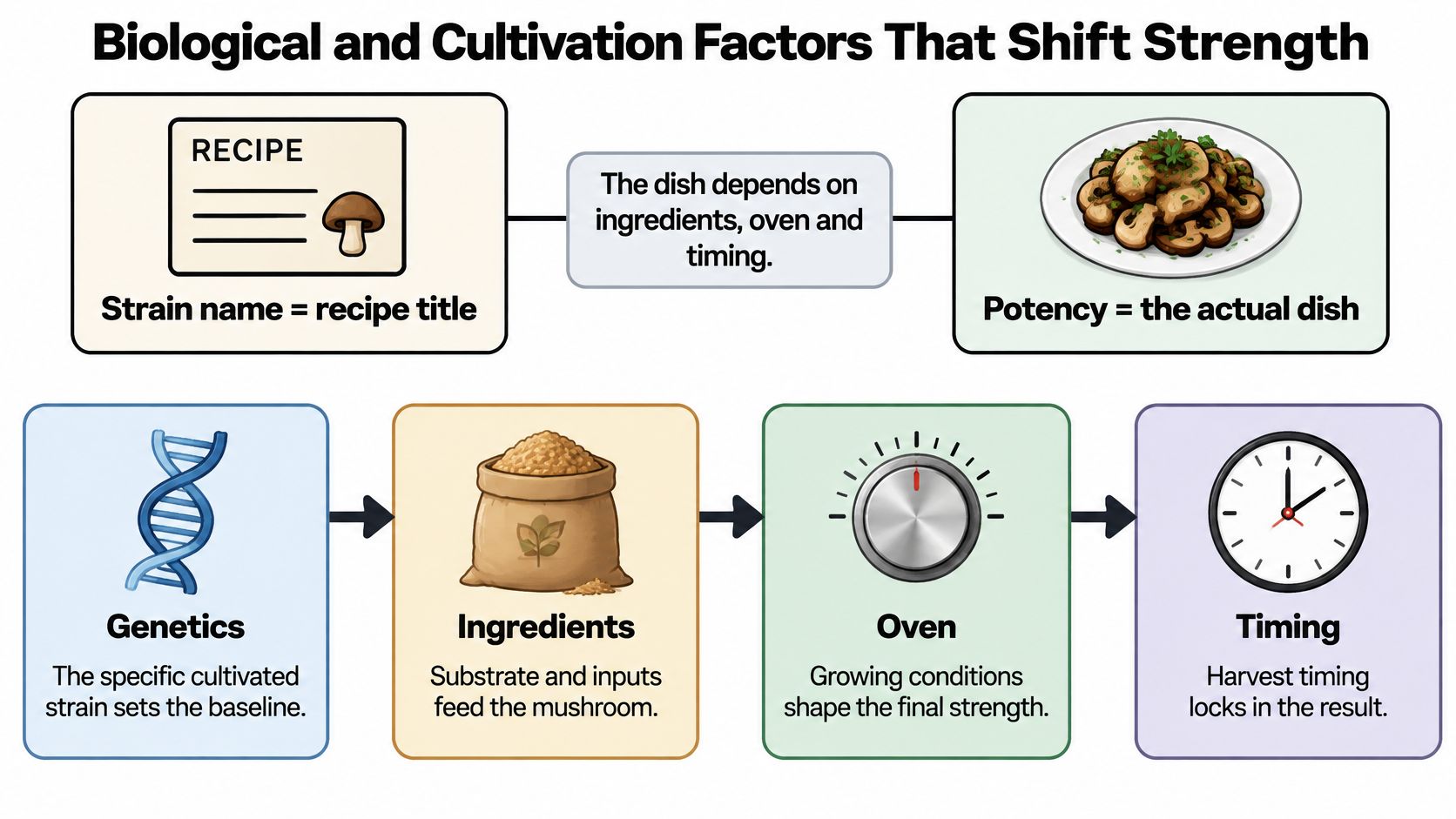
A Golden Teacher label identifies a cultivated category, not a measured chemical profile. The strain name is a weak predictor of an individual batch's strength because genetics and cultivation can vary, while the label alone does not report concentrations.
A cooking analogy helps clarify the distinction: genetics, growing conditions, and timing may all shape the result, but knowing those factors does not provide a reliable formula for increasing potency. The evidence supports variation, not a simple rule that changing one input will produce a predictable chemical change.
Genetics and Growing Conditions
Genetics and the cultivated line may contribute to a mushroom's chemical profile. A cultivation guide can explain growing terminology and methods, but it does not establish the potency of a resulting harvest. The Golden Teacher growing guide offers cultivation context; a batch-specific analysis is still needed to describe chemical concentration.
The name also cannot establish a fixed potency ceiling or confirm that a particular supplement reliably raises alkaloid content. Those claims would require controlled evidence on the specific intervention and material. Without it, treat the strain label as identification, not a potency specification.
Flushes, Mushroom Parts, and Processing
Concentration may differ among samples, so a result from one portion of a harvest should not automatically stand in for all the material. The earlier cited information does not establish specific flush-to-flush or cap-to-stem patterns for Golden Teacher, so those patterns should not be treated as known rules.
That uncertainty has a practical consequence: a sample must represent what will be used. A cap-only test may not describe a package containing both caps and stems, and a result from one harvest cannot be assumed to describe another. Drying and later handling also affect the material submitted for testing, while differences in analytical methods can make results harder to compare.
For dosing, use dried weight and, when available, a batch report stating the measured compounds in milligrams per gram. Apply that result only to material represented by the sample. If stock has aged or been stored under different conditions, retest rather than assuming its earlier result still applies.
Shared ancestry is not demonstrated chemical similarity. A common cultivated name does not make one batch's lab result transferable to another.
How Golden Teacher Compares With Other Strains
A strain name identifies a category, not a measured concentration. The evidence summarized for Golden Teacher includes label-specific observations and multi-strain research, but it does not establish a product-wide ranking against Penis Envy, Enigma, or Psilocybe azurescens. Those comparisons require reports on the same chemical basis.
What the Available Comparisons Can Establish
| Type | What the cited evidence covers | What a comparable report would need |
|---|---|---|
| Golden Teacher | Label-specific observations and findings from multi-strain research, neither of which describes every product sold under the name | Tested material identified as Golden Teacher, with psilocybin and psilocin reported in mg/g |
| Penis Envy | No product-specific range is established in the evidence summarized here | A tested sample with both compounds reported in the same units |
| Enigma | No product-specific range is established in the evidence summarized here | A tested sample with both compounds reported in the same units |
| Psilocybe azurescens | The cited datasets do not provide a directly comparable species result | Species-identified material analyzed for the same compounds and reported in the same units |
These are limits of the available evidence, not proof that the named types have equal or different potency. A usable comparison needs matching analytes, units, and material: for example, dried fruiting bodies compared with dried fruiting bodies, rather than a report on one form set beside a result from another. If methods or sample descriptions differ, the numbers may not support a clean ranking.
For Penis Envy and Enigma, reputation alone cannot supply the missing measurements. The evidence here gives no basis for assigning either a higher or lower concentration than Golden Teacher. The overview of P. cubensis strains helps clarify how strain names are used, but naming information is not a chemical comparison.
Species Results Need Matched Measurements
Psilocybe azurescens is a different species, so a reported result for it should not be treated as a direct ranking unless the tested material and analytical basis can be compared with the Golden Teacher results. The datasets summarized here do not provide that matched comparison. A reputation for strength cannot fill the gap.
The practical value of comparison is therefore conditional: use it when reports specify the material tested and provide results for the same compounds, in the same units, on a comparable basis. Without those details, the evidence can distinguish what has been measured from what remains unanswered, but it cannot establish which named type is stronger.
Dosing Bands From Micro to High and What Each Needs
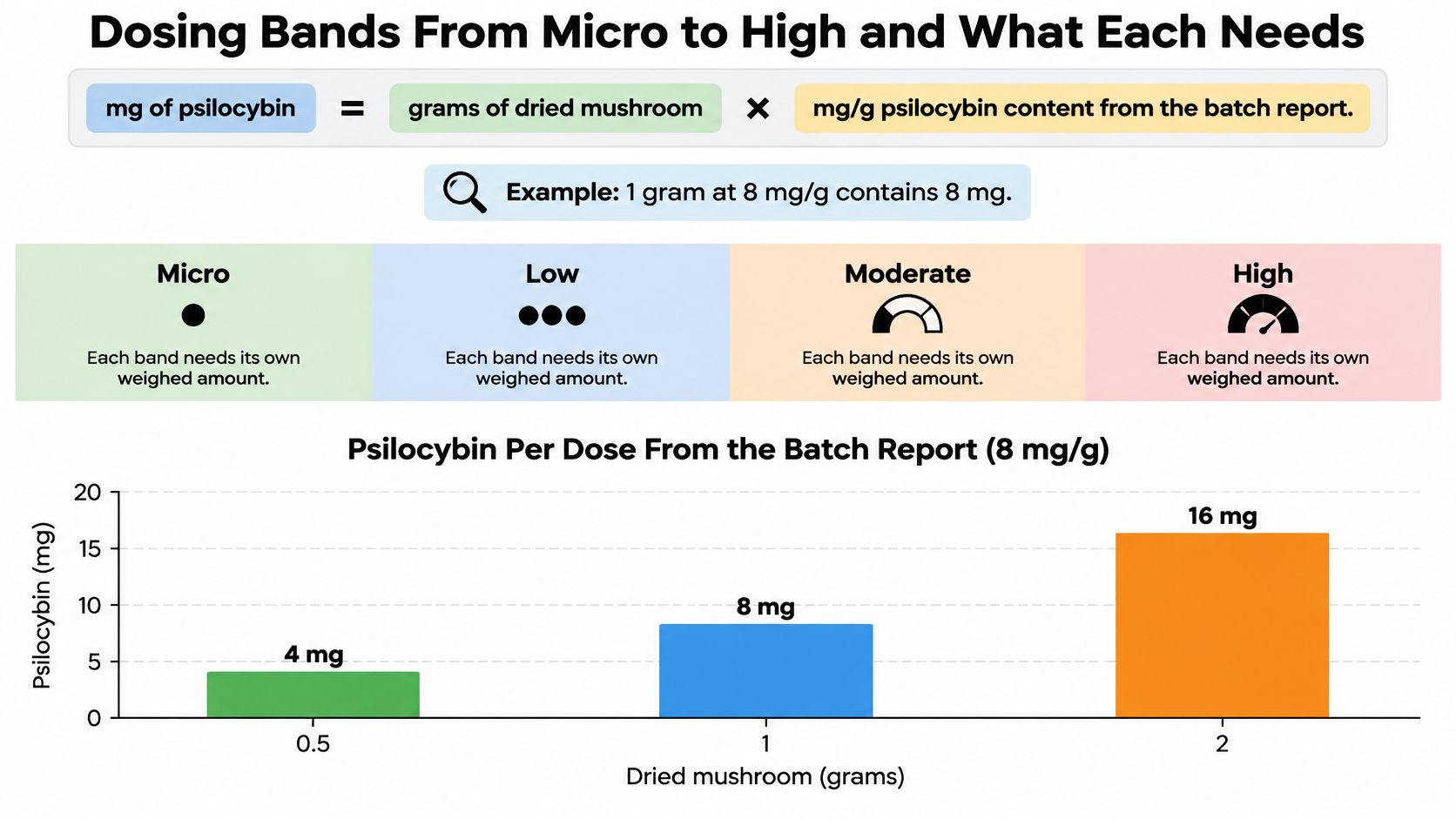
Measured compound amount equals dried mushroom weight multiplied by the batch concentration. Use the psilocybin result to calculate psilocybin content, and the psilocin result to calculate psilocin content separately. If a report gives concentration in milligrams per gram, multiplying that value by the dried weight estimates the amount of the measured compound in that weight.
This is a way to describe chemical exposure, not to determine a medically appropriate amount. The calculation is only as informative as the sample's representativeness and the finished product's test results. A hypothetical example can show the arithmetic, but it cannot establish the strength of a particular Golden Teacher batch.
Why Weight Bands Can Mislead
“Micro,” “low,” “moderate,” and “high” are informal labels, not validated Golden Teacher formulations with established dried-weight cutoffs. The strain name alone cannot supply those cutoffs: batches may differ, and a label does not show the concentration in the material being measured.
For a particular batch, the more useful method is to start with its dried weight and a batch-specific laboratory result in milligrams per gram. Calculate the measured compound amount from those figures, keeping psilocybin and psilocin separate. If no representative batch result is available, the weight alone cannot establish the compound exposure.
The distinction is between describing exposure and prescribing an amount. More precise arithmetic cannot turn an untested average into a batch measurement or establish an individual response. The chart illustrates a calculation framework, not universal boundaries for informal dose bands.
A microdose label does not establish fitness to drive. Familiarity with one batch also does not establish how the same weight from another batch will affect someone.
The accompanying video is supplementary educational material. It does not replace a laboratory report or clinical assessment.
Edibles Require Finished-Product Measurements
For chocolates and drinks, dried mushroom weight may be less informative than measured milligrams per serving in the finished product. Testing the starting mushroom material does not establish the concentration in the prepared edible or how that concentration is distributed among servings.
Ask whether the laboratory tested the finished product or only its starting material. A certificate for mushrooms cannot show that each chocolate piece or drink portion contains an even amount. Without finished-product testing, the serving's measured compound content remains unknown.
Keep these distinctions in view:
- Concentration isn't response: A chemical result does not predict an individual's experience.
- Serving isn't validation: Printed serving divisions do not demonstrate uniform composition.
- Average isn't an assay: Population-level findings cannot replace a batch result.
- Small isn't automatically non-impairing: An informal label does not establish fitness for work or driving.
If a representative result is missing, the defensible conclusion is unknown exposure, not a reliably low band.
Legal Limits and Health Cautions in Detroit and Ann Arbor
Local decriminalization shouldn't be read as blanket permission to possess, sell, deliver, or transport psilocybin. A change in enforcement priority and a legally authorized commercial market are different arrangements. A storefront, delivery listing, or local reputation doesn't establish which activities are permitted.
The potency studies cited here aren't legal authorities. They don't verify the current legal position in Detroit, Ann Arbor, Michigan, or neighboring states, so they shouldn't be used to support precise claims about ordinances, ballot measures, or commercial permissions.
Check the Activity, Not Just the City
Ask a qualified local attorney or consult current official government materials before relying on a claim of legality. The question needs to identify the activity, because possession, cultivation, therapeutic services, sale, and transport aren't interchangeable.
For readers in Illinois, Ohio, or Indiana, proximity to Michigan doesn't answer the legal question. Don't assume that a policy applicable in one municipality applies across a state boundary or authorizes interstate transport.
A useful legal check separates:
- Jurisdiction: Which federal, state, and local rules apply?
- Activity: Does the relevant rule address possession, services, sale, or something else?
- Authority: Is the explanation based on current official text or a retailer's interpretation?
- Timing: Has the policy changed since the explanation was published?
Legal caution: Reduced enforcement priority isn't the same thing as authorization for every related activity.
Medical Review Is Separate From Potency Testing
A certificate answers a chemistry question. It doesn't clear someone medically for use, and it doesn't make medication decisions unnecessary.
Before considering psilocybin, discuss your circumstances with a licensed clinician, particularly if you have a personal or family history of psychosis or bipolar disorder, a significant heart condition, or are pregnant. Bring a complete medication list, including lithium, MAOIs, SSRIs, other prescriptions, nonprescription products, and supplements.
This is a screening checklist, not a claim that every listed circumstance has the same mechanism or level of risk. Don't stop, reduce, or substitute prescribed medication to change a psychedelic response.
The practical boundary is straightforward: neither a small advertised serving nor a familiar strain name replaces medical assessment. If an exposure produces severe distress, concerning physical symptoms, or an inability to remain safe, seek urgent medical help rather than trying to manage it through further dosing.
This is general educational information, not medical or legal advice. Current legal status and individual health suitability require their own qualified review.
Test, Store and Confirm Each Batch Before You Dose
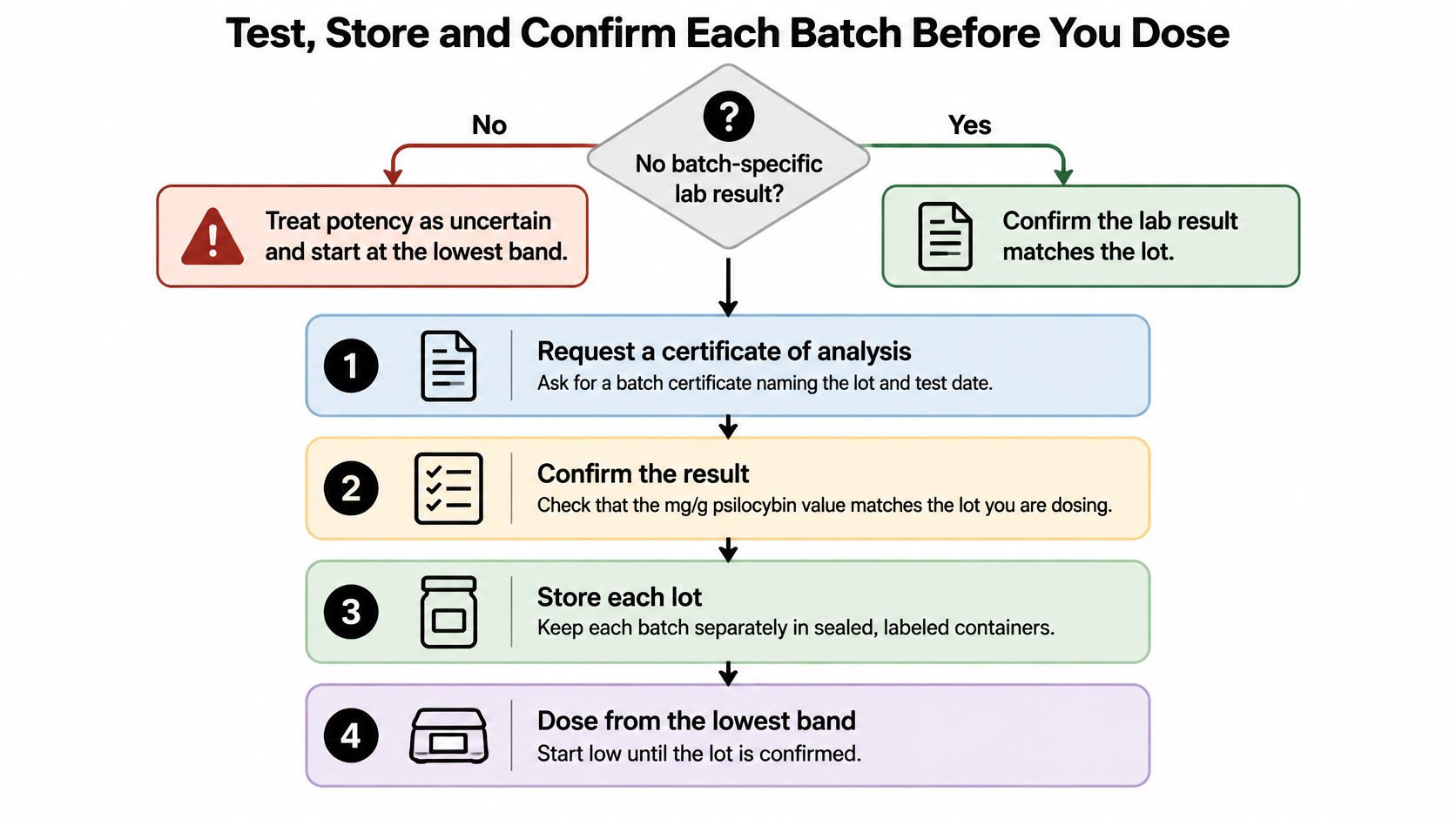
A strain name cannot establish a batch's potency. Without a matching laboratory result, treat concentration as unknown, rather than placing the material in the lowest dosing band. Testing can narrow that uncertainty, but it does not determine whether use is appropriate.
A practical quality-control process connects the tested sample to the material in hand, then checks whether the result remains relevant after storage. For a batch report, the useful number is the measured concentration in milligrams per gram of dried material. Multiply that concentration by the weighed amount, using the report's units and stated basis. If no batch-specific concentration is available, a familiar name such as Golden Teacher is not a substitute.
Establish What the Report Actually Covers
Request a lot-specific certificate. Match the product identifier to the report, and check the sampling and test dates. A result for another harvest, formulation, or unidentified sample does not establish what is in the package being assessed.
Check the analytical method and units. Look for validated HPLC or LC-MS testing that reports psilocybin and psilocin separately. Ask the laboratory or supplier whether a displayed total is a simple sum, a broader tryptamine measurement, or a calculated value.
Identify the tested material. Confirm whether the sample was a cap, stem, mixed dried mushroom, extract, chocolate, or drink. Results for one material cannot automatically be applied to another.
Keep the calculation tied to the report. Apply the reported concentration to the weighed amount, matching units and the report's stated basis. For a finished edible, a validated serving-level result is more informative than estimating exposure from the mushroom variety used.
A genuine certificate can still be irrelevant to the package if its sample came from a different lot or product form. Match the report to both the material and the batch.
Preserve the Material and Reassess Older Results
- Control storage conditions. A peer-reviewed P. cubensis stability study found the lowest decay in dried biomass stored in darkness at room temperature, and the greatest degradation in fresh mushrooms stored at −80°C under the conditions tested. Those findings do not establish a universal rule for every freezer, formulation, or package.
For dried material, use sealed, labelled, oxygen-limited packaging and limit exposure to light and humidity. This guide to storing dried mushrooms provides practical context. Appearance and packaging cannot confirm how much alkaloid remains.
Record dates and retest older stock. Keep the lot identifier, original certificate, storage history, and any later results together. Set retesting intervals that reflect the material and storage conditions; an original result does not remain current indefinitely.
Do not compensate for suspected aging by increasing the amount. A tested sample may not represent the entire lot, and storage may affect different portions differently. For example, pieces from one package may have different starting concentrations, or may have experienced different moisture, light, or heat exposure. A current analysis of a representative sample is more informative than assuming the remaining material has weakened uniformly.
The stability study covers particular materials and experimental conditions, not every retail product made with mushroom-derived ingredients. Findings for dried biomass do not validate the shelf life of a chocolate, drink, or extract.
A certificate describes the sample tested at a particular time. Records connect that result to the lot and its storage history.
Ask Product-Specific Questions
For dried products such as Penis Envy and Enigma, ask whether the sample represents the lot. For chocolates and drinks, ask whether the finished formulation was tested and how uniformity between servings was assessed. A mushroom-ingredient result alone does not establish the concentration in each finished serving.
These questions do not confirm that any product has a current certificate, validated serving uniformity, or authorization for sale. Each claim requires its own documentation.
The useful test is whether the seller can connect this package, this laboratory sample, this analytical result, and this storage history without gaps. Metro Mush lists dried mushroom varieties, chocolates, and drinks. Its product information can help direct questions about lot certificates, finished-product measurements, and storage records. Any decision about purchase or use remains subject to applicable law and appropriate health review.