
A controlled analysis found 7.8-fold variation in total tryptamines across 14 cultivated Psilocybe cubensis strains, even under standardized growing conditions. (Analytical study of cultivated cubensis strains) That spread makes a strain leaderboard a weak guide for consumers: a familiar cultivar name cannot guarantee a product's chemical strength, and chocolates or drinks introduce additional uncertainty about content per serving.
| Product or cultivar | What the available evidence can tell you | Main uncertainty |
|---|---|---|
| Penis Envy | One tested sample measured 17.59 mg/g total tryptamines. (Analytical study of cultivated cubensis strains) | One sample does not establish a dependable value for other batches. |
| Enigma | It is a cultivated cubensis line often discussed in potency comparisons. | No published batch assay establishes a dependable concentration for Enigma, so treat the name as lineage only. |
| Golden Teacher and other cubensis lines | Analyses of cultivated cubensis show substantial variation. | A cultivar name is not a measurement of a particular batch. |
| Dried mushrooms | Potency can be measured in mushroom material, with results depending on the sample and method. (Review of psilocybin and psilocin concentrations) | Individual mushrooms and batches can differ. |
| Chocolates and drinks | A meaningful comparison requires verified active content per serving. | Extraction, mixing, and serving size affect the amount in each portion. |
For consumers, the more useful comparison is between the amount of active compound in a portion and how reliably that amount is known. A result from dried mushroom material does not automatically establish the content of a chocolate or drink. Batch-specific testing and clear serving information offer stronger evidence than a strain's reputation, but they still apply only to the tested product and sample.
What "Strongest" Actually Means in Psilocybin
A strain name is an identity label, not a chemical specification. In a liquid-chromatography analysis of several Psilocybe cubensis strains, average combined psilocybin and psilocin concentrations ranged from 0.879% to 1.36% of dry weight. The researchers also found variation among individual mushrooms carrying the same strain name. (2024 liquid-chromatography analysis)
That distinction matters for popular labels such as Penis Envy, Enigma, and Golden Teacher. The name may indicate a cultivated line, but it can't tell you the precise amount of active compounds in the mushroom you have. Genetics, growing conditions, maturity at harvest, drying, storage, and variation among fruiting bodies all affect the result.
A label is not a measurement
“Strongest” can mean several different things: the highest measured concentration in a sample, the largest amount in a serving, or the most intense experience someone reports. Those meanings aren't interchangeable. A concentration measured in milligrams per gram doesn't by itself tell you how much a particular serving contains, and a subjective report can't substitute for chemical analysis.
Even a lab result needs context. Was the tested material from the same batch being sold? Were multiple mushrooms tested, or just one? Was the result reported on a dry-weight basis, and does the measurement distinguish psilocybin from psilocin? Without that information, a number can look more definitive than it is.
Compare evidence, not reputations
For dried mushrooms, a recent certificate of analysis tied to the batch is more useful than a strain ranking. For chocolates and drinks, the important question shifts to whether the product has clearly stated, verified active content per serving. Dried-mushroom results can't be carried over to an edible, because extraction and formulation introduce additional variables.
Practical rule: Treat a strain name as a clue about lineage, not a promise about potency. Use product-specific testing and serving information to judge how much confidence a label deserves.
The useful consumer framework is therefore not a permanent leaderboard. It's a way to compare measured content, batch transparency, serving clarity, and uncertainty across different product types.
The Chemistry Behind Psilocybin Potency
Psilocybin changes into psilocin in the body, and the two compounds are chemically distinct. A potency result may list them separately or combine them in a total-tryptamine figure. Those measures are related, but they are not interchangeable: each describes a different part of a sample's chemical composition.
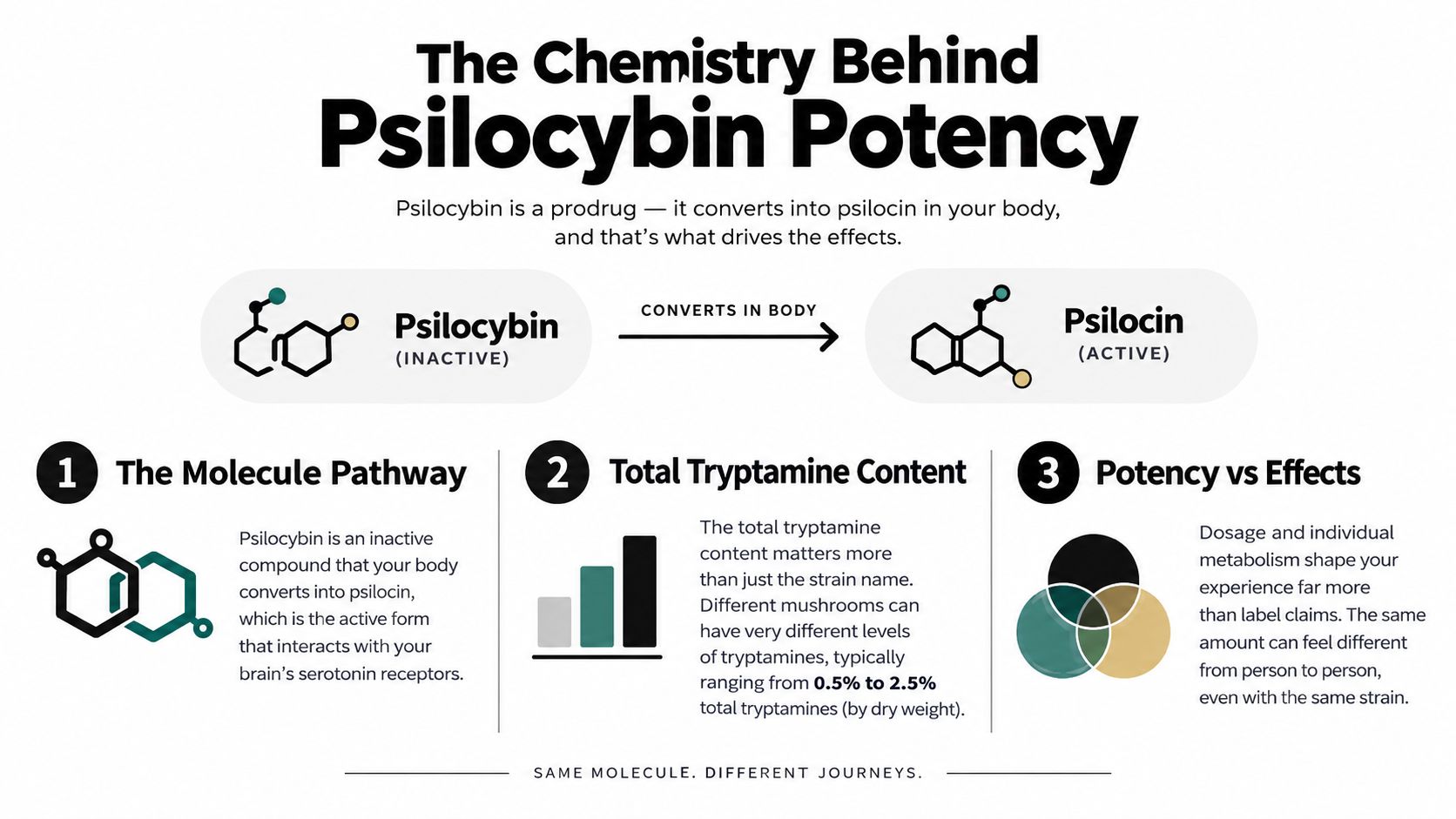
In one analysis of cultivated cubensis mushrooms, measured total tryptamines ranged from 2.62 to 20.65 mg/g. The tested Penis Envy sample contained 17.59 mg/g total tryptamines, including 15.49 ± 1.08 mg/g psilocybin and 1.77 ± 0.14 mg/g psilocin. These are results for particular tested material, not fixed specifications for every mushroom carrying the same cultivar name. (Analytical study of cultivated cubensis strains)
Why the numbers need context
Reported concentrations vary across samples and testing methods. Differences in genetics, cultivation, harvest, storage, and analysis can all affect the result. That variability makes a single sample a weak basis for predicting another batch.
The history of research also illustrates why chemical identity matters. Swiss chemist Albert Hofmann isolated psilocybin and psilocin from Psilocybe mexicana in 1958. (Clinical research and the history of psilocybin)
A later phase II trial involving 233 adults with treatment-resistant depression compared single doses of 25 mg, 10 mg, and 1 mg. At three weeks, the 25-mg group showed significantly greater improvement than the 1-mg control; the reported comparison did not find the same significant advantage for 10 mg over 1 mg. This was a clinical trial, not a test of retail mushrooms or edible products.
The practical distinction is between a compound's measured amount and a product's stated format. A mushroom assay does not establish the active content of a chocolate or drink, where formulation and serving information also matter. Readers exploring information about blue psilocybe mushrooms should apply the same caution: appearance and strain labels cannot verify chemical content.
Comparing Common Cubensis Strains by the Numbers
A single cultivated-mushroom dataset reported total tryptamines from 2.62 to 20.65 mg/g across 14 strains, with a specific result for Penis Envy. That spread is useful for understanding uncertainty, not for ranking every strain or product. The dataset did not provide comparable measurements for Enigma or Golden Teacher, so precise cultivar ranges for those strains would imply evidence that is not available.
| Strain | Psilocybin (mg/g) | Psilocin (mg/g) | Reported effect profile | Predictability caveat |
|---|---|---|---|---|
| Penis Envy | 15.49 ± 1.08 in the tested dataset | 1.77 ± 0.14 in the tested dataset | These chemistry results do not establish a distinct subjective profile | The measured total of 17.59 mg/g applies to the tested batch, not every product bearing the name. |
| Enigma | No published assay in this dataset | No comparable psilocin result reported | No verified profile established by these measurements | The strain name does not provide a batch result. |
| Golden Teacher | Not measured in the cited dataset | No measurement reported | No verified profile established by these measurements | Popularity cannot establish concentration. |
| Other cultivated cubensis strains | Reported values vary across the dataset | Reported values vary across the dataset | Individual reports are not a controlled comparison of strain effects | The dataset gives a range across strains, not separate values for every cultivar; results also depend on sample and method. |
The Penis Envy figures are measurements from cultivated cubensis material, not typical specifications for retail batches. (Analytical study of cultivated cubensis strains) Even within one dataset, a result describes the tested material. It cannot establish the concentration of another harvest carrying the same label.
Why a leaderboard overpromises
Cultivar descriptions often attach a particular intensity or mood to a name. The available analytical measurements do not establish reliable, distinct subjective profiles for Penis Envy, Enigma, and Golden Teacher. Chemistry can quantify compounds in the tested sample; it cannot validate informal experience reports as predictable effects.
Comparisons are most useful when the entries rest on comparable evidence. A batch-specific result beside a strain with no measured value does not create a fair potency ranking. It creates an uneven comparison, where reputation may be mistaken for measurement.
Published concentration ranges also overlap across samples. A strain described as premium therefore cannot be assumed to exceed every batch of another strain. For consumers, the practical question is how much uncertainty remains between a cultivar name and the material being sold.
If a seller provides a recent certificate of analysis, check whether it identifies the batch, lists psilocybin and psilocin separately, and states the units clearly. Sample preparation matters too: a result from several fruits or homogenized material may not describe an individual mushroom. The strongest comparison is a like-for-like comparison of batch measurements, not a confident-sounding strain list.
Dried Mushrooms vs Chocolates vs Drinks
A potency figure answers different questions depending on the product. For dried mushrooms, it describes the tested material; for chocolates and drinks, consumers also need to know how much active content is in a serving and whether it is evenly distributed. A shared strain name does not make these measurements interchangeable.
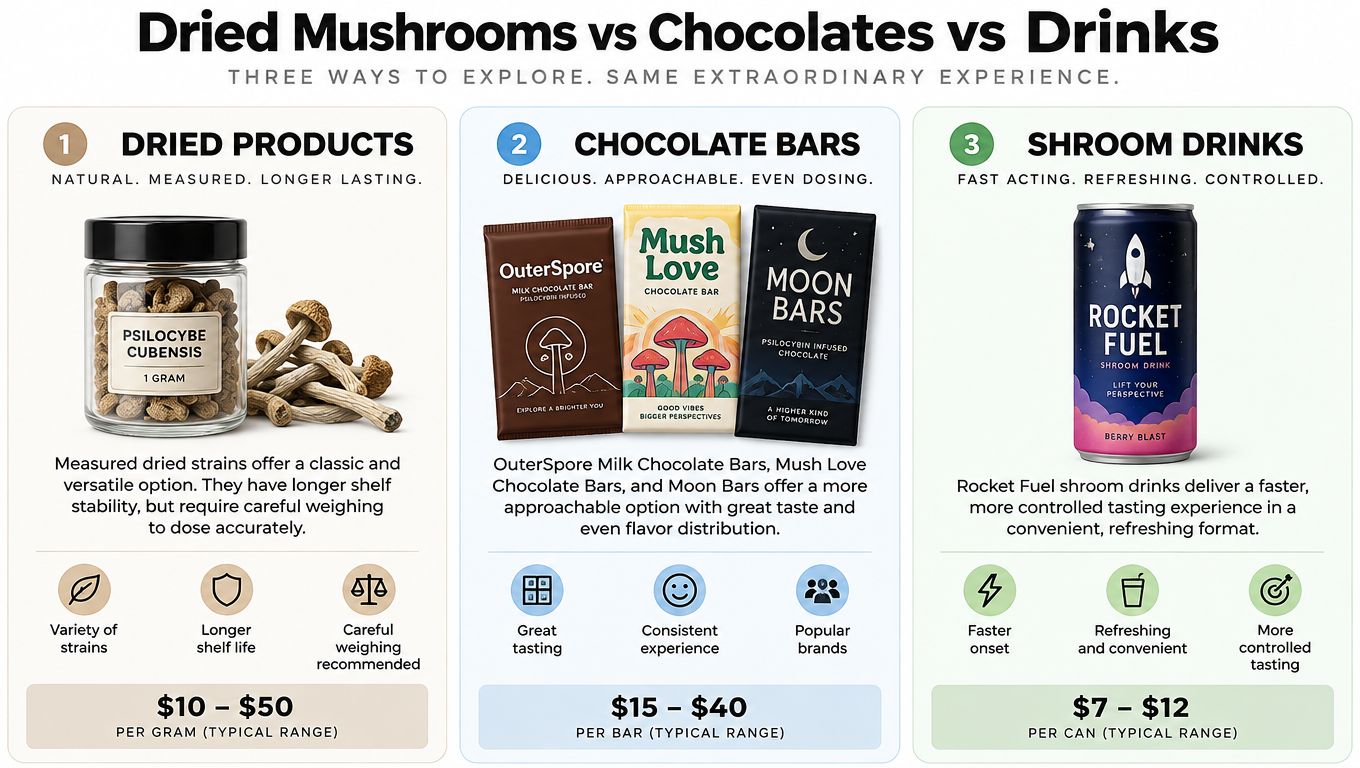
Three formats, different measurement questions
- Dried mushrooms: Interpret concentration alongside the weight of the tested material and portion. Individual mushrooms can vary, so a strain label alone does not establish consistency.
- Chocolate bars: Look for stated content per serving and a clear serving definition. Whether active content is evenly distributed depends on manufacturing, not on the format alone.
- Drinks: Check whether the stated amount applies to the container or a defined serving. Extraction and mixing can affect how well the figure represents each pour.
Metro Mush lists dried strains alongside OuterSpore Milk Chocolate Bars, Mush Love Chocolate Bars, Moon Bars, and Rocket Fuel drinks. These names identify product categories, not laboratory results or serving-level potency. Information about mushroom chocolate bar formats can help explain the product type, but it cannot replace batch-specific testing.
Published mushroom measurements vary widely. That variability means dried-mushroom results should not be transferred directly to finished chocolates or drinks, where extraction and serving size introduce additional variables. The review of 74 publications discussed earlier illustrates why a concentration measured in mushroom material cannot, on its own, establish the content of an edible serving.
Ease of portioning and potency are separate questions. A clearly defined serving may be easier to assess than a concentration claim that omits batch or portion details. Compare what the maker documents for the actual product, including the serving basis and any batch-specific results, rather than relying on format or a headline claim.
Matching Strain and Format to Your Goal
Start with the information you can verify, then decide whether the format offers enough clarity for your purpose. Don't begin with the assumption that the most famous or strongest-sounding cultivar is the right choice. A product with unknown serving content can be harder to assess than one with transparent, batch-specific information, even if the latter isn't marketed as exceptional.
For someone prioritizing consistency
Choose a format only if the seller can explain what a serving means and support its stated content. With dried mushrooms, that may mean asking about batch testing and how material was sampled. With a chocolate or drink, ask for the amount per defined serving, not only a total for the package or a broad claim about the ingredient.
A kitchen scale can help measure dried material by weight, but it can't identify its chemical concentration. Weighing therefore improves one part of the information, not the whole calculation.
For someone unfamiliar with a product
Avoid treating a cultivar's reputation as a reason to select it. Prioritize clear labeling, a small and identifiable serving unit, and a setting where you can remain safe and supported. If the product's content is unclear, the uncertainty itself is important information.
For experienced consumers
Experience with one batch doesn't establish what another batch contains. Check whether the assay is recent and batch-specific, whether the reported numbers use a clear unit basis, and whether the tested material matches what's being sold. Also consider your mental state and surroundings, rather than assuming that prior familiarity makes a new product predictable.
A format's practical value comes from how clearly it tells you what you're taking, not from whether it sounds more concentrated.
No format guarantees a particular experience. The more decision-relevant question is whether the maker provides enough information to compare servings and whether the choice fits your circumstances without relying on a strain's reputation.
Risks, Interactions, and Harm Reduction
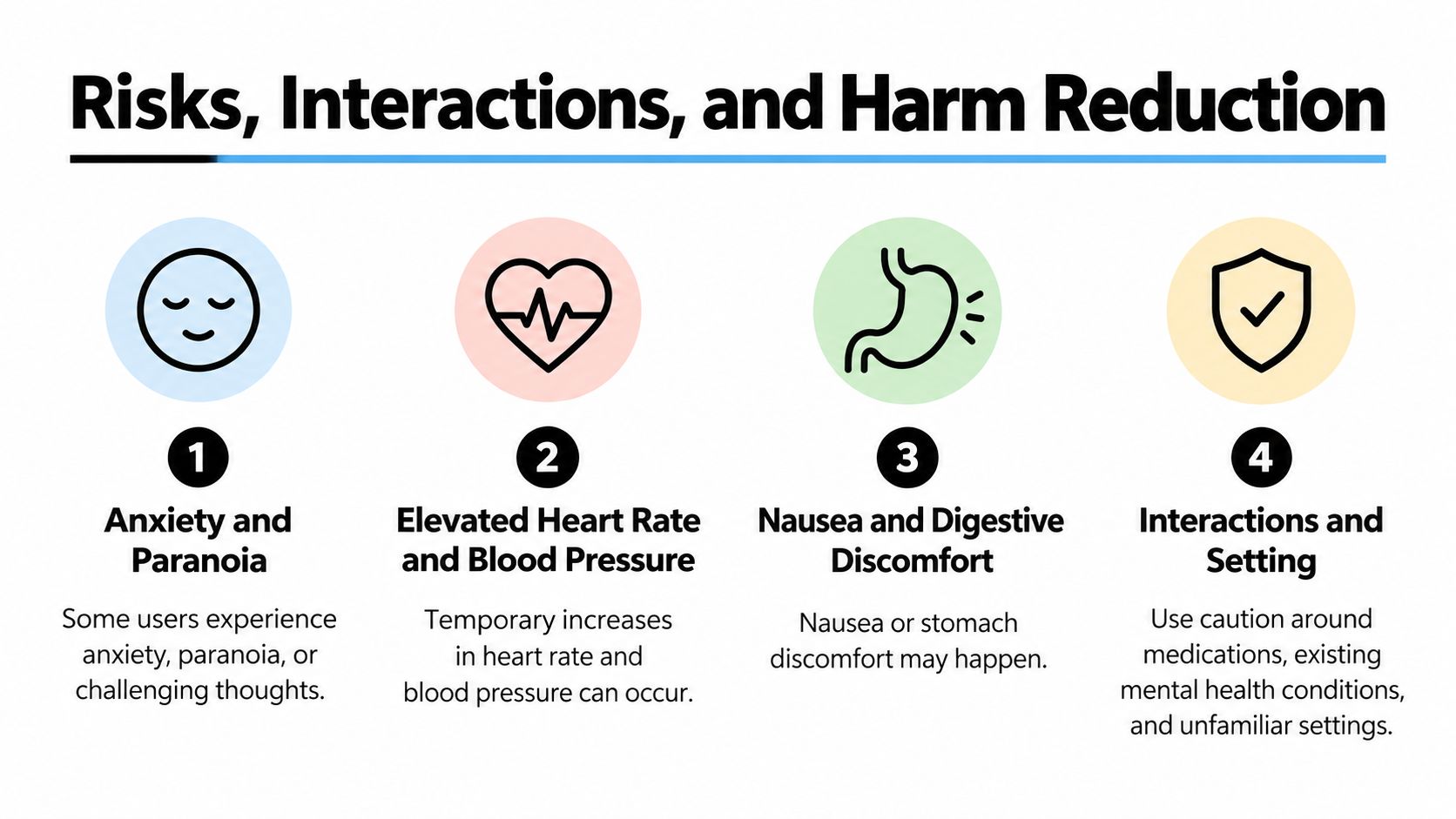
Psilocybin can cause anxiety, paranoia, increased heart rate and blood pressure, nausea, and dizziness. Health guidance also warns that it may be unsafe for people with psychotic disorders or severe bipolar illness. (Health guidance on psilocybin)
Don't use body size as a dosing rule
The linked NCCIH guidance reports that therapeutic studies often use 20–30 mg of psilocybin regardless of body weight. These research amounts are not retail dosing instructions, but they challenge the assumption that a heavier person automatically needs more. The finding also offers no basis for predicting how a particular mushroom, chocolate, or drink will affect an individual.
Medication decisions require individualized medical advice. A strain name or serving label cannot establish that a combination is safe, and prescribed medication should not be stopped to take psilocybin. Anyone taking medication or with a mental-health history should consult a qualified clinician before considering use. For information about psilocybin drug interactions, consult a clinician about the medicines they personally take.
Prepare for uncertainty
Avoid combining psilocybin with alcohol, stimulants, or other substances. Cultivar names cannot guarantee a particular mood, visual effect, or intensity, and product content may be uncertain. If use occurs, choose a calm, familiar setting, avoid using while distressed, and arrange for a trusted sober person to be present.
If effects become unexpectedly strong, do not take more or add other substances. Move to a quieter, safer place and stay with someone trusted. Seek urgent medical help if there is immediate danger, a serious physical reaction, or concern that someone may harm themselves or others.
Making a Smart Choice With Metro Mush
A useful product comparison starts with questions, not a strain ranking. Check whether the menu identifies the product format, whether serving content is stated clearly, and whether a batch-specific test is available. If the answer is unclear, treat that uncertainty as part of the decision.
Metro Mush serves adult consumers in the Detroit and Ann Arbor areas, with menu browsing and ordering by text. Its listed promotions include Mix & Match Saturdays, offering three bars or drinks for $100 with savings of up to $40, plus ongoing discounts for fire, police, and veterans and a Discord community discount. The stated minimum order is $75. These are ordering details, not evidence of a product's potency or a guarantee of a particular experience.
For local ordering questions, the listed text numbers are Detroit Metro at 734-691-6122 and Ann Arbor Metro at 734-280-2868. Verify current menu information and availability directly before ordering.
The most defensible “strongest” choice is the product whose serving information you can understand, whose batch evidence you can review, and whose use you can approach with care. Verified content per serving beats a confident strain name.
Frequently Asked Questions About Psilocybin Potency
How can I check a product's strength without a lab?
Ask the seller for a recent certificate of analysis tied to the specific batch. Check whether it reports psilocybin and psilocin, states the unit basis, and matches the product you're considering. If no batch-specific results are available, a strain name or informal description can't verify concentration.
Why might two chocolates from the same brand feel different?
The brand name doesn't establish that every batch has identical active content or that every portion is evenly mixed. Ask whether the maker tests finished products and states content per serving, rather than relying on a whole-bar figure alone. Don't treat a previous experience with one chocolate as a reliable measure of another.
What should I do if the effects feel unexpectedly strong?
Don't take more or mix in alcohol or other substances. Stay with a trusted sober person in a calm, safe place, and seek emergency assistance if there's immediate danger or a serious physical or psychological reaction.
How do delivery and pickup questions work?
Metro Mush lists ordering by text for Detroit Metro and Ann Arbor Metro, and offers local coverage information through its menu. For nearby Illinois, Ohio, or Indiana communities, confirm current service coverage and applicable rules directly with the business before placing an order.
Before choosing among dried mushrooms, chocolates, or drinks, compare the available batch and serving information rather than relying on a strain's reputation. Visit Metro Mush to review its menu and ask about product details and local ordering options.