
Stop treating blue bruising like a potency scoreboard. A mushroom can bruise deep blue and still be a poor guide for dose, because the color comes from chemistry at the injury site, not from a simple “stronger equals bluer” rule. For anyone looking at blue psilocybe mushrooms in Michigan, that difference matters more than the color itself.
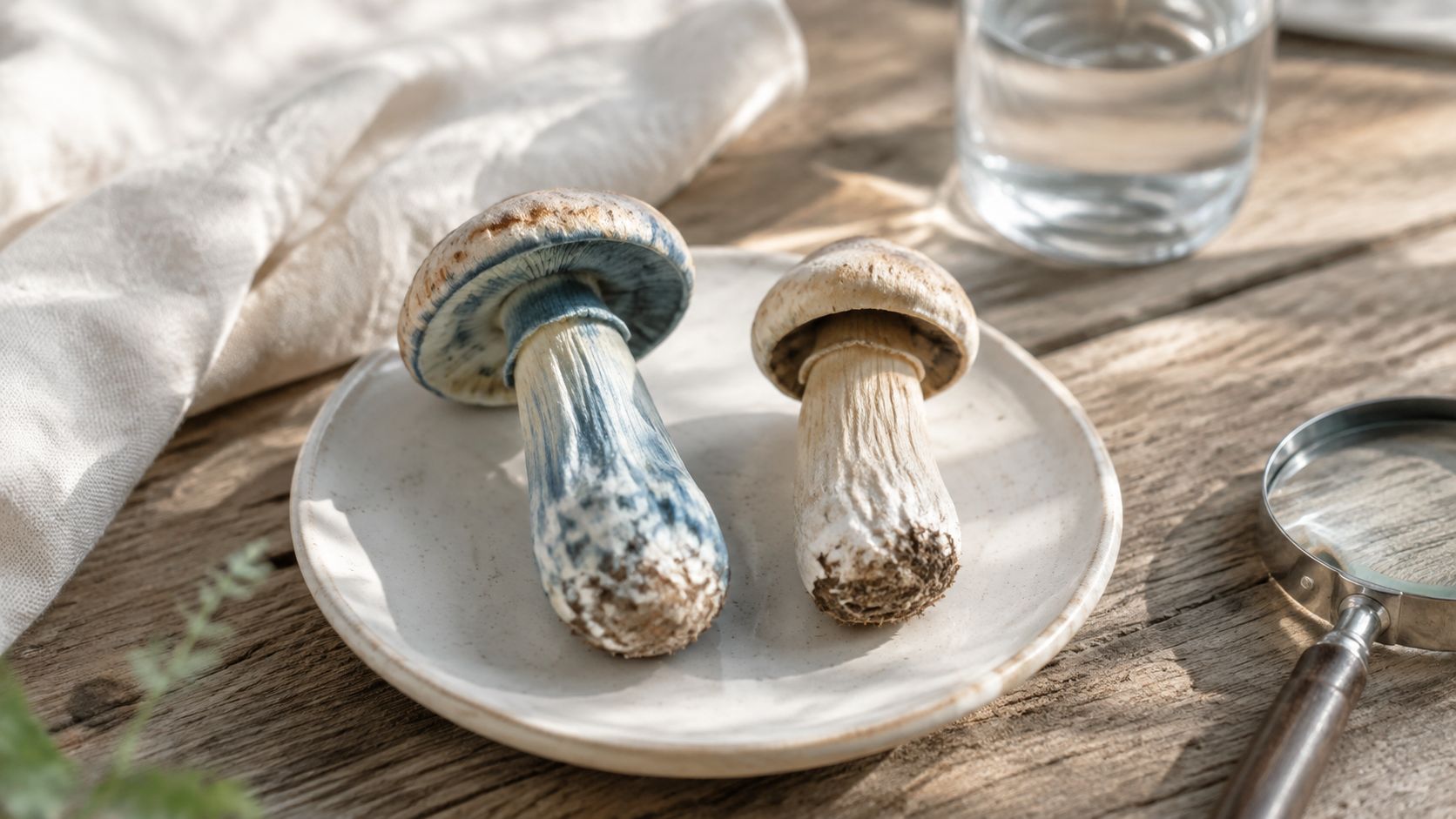
Blueing is real, but it's only one clue in a much bigger identification puzzle. A reader who understands what the bruise is showing will make calmer, safer decisions and avoid the common mistake of judging a mushroom by color alone. If you want a broader look at potency myths, this overview of the strongest magic mushrooms shows why appearance and strength don't line up neatly.
Why Blue Does Not Always Mean More Potent
Blue bruising can make a mushroom look stronger at first glance, but the color alone does not measure potency. Bruising is common across Psilocybe species, and a review found 144 of an estimated 277 to 326 known Psilocybe sensu lato species show this inducible blueing response. That means blueing is widespread chemistry, not a simple strength rating.
The better way to read the color is to treat it as a clue, not a verdict. Psilocybe azurescens, sometimes called the “blue angel,” has been reported as a notably active species, while P. cubensis is also known to bruise blue and can vary a lot from one sample to another. The full alkaloid comparison belongs in the species table in Section 3, where the numbers can be read in context instead of being mistaken for a universal rule.
What the bruise can and can't tell you
Blue color shows that psilocybin-related compounds are reacting after the tissue is damaged. It does not tell you how much active material sits in the whole mushroom, whether that material is spread evenly through the cap and stem, or how harvest and storage changed the sample before it reached a shelf.
Practical rule: treat blue bruising like a smoke alarm, not a measuring cup.
That distinction matters because shoppers often judge with their eyes. A darker blue patch can make a product seem more impressive, yet the safer choice is to look at the species, the product format, and the source, then use color as only one piece of information. For a broader consumer-facing comparison, see this overview of the strongest magic mushrooms.
The Enzymatic Oxidation Cascade Behind Blue Bruising
The blue color isn't a stain in the usual sense. It's the result of an enzymatic oxidation cascade, which is a more technical way of saying the mushroom's own chemistry changes after tissue damage and exposure to air. The best everyday analogy is a sliced apple turning brown, except here the end result is a blue tone instead of a brown one.
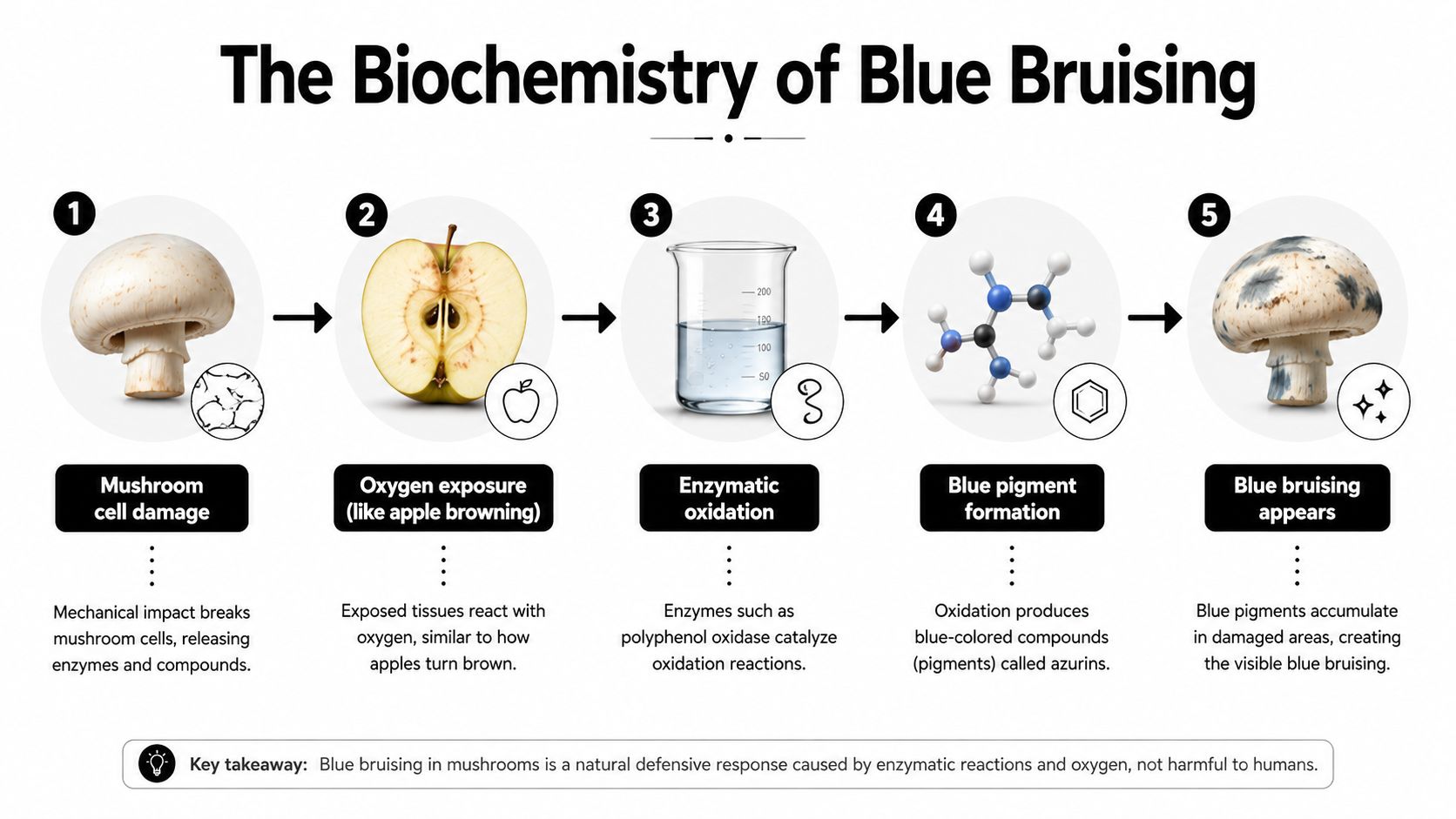
The 2020 mechanistic study mapped the process in two linked enzyme steps. First, PsiP acts as a phosphatase and dephosphorylates psilocybin into psilocin. Then PsiL, a laccase, drives oxidation into a mixture of quinoid psilocyl oligomers that generate the blue color (mechanistic study). That's the core reason bruising appears after handling, cutting, or drying.
The useful takeaway is that blueing reflects psilocin-related chemistry, but it still doesn't work as a precise potency meter. The intensity depends on how much psilocin is available where the tissue was damaged and how quickly the oxidation products form. A mushroom with a faint bruise can still be active, and a heavily bruised one can still vary widely from another sample.
Why this matters in plain language
Think of the mushroom as a chemistry lab that opens when cells are broken. Once the internal structures are disturbed, enzymes and compounds that were separated inside the tissue meet each other, and the visible color change follows.
That's why bruising can happen faster in one sample than another, even within the same species. It's also why a visual check should never replace a real understanding of product identity or preparation.
Common Blue-Associated Psilocybe Species and Their Alkaloid Profiles
A lot of confusion starts because people use “blue mushroom” as if it names a single thing. It doesn't. The genus includes multiple species, different chemotypes, and changing growing conditions, so the alkaloid profile can shift a lot from one sample to the next.
Side-by-side comparison helps more than color alone
| Species | Psilocybin % dry weight | Psilocin % dry weight | Notable Characteristics |
|---|---|---|---|
| Psilocybe azurescens | up to 1.8%, average around 1.1% | up to 0.5%, average around 0.15% | Often called the “blue angel,” historically noted for high potency (PMC review) |
| Psilocybe azurescens fresh alkaloid concentration | 1.33% | 0.2% | Comparative table value from the same source, shown alongside other species |
| Psilocybe cubensis fresh alkaloid concentration | 0.63% | 0.60% | Commonly encountered species, still chemically different from azurescens |
| Psilocybe genus overall | almost nothing up to 2.5% dry weight | not given in the cited summary | Variability depends on species and growing conditions (Wikipedia summary) |
That spread explains why visual shorthand fails. Two mushrooms may both bruise blue, yet one can belong to a species or chemotype with a very different profile. For readers comparing popular market names like Penis Envy or Enigma, species identity matters more than the bruise itself, and strain names often function as labels rather than precise chemical descriptions.
The broader legal and cultural picture matters too. U.S. law-enforcement seizures of psilocybin mushrooms rose from 402 in 2017 to 1,396 in 2022, and seized weight increased from 226 kg to 844 kg over the same period (Wikipedia summary). The same summary says the Midwest accounted for 36.0% of seizures, with the West at 33.5%. For Michigan readers, that helps explain why species literacy has become more relevant, not less.
A label that says “blue” tells you the mushroom bruises. It does not tell you the whole chemistry story.
For a closer look at one widely discussed blue-associated market name, see Blue Meanie Cubensis. Color can be useful, yet species identity and alkaloid variation carry far more weight than a bruise.
Practical Identification and Handling Tips for Consumers
Blue bruising should never be your only identification tool. Visual appearance alone is unreliable, and recent scientific work keeps pointing toward DNA authentication because preserved specimens and blue-staining mushrooms can be misleading when judged only by the eye (NSF review).
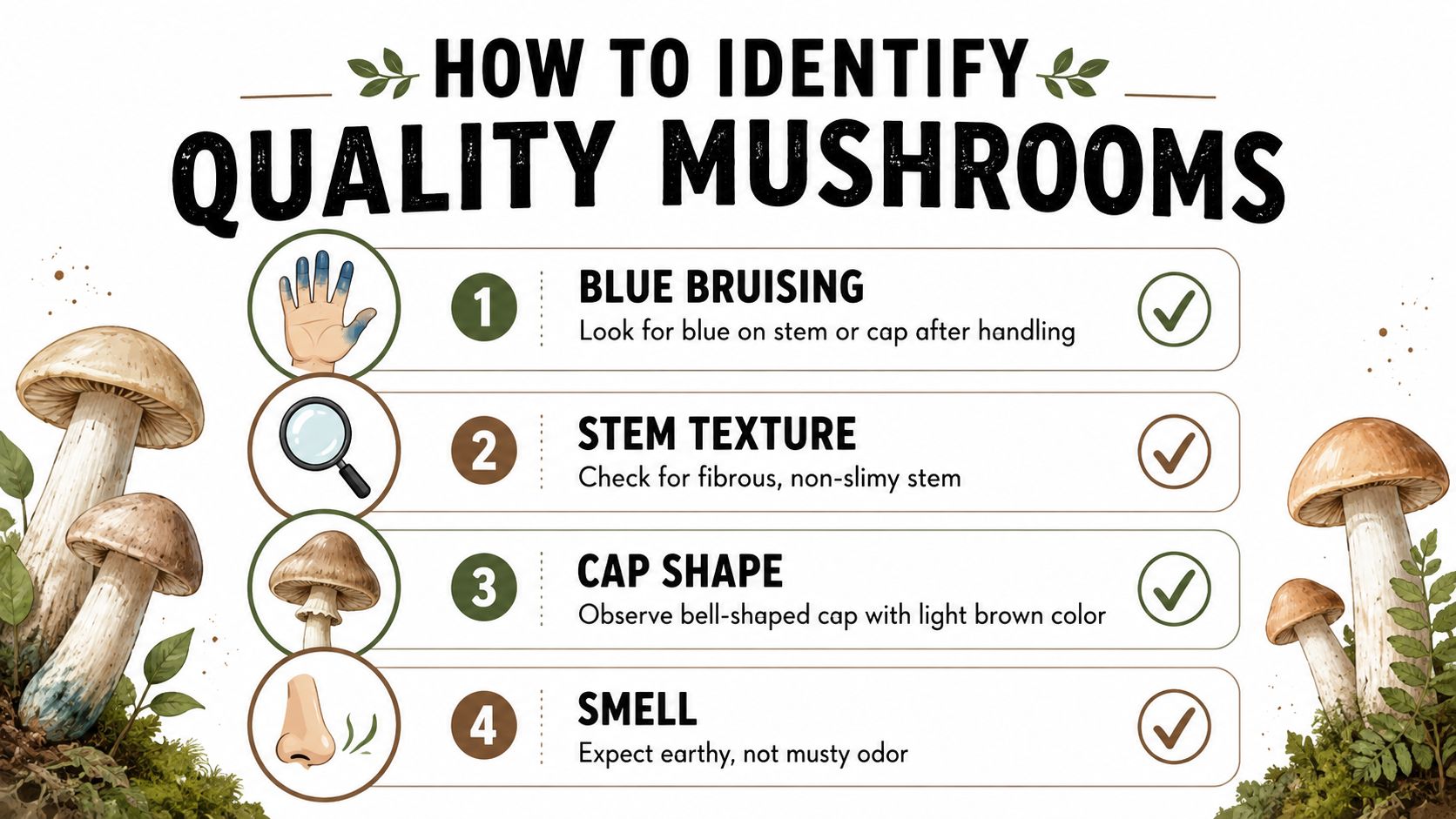
Four checks that matter more than color
- Blue bruising: Look for blue on the stem or cap after handling, but treat it as one clue, not proof of potency.
- Stem texture: A fibrous, non-slimy stem is more consistent with a clean specimen than a wet or sticky one.
- Cap shape: Pay attention to whether the cap matches the expected growth pattern for the species or product label.
- Smell: Earthy is one thing, musty is another, and a sour or off odor deserves caution.
Natural bruising can be confused with contamination. Mold often looks fuzzy, spreads irregularly, or appears in colors and textures that don't behave like a bruise from handling. If the surface looks slimy, powdery in the wrong places, or oddly discolored without an obvious touch point, don't assume it's the same thing as oxidation.
Storage also changes what you can observe. Dry, cool handling helps preserve the sample and makes bruising patterns easier to interpret later. If a product is packed too tightly, exposed to excess moisture, or repeatedly handled, you lose both quality and the ability to read the bruise correctly.
Best practice: if a specimen raises questions, ask for the species name, not just the color description.
That's especially important because the genus is diverse and the same blue tone can show up in very different mushrooms. A careful consumer asks for clarity, then uses bruising as supporting evidence, not a verdict.
Effects and Dosing Guidance Across Product Formats
Dosing is where the blue-bruising myth can cause the most trouble. If you assume every blue mushroom is equally strong, you can overshoot your intended experience, especially when the product is a dried mushroom, a chocolate bar, or a drink with a different absorption pattern.
Start low and let the format do the talking
Dried mushrooms are the least predictable format because size, storage, and species all affect the experience. Edibles and drinks can feel easier to standardize, but they still depend on how the product was made and how evenly the active material is distributed. That's why starting low and going slow is still the cleanest rule for a cautious adult consumer.
For people comparing formats, the goal isn't to chase intensity. It's to choose a product that matches their comfort level and then pay attention to how the body responds over time. A chocolate bar can feel more manageable for some users because it's portioned, while a drink may feel different because liquid formats are often consumed faster and can seem more immediate in practice.
Here's the part many first-time consumers miss. A strong-looking mushroom isn't necessarily the best fit for a first session, and a mild-looking one isn't automatically “safe” to take casually. Species-level variability, as described earlier, is exactly why two visually similar products can lead to different outcomes.
A cautious consumer approach
- First-time users: choose the most conservative amount that still lets you assess sensitivity.
- Experienced users: don't let familiarity override product differences between species, batches, or formats.
- Edible formats: read the package carefully, because the form is part of the experience, not just the flavor.
- Dried products: inspect for texture, odor, and any sign that handling has changed the product's condition.
If a product claims premium status, that should prompt more questions, not fewer. Ask what species it is, how it was processed, and whether the form you're buying is meant for a measured, repeatable experience or a more variable one.
Safety Practices and Legal Awareness in Southeast Michigan
Harm reduction is the baseline for psychedelic product use. Blue bruising can point to psilocybin-related chemistry, but it does not tell you whether a product is suitable, how your body will respond, or whether the setting around you is ready for that experience. A sober sitter, a calm room, and clear expectations do more work than a flashy label ever will.
Legal rules matter just as much as chemistry. Some local policies have shifted, but those changes do not cancel state or federal law, and one city's approach should never be treated as a blanket rule for the whole region. For Michigan readers, the Michigan psilocybin legal overview is a useful place to check local guidance before making any purchase or possession decision.
Safety habits that help
- Set and setting: choose a calm place and a time when you will not be rushed.
- Trusted sitter: keep a sober person nearby if you are trying a new product or a new amount.
- Substance testing: do not rely on unlabeled products just because the packaging looks polished.
- Avoid risky mixes: be careful with other substances that can complicate the experience.
- Know when to seek help: persistent distress, severe confusion, or physical symptoms that feel out of range deserve medical attention.
Unregulated products can be mislabeled, and consumer-facing claims are not a substitute for verification. That warning is practical, not abstract. If you cannot confidently identify what is in a product, you cannot responsibly predict how it will affect you.
Safety comes first, because a good experience starts before consumption, not after things feel intense.
For Detroit and Ann Arbor adults, that means treating blue bruising as a clue about chemistry, not a cue to improvise. Legal awareness and harm reduction belong in the same conversation, because both protect the person making the choice.
Making Informed Purchases at Metro Mush
The smartest purchase starts with the science you now know. If a product is labeled with a strain name like Penis Envy or Enigma, ask whether the seller can explain the species, the format, and why the product is being recommended for your experience level. Blue bruising may help confirm that a sample has psilocybin-related chemistry, but it still doesn't replace clear labeling or careful selection.
That same standard applies across dried mushrooms, chocolate bars, and drinks. A person who wants a more controlled experience should favor products that make portioning easier, while someone comparing dried options should ask more questions about variability and handling. The point is to buy with your head, not with the bruise color.
If you're in Southeast Michigan and want a local place to apply that mindset, Metro Mush offers a curated menu, local delivery, and a straightforward way to compare formats before you order. Explore the selection at Metro Mush, then match the product to your comfort level, your setting, and the chemistry you now know how to read.
Metro Mush carries dried strains, chocolate bars, and drinks for adult consumers across Detroit and Ann Arbor, and that mix makes it easier to choose a format that fits your experience level. If you want to shop with better context behind blue bruising, potency, and safe use, visit Metro Mush and review the menu before you decide.