


What are you buying when you see Pearly Gates mushrooms on a menu or in a strain guide, a distinct cubensis hybrid, or a label that makes an ordinary product feel premium? That question matters because this strain sits at the intersection of genetics, appearance, potency, and marketing, and those are not always the same thing.
Pearly Gates has earned attention because it is repeatedly described as a hybrid of True Albino Teacher and Melmac, part of the modern PE-lineage breeding wave rather than an old wild-collected variety, and because it carries a reputation for high potency and unusual albino traits (Mushlove Genetics). It also shows up in retail-style menus and genetics catalogs, which tells you the name has moved beyond niche breeder circles into broader consumer use (Thick Cultures).
What Makes Pearly Gates Mushrooms Stand Out
What makes Pearly Gates mushrooms stand out, the mushroom itself, or the label wrapped around it? That question matters because this name is used in a market where visual traits, vendor descriptions, and breeding claims can blur together. For a buyer, the safest starting point is to separate what can be seen from what can only be claimed.
The clearest thing you can verify is the appearance. A batch may be presented as albino-looking, unusual, or premium, but those words do not prove lineage on their own. They describe how a product is being framed, while the mushroom's actual look is what your eyes can check in front of you.
That is why Pearly Gates gets so much attention. It is often sold as a high-potency cubensis with a modern breeding pedigree, which gives it a stronger reputation than an ordinary store label might suggest. For curious buyers, that combination of visual novelty and potency talk makes it feel different from the standard cubensis offer.
What the premium label usually implies
A premium label usually points to one of three things. The seller expects the strain to be stronger than average, the appearance is meant to stand out, or the line is presented as the result of more selective breeding than a generic catalog item.
Pearly Gates is described in that way across breeder and vendor pages, including as part of the PE-lineage family and as a strain that attracts buyers looking for something beyond a basic cubensis (Mushlove Genetics). That is the marketing layer. The practical layer is slower and less glamorous. A strain described as very slow-growing may be treated as more specialized by cultivators and sellers, which can shape how it is priced, stocked, and discussed (Thick Cultures).
A useful way to read the label is to ask what part is visible and what part is asserted. Color, shape, and general growth pattern can be observed. Claims about exact lineage, exceptional strength, or rare status need more caution, because those are not things you can verify just by looking at a listing.
For broader context on the species level, see this Psilocybe cubensis strain overview.
Practical rule: if a strain is sold as both visually unusual and unusually potent, treat the label as a sales claim first. Verify the traits you can actually see, then treat the rest as unconfirmed until you have better evidence.
The Genetics and Lineage Behind the Strain
Pearly Gates is usually described as a bred cubensis line rather than a field-collected one, and the name is most often tied to a cross involving True Albino Teacher and Melmac. That kind of origin story places it in the same selective-breeding family as other Psilocybe cubensis strain names, where growers keep choosing for traits they want and then pass those traits forward in later generations (General cubensis background). The broad idea is clear even if every vendor phrase is not.
That distinction matters for interpretation. A naturally collected mushroom line usually comes with a geographic or ecological origin story, while Pearly Gates is presented as a managed breeding result. In plain language, the label points to human selection, not a stable wild population. That also means the name can describe a marketing decision as much as a biological one.
The harder question is verification. Community discussion shows that people do not always agree on whether a batch matches the Pearly Gates name, and there are repeated reports of phenotype variation across vendors (Shroomery forum discussion). That does not make the strain meaningless. It means the label can be easier to print than to prove.
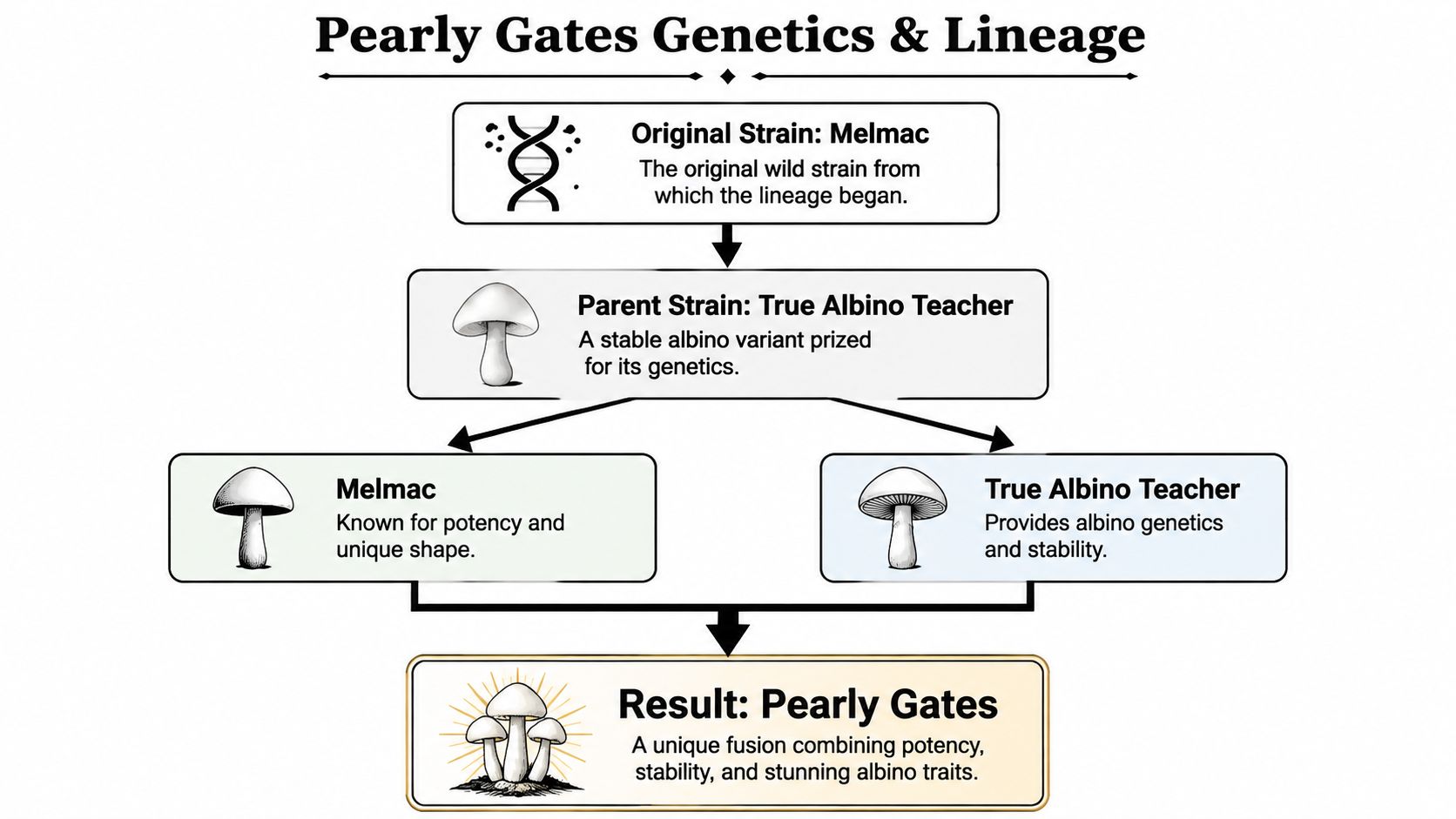
A careful way to read the lineage is this. Pearly Gates is a strain name attached to a breeding story, and that story may be accurate in a broad sense without being fully confirmable for every batch on the market. So the name is useful, but only up to a point. The safer approach is to treat it as a claim about origin and selection, then compare that claim with visible traits and seller documentation instead of assuming the label settles the issue on its own.
How to Identify Pearly Gates by Sight
What can you verify with your eyes, and what is just a seller's label? That question matters with Pearly Gates mushrooms, because visual identification can support a claim, but it cannot prove the full story on its own.
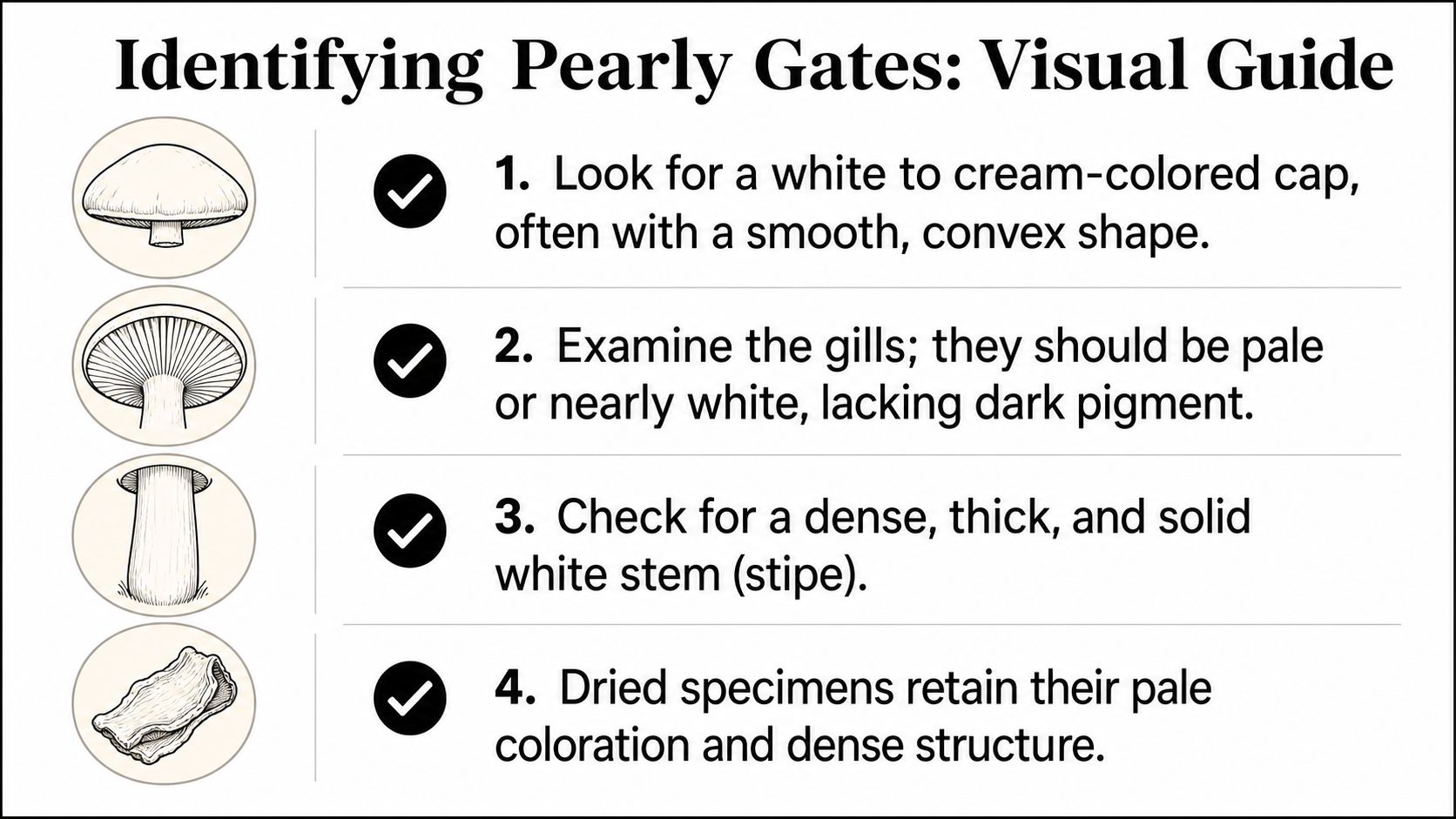
Start with color. Pearly Gates is commonly described as having white to cream caps, white or nearly white gills, and a generally light, albino-leaning look. If a sample shows strong dark pigmentation in the cap or gills, that is a reason to stop and question the label.
Structure gives you another clue. Vendors and strain guides often describe dense, thick stipes, which means the stem should look solid rather than thin or fragile. Dry material often keeps that stem character better than it keeps cap shape, so the stipe can be the most useful feature when a buyer is comparing similar-looking products.
What the pigment tells you
Albino or leucistic genetics usually show up as limited pigment, especially in the cap and gills. That is why Pearly Gates is often described as having transparent or lightly pigmented spores and a pale overall presentation. In practical terms, you are looking for a mushroom that reads as washed in light color, not one that carries the usual tan or brown spore darkness.
Bruising is the fourth cue, but it needs careful reading. Pearly Gates is often noted for blue or blue-grey bruising when handled, and that color shift is usually linked to oxidation in psilocybin-rich tissue, not to a direct measure of potency. Bruising can support an identification, yet it cannot confirm strength, and it cannot prove that a vendor's label is accurate.
If you want a quick visual checklist, use all four features together: pale caps, pale gills, dense stems, and blue bruising. One trait by itself is weak evidence. A full match makes the label more believable, but it still does not settle the question of provenance or chemical profile.
Potency Profile and What the Numbers Mean
How strong is Pearly Gates really, and how much of that answer comes from the label instead of the mushroom itself? The honest starting point is that vendor names can blur together, while chemistry is what can be checked. A visible trait may help you judge whether a product matches the label, but potency needs measured data, not marketing language.
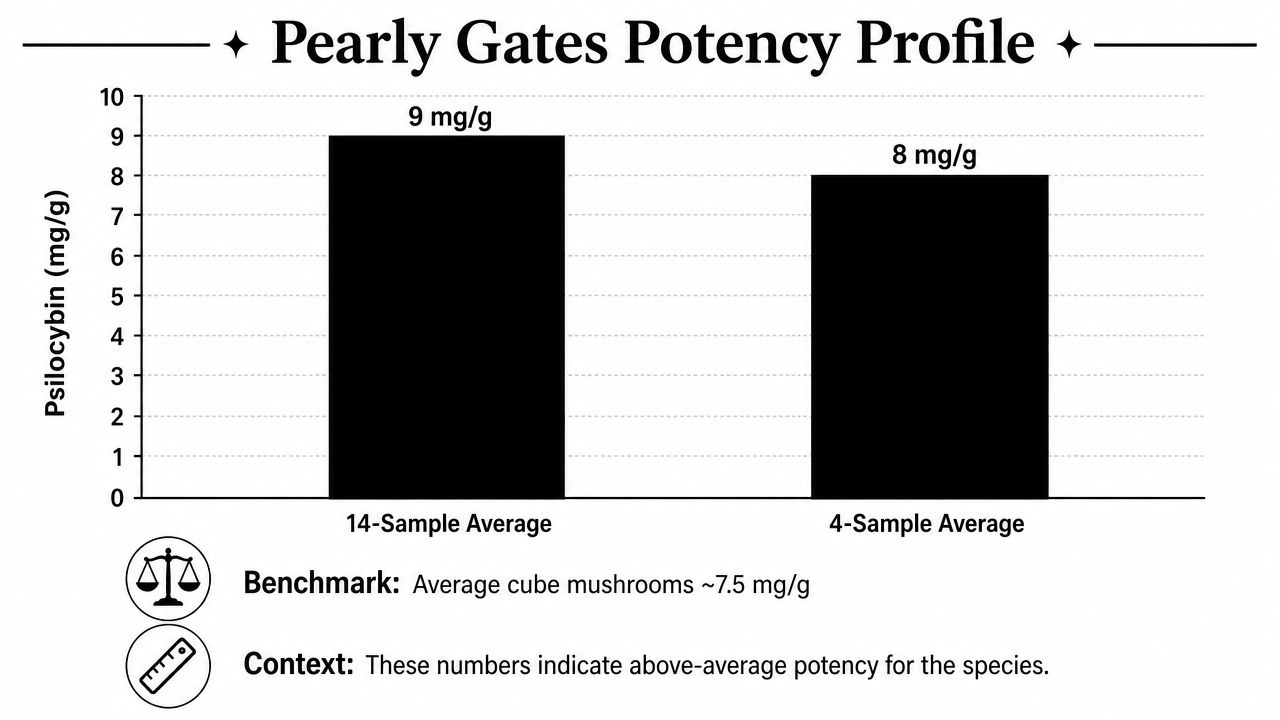
One public potency profile reports 9 mg/g psilocybin across a 14-sample average, with results ranging from 3 to 24 mg/g for “True Albino Melmak Pearly Gates” (A bar chart showing the psilocybin potency of Pearly Gates mushrooms compared to average cube mushrooms.). A separate set in the same profile averages 8 mg/g across 4 samples, with a range of 4 to 12 mg/g (Mushlove Genetics).
Those numbers matter because they sit above the commonly cited cultivated cubensis average of 8 mg/g psilocybin and 1 mg/g psilocin. That does not make Pearly Gates a different species, and it does not mean every batch will land at the top end. It does mean the strain is often treated as one of the stronger cultivated cubensis examples, so the label should be read with more caution than a casual “standard cube” listing.
The practical lesson is straightforward. If a seller presents Pearly Gates as ordinary cubensis, that deserves a second look. Reported descriptions of fast onset, roughly 30 minutes, and strong euphoric effects fit the higher-potency profile, though personal response still depends on body size, sensitivity, and what else is in the system. For readers who want a more careful framework before using any product label as a dosing guide, this microdosing primer is a useful reference point.
| Sample set | Measured result | What it suggests |
|---|---|---|
| 14-sample set | 9 mg/g psilocybin | Above many average cultivated examples |
| 4-sample set | 8 mg/g psilocybin | Still in the stronger end of common cubensis results |
Dosing Guidelines and Microdosing Notes
With Pearly Gates, the safest first move is to treat the label as a warning, not a guarantee. Vendor descriptions often point to higher potency, but visual identification alone cannot confirm how strong a specific batch will feel. A dosing resource for this strain recommends using 30 to 50% less than standard cubensis amounts because it is treated as very high potency (Healing Mushrooms).
Another guide places an experienced-user range at 1.5 to 2.5 g and microdose protocols at 50 to 75 mg (Microdosing guide). Those figures work best as a cautious reference, especially because the same name can cover different grows, different drying levels, and different realities from one seller to another. A smaller body, a lower tolerance, recent cannabis use, or a history of strong psychedelic reactions all argue for starting lower than a casual label might suggest.
A cautious starting framework
| Experience level | Standard Cubensis Starting Dose | Pearly Gates Starting Dose | Microdose Range |
|---|---|---|---|
| First-time or very cautious adult | Lower than a typical full-dose benchmark | Start well below a standard cubensis amount | 50 to 75 mg |
| Experienced user | Usual cubensis experience-based range | 1.5 to 2.5 g as a cautious reference point | 50 to 75 mg |
| Sensitive to psychedelics or combining substances | Reduce further | Reduce further | Consider a smaller-than-usual microdose |
Dry mushrooms and edibles do not behave the same way. Chocolate bars and drinks can delay noticeable onset, which makes premature redosing more likely if someone expects the timing of dried fruiting bodies. If Pearly Gates is sold inside an edible, patience matters more than the label on the package, because the delay can make a normal dose feel like nothing before it suddenly does.
The microdose side also deserves restraint. A microdose is meant to sit below the threshold where ordinary activities become difficult, so the point is not to chase a noticeable trip. For a careful overview of spacing, tracking, and common microdosing habits, this microdosing primer is a useful place to start.
| Sample set | Measured result | What it suggests |
|---|---|---|
| 14-sample set | 9 mg/g psilocybin | Above many average cultivated examples |
| 4-sample set | 8 mg/g psilocybin | Still in the stronger end of common cubensis results |
Comparing Pearly Gates to Similar Strains
How do you tell Pearly Gates apart from the other pale, high-profile cubensis strains if the label may be doing some of the work for you? The safest answer is to separate what can be checked with your eyes from what only the vendor claims.
Pearly Gates makes the most sense next to Penis Envy, True Albino Teacher, and Melmac. They all belong to the same broader cubensis family, yet each one leans toward a different mix of appearance, growth behavior, and reputation. Pearly Gates is usually presented as an albino hybrid with a paler, cleaner look and a more curated market image.
That visual distinction matters, but only up to a point. A mushroom can look pale, dense, or unusual and still be mislabeled, so appearance helps with sorting, not with proving identity. Pearly Gates is also commonly described as very slow-growing, with slow pinset and only moderate sporation, which makes it feel more specialized than a straightforward production cubensis. Cultivation notes from Thick Cultures describe the strain in that direction, and that slow pace is part of why it is often treated as a niche option rather than a casual bulk strain.
Where it fits visually and practically
- Pearly Gates: pale cap, pale gills, dense structure, albino-leaning appearance.
- Penis Envy: distinct shape, iconic look, strong PE-lineage reputation.
- True Albino Teacher: lighter pigment and classic albino association.
- Melmac: wavier, more irregular morphology, often treated as the more unusual-looking parent side.
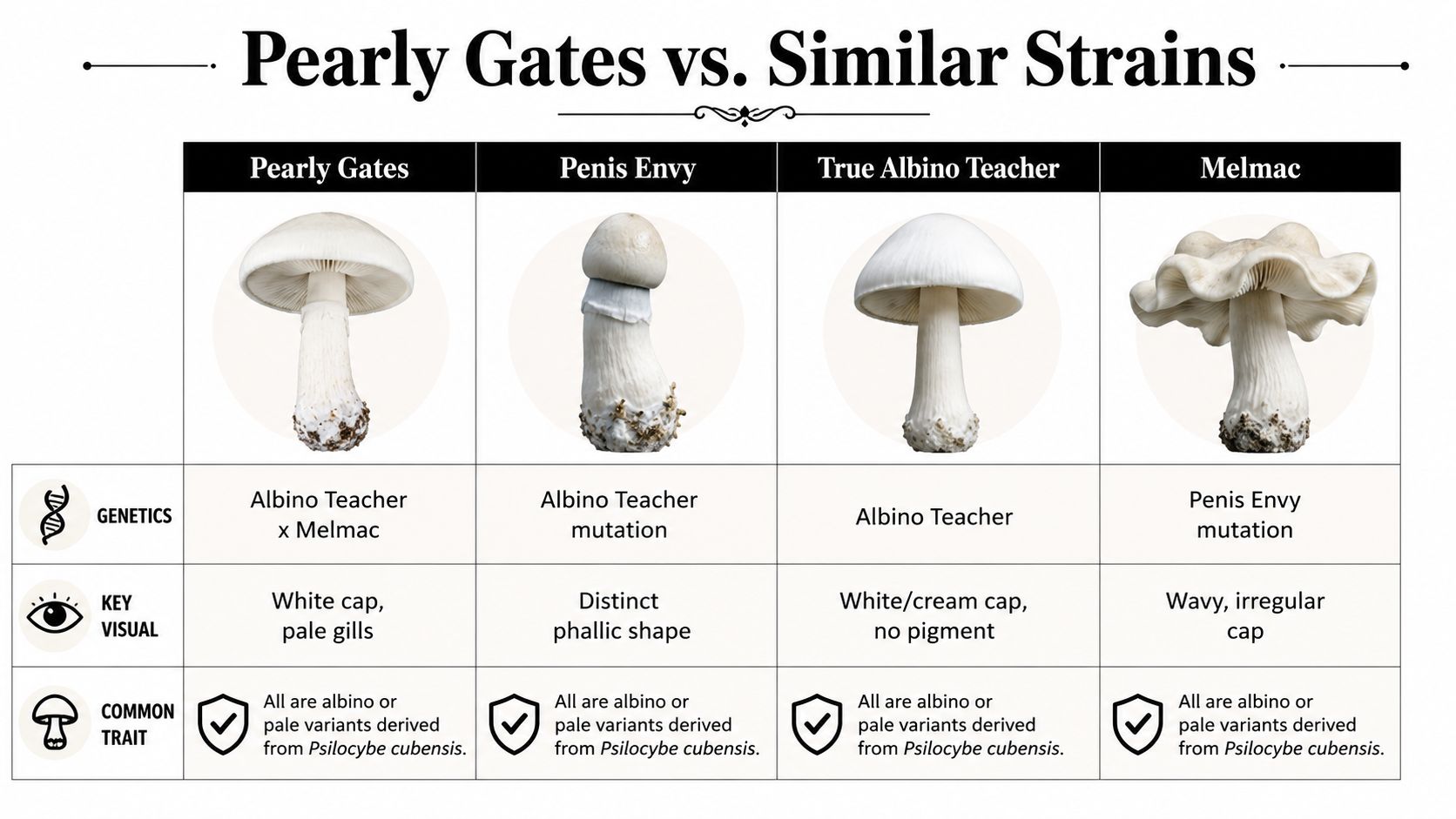
For a buyer, the question is what can be verified before use. If you are looking for a striking pale hybrid with strong potency and a more niche pedigree, Pearly Gates fits that request on paper and often in appearance. If you want a more familiar cubensis experience, a common strain may be easier to evaluate and less dependent on vendor branding.
Harm Reduction and Safety Considerations
Pearly Gates deserves more caution than a gentler cubensis because its reputation and measured potency both point in the same direction: don't improvise your dose. Set and setting still matter most. A calm location, a clear schedule, and no urgent obligations reduce the chance that a strong onset turns into a stressful one.
A sober sitter becomes more useful as dose increases or as the person using mushrooms becomes less experienced. That's especially true if someone is already anxious, sleep-deprived, or under pressure. Red flags for waiting rather than proceeding include emotional volatility, confusion about the product, and uncertainty about whether the batch is what the label says it is.
Practical rule: blue bruising can help support identification, but it doesn't tell you how strong a batch is. Treat bruising as a visual clue, not a dosage calculator.
Cannabis is the most common interaction people underestimate. Many users combine it with psilocybin, but the combination can push intensity higher in ways that are hard to predict, especially with a potent strain. If you're using both, reduce the mushroom dose rather than assuming you can “balance” the experience later.
Medication questions belong in the pre-session checklist, not in the middle of the experience. If you're unsure about interactions, wait. A conservative delay is safer than trying to rescue an overly intense session after it starts.
Responsible Sourcing and What to Ask Before Buying
How do you tell a Pearly Gates product from a label that just sounds convincing? Start with the limits of what you can verify. Strain names in this market are not formally standardized, so a careful buyer has to ask better questions than “Is this real?” Pearly Gates appears in retail-style menus and pickup listings in at least one Michigan market, including Ann Arbor, which shows how far the name has traveled in adult-use conversation. That still leaves the labeling problem unresolved, because the name alone does not confirm what is in the package.
A better source gives you consistent appearance from batch to batch, clear labeling, and straightforward answers about product form. If you are shopping for a dried product, you should be able to ask whether it looks pale by design, how it was stored, and whether the batch matches the stated strain profile. General guidance on evaluating mushroom product quality applies here too, especially when labels can outpace verification, as covered in the high-quality mushroom products guide.
Ask three things before you buy. What visual traits match the label? Is the product dry mushroom, edible, or a mixed-format item? What should I expect for potency relative to a standard cubensis? If the answers stay vague, the label is doing more work than the product.
One more practical check helps. Ask what the seller can verify visually, and what they are repeating from vendor marketing. Pale coloring, cap shape, and general consistency can support a claim, but they do not prove lineage or strength on their own. That is the same reason a careful buyer treats strain names as a starting point, not a guarantee.
If you want a calmer way to compare products and read quality signals before choosing, Metro Mush offers guidance on high-quality mushroom products for adult consumers who want more clarity around format, appearance, and potency-minded buying.