
If you've ever wondered how mushroom cultivators get such consistent and fast results, the answer often comes down to one powerful tool: mushroom liquid culture. Think of it as a secret weapon for growing mushrooms, a supercharged starter that gives the mycelium a massive head start.
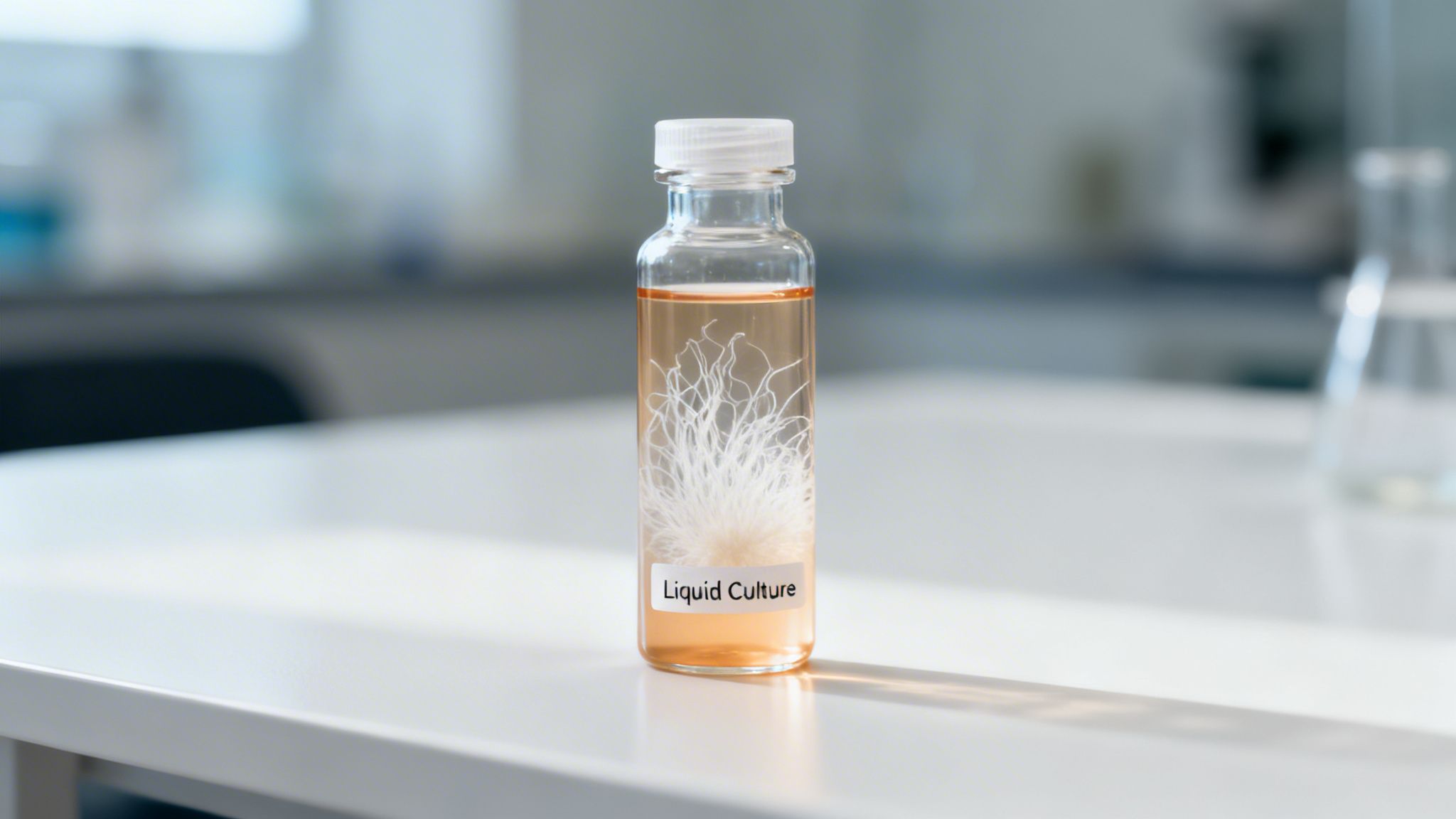
In simple terms, mushroom liquid culture is a nutrient-rich liquid packed with living, breathing mycelium—the intricate root-like network of the fungus. It's a bit like a sourdough starter, but for mushrooms.
Understanding the Power of Liquid Culture
So, what's actually in that little bottle or syringe? At its heart, a liquid culture is a sterile blend of water and simple sugars, like honey or dextrose. This sugary solution acts as the perfect food source, allowing the mycelium to thrive.
When a small, healthy piece of mycelium tissue is introduced to this liquid, it doesn't just survive—it explodes with growth. The mycelium expands into a cloudy, web-like colony suspended in the nutrient broth, creating a dense concentration of vigorous, ready-to-go fungal tissue.
To get a better sense of the key ingredients, here’s a quick breakdown.
Mushroom Liquid Culture at a Glance
| Component | Description | Analogy |
|---|---|---|
| Live Mycelium | The living, actively growing fungal network. | The "yeast" in a sourdough starter. |
| Nutrient Broth | A sterile solution of water and sugars (e.g., honey, dextrose). | The "flour and water" that feeds the starter. |
| Sterile Container | A sealed jar or syringe that prevents contamination. | The clean, airtight jar that protects the starter. |
This combination creates a potent and reliable tool for any cultivator.
From Spore to Mycelium: A Slower Path
To really appreciate why liquid culture is such a big deal, you have to compare it to starting from spores. Trying to grow from spores is like planting a seed and hoping for the best. Each spore is a tiny genetic lottery ticket that first has to germinate, a process that can take days or even weeks.
This waiting game not only slows down your entire timeline but also opens up a huge window for contamination to sneak in and ruin the whole project.
A liquid culture completely skips this unpredictable germination phase. Because the mycelium is already alive and kicking, it hits the ground running and begins colonizing its new home—like a grain bag or substrate—almost immediately.
The Accelerator for Modern Mycology
This ability to start fast is precisely why so many cultivators rely on mushroom liquid culture. It's not just about saving time; it's about boosting your success rate. By giving your desired mycelium a huge head start, it can easily outcompete any stray mold or bacteria that might be lurking.
This technique has become a cornerstone of modern mycology and a key part of the wider world of mushroom cultivation. It’s what allows growers to produce consistent, high-quality results, turning what could be a game of chance into a far more predictable and rewarding science.
The Science Behind Mycelium Expansion
To really get why mushroom liquid culture works so well, you first have to meet the star of the show: mycelium. This sprawling, root-like network is the actual living fungus. It’s the part that does all the work underground long before you ever see a mushroom.
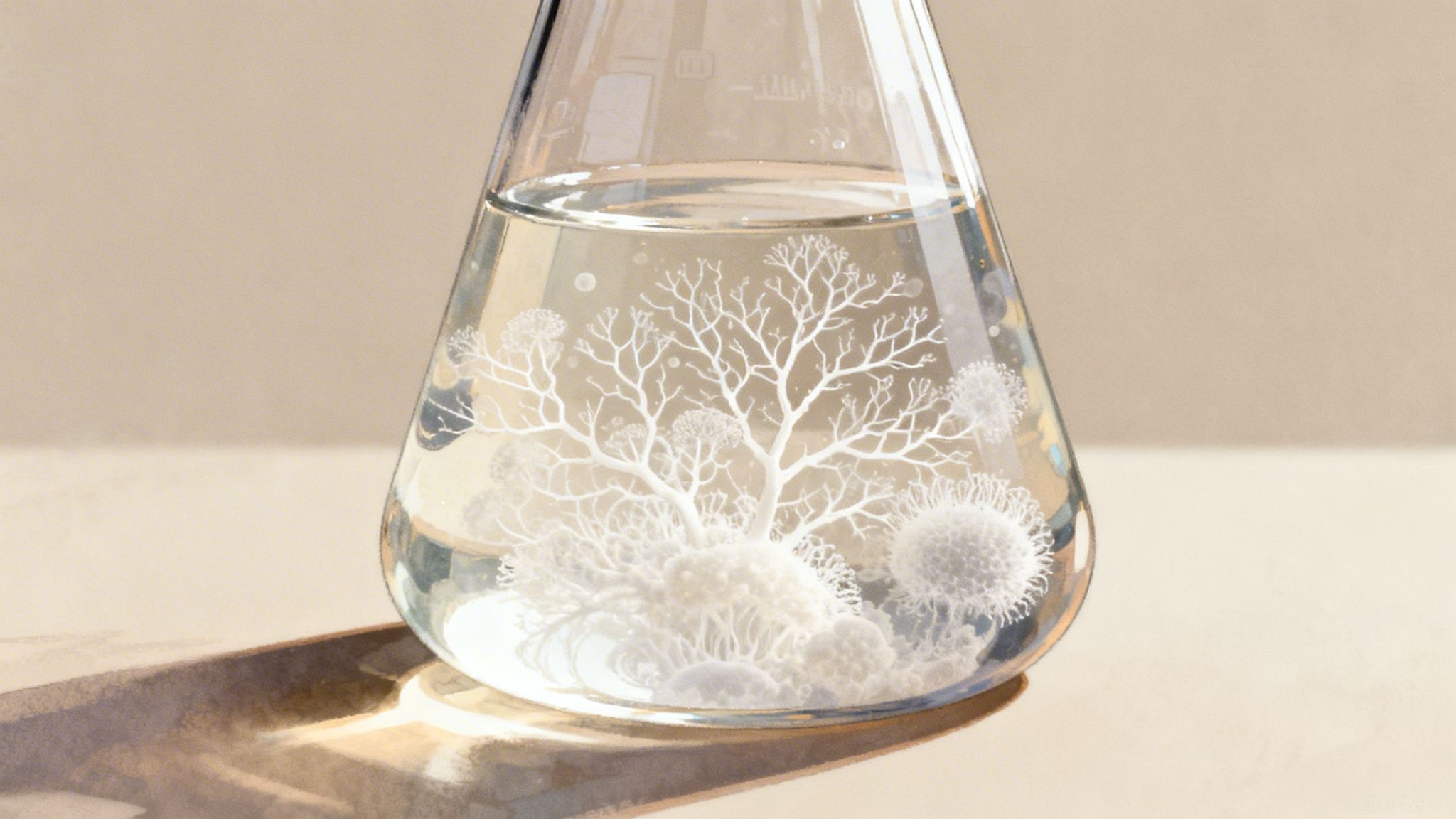
Unlike spores, which are basically mushroom seeds that need to wake up and germinate, a liquid culture is packed with living, growing mycelium. It's suspended in a nutrient broth—usually just water mixed with a simple sugar like honey, light malt extract, or dextrose. This sweet liquid is the perfect fuel for explosive growth.
The Power of Exponential Growth
When you introduce a small, healthy piece of mycelium into this sterile, sugary liquid, it gets right to work. It starts eating the sugars and branching out, creating new strands that branch out themselves. It’s a lot like a tiny spark turning into a wildfire.
This growth isn't just steady; it's exponential. A single piece of mycelial tissue multiplies rapidly, turning a clear jar of sugar water into a thick, cloudy web of life. It’s an incredibly fast way to turn a tiny bit of genetic material into a massive amount of starter culture.
The end goal is a thriving colony suspended in liquid, where every single drop is loaded with countless starting points for new growth. This is what gives liquid culture its legendary speed and consistency.
From Broth to Substrate
This dense, living liquid is the secret to a much faster cultivation process. When you inject the liquid culture into a sterilized substrate like a grain bag, the mycelium is already awake, hungry, and ready to go. There’s no waiting around for it to germinate.
This head start gives your chosen fungus a huge advantage over any stray contaminants. The mycelium can quickly take over its new food source, choking out any competing mold or bacteria before they even get a chance to establish themselves. In fact, many growers report that using liquid culture can shave 30-50% off their colonization times compared to starting with spores.
This rapid takeover is a game-changer for a few key reasons:
- Faster Harvests: Less time colonizing means you get to see mushrooms sooner.
- Reduced Contamination: The mycelium quickly dominates the substrate, leaving no room for unwanted guests.
- Consistent Results: You’re cloning a proven, living culture, so you have a much better idea of what to expect.
At the end of the day, the science here is simple. By giving mycelium a perfect, energy-rich environment, liquid culture turns a small sample into a powerful force for fungal growth. It sets the stage for faster, healthier, and more reliable results.
The Cultivator’s Edge: Why Liquid Culture is a Game-Changer
So, what’s all the hype about mushroom liquid culture? If you've spent any time in mycology circles, you've heard it mentioned, and for good reason. It offers some serious advantages over starting with spores, whether you're a commercial grower or a home hobbyist just looking for better results.
Think of it like this: starting with spores is like planting a seed and hoping it sprouts. Starting with liquid culture is like planting a young, healthy sapling that's already growing. You get to skip the entire germination waiting game, which can take a week or even longer with spores.
Because the mycelium in a liquid culture is already alive and kicking, it gets to work colonizing its new home almost immediately. This head start makes a massive difference, shaving significant time off your project from start to finish.
Faster Harvests and Higher Success Rates
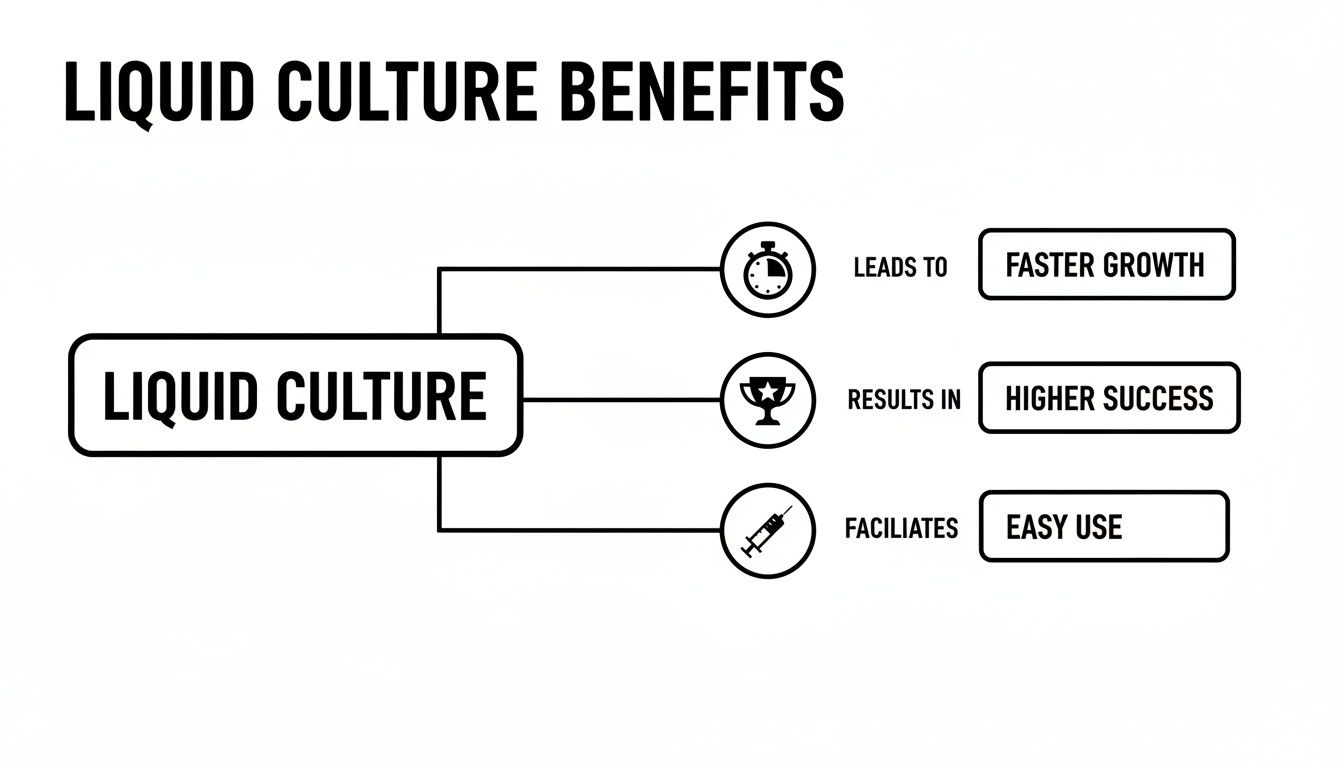
By kickstarting the colonization phase, liquid culture gets you to harvest day much faster. Many growers report that it cuts their spawn run times by 30-50% compared to using a spore syringe. For anyone trying to get a few harvests in a season, that efficiency is huge.
Speed isn't just about impatience, either—it's one of your best defenses against contamination. When your mycelium grows fast and aggressively, it outcompetes any stray mold or bacteria that might be lurking. It takes over the territory before contaminants can get a foothold, which dramatically increases your chances of success.
Simply put, a faster colonization is a safer colonization. The less time your substrate is vulnerable, the lower the risk of contamination ruining your entire project.
This is a big part of why liquid culture has become so popular in the cultivation world. Slashing spawn production from weeks to just a few days has a direct impact on the availability of quality mushrooms. You can dig deeper into how this is changing the market in recent industry reports.
Precision and Ease of Use
Beyond sheer speed, liquid culture syringes are incredibly easy and precise to work with. Spreading spores can feel like a guessing game, but a syringe lets you inject the living mycelium exactly where you need it to go.
The process is sterile and clean, making it simple to inoculate several grain jars or bags from just one syringe. This precision helps the mycelium spread evenly, leading to more uniform colonization and reliable, repeatable results from one grow to the next.
For any cultivator, this consistency is key. Here’s why:
- Predictable Genetics: You’re working with a clone, so you know exactly what traits to expect every single time.
- Efficient Inoculation: One syringe can kick off multiple new projects quickly and without a mess.
- Less Waste: By applying the culture exactly where it needs to go, you make every drop count.
When you add it all up, the combination of speed, reliability, and precision makes liquid culture an indispensable tool. It empowers you to get better, faster, and more consistent harvests, taking your cultivation game to the next level.
Comparing Cultivation Starting Methods
So, you’re ready to start your cultivation journey, but where do you actually begin? When it comes to starting a new mushroom culture, you’ll run into three main options: spore syringes, agar plates, and of course, liquid culture.
Each one has its own purpose, and knowing the difference will help you choose the best tool for the job. Let's break down what makes each method unique.
The Tools of the Trade
Starting with a spore syringe is like playing the genetic lottery. You get a syringe packed with millions of microscopic spores, each with its own unique genetic code. While that sounds exciting, it’s also the slowest and most unpredictable way to start. The spores have to germinate and then find a compatible partner to create mycelium, a process that adds weeks to your timeline with no guarantee of the final results.
For cultivators who want total control, agar plates are the genetic scalpel of mycology. An agar plate is just a petri dish with a nutrient gel that allows you to grow out mycelium and isolate specific genetics. This is how experts select for traits like fast colonization or impressive fruits. But this method isn't for beginners—it requires serious sterile technique, often with a laminar flow hood, and a whole lot of patience.
The Growth Accelerator
This is where liquid culture comes in as the ultimate growth accelerator. It gives you the best of both worlds: the proven genetics of an isolated strain plus the lightning-fast speed of a living, breathing organism.
Since the mycelium is already alive and growing in the nutrient broth, it completely skips that slow, uncertain germination phase. This simple fact dramatically cuts down on colonization times and gives contaminants far less opportunity to ruin your project. The result is faster, more reliable growth every single time.
To put it all into perspective, here’s a quick side-by-side look at how these three methods stack up.
Comparing Mushroom Starting Methods
| Method | Speed | Genetic Consistency | Ease of Use | Best For |
|---|---|---|---|---|
| Spore Syringe | Slow | Low (Genetic Lottery) | Easy | Beginners exploring variety |
| Agar Plate | Moderate | High (Isolation) | Difficult | Experts isolating specific traits |
| Mushroom Liquid Culture | Fast | High (Cloned) | Easy | Rapid and consistent growth |
If you're still curious about playing the genetic lottery, you can learn all about how to use psilocybe spore syringes in our detailed guide. While spores definitely have their place, liquid culture has become the go-to for anyone who values speed, consistency, and predictable results.
You might not spend much time thinking about what happens in a cultivator’s lab, but the science behind the scenes has a huge effect on the mushroom products you can buy. Techniques like using mushroom liquid culture aren't just for hobbyists—they’re what’s fueling the entire industry and making it possible for producers to keep up with a massive surge in demand.
When growers can produce mushrooms faster and more consistently, those benefits come straight to you. It means more of your favorite strains are in stock, you have a wider variety of products to explore, and the quality is reliable every single time. The speed and efficiency of liquid culture are what make all of this possible.
Fueling a Booming Industry
Behind every great mushroom product is a cultivator who knows how to scale up. These innovations are the engine behind the rapidly expanding market, allowing producers to keep pace with your interest—whether it’s for gourmet cooking or functional and psilocybin products from companies like Metro Mush.
There's a clear line connecting lab efficiency to market growth. The explosion in demand for functional mushrooms, which liquid culture helps mass-produce, is a big reason why the market is projected to hit USD 73.24 billion in 2025. Even more impressive, it's expected to soar to USD 142.82 billion by 2032, thanks to a strong 10.0% annual growth rate. You can dive deeper into the data on these mushroom market trends to see the full picture.
This explosive growth isn't just a number—it’s proof that cultivation science works. Efficient methods give producers the power to create the consistent, high-quality products that people are actively looking for.
From Lab Innovation to Your Edibles
At the end of the day, the journey from a sterile jar of mushroom liquid culture to the psilocybin edible in your hand is shorter and more dependable than ever before. This efficiency leads to better quality control, making sure the final product is pure and potent. It also encourages more producers to join the market, which sparks healthy competition and even more innovation.
Knowing this connection helps you appreciate the dedication that goes into every product. The next time you enjoy a carefully crafted edible, you’ll know that a lot of science and hard work in a lab helped bring it to you, bridging the gap from a tiny strand of mycelium to a thriving, accessible market.
Buying vs. DIY Liquid Culture: What’s the Right Move for You?
When you get into mycology, you’ll quickly hit a fork in the road: should you buy ready-to-go liquid culture, or roll up your sleeves and make it yourself? There’s no single right answer. It really comes down to your experience, your budget, and what you hope to get out of the experience.
Buying a pre-made liquid culture syringe is, without a doubt, the easiest and most reliable way to start. Think of it as the convenience option. You get high-quality, verified genetics from a trusted source, and it’s guaranteed to be sterile. For anyone just starting out, this takes a massive amount of guesswork and risk off the table, which means you're far more likely to have a successful first grow.
The DIY Approach
On the other hand, making your own liquid culture is a path that calls to many cultivators who want to go deeper into the science of mycology. The DIY route can save you a lot of money in the long run, letting you turn one culture into a nearly infinite supply.
But be warned: this path isn't a walk in the park. The learning curve is steep. You'll need to invest in some specific gear upfront, like a pressure cooker to sterilize everything and a clean workspace—either a still air box or a laminar flow hood.
The single biggest hurdle in DIY liquid culture is contamination. That sugary nutrient broth is the perfect home for hungry bacteria and mold. One tiny slip-up in your sterile technique can contaminate and ruin an entire batch.
Making an Informed Choice
So, what's the best choice for you? Let's break it down.
- Buying Pre-Made: This is your best bet if you're a beginner, if you value your time and convenience, or if you want specific, trusted genetics without any of the risks of contamination.
- DIY: This is a great fit for more experienced growers who love to experiment, want to be self-sufficient, and already have the right equipment and a solid sterile technique down.
The sheer efficiency of professionally made liquid culture is a big reason it's so popular, especially for fast-growing strains. Take Shiitake mushrooms, for example. The ability to propagate them quickly with liquid culture has helped power a global industry projected to jump from USD 72.89 billion in 2025 to USD 138.47 billion by 2032. You can dig into more of these market trends in this full mushroom market analysis.
Ultimately, if you're just getting your feet wet, buying a pre-made liquid culture or a complete magic mushroom spore kit is the smartest way to ensure you have a positive and successful experience right from the start.
Common Questions About Liquid Culture
As you get more into mycology, a few questions always pop up. It’s natural to be curious. Let's tackle some of the most common ones about mushroom liquid culture so you can move forward with confidence.
One of the first things people wonder is, how long does a liquid culture syringe actually last? If you store it properly in a cool, dark spot like your fridge (2–5°C or 35–41°F), a good quality syringe can stay viable for up to 6 months. But it's always best to use it sooner rather than later, as the mycelium will eventually use up all the nutrients in the solution.
Another big question is how a liquid culture differs from a spore syringe. This is a crucial distinction.
A spore syringe is like a packet of seeds—it contains dormant spores that need time to wake up, find each other, and germinate. It's a slower, less predictable process. A mushroom liquid culture, on the other hand, is a living, breathing network of mycelium, giving your project a huge head start for much faster and more reliable growth.
Storage and Legality
Proper storage couldn't be simpler, but it’s absolutely critical. Just keep your liquid culture syringes sealed in their sterile packaging and pop them in the refrigerator until you’re ready to go. This simple step protects the live mycelium from temperature swings and keeps contaminants out, ensuring it’s ready for action when you are.
Finally, let's talk about legality. This is where things get specific. The legal status of a liquid culture depends entirely on what kind of mushroom it is. Cultures for gourmet or medicinal mushrooms like Lion's Mane and Reishi are perfectly legal to buy, sell, and own.
However, if the liquid culture contains mycelium from a psilocybin-producing species, it’s generally considered illegal in places where psilocybin is a controlled substance. This is different from spores, which are often allowed for microscopy because they don't contain psilocybin themselves. Always make sure you know your local laws.
Ready to explore the benefits of professionally crafted mushroom products? Metro Mush offers a curated selection of premium psilocybin edibles and more, with convenient delivery in the Detroit and Ann Arbor areas. Check out our menu and place your order today.