
If magic mushrooms only changed what you see, why can the same experience feel comforting to one person and frightening to another? The missing piece is that psilocybin can change emotion, attention, time perception, and your sense of self, not just produce unusual visuals.
When people ask “what is magic mushrooms like,” they're often looking for a predictable sequence: take a product, notice some colors, then return to normal. In practice, the experience can be physically uncomfortable, emotionally moving, confusing, or several of those at once. Understanding the range is more useful than expecting a particular kind of trip.
How Long Magic Mushrooms Take to Kick In and Wear Off
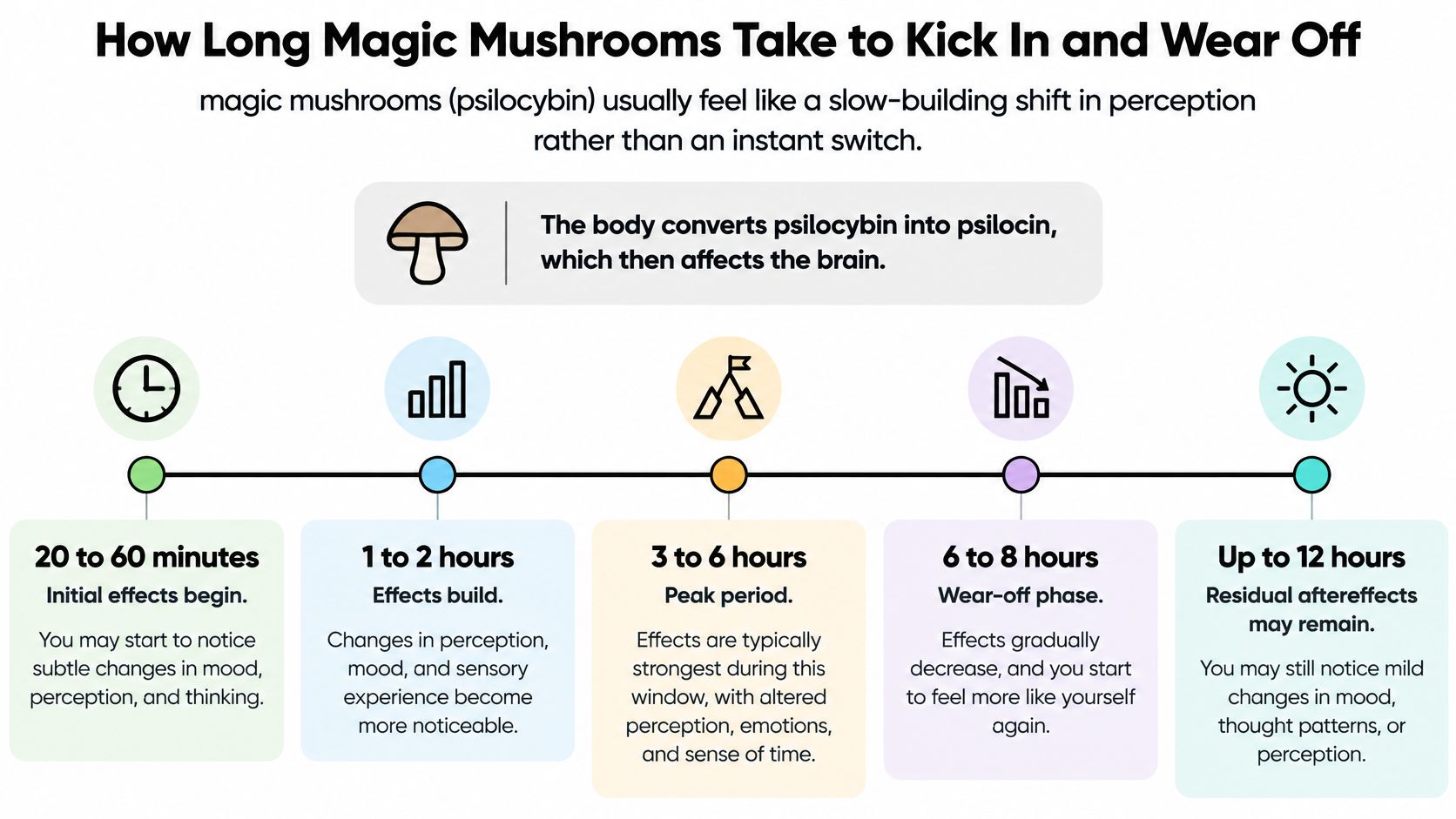
How long might an oral mushroom experience last? Effects commonly begin 20–90 minutes after ingestion and may continue for up to roughly 12 hours, according to the National Institute on Drug Abuse's psilocybin overview. These are broad ranges, not a schedule that can predict when someone will feel normal or be unimpaired.
Typical timeline after an oral dose
The stages can overlap, and their timing varies. A lull in intensity does not necessarily mean the experience has ended.
| Stage | Typical timing | What it usually feels like |
|---|---|---|
| Onset | 20–90 minutes after ingestion | Subtle shifts in mood, color, attention, or physical restlessness |
| Building | After initial effects emerge | Perception becomes less familiar; time may feel slower |
| Peak | During the most intense part of the experience | Stronger visual, emotional, and self-related changes |
| Comedown | As the intensity begins to ease | Gradually fading effects, sometimes with fatigue or lingering emotion |
| Afterglow | After the strongest effects subside | Possible calm, sensitivity, or tiredness, not guaranteed well-being |
The timeline graphic shows a general progression. Its stage boundaries are illustrative, not reliable checkpoints for dosing or driving.
For example, someone may notice little at first and mistake the delay for a weak effect. Taking more before the first amount has fully taken effect can lead to greater intensity than intended.
Practical rule: A slow onset does not mean a product has not worked. Avoid taking more while effects are still unfolding, and do not use lingering effects as a reason to redose.
The guide to how long psilocybin lasts provides more context on duration. Allow time for the full experience and recovery, rather than planning only around the first noticeable effects.
Timing does not identify a mushroom. The orange-capped Gymnopilus identification tips concern a different mushroom genus, so they cannot establish whether a mushroom is psilocybin-containing or safe to eat. Never rely on expected onset or subjective effects to identify a mushroom after ingestion.
What the Experience Feels Like, Sense by Sense
A useful analogy is a dimmer switch on attention and perception. The room may stay physically unchanged while its colors, sounds, textures, and emotional associations become much more noticeable. Unlike a real dimmer, though, you can't reliably turn the intensity back down.
Vision, sound, and body sensations
Colors may look richer. A patterned blanket might appear to ripple, or a wall may seem to breathe even though you know it isn't moving. With closed eyes, some people notice shifting shapes or patterns; others have little visual change.
Sound can become absorbing or intrusive. Familiar music may feel unusually moving, while conversation, traffic, or a humming appliance can become difficult to ignore. More sensory detail isn't always more enjoyable.
The guide to magic mushroom visual effects explores these perceptual changes further. Visual intensity alone doesn't tell you how impaired someone is or how emotionally difficult their experience might become.
Time and space can also feel unfamiliar:
- Stretched moments: A short pause in conversation may feel much longer than it is.
- Altered surroundings: A familiar room can seem unusually large, intimate, or strange.
- Changed body awareness: Someone may feel heavy, light, restless, or uncertain about where their body ends.
A quiet, comfortable room can reduce demands, but no room guarantees a relaxed experience.

Emotion, self-awareness, and meaning
Feelings may arrive with unusual force. Laughter can become tenderness; a memory can bring sadness; a small uncertainty can turn into fear. These shifts don't necessarily follow a clear storyline.
In a controlled Johns Hopkins dose-ranging study, 72% of volunteers at the two highest doses met criteria for a mystical-type experience, while 39% experienced extreme anxiety or fear at one or both of those doses. Participants received measured psilocybin with structured support, so these findings aren't a forecast for an unsupervised mushroom experience.
A sense of connection to other people or nature is possible. So is a reduced sense of being a separate self, which can feel peaceful to one person and alarming to another. Thoughts may seem profoundly important without necessarily being accurate.
Let an intense insight remain an observation until you're rested and sober. You don't need to make a relationship, financial, or health decision during a trip.
Consider someone sitting with a trusted companion. At first, the fabric of a chair catches their attention; later, music brings tears, and ordinary conversation feels difficult. As the intensity fades, they may want silence rather than celebration. That's one possible arc, not a promised outcome.
How Dose Changes the Experience
Dose strongly influences intensity, but dried weight is only an approximate guide. A scale measures mushroom material, not the amount of psilocybin and psilocin inside it.
Labels such as microdose, light, standard, and high dose describe broad intentions. They aren't standardized safety categories, and they don't establish who can use a product without risk.
Dose levels and what they typically feel like
| Dose level | Dried weight (approx.) | Typical effect | Best suited for |
|---|---|---|---|
| Microdose | No reliable universal weight | Intended to produce little or no noticeable alteration; benefits aren't assured | Not an established recommendation for daily use |
| Light recreational | Requires verified batch potency to interpret | Less intense changes may occur, but impairment remains possible | Not automatically suitable for first-time users |
| Standard recreational | No standardized weight-based definition | More obvious perceptual, emotional, and time-related changes may occur | Experience doesn't remove the need for screening and support |
| High dose | Weight alone can't define intensity reliably | Potentially overwhelming changes, fear, confusion, and impaired judgment | Not made safe simply by experience or a sitter |
The reason for avoiding a universal gram chart is practical. A chart can look precise while concealing the information that matters most: the chemical strength of that particular batch.
An analytical review in the Journal of AOAC International illustrates a 3-gram dried amount containing about 19.8 milligrams of active compounds in a lower-potency batch versus 46.2 milligrams in a higher-potency batch. That's more than a twofold difference despite identical mushroom weight.
Why familiar amounts can surprise you
Suppose someone weighs a portion that looks identical to a previous portion they tolerated. If the new batch is more concentrated, their prior experience won't reliably predict what happens next. Familiarity with a variety name doesn't resolve that uncertainty.
Batch-level laboratory information is more useful than a reputation for being gentle or strong. Even then, verified potency can't account for every difference in individual sensitivity or psychological response.
Keep a record of the product, batch identification, stated potency, and amount consumed if you're documenting an experience. A record can clarify what happened, but it shouldn't become permission to escalate.
If someone develops intense fear, a racing heart, or marked confusion, stop adding substances. Help them sit somewhere calm with a sober companion, and assess whether symptoms require urgent medical attention. Don't assume a distressing reaction is harmless just because it followed a psychedelic.
Why Dried, Chocolate and Drink Forms Differ
Product form changes how easily you can measure what you're taking. It doesn't, by itself, tell you whether the contents are weak, strong, accurately labeled, or appropriate for you.
Dried mushrooms allow you to weigh the material directly. Chocolate, gummies, drinks, and capsules may offer convenient portions, but the usefulness of those portions rests on reliable ingredient and potency information.
How each product form changes dose control
| Form | Control over dose | Onset feel | Main trade-off |
|---|---|---|---|
| Dried mushrooms | You can weigh material or prepare it as tea | Delayed oral onset remains possible | Material weight doesn't establish chemical potency |
| Chocolate bars and gummies | Portions help only when contents are clearly specified | Don't assume a food format has a predictable onset | A square or gummy isn't a standardized dose |
| Drinks | Liquid volume can be measured | Don't assume a drink will act quickly | Measured volume isn't the same as verified active content |
| Capsules and microcapsules | Pre-portioned contents can simplify tracking | Oral effects can still be delayed | Capsule size doesn't prove potency or benefit |
A chocolate bar isn't slower by nature, and a drink isn't reliably faster, based on the information available here. Treating those assumptions as dosing instructions can encourage premature additional consumption.
Likewise, pre-measured doesn't mean clinically validated. A capsule marketed for a low-dose routine doesn't establish that daily use is beneficial or appropriate.
Read the contents, not just the format
A public-health review indexed by PubMed summarizes testing that found more than 20-fold variability in psilocybin potency across mushroom samples. That finding concerns the samples tested, not a fixed difference between every chocolate, drink, or dried product.
Popular names such as Penis Envy and Enigma don't function as laboratory specifications. A name may identify what a seller calls a variety, but it can't establish the subjective character of a trip.
Before interpreting any serving, check:
- Active content: Does the label distinguish mushroom weight from milligrams of psilocybin?
- Serving definition: Is the stated amount for the whole package or an individual portion?
- Batch identification: Can the product be matched to the relevant test information?
- Testing detail: Does the laboratory report identify what was measured, rather than displaying a testing claim?
For example, a package describing mushroom material per bar answers a different question from a report describing psilocybin per serving. Neither should be substituted for the other. If the information is unclear, postponing use is safer than estimating from taste, packaging, or price.
Safety Signs, Contraindications and When to Get Help
The idea that every trip is either glorious or catastrophic misses a substantial middle ground. Someone can experience nausea, anxiety, dizziness, or sensory overload without facing a medical emergency, but those symptoms still deserve attention.
The Washington State Liquor and Cannabis Board's psilocybin research brief identifies headaches, nausea, anxiety, dizziness, and increased blood pressure as frequent adverse effects, with most resolving within two days. A usual recovery pattern is not a reason to wait when symptoms are severe.
Expected effects versus signs that need urgent help
| Symptom | Usually expected? | Action |
|---|---|---|
| Nausea, mild headache, jitteriness | Common and often short-lived | Rest somewhere safe, sip water if fully alert, and stay with a sober companion |
| Anxiety or confusion during intense effects | Possible; a calmer environment may help | Reduce stimulation, speak simply, and offer reassurance |
| Persisting symptoms beyond the usual recovery period | Not something to dismiss | Seek medical advice, sooner if symptoms interfere with functioning |
| Chest pain, fainting, or trouble breathing | Not an effect to manage as an ordinary trip | Call emergency services immediately |
| Severe agitation, psychosis-like symptoms, or risk to self or others | Requires urgent assessment | Call emergency services and don't leave the person alone |
Call emergency services for chest pain, fainting, breathing trouble, or severe agitation. Tell responders what the person may have taken, including other substances and medicines. Keep packaging available if you have it.
Don't give food or drinks to someone who isn't fully alert. Avoid arguing about what they're perceiving, and don't put yourself at risk trying to physically control an agitated person.
Who needs medical advice before considering use
Heart conditions and high blood pressure warrant particular caution because psilocybin can raise heart rate and blood pressure. Significant psychiatric vulnerability also calls for professional assessment, not reassurance from someone who previously had a pleasant trip.
Bring these issues to a clinician:
- Psychiatric history: Personal or close family history of psychosis or bipolar disorder.
- Pregnancy: Don't interpret an absence of obvious warnings as evidence of safety.
- Medicines: Antidepressants, other serotonergic medicines, and any prescription or nonprescription drugs you take.
- Other substance use: Alcohol, cannabis, and other psychoactive substances can complicate the experience and assessment of symptoms.
Don't stop prescribed treatment to take mushrooms. The psilocybin drug-interactions guide can help organize questions, but it can't replace advice suited to your medicines and health history.
Support isn't treatment: A trusted companion can reduce immediate hazards, but they can't rule out a medical emergency or make an unsuitable drug combination safe.
Avoid driving, cycling in traffic, swimming, or operating equipment while affected. Risk depends on health, contents, intensity, surroundings, and available support, not whether the product is described as natural.
Set and Setting That Shape Your Trip
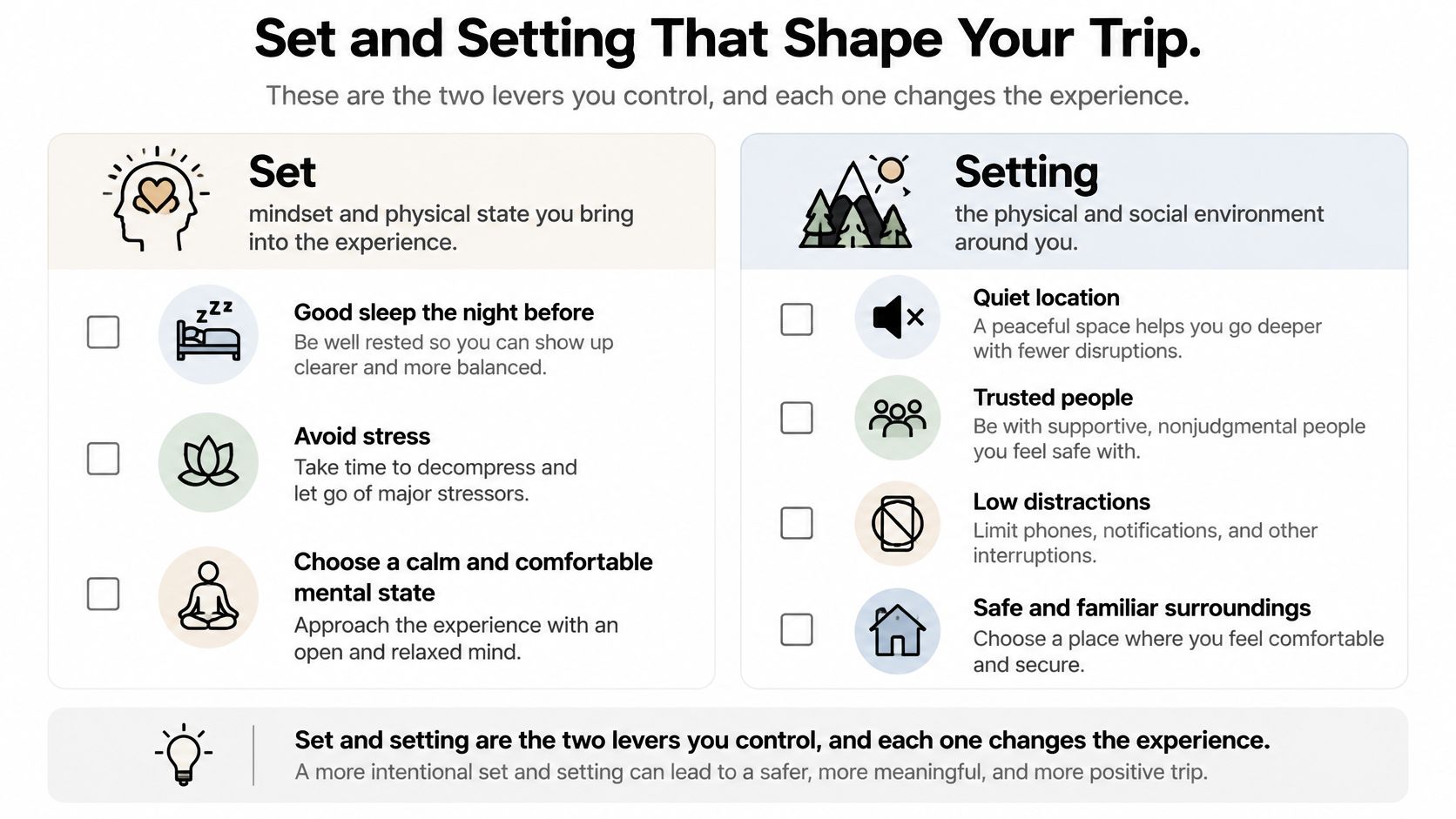
Set means the mindset and physical state you bring to the experience. Setting means the physical and social environment around you. Both are partly within your control, but neither guarantees a positive outcome.
This checklist separates personal preparation from environmental preparation.
Prepare without pressuring yourself
- Check your current state: Postpone if you're exhausted, acutely distressed, or feeling pressured to participate.
- Keep intentions simple: Write down what you're curious about without demanding healing, insight, or a particular emotion.
- Choose familiar surroundings: Use a comfortable, private place where you won't need to deal with strangers or unexpected visitors.
- Reduce sensory demands: Prepare gentle lighting, manageable sound, and somewhere to lie down.
- Arrange sober support: Choose someone you trust who understands the emergency plan and won't take substances alongside you.
- Keep essentials accessible: Have water, a blanket, simple food for later, and a charged phone available.
- Remove obligations: Arrange transport and protect recovery time so you aren't forced into driving, work, or caregiving.
Crowds and unfamiliar places create demands you may find harder to manage while perception and judgment are altered. Even well-meaning friends can add pressure by expecting someone to talk, socialize, or enjoy themselves.
The accompanying video offers another format for considering preparation and support.
Rehearse the support plan
Agree on a simple phrase or hand signal that means I need less stimulation and more help. It can prompt the sitter to lower music, reduce conversation, or help the person settle somewhere quieter. It cannot stop the drug's effects.
Decide who will check in, who can contact additional help, and where essential information is kept. Ask before touching someone, and offer choices rather than issuing unnecessary instructions.
Leave room for the next day to be ordinary. Rest, a meal, and an unpressured conversation may be more useful than trying to explain every sensation immediately.
Confirm Your Readiness Before You Take Any Dose
Readiness isn't a test of confidence. It's a decision about whether you have enough information, appropriate health advice, and practical support to avoid preventable harm.
No-go conditions
Postpone when a health concern hasn't been assessed, when you're unsure about a medicine interaction, or when the plan includes mixing substances. Being experienced doesn't answer those questions.
Unclear product contents are another reason to stop. A familiar package, an appealing variety name, or a friend's recommendation doesn't establish what's in your portion.
Legal uncertainty also needs resolving before purchase or possession. Check current official rules for your location and any place you'd travel through; don't assume a local enforcement policy makes possession or transport lawful elsewhere.
Information you need before deciding
- Health clearance: Discuss relevant cardiovascular, psychiatric, pregnancy, and medication concerns with a clinician.
- Product clarity: Understand what the label measures and whether batch-specific potency information is available.
- Practical support: Have a sober companion, a suitable place, and an emergency plan.
- Protected time: Make sure you won't need to drive, work, or care for someone while affected.
Package quantity deserves special attention. Our Moon Bar contains 3.5 grams of McKennaii magic mushrooms, which describes mushroom material in the whole bar, not a verified milligram amount of psilocybin or a recommendation to consume the package.
For a first experience, curiosity isn't a reason to pursue intense effects. For someone returning after a gap, an old routine isn't proof of current readiness. If essential information is missing, choosing not to take a dose is a complete and reasonable decision.
Listed weight is not a guarantee of potency. If you choose to proceed in a lawful setting after appropriate screening, keep exposure low rather than chasing an expected experience, regardless of the strength suggested by the label.
Metro Mush offers dried mushrooms, chocolates, and shroom drinks for adult consumers in the Detroit and Ann Arbor areas. Visit Metro Mush to browse product descriptions and compare formats, keeping the distinction between package weight, serving information, and verified potency in mind.