

A 2023 ecological meta-study found that only 25% of documented white-truffle sites were in Piedmont, the region buyers picture when they hear Alba, while the mapped range ran roughly from western Switzerland to eastern Bulgaria and from Sicily to Hungary, according to an Open Research Europe review. That same review puts annual production at only "a few tens of tonnes."
The trade-off comes before the romance. White truffles Alba is a famous market name, not a birth certificate. You are paying for a wild, short-lived aroma, and the postcard of one Italian town does not prove where the piece was dug.
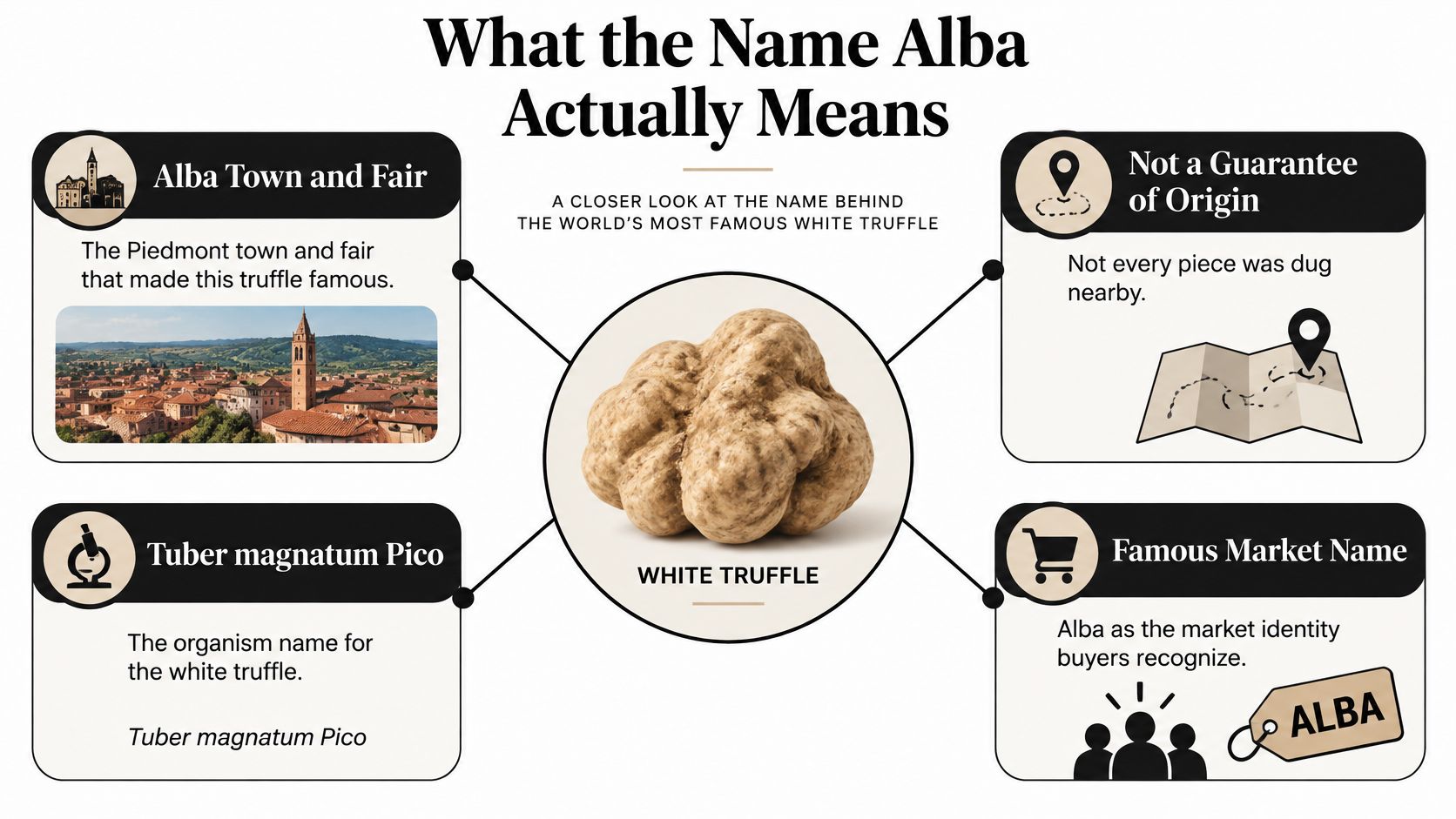
What the Name Alba Actually Means
Only about a quarter of documented white-truffle sites are in Piedmont. So “Alba white truffle” is a famous market name, not proof that a particular truffle came from Alba.
The organism is Tuber magnatum Pico, a fungus that forms underground fruiting bodies in partnership with living tree roots. The part you eat grows with those roots, rather than in a tray like a button mushroom. That dependence helps explain why a missed harvest cannot be replanted.
What the fungus actually needs
White truffles commonly grow with oak, willow, hornbeam, and poplar. Soil chemistry, rainfall, temperature, and the microbes around the roots also shape whether the fungus can fruit. A menu that says only “white truffle” therefore leaves two useful details unanswered: the species and the harvest place.
Piedmont is the best-known center, but the species grows in other parts of Italy and across parts of the Balkans, with rarer sites in Switzerland and southeastern France. A town name on a box is a weak stand-in for the truffle's actual origin.
A town name can describe a brand or market. Ask for the harvest place if you want to know where the truffle was dug.
Wild harvest still sets the market
Cultivation has not turned the white truffle into a farm crop. Natural harvests still supply auctions, dealer cases, and the parcel a cook brings home.
That is why it makes sense to budget in grams, not handfuls. Ordinary cultivated mushrooms can be produced as a crop; white truffles remain wild harvests sold under a famous market name. The name may signal a tradition, but the harvest place is what tells you where the truffle came from.
White Truffle Prices From Market to Auction
For a first-time buyer, the trade-off is straightforward: ordinary market prices are far below auction headlines, but even a small truffle can cost hundreds of euros. INRAE figures reported by Luxury.it put ordinary market prices at about €1,500–€3,000 per kilogram, while auction-season prices can reach €50,000 per kilogram. The first range is a buying reference; the second belongs to exceptional lots and bidding rooms.
A weekly quotation gives a more useful comparison for a specific purchase. The Centro Nazionale Studi Tartufo series for medium specimens averaged €400 per 100 grams on October 11, €450 on October 18, €480 on October 25, and €500 on November 1. That works out to roughly €4,000–€5,000 per kilogram across those dates. A quote is like a dated price tag: without its date and specimen size, it is hard to compare fairly.
Shelf quotes versus a charity record
Auction totals tell a different story from the price of a restaurant portion or a truffle bought for home. A single headline lot can attract bidders for its size, aroma, named place, and the event itself. Treat that price as a spectacle, not as the going rate for a typical purchase.
| Quote | When | Price | How to read it |
|---|---|---|---|
| Ordinary trade | Typical season | €1,500–€3,000 per kg | A buying reference, not an auction price |
| Medium specimens | 11 Oct 2025 | €400 per 100 g, about €4,000 per kg | Early weekly quotation |
| Medium specimens | 18 Oct 2025 | €450 per 100 g, about €4,500 per kg | One week later |
| Medium specimens | 25 Oct 2025 | €480 per 100 g, about €4,800 per kg | The quotation rose |
| Medium specimens | 1 Nov 2025 | €500 per 100 g, about €5,000 per kg | Highest point in this series |
| Auction-season extreme | Scarce prestige weeks | Up to about €50,000 per kg | Not a normal restaurant or home price |
Prices can shift within weeks, so compare a seller's dated quote with the price per gram for the piece you are buying. The contrast with oyster mushroom prices helps explain why white truffles are different: oyster mushrooms are farmed, while white truffle prices reflect scarce wild supply.
Budget rule: use the current weekly trade quote to judge a fragrant piece. Auction headlines are not shelf prices.
When the Alba Season Actually Runs
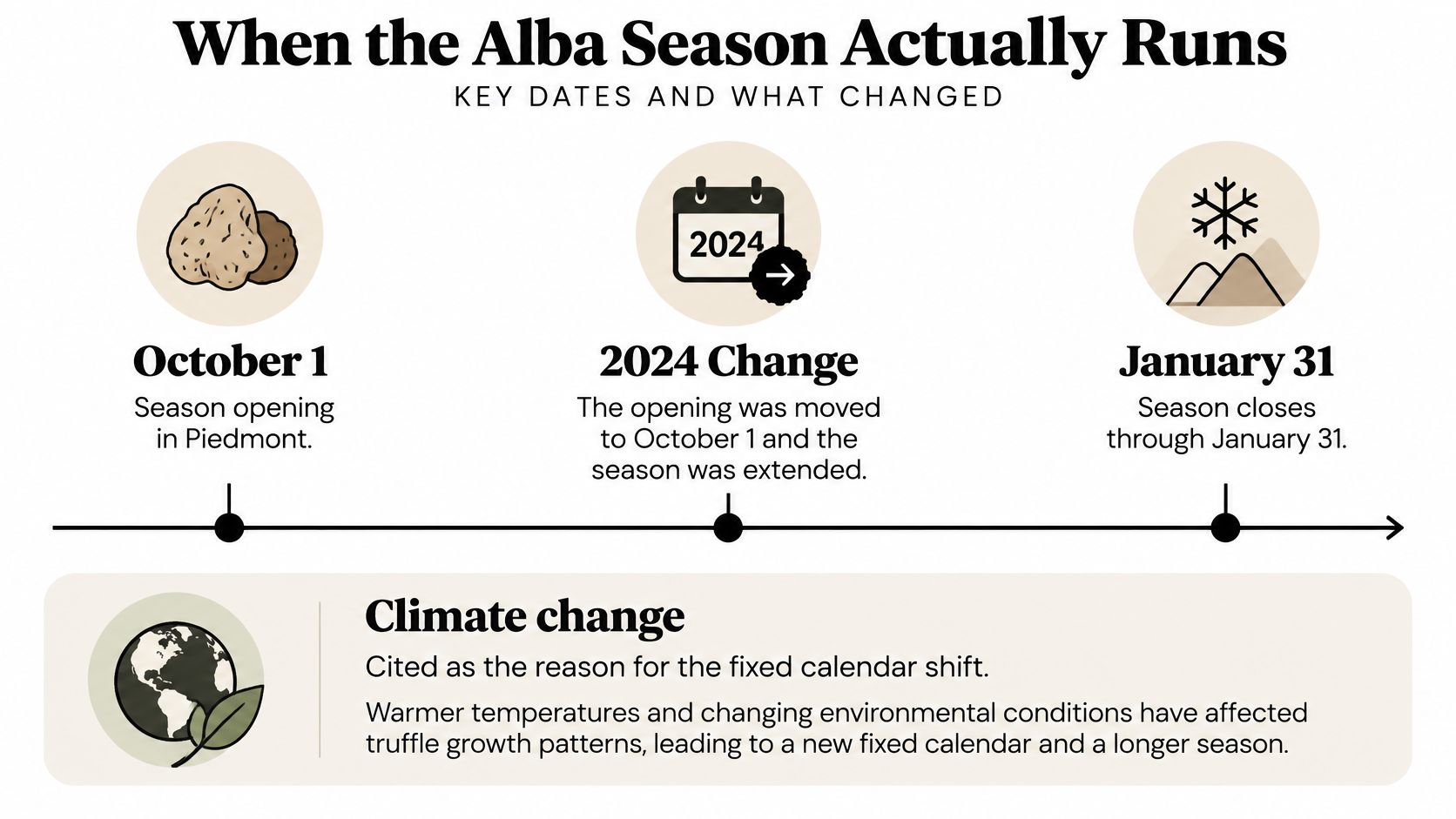
The old postcard said October through December. Piedmont reportedly moved the opening to October 1 and extended the season to January 31 from 2024, citing climate change, according to a Terra Rossa white truffle guide. A fixed autumn-only rule can miss both early legal weeks and late ones.
Three stretches inside one legal window
Early October is the opening. Supply starts, and quotes often sit below the later climb. Mid-October into the first days of November is when buyers feel the market tighten and medium pieces get dearer week by week. December through January 31 is still inside the Piedmont window. You can buy. You just cannot assume every late piece smells like the best week of the year.
A legal open date is not a freshness date. The same guide puts recommended eating at about seven days even under good cold storage, with aroma often flattening after three to five days. Four clocks matter more than the month on the poster.
Harvest date: the day the aroma clock starts, not the day you paid.
Purchase date: useful only beside the harvest date.
Transit time: days in a truck or on a plane are already gone from the week you think you own.
Remaining aroma life: what is left after those days, which is why a "seasonal" truffle can arrive tired.
| Window | Dates or length | What to assume |
|---|---|---|
| Piedmont open season | 1 October to 31 January, from 2024 | Longer than the old October-to-December rule |
| Early season | Opening weeks of October | Supply starts; prices often below the November peak |
| Quoted peak weeks | 11 October to 1 November 2025 | Medium pieces moved from €400 to €500 per 100 g |
| Late season | December through 31 January | Still in the Piedmont window; judge each piece, do not assume peak aroma |
| Aroma life after receipt | About 7 days, often flatter after 3 to 5 | Counted from harvest; transit has already used time |
Book the meal for the week the truffle arrives. Do not book it for an abstract month called truffle season. The same timing habit shows up with ordinary fungi. Checking when mushroom season runs is a calendar question, and this luxury is a calendar question with a much shorter second clock.
Why the Aroma Matters More Than Size
You are buying a perfume, not a steak. A good piece smells clean and strong, with garlic, warm potato, malt, and butter, and it should scent a hot plate rather than sit on it like a slice of meat. Weight and a pretty rind are secondary. If the smell is faint, the grams were wasted before you shaved them.
A chef shaving at the pass is the right picture of how little mass you need once the scent is intact.
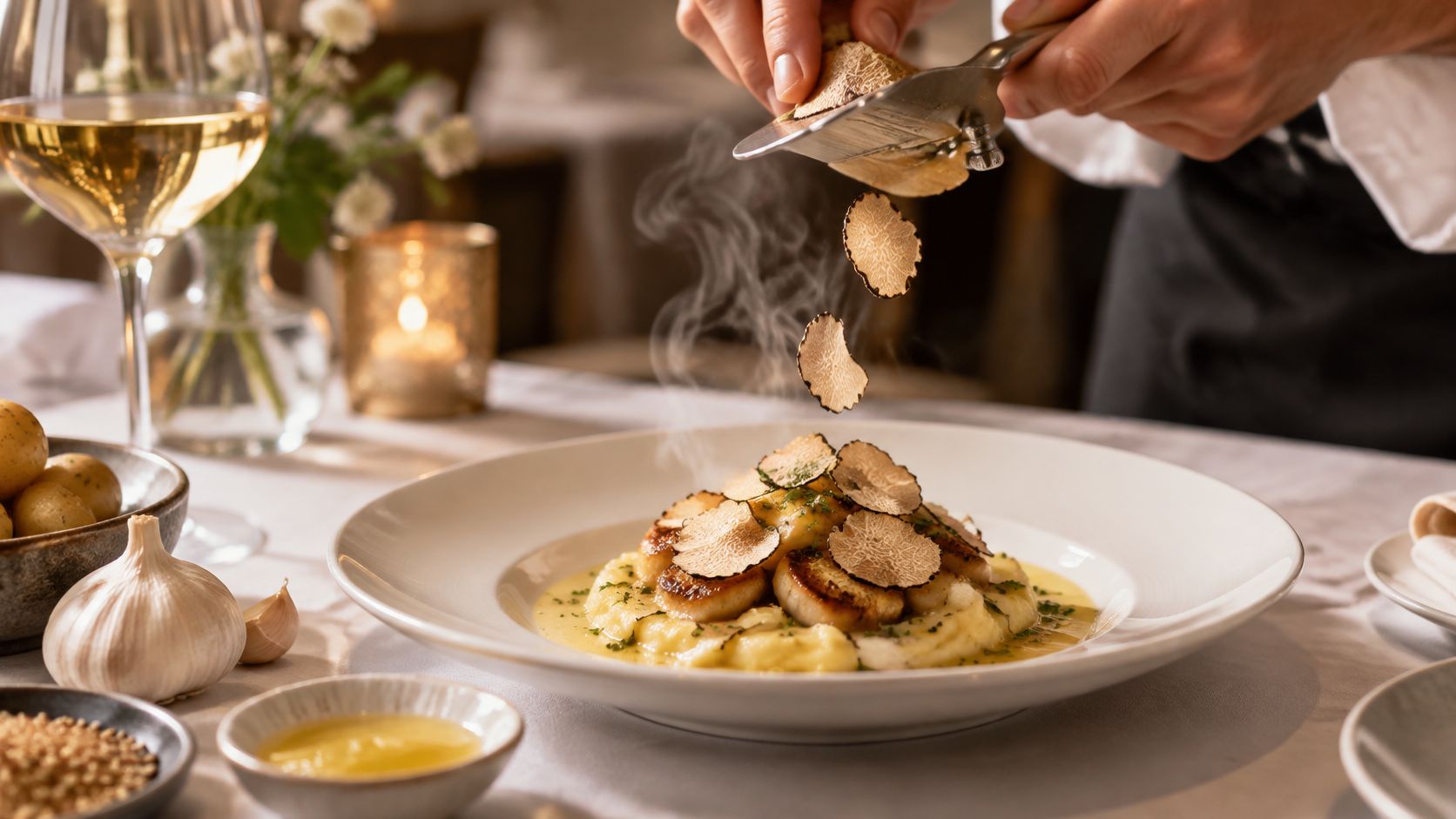
Trace compounds, not "more smell"
The premium aroma is not just a bigger pile of volatiles. Sensomics work in the Journal of Agricultural and Food Chemistry identified 20 odor-active regions, with dilution factors reaching 4096. Impact depends on how far a compound sits above its detection threshold, not on how much of it you could weigh.
Bis(methylthio)methane carries the garlic note. 3-(methylthio)propanal reads as potato. 2- and 3-methylbutanal read as malt. 2,3-butanedione reads as butter. Odor-activity values above 1000 for bis(methylthio)methane, 3-methylbutanal, and 1-pyrroline (3,4-dihydro-2H-pyrrol) show why a trace can dominate the room.
A drop of perfume in a kitchen outweighs a bowl of plain water. That is the buying test. Judge firm flesh and an intact fresh aroma, not mass and not a beige photograph.
Species is part of the smell
Volatile profiles can also separate T. magnatum from related white truffles such as T. borchii. A label that only says "white truffle" is not a species check. Paperwork comes later. At the counter, your nose is the first filter, and a milder relative will not suddenly become this truffle because the price was high.
Simple Dishes That Let a Few Grams Shine
Heat drives off the compounds you paid for. Shave at the table over food that is already hot, salty, and fatty enough to hold scent. Do not simmer the truffle, do not bake it inside a gratin, and do not bury it in a long sauce.
Fat holds the sulfurous aroma. Salt makes it readable. A quiet base does not compete. That is the whole method. The dishes below are vessels, and the amounts are for one generous plate or a small shared serving, not for a banquet.
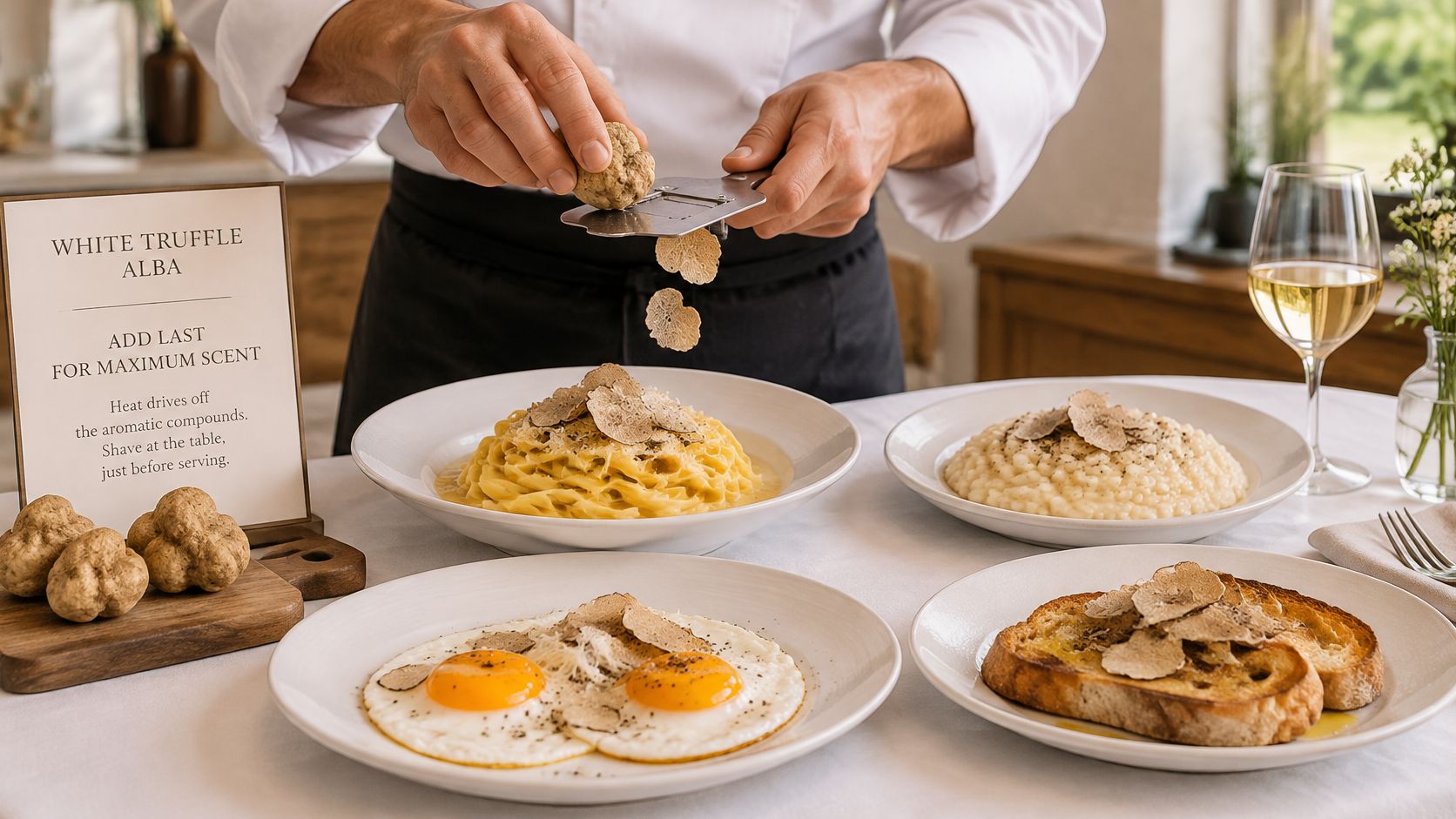
Four plates worth the grams
- Tajarin or plain egg tagliatelle. Toss two portions in warm butter and salt. Shave about 8 to 15 grams over the bowls once they leave the pot. The noodles should be glossy, not swimming.
- A fried or soft egg. Use 5 to 10 grams. The yolk works like a sauce, so you do not need a pan sauce at all. Pepper lightly. Stop there.
- Risotto finished off the heat. For four modest servings, take the pan off the burner, stir in butter, then add 10 to 20 grams. If the rice is still on the flame, you are cooking away the purchase.
- Carpaccio or warm potatoes. A few grams on thin veal or beef, or on hot potatoes with butter, is a garnish. It is not a stuffing and not a crust.
A restaurant tasting may pile a dramatic shaving on one course so the room smells it. At home, buy the smallest piece that still smells powerful and stretch it across two nights. Night two still has to fall inside the short aroma window. If you want the same "quiet base, strong finish" habit with ordinary mushrooms, the steps in how to prepare chestnut mushrooms are a useful contrast. Those can take the pan. This truffle cannot.
Skip high oven heat, cream sauces that cook for half an hour, and any plan that hides the shavings under cheese until they disappear. If the dish would still taste complete with the truffle left off, you chose the right plate.
Proof to Request Before You Pay
A high price and a marbled beige lump do not prove you hold Tuber magnatum from Alba. That is the mistake buyers outside Italy make when a photo looks luxurious. Agro Food makes the practical point that looks are a weak test, while documented provenance, an Italian dealer certificate, a harvest date, and recognized grading are the signals worth trusting. The fungus is wild-foraged, and the ask can move sharply inside a few weeks, so a number with no date is not a credential.
Premium pricing by itself does not prove authenticity. A deal far under that week's trade quote is a reason to ask more questions, not a bargain to grab.
What to demand before you transfer the money
Work the checks in order. You want the species name on the offer, because "white truffle" alone can hide T. borchii or another milder relative. You want a real place, a dealer, and a lot. "Alba style" is a mood. A useful answer names ground.
Then match the harvest date to the ship time. The aroma clock is already running while the box is in transit. On arrival, trust firm flesh and a strong garlic-malt smell over the picture that sold you. If species, place, harvest date, or aroma is missing, do not buy the piece to sort it out later.
| Signal | Ask for this | Walk away if |
|---|---|---|
| Species | Tuber magnatum Pico named on the offer | The label only says white truffle and could be T. borchii |
| Origin | A named place and lot, not Alba as a style | No origin, or Alba used only as marketing |
| Harvest date | A date you can compare with transit time | No date, or the piece is already weeks from the ground |
| Paperwork | Italian dealer certificate or equivalent provenance | The only proof offered is a high price |
| Condition | Firm flesh and a strong intact aroma | Soft, wet, sour, or faint smell |
| Unit price | Near the current seasonal euros per gram | Far below that week's market with no clear reason |
If the seller's only proof is the adjective "Alba" and a large number, you are shopping a story.
Store It Cold and Finish It This Week
A few days at room temperature can cut the garlic and malty odorants and speed off-odors in T. magnatum, even while the truffle still looks fit to sell. Food-science research summarized in European Food Research and Technology ties that loss to both volatile chemistry and the bacteria living with the fungus. Preservation treatments can also shift the odor profile a lot while overall intensity barely moves. Cold and speed are the handling plan. A jar of oil is a different product, not a stand-in for the fresh fungus.
A five-step hold
- Get it cold fast. Minutes on the counter are part of the damage. Unpack, sniff, and refrigerate before you set the table.
- Nest it in clean absorbent paper inside a clean sealed container. You want contact with something that takes up moisture, not a wet puddle.
- Change the paper daily. Damp paper turns into the off-odor you are trying to avoid.
- Isolate the smells. Keep the box away from cut onions, strong cheese, and other fridge odors, and do not leave standing water in the container.
- Eat it this week. Log the harvest date, the transit time, the temperature, the firmness, and the aroma for that lot. Eye appeal alone will not tell you the clock is done.
Two shortcuts that backfire
Oil can encourage fermentation. Rice pulls moisture and scent out of the piece, which is nice for the rice and bad for the truffle. Neither keeps the fresh profile. Restaurants and importers should track each lot the same way a cook tracks a single piece, then sell or shave while the smell is still the one on the invoice.
If the aroma is already sour, faint, or wet-flat when you open the box, storage will not repair it. That decision belongs at purchase, not after three hopeful days in the fridge.
Metro Mush helps adult shoppers in the Detroit and Ann Arbor area choose mushroom products with clear menus, store pickup, and local delivery. If you like learning how a scarce wild ingredient is priced, stored, and finished before the aroma fades, bring that same care to what you order. Visit Metro Mush to see current strains, chocolates, and drinks and place an order by text.