

The usual advice about Luna Bars flavors is to pick whichever sounds tastiest. That skips the harder question: is the name you found an official flavor, a retailer's older listing, or a mash-up that needs its own nutrition check?
Start with the exact product name and its listing status. Then compare flavor cues, ingredients, and the package you can buy. A chocolate name isn't an allergen statement, and a searchable product page isn't proof of a current national launch.
Current Luna Bars Flavors at a Glance
The trickiest part of a Luna flavor list is catalog reliability, not finding a flavor that sounds good. Official names, retailer listings, and mash-ups belong in separate groups because one kind of listing does not establish the status of another.
Clif's January 2025 overview names seven individual classics and counts two Mash-Ups, without spelling out both Mash-Up names. Use it as a dated lineup reference, not a promise about current store stock.
Luna Bar flavor status snapshot
The table separates names in Clif's overview from a retailer example. “Named” means the flavor appears as an individual choice in the overview; it does not mean every store carries it.
| Flavor | Best status | Family | What the listing proves |
|---|---|---|---|
| LemonZest | Named in Clif overview | Fruit | Official name at the reference date |
| Blueberry Bliss | Named in Clif overview | Fruit | Official name at the reference date |
| Chocolate Dipped Coconut | Named in Clif overview | Dessert | Official name at the reference date |
| Nutz Over Chocolate | Named in Clif overview | Nut and cocoa | Official name at the reference date |
| Chocolate Cupcake | Named in Clif overview | Dessert | Official name at the reference date |
| White Chocolate Macadamia | Named in Clif overview | Dessert | Official name at the reference date |
| Chocolate Peppermint Stick | Named in Clif overview | Dessert | Official name at the reference date |
| Two Mash-Ups | Counted in Clif overview | Mash-up | The overview counts two, but does not fully spell out their names |
| Caramel Walnut Brownie | Whole Foods portfolio example | Dessert | Retailer example, separate from the individually named choices |
A product page and a national launch are different kinds of evidence. For example, the Whole Foods listing for Caramel Walnut Brownie shows that the retailer catalogs that flavor; it does not add the name to Clif's individually listed choices. That distinction works like sorting a grocery shelf by label: each item stays in the category its listing supports.
Read the status before the flavor
Mash-Ups need particular care. The official overview counts two, but does not fully name them, so a retailer's combination listing cannot, by itself, identify either one as an official Mash-Up. Keep the retailer entry separate rather than filling the gap by deduction.
A visible product page shows that a retailer has cataloged an item. Check the store listing separately for current availability, and read the package name when comparing products. Catalog presence alone does not establish what is on the shelf today.
Use this snapshot for U.S. LUNA products associated with Clif. Keep other Luna-branded bars separate until the manufacturer, country, and package identity match. Similar branding is not enough to merge two catalogs.
Calories Protein and Sugar by Flavor
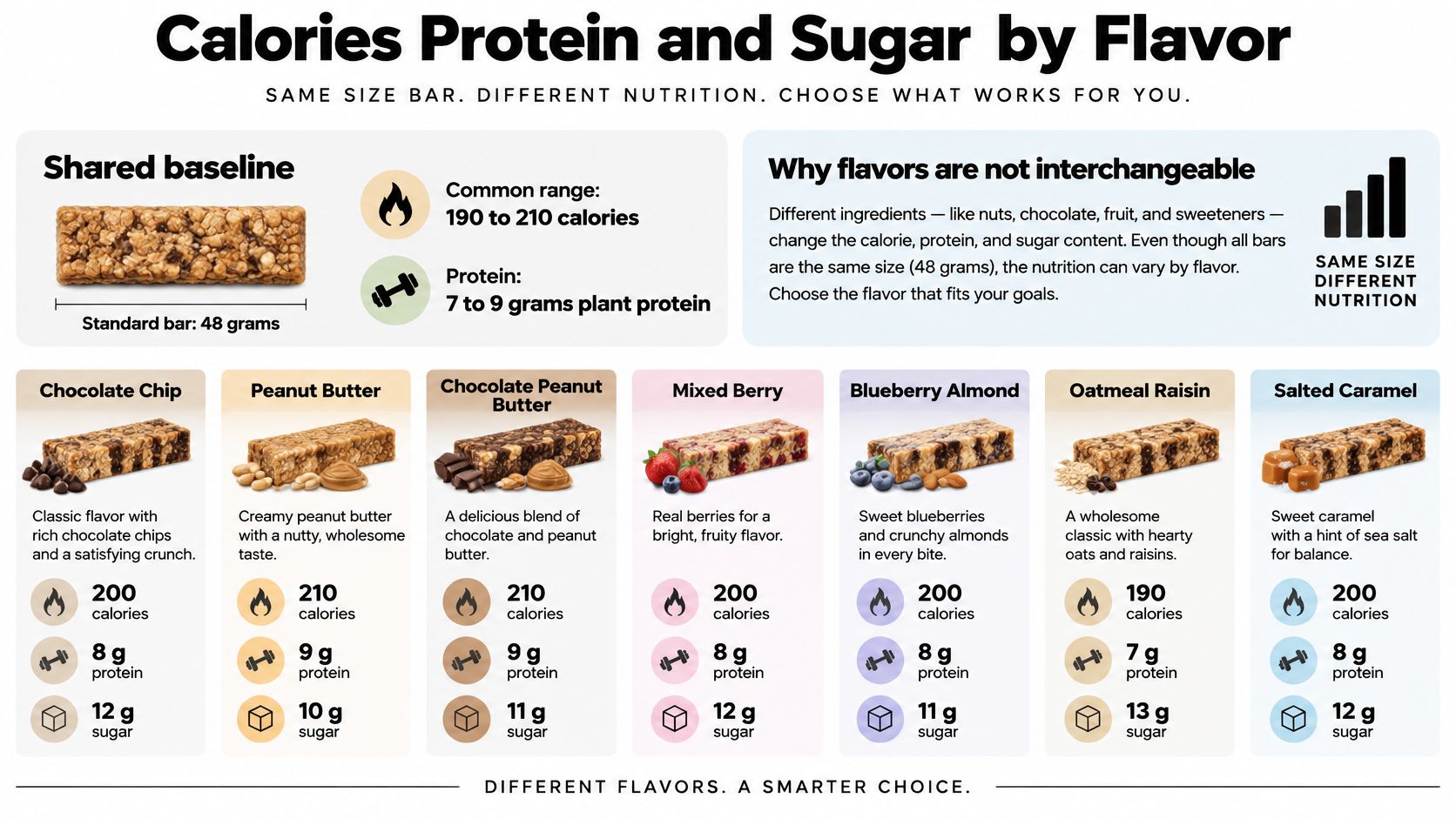
The harder part of comparing LUNA bars is matching each nutrition panel to the exact flavor name. A retailer listing can represent a particular product, but it does not establish that a mash-up belongs to the same official lineup as a named flavor. Check the wrapper and serving size before comparing numbers.
The chart gives a quick visual comparison; the table shows the published per-bar values.
Published nutrition for named Luna flavors
Whole Foods' published nutrition information lists LemonZest at 190 calories and 85 milligrams of sodium per bar, compared with 200 calories and 200 milligrams for Caramel Walnut Brownie.
| Flavor | Calories | Protein (g) | Carbs (g) | Fiber (g) | Total sugar (g) | Sodium (mg) |
|---|---|---|---|---|---|---|
| LemonZest | 190 | 8 | 28 | 3 | 9 | 85 |
| LemonZest + Blueberry | 190 | 7 | 29 | 2 | 11 | |
| Caramel Walnut Brownie | 200 | 8 | 25 | 2 | 10 | 200 |
| White Chocolate Macadamia | 200 | 8 | 27 | 3 | 8 | 170 |
| Chocolate Peppermint Stick | 200 | 8 | 28 | 3 | 8 |
What the differences mean at the shelf
Among the flavors with sodium values shown, LemonZest has the lower amount. It also has the fewest calories in this comparison, tied with LemonZest + Blueberry. The shared calorie count does not make the two bars nutritionally identical: their listed protein, carbohydrate, fiber, and sugar values differ.
Caramel Walnut Brownie has the same protein amount as LemonZest, yet its sodium and calorie values are higher. Protein alone therefore gives only one part of the comparison. A dessert-style name also says nothing about the bar's fiber value, so check the panel rather than guessing from flavor.
White Chocolate Macadamia and Chocolate Peppermint Stick match on several listed nutrients, including calories, protein, fiber, and total sugar. Those similarities do not establish that their ingredients or allergen statements are the same. Check each package separately.
- For sodium: Compare the values shown for LemonZest, Caramel Walnut Brownie, and White Chocolate Macadamia.
- For sugar: Total sugar and added sugar are related, but they are not interchangeable label terms.
- For fiber: Use the flavor-specific panel instead of assuming all oat-based bars have the same amount.
- For serving size: Make sure the panel describes the individual bar you plan to eat.
Choose the nutrient that matters to you, then compare flavors that fit that priority. A lower-calorie bar may suit one occasion, while another shopper may focus on protein, sugar, or fiber.
Flavor Families and Tasting Notes
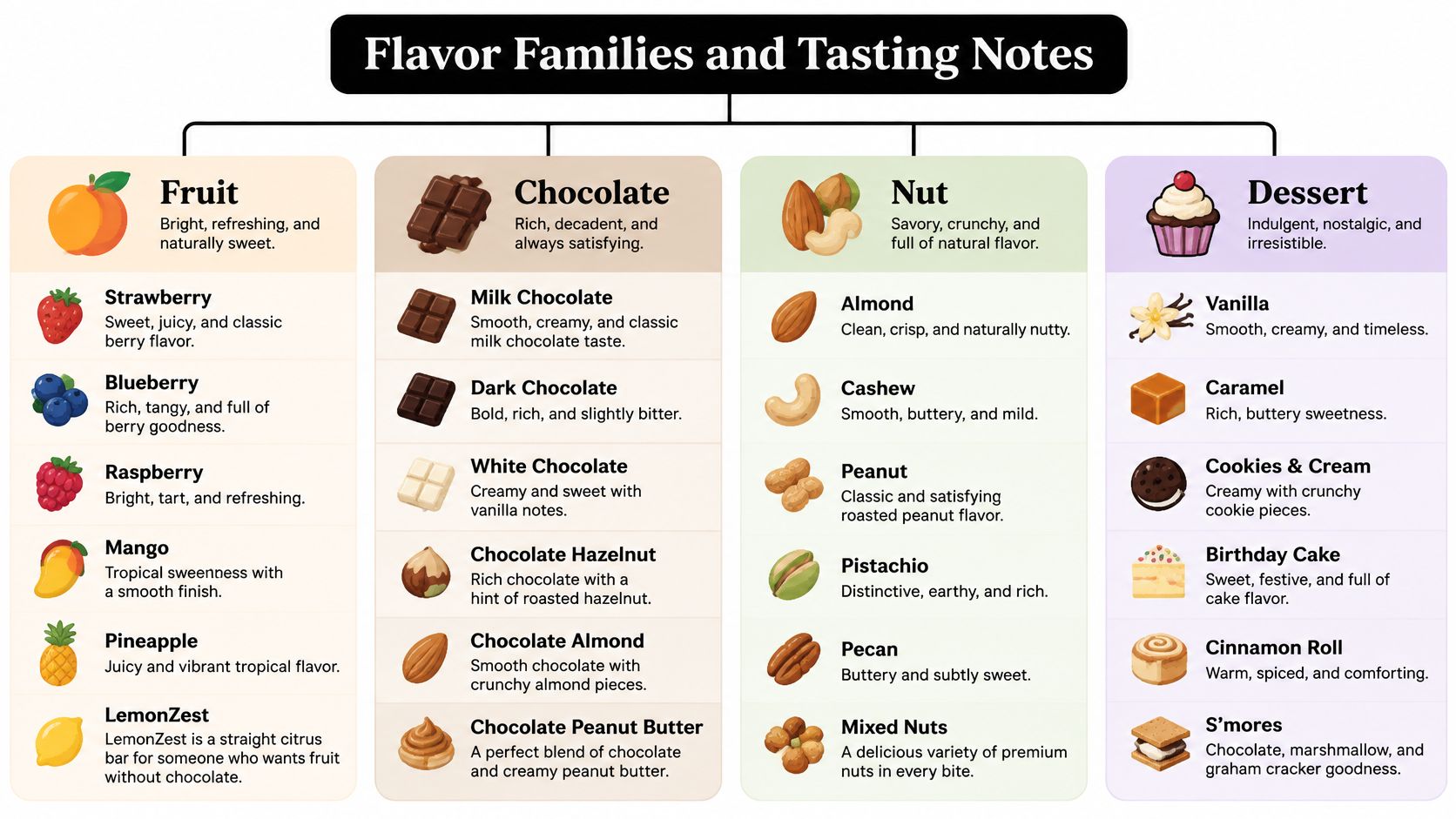
Flavor names are useful buying cues, but they aren't tasting-panel results. Lemon suggests citrus, brownie suggests a dessert profile, and macadamia signals a nut-associated flavor; none establishes crunch, softness, coating thickness, or how sweet a particular shopper will find the bar.
Whole Foods describes a portfolio of 12 flavors, which is best understood as a retailer portfolio snapshot rather than a permanent worldwide lineup.
Use the flavor-family visual to narrow your preferences, then keep the product-status distinctions intact.
Fruit and dessert choices
LemonZest is the straightforward citrus option for someone choosing a fruit-named bar rather than a chocolate-named one. Check its ingredients if avoiding chocolate components is a requirement rather than a preference.
Blueberry Bliss offers a berry-led name within the dated official selection. It suits shoppers who prefer blueberry cues, but there isn't a separate nutrition panel here to support comparisons with the other fruit choices.
Chocolate Dipped Coconut combines coconut and chocolate cues. Choose it because that combination appeals to you, not because the name establishes how much coconut or coating you'll get.
Chocolate Cupcake is the direct chocolate-dessert choice. The name suggests the intended flavor direction, but it doesn't justify describing the bar as cake-like, fudgy, or crisp without examining the product.
White Chocolate Macadamia points toward a white-chocolate-style and macadamia combination. It's a sensible flavor shortlist entry for someone who likes that pairing, subject to the package's nut and coating disclosures.
Chocolate Peppermint Stick adds peppermint to the chocolate family. It suits mint-and-chocolate preferences, but its holiday association shouldn't be mistaken for proof of a seasonal-only sales schedule.
Nut and cocoa, mash-ups, and retailer names
Nutz Over Chocolate belongs in a nut-and-cocoa category rather than a generic chocolate category. Peanut eaters may find the profile appealing; anyone avoiding peanuts needs to treat the ingredient check as decisive.
The official Mash-Ups category shouldn't be expanded with guessed combinations. LemonZest + Blueberry is the retailer-confirmed citrus-and-berry example, suitable for shoppers who want a combined fruit profile rather than a single named fruit.
Caramel Walnut Brownie stacks caramel, walnut, and brownie cues into a dessert name. Before searching for a box, establish whether a retailer can fulfill that exact product.
Mint is a retailer-example name with insufficient detail for a confident tasting description. Don't assume it's a shortened name for Chocolate Peppermint Stick.
Lemon may be shorthand for LemonZest, but the wrapper must settle that question. A shortened search result isn't evidence of a separate citrus recipe.
Strawberry Banana suggests a familiar fruit pairing, but the retailer listing doesn't settle its relationship to the dated official catalog. Check the product format and package identity before comparing it with the classic bars.
For a broader look at LUNA products, the video below provides additional product context. Use the actual wrapper, rather than a video image, for purchase-specific details.
Ingredients Allergens and Diet Checks
Flavor names are useful for browsing, but they are not ingredient lists. LUNA bars share a protein-and-grain foundation, while each variety can differ in its inclusions, coating, cocoa, fruit components, and flavorings.
Clif's ingredient guide describes a core blend commonly built from soy protein isolate, rolled oats, rice flour, roasted soybeans, and soy flour. Treat that blend as a starting point, not a substitute for the label on the flavor you plan to buy.
Why Nutz Over Chocolate needs a closer look
Nutz Over Chocolate is a useful worked example: its name signals both peanut and chocolate, but the wrapper is what identifies the full recipe. It is a peanut-based flavor, so check its current package for the complete peanut, soy, and other ingredient disclosures before buying.
That label check matters because another chocolate-named flavor may use different nuts, coating fats, or flavoring ingredients. A shared flavor cue does not mean a shared recipe.
Fruit profiles also call for a close read. Concentrates, acids, pectin, and natural flavors may contribute to a fruit character, so the name on the front cannot show you the complete ingredient list.
The wrapper check
Read the full ingredient list alongside the allergen statement. For a serious allergy, a shelf tag, shortened online description, or package from another flavor is not a safe substitute.
- Soy: Check for soy protein, soy flour, roasted soybeans, and other soy ingredients disclosed on the package.
- Peanuts and tree nuts: Identify the specific nut. A nut-associated flavor name does not establish which nuts are present.
- Added sugar: Use the nutrition panel for the declared amount, and the ingredient list to see the sweetening ingredients.
- Coatings: Check for milk and other ingredients relevant to your diet. White-chocolate-style wording alone does not confirm what the coating contains.
Allergen boundary: A flavor guide can help you find the right package, but only that package's current label can inform an allergy decision.
Plant-based protein does not by itself establish that a bar is vegan. Protein source and the complete recipe answer different questions, so shoppers avoiding animal-derived ingredients should check the flavor-specific ingredient list.
Formulations and packaging can change. If you keep a saved shopping list, compare the current package with the one you previously bought rather than assuming the same wrapper color means the recipe is unchanged.
For nutrition decisions, use the panel for the exact flavor. Familiar ingredients alone do not show how a bar fits your sugar, sodium, or fiber priorities.
Bar Size and Pack Options
A box is a purchasing format, not a serving size. Compare the nutrition panel on the individually wrapped bar, even when the outer carton emphasizes a flavor assortment.
A single-flavor box can simplify repeat shopping, while a mixed box can help you discover preferences. Neither format guarantees that an old product photo matches what the retailer will send.
Choose the pack for the job
| Shopping goal | Useful format | Check before buying |
|---|---|---|
| Try an unfamiliar flavor | Single bar | Exact wrapper name and ingredient list |
| Keep a predictable desk snack | Single-flavor box | Every wrapper matches the intended flavor |
| Compare several profiles | Mixed box | Printed assortment, not just the front image |
| Replace a favorite combination | Exact-name product listing | Classic versus mash-up identity |
For a trail bag or office drawer, a single-flavor box reduces surprises once you know you like the product. It doesn't establish storage suitability by itself, so read the package's storage instructions and consider whether a coating could be inconvenient in warm conditions.
A variety box serves a different purpose. Read the assortment description carefully, especially if the pictured bars include older-looking designs or names you haven't seen sold individually.
Read the carton and the wrappers
Don't assume Caramel Walnut Brownie, Mint, or Strawberry Banana is included because it appears in a marketplace collage. Sellers sometimes use broad product-family imagery where shoppers need an exact contents list.
The same caution applies to mash-ups. A combined-fruit bar and a classic fruit bar can look related while carrying different names and nutrition panels.
- Outer carton: Confirm the flavor assortment and whether substitutions are disclosed.
- Individual wrapper: Match the product name, net weight, and serving description.
- Nutrition panel: Check whether the figures apply to an individual bar or another stated serving.
- Listing title: Make sure the title describes the same pack shown in the package photographs.
A multipack shouldn't change an unchanged bar's per-serving nutrition, but package format isn't evidence that the formulation is unchanged. Compare the labels when moving between single bars and boxed stock.
Keep price comparisons separate from nutrition comparisons. A larger carton may suit a repeat purchase, while a single bar avoids committing to a flavor you haven't tried.
Where Flavor Stock Actually Shows Up
The most useful retailer page is the one that can tell you whether the exact item can reach your address or be picked up at your selected store. A search-engine result is only a starting point.
The available catalog examples come from different places: Clif supplies the official-name reference, Whole Foods supplies several portfolio and nutrition examples, and Wegmans identifies the lemon-and-blueberry combination. Those roles shouldn't be collapsed into a universal stock list.
Read a store page as a fulfillment offer
Start by selecting your store or delivery location. A product page can remain accessible even when that location has no stock, so location-free browsing can create a false impression of availability.
Then inspect the package image and description together. Confirm that the manufacturer is the expected LUNA brand, that the flavor name matches throughout the page, and that the product format is the one you intend to compare.
- Search precisely: Use the full flavor name rather than just lemon, mint, or chocolate.
- Check fulfillment: Look for an active pickup or shipping option associated with your location.
- Inspect photographs: Prefer readable ingredient and nutrition panels over decorative product images.
- Resolve contradictions: If the title and photograph name different flavors, ask the retailer before ordering.
A displayed price helps distinguish a usable offer from a bare catalog record, but it still doesn't guarantee fulfillment. An order confirmation or store confirmation is stronger evidence than an undated product URL.
Situations that need extra care
Say a peppermint listing appears during warmer months. The timing alone doesn't tell you whether it's regular inventory, an older assortment, or a page without stock.
A brownie page presents a different problem: the search result may preserve an older package image. Compare the current fulfillment information and the product description rather than treating the image as a launch announcement.
A mash-up can be listed within an assortment while its standalone product page is difficult to find. Read the carton contents instead of deciding that the flavor has disappeared entirely.
Prefer a retailer that identifies what it can send, not merely what it has listed.
For names outside the official reference selection, buy only when current inventory information and the package identity agree. For products sold outside the U.S., establish the brand and market before applying this catalog.
Discontinued Renamed and Regional Flavor Questions
A missing flavor isn't automatically discontinued. Retailers choose assortments, sell through inventory, and change package formats, while old product records can remain searchable.
The stronger question is what evidence would distinguish a local stock gap from a changed product. Use the wrapper identity and current fulfillment information rather than drawing a conclusion from search visibility.
Separate the possible explanations
Missing locally means your store doesn't currently offer the product you're seeking. Check another store location or package format before making a brand-wide conclusion.
Renamed or duplicated means different listing text may refer to the same product. Lemon and LemonZest are candidates for comparison, not confirmed synonyms: inspect the wrapper name, manufacturer, ingredients, and serving description.
Discontinued or unverified requires more caution. A retailer-only name with no usable stock information remains unverified unless the manufacturer or retailer supplies a clear status statement.
| What you find | What you can conclude | What remains unresolved |
|---|---|---|
| Product page without fulfillment | A catalog record exists | Whether it can currently be purchased |
| Current inventory for an older name | That retailer offers the item | Whether it belongs to an active national lineup |
| Different names with matching imagery | The listings may overlap | Whether the products are actually identical |
| Similar branding abroad | A related-looking product exists | Whether the U.S. catalog applies |
What not to infer
A page-update date isn't necessarily a launch date. Likewise, a fresh customer review doesn't establish that the manufacturer is still producing the exact package pictured.
Seasonal associations can also mislead. Chocolate Peppermint Stick sounds holiday-oriented, but that impression alone can't prove a limited sales calendar or explain a local stock gap.
For non-U.S. purchases, compare the manufacturer and country information before assuming a regional variation or rename. A shared brand-like word doesn't establish a shared formulation.
Finish with a practical check: confirm that the retailer has current inventory, then match the flavor name on the physical wrapper. If those don't agree, leave the product's status unresolved rather than labeling it discontinued.
Pick a Flavor Before You Check Out
The hardest part of choosing a LUNA flavor may be confirming what the name refers to. Official flavor names, retailer listings, and mash-ups are not interchangeable: treat the wrapper as the label on a jar and check that it matches the item you intend to buy.
Clif's LUNA collection describes a standard 48-gram bar as generally providing about 190–210 calories and 7–9 grams of plant-based protein, with gluten-free, low-glycemic, and complete-plant-protein positioning. These are category-level details, not a substitute for checking the nutrition and ingredient panels for the individual flavor.
Match the choice to your priority
For citrus, compare LemonZest with the wrapper and its published panel, especially if sodium matters to you. White Chocolate Macadamia may suit a white-chocolate-and-nut preference, but check its nut and coating ingredients. Nutz Over Chocolate also calls for a peanut check. Chocolate Peppermint Stick fits a chocolate-and-mint preference if a retailer can confirm the exact product.
- Want a fruit combination: Check for the full LemonZest + Blueberry name, rather than assuming a generic blueberry listing is the same flavor.
- Considering a retailer-only name: Look for current fulfillment details and a package photo that matches the listing.
- Buying the same flavor again: Choose an exact flavor name, not an unspecified assortment.
- Avoiding an ingredient: Follow the ingredient and allergen disclosures, even if another flavor sounds more appealing.
Make the package the final authority
Plant-protein wording does not establish vegan status. Gluten-free positioning does not answer whether a bar contains soy, peanuts, tree nuts, or milk ingredients, either. Read the package details that apply to your needs.
If an online listing does not show those details, choose one that does or inspect the bar in person. A familiar flavor name alone cannot confirm what is in the package. Before checkout, match the flavor name, the bar size, and the allergen line with the product you meant to buy.
Metro Mush is a separate adult-focused psilocybin business, not a LUNA snack-bar retailer. Mushroom edibles and ordinary snack bars aren't interchangeable; keep intoxicating products clearly labeled, securely stored, and separate from everyday food. To shop Metro Mush's current selection, browse its online menu, confirm delivery to your area, then place an order by text at 734-691-6122 for Detroit or 734-280-2868 for Ann Arbor. The minimum order is $75.