


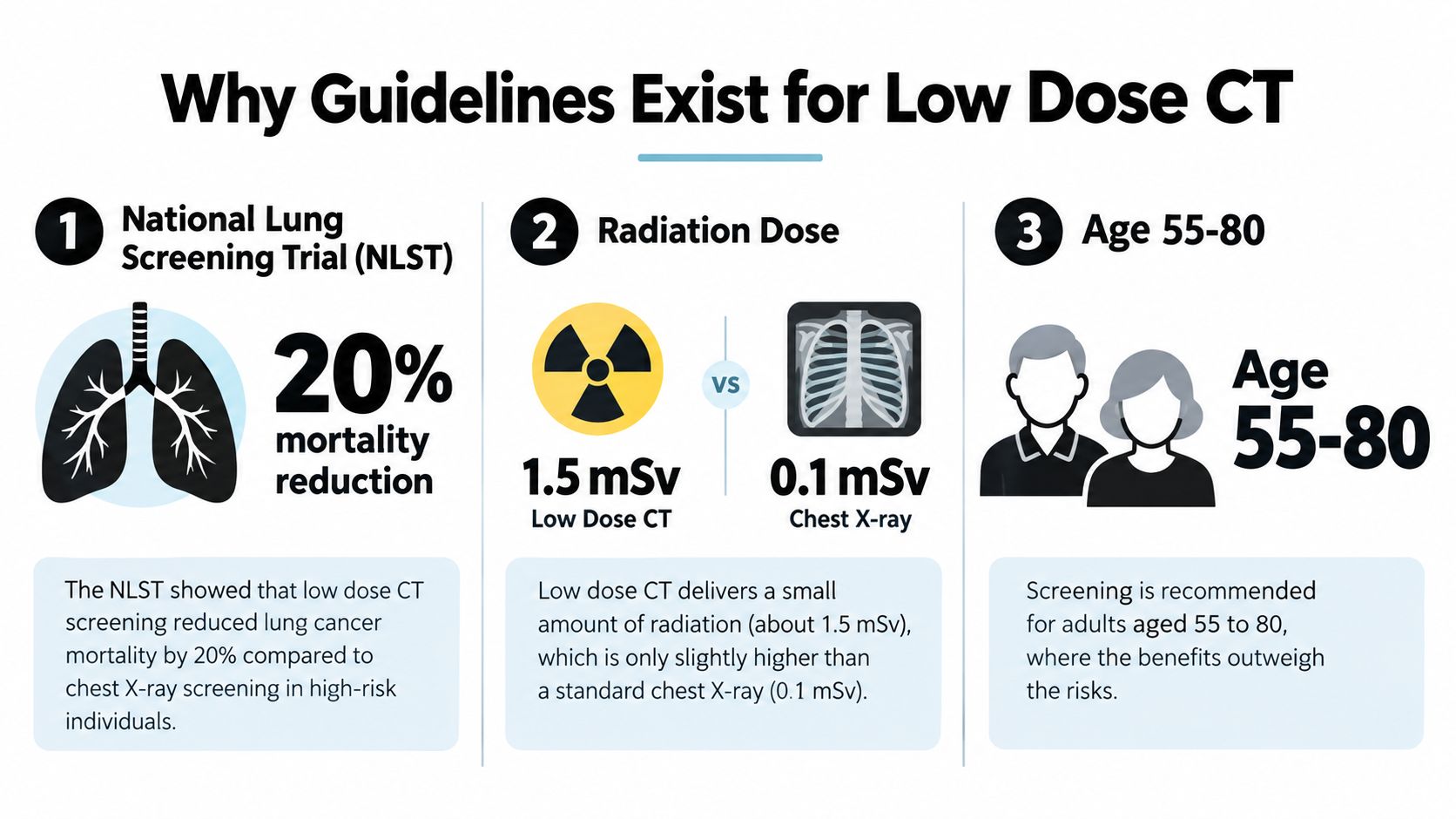
Low-dose CT reduced lung cancer deaths by 20% compared with standard chest X-rays in the landmark National Lung Screening Trial, which involved 53,454 participants. That result is why current low dose CT guidelines focus on people at substantially higher risk, rather than recommending CT scans for every adult.
A screening scan can find lung changes before symptoms appear, but the scan is only one part of the decision. You also need to understand who benefits, how professionals define “low dose,” what an abnormal result may lead to, and whether you'd be able to pursue treatment if cancer were found.
Why Guidelines Exist for Low Dose CT
The National Lung Screening Trial compared low-dose computed tomography, or LDCT, with standard chest radiography in current or former heavy smokers aged 55 to 74. Participants had at least 30 pack-years of smoking exposure, no symptoms, and no previous lung cancer diagnosis. They received three annual rounds of either LDCT or chest X-ray.
Lung cancer mortality was 247 deaths per 100,000 person-years in the LDCT group, compared with 309 deaths per 100,000 person-years in the X-ray group. The resulting 20.0% relative reduction in lung cancer mortality provided the evidence base for major U.S. recommendations supporting annual LDCT in defined high-risk populations, as described in the National Institutes of Health summary of the NLST findings.
Why CT replaced chest X-ray for screening
A chest X-ray produces a two-dimensional image. Small or overlapping abnormalities can be difficult to identify. LDCT creates detailed cross-sectional images of the chest, allowing clinicians to evaluate small lung nodules and other findings more closely.
That doesn't mean CT is automatically better for everyone. The NLST studied people with a specific risk profile, not low-risk adults or people with symptoms. The evidence supports a targeted program in which the expected benefit of finding serious disease early outweighs the potential harms of radiation, false-positive findings, follow-up procedures, and anxiety.
Practical rule: A guideline isn't an arbitrary barrier to testing. It defines the group in which screening has demonstrated benefit.
The term “low dose” also needs context. LDCT uses substantially less radiation than a conventional diagnostic chest CT, but it still exposes the patient to radiation and can produce findings that require further evaluation. The most useful question isn't just whether a scan is low dose. It's whether the examination is appropriate for your risk, uses enough image quality to detect important nodules, and includes a clear plan for follow-up.
Understanding Eligibility and Who Qualifies
The 2021 U.S. Preventive Services Task Force recommendation applies to adults aged 50 to 80 who have at least 20 pack-years of smoking exposure and either currently smoke or quit within the previous 15 years. The recommendation carries a B grade, meaning the task force found moderate certainty of a moderate net benefit for people at high risk. The criteria are detailed in the USPSTF recommendation on lung cancer screening.
You can work through the criteria in this order:
- Age: You're within the recommended range if you're between 50 and 80.
- Smoking exposure: You need at least 20 pack-years.
- Current or recent smoking: You currently smoke, or you stopped within the past 15 years.
- Ability to benefit: You should be healthy enough and willing enough to undergo diagnostic evaluation and potentially curative treatment.
Calculating pack-years
A pack-year combines the amount smoked with the duration of smoking. Smoking one pack each day for one year equals one pack-year. Smoking two packs per day for ten years also equals 20 pack-years, as does smoking one pack per day for 20 years.
The threshold changed from the earlier framework, which generally began at age 55 and required 30 pack-years. The updated approach includes younger adults and people with lower cumulative exposure. Modeling cited in the verified guidance estimated that the projected reduction in lung cancer mortality could rise from approximately 9.8% under the older approach to about 13% under the expanded criteria, as summarized by the National Cancer Institute's account of the NLST and screening evidence.
Eligibility still isn't the same as an automatic order for a scan. Screening is intended for people without signs or symptoms of lung cancer. It should stop when a person has not smoked for 15 years, develops a condition that substantially limits life expectancy or the ability or willingness to undergo curative lung surgery, or reaches the upper age boundary in the guideline framework.
If you don't have a smoking history, don't assume that requesting LDCT is a safer general health check. Major guidance doesn't recommend routine screening for low-risk people because the evidence of benefit is insufficient, while false positives and unnecessary procedures can still occur.
How Radiation Dose Is Defined Clinically
“Low dose” isn't a universal percentage reduction. Clinicians define an appropriate LDCT protocol by starting with the clinical question and the minimum image quality needed to answer it. Lung nodules are high-contrast targets, so they can often be detected with less radiation than a low-contrast lesion elsewhere in the body.
Radiology teams adjust several technical factors:
- Tube potential and current: These influence the X-ray energy and amount of radiation used.
- Pitch and scan length: These affect how the scanner moves through the body and how much anatomy is exposed.
- Automatic exposure control: The scanner can adapt output to the patient's body size.
- Iterative or deep-learning reconstruction: These methods can help preserve useful image quality from lower-signal data.
- Clinical coverage: Limiting the scan to the relevant target avoids unnecessary exposure.
The Radiology Society of North America review of CT dose optimization explains why facilities monitor CTDIvol and DLP against diagnostic reference levels, or DRLs. CTDIvol is a scanner output indicator, while DLP incorporates the scan length. DRLs are optimization benchmarks, not personal dose limits and not a guarantee that every patient will receive the same exposure.
The technical benchmarks for lung screening
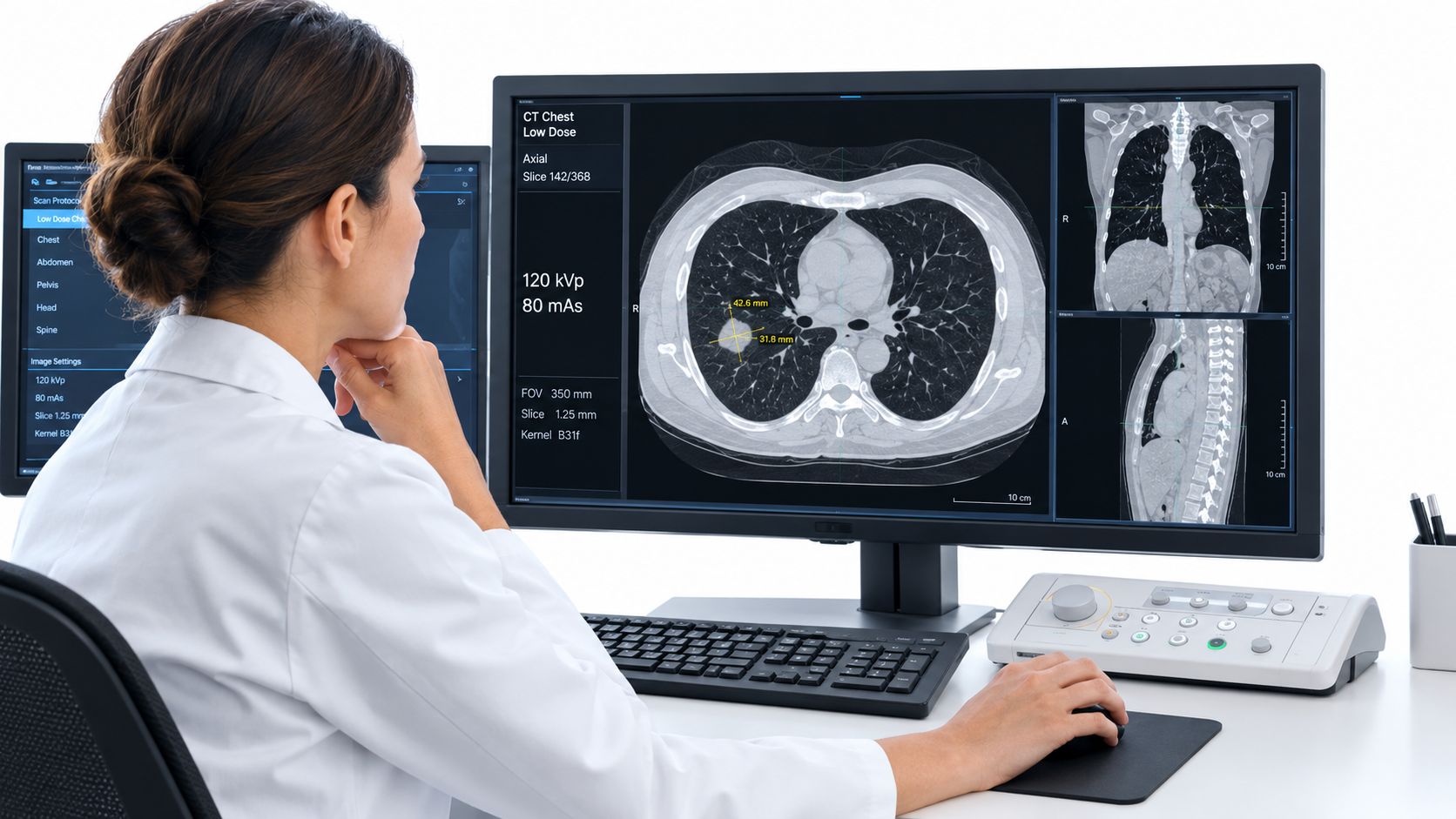
For a standardized adult screening examination, the ACR and CMS-referenced benchmark is a CTDIvol of no more than 3.0 mGy and an estimated effective dose of no more than 1 mSv for a standard 170-centimeter, 70-kilogram adult with a BMI of 24.3. The technical guidance on lung cancer screening dose benchmarks emphasizes that these values don't apply identically to every body type.
A larger patient may need more exposure to preserve diagnostic signal. A smaller patient may be scanned below the benchmark. A technically “lower” dose isn't a success if the resulting images no longer support reliable nodule detection.
Separating Screening From Diagnostic Testing
Screening and diagnosis answer different questions.
Screening asks: “Does an asymptomatic person with a high-risk history have a lung finding that needs attention?”
Diagnostic testing asks: “What is causing this person's symptoms, and what examination will characterize it accurately?”
That distinction matters because a person with persistent cough, coughing up blood, unexplained weight loss, chest pain, or other concerning symptoms shouldn't wait for a routine screening appointment. Symptoms require clinical assessment and, when appropriate, a diagnostic imaging protocol selected by the treating team. The screening eligibility checklist doesn't replace that evaluation.
| Screening LDCT | Diagnostic evaluation |
|---|---|
| Used for eligible people without symptoms | Used when symptoms or a known abnormality require investigation |
| Usually designed to identify and manage lung nodules | Chosen to answer a specific clinical question |
| Uses an optimized low-dose acquisition | May require different exposure, contrast, or imaging coverage |
| Leads to routine follow-up when findings are negative | Leads to targeted testing based on the suspected cause |
“Low dose” also doesn't mean “no risk.” Even an appropriate screening scan can identify a benign nodule, an incidental finding outside the lungs, or an abnormality that can't be classified immediately. Further CT imaging, PET imaging, specialist review, or biopsy may follow.
A lower radiation dose reduces exposure. It doesn't eliminate uncertainty, false positives, or the need for clinical judgment.
This is why you shouldn't ask a facility for the lowest possible dose. Ask whether the protocol is appropriate for lung screening, whether the team monitors image quality, and who will explain the result and coordinate follow-up.
Addressing Risks and False Positives
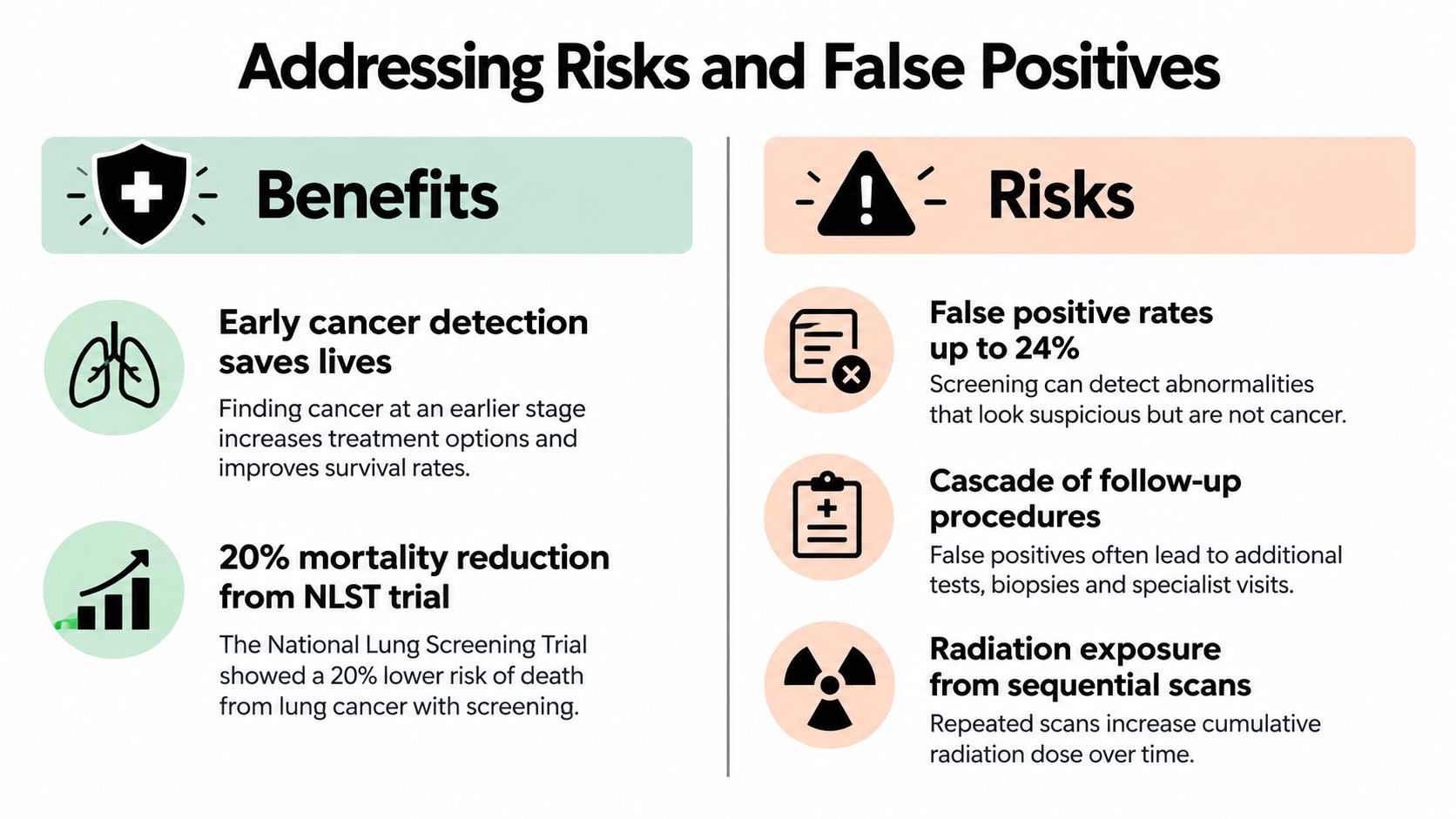
The benefit of early detection has to be weighed against what happens after an unexpected finding. A positive or indeterminate scan doesn't mean you have lung cancer. It means the radiologist has found something that may need comparison with prior images, repeat imaging, specialist assessment, or tissue diagnosis.
The risks include false-positive results, incidental findings, anxiety, unnecessary procedures, complications, overdiagnosis, and financial costs. The National Cancer Network risks summarized in the verified guidance also include false-negative results, meaning a screening scan can fail to show a cancer that is present. These limitations make shared decision-making essential.
A practical decision matrix
| Question | Screening pathway | Diagnostic pathway |
|---|---|---|
| Who is it for? | An asymptomatic adult who meets high-risk criteria | A person with symptoms or a known abnormality |
| Main purpose | Find a potentially important lung nodule early | Explain a symptom or characterize a specific finding |
| Typical next step after a reassuring result | Continue at the recommended screening interval | Continue clinical evaluation if symptoms persist |
| Typical next step after an uncertain result | Repeat imaging or specialist review | Targeted imaging, laboratory assessment, referral, or biopsy |
| Main decision concern | Whether expected benefit outweighs downstream harms | Which test can answer the immediate clinical question safely |
Australia's national lung cancer screening guidance estimates that about 3% of screened people receive a high-risk or very-high-risk nodule result, potentially triggering additional testing. That figure comes from the Australian national program workforce frequently asked questions. It doesn't mean every such result represents cancer. It illustrates why the pathway after the scan deserves attention before you consent.
Ask about practical issues early. Find out whether follow-up imaging is available where you live, whether specialist review is coordinated, what your insurance covers, and what happens if a biopsy is recommended. A screening program can only provide its full benefit when people can access the next steps.
The Path After an Abnormal Scan
A screening report usually leads to one of three broad pathways. The exact terminology and timing depend on the radiologist, the nodule's appearance, prior images, local protocols, and your overall health.
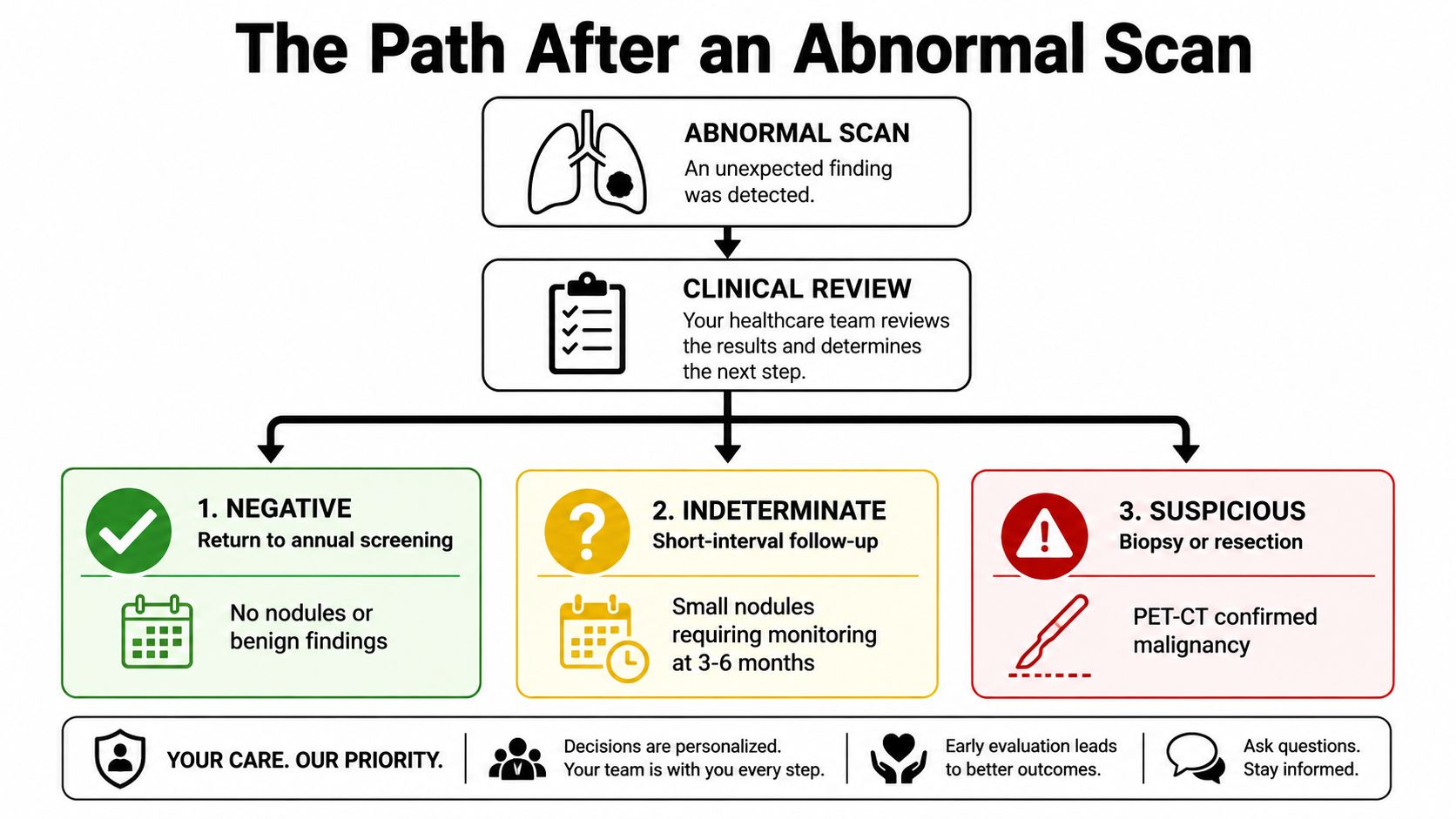
Negative or reassuring findings
A negative result may mean no suspicious nodules are visible, or that the radiologist sees only findings considered benign. Your clinician may recommend returning at the routine screening interval if you still meet the criteria. A negative scan lowers concern at that moment, but it doesn't permanently remove future risk.
Indeterminate findings
An indeterminate nodule is not clearly benign or clearly suspicious. The team may compare it with earlier scans, recommend surveillance imaging, or refer you for specialist review. Stability over time can support a benign interpretation, while growth or a change in appearance may require a more intensive evaluation.
This is the stage where waiting can feel alarming, even when surveillance is the medically appropriate choice. Ask what the finding is, why the team chose the proposed interval, who will review the next scan, and which changes would prompt escalation.
Suspicious findings
A suspicious finding may lead to multidisciplinary assessment, PET imaging, biopsy, or another procedure. A biopsy can help determine whether cancer is present and identify the type, but the safest route depends on the nodule's location, your lung function, other health conditions, and the balance of risks and benefits.
An abnormal scan is therefore a decision point, not a diagnosis. Before leaving the appointment, make sure you know the next action, the responsible clinician, and how you'll receive results.
Making the Final Decision on Screening
Use eligibility as the beginning of a conversation, not the end of one. The central question is whether screening could help you live longer while you remain able and willing to complete the evaluation and treatment that an abnormal result might require.
A person who meets the age and smoking criteria but has a serious condition that limits life expectancy may gain little from detecting a slow-growing cancer. Similarly, someone who wouldn't pursue surgery, radiation, or another curative-intent treatment may face the anxiety and procedures of screening without receiving its intended benefit.
Discuss these points with your clinician:
- Your risk history: Confirm your age, pack-year calculation, smoking status, and quit date.
- Your health status: Review lung function, other serious illnesses, and your ability to tolerate possible treatment.
- Your follow-up access: Identify where repeat imaging, specialist review, PET imaging, or biopsy would occur.
- Your preferences: Consider how you'd feel about uncertain findings and whether you'd pursue curative treatment if cancer were detected.
- Smoking cessation: If you currently smoke, ask for support to stop. Screening doesn't replace cessation, and both decisions belong in the same care conversation.
Annual LDCT can be valuable for the right high-risk person, but it isn't a general wellness scan. Ask your primary care clinician or a qualified screening service to review your circumstances, explain the local follow-up pathway, and confirm that the expected benefit outweighs the possible harms.
Metro Mush offers a curated selection of psilocybin products for adult consumers in the Detroit and Ann Arbor metro areas, including dried mushroom strains, chocolates, and drinks. Visit Metro Mush to review the menu, check locations, and learn how to place an order through its local delivery service.