

Harm reduction is effective for opioid treatment, overdose prevention and injection-drug services, with opioid agonist treatment associated with about 63% lower all-cause mortality during treatment than outside treatment. Evidence for psychedelic use outside clinics is much thinner, so safer-use steps shouldn't be mistaken for proof that a product or setting is safe.
That distinction matters whether you're considering medication treatment, picking up sterile supplies or planning around psilocybin use. Reducing a particular risk and establishing overall safety are different questions. An intervention can help without making drug use harmless, and a sensible precaution can remain unproven in controlled studies.
Is Harm Reduction Effective? The Short Answer
Yes, for specific interventions and outcomes, not as a blanket claim about everything called harm reduction. The clearest evidence concerns preventing infection and death through opioid treatment, sterile injection equipment and access to overdose-reversal medication.
A systematic review of opioid agonist treatment covering 32 cohort studies reported an all-cause mortality risk ratio of 0.372 during treatment compared with periods outside treatment, approximately a 63% relative reduction. That's a comparison between periods of care and periods without care, not a promise about any individual patient.
Evidence scorecard by harm-reduction intervention
| Intervention | Population | Outcome measured | Reported effect | Evidence strength |
|---|---|---|---|---|
| Syringe services programs | People who inject drugs | HIV infection risk | Lower risk among attendees | Strong, consistent observational body |
| Methadone after nonfatal overdose | People who survived an opioid overdose | Subsequent opioid-overdose deaths | Lower mortality than among comparable people receiving neither medication | Strong observational evidence from a U.S. study |
| Buprenorphine after nonfatal overdose | People who survived an opioid overdose | Subsequent opioid-overdose deaths | Lower mortality than among comparable people receiving neither medication | Strong observational evidence from a U.S. study |
| Opioid agonist treatment overall | Patients during treatment versus outside treatment | All-cause mortality | Substantially lower mortality during treatment | Strong cohort-study synthesis |
| Overdose education plus naloxone distribution | Communities implementing the intervention | Opioid-overdose death rates | Lower community death rates | Moderate to strong evidence |
| Naloxone distribution | Population-level distribution programs | Estimated overdose deaths prevented | Benefit estimated through modelling | Modelled estimate, not a guaranteed kit-to-life conversion |
| Psilocybin use outside clinics | Adults using informally | Harm-reduction behavior outcomes | No established quantified effect | Insufficient direct outcome data |
Find the row closest to your situation, then read across to the outcome measured. Preventing HIV infection isn't the same outcome as preventing an overdose. Neither establishes whether an informal psychedelic product contains what its label says.
Most of these mortality and infection findings come from observational evidence. Researchers compare groups or periods of exposure rather than assigning everyone randomly, so differences between participants can influence the result.
Reading rule: Ask what changed, for whom, compared with what, and under which conditions.
Large, consistent associations still matter for public-health decisions. But confidence in an established opioid service shouldn't automatically transfer to a different substance, product or setting.
What Harm Reduction Means and the Principles Behind It
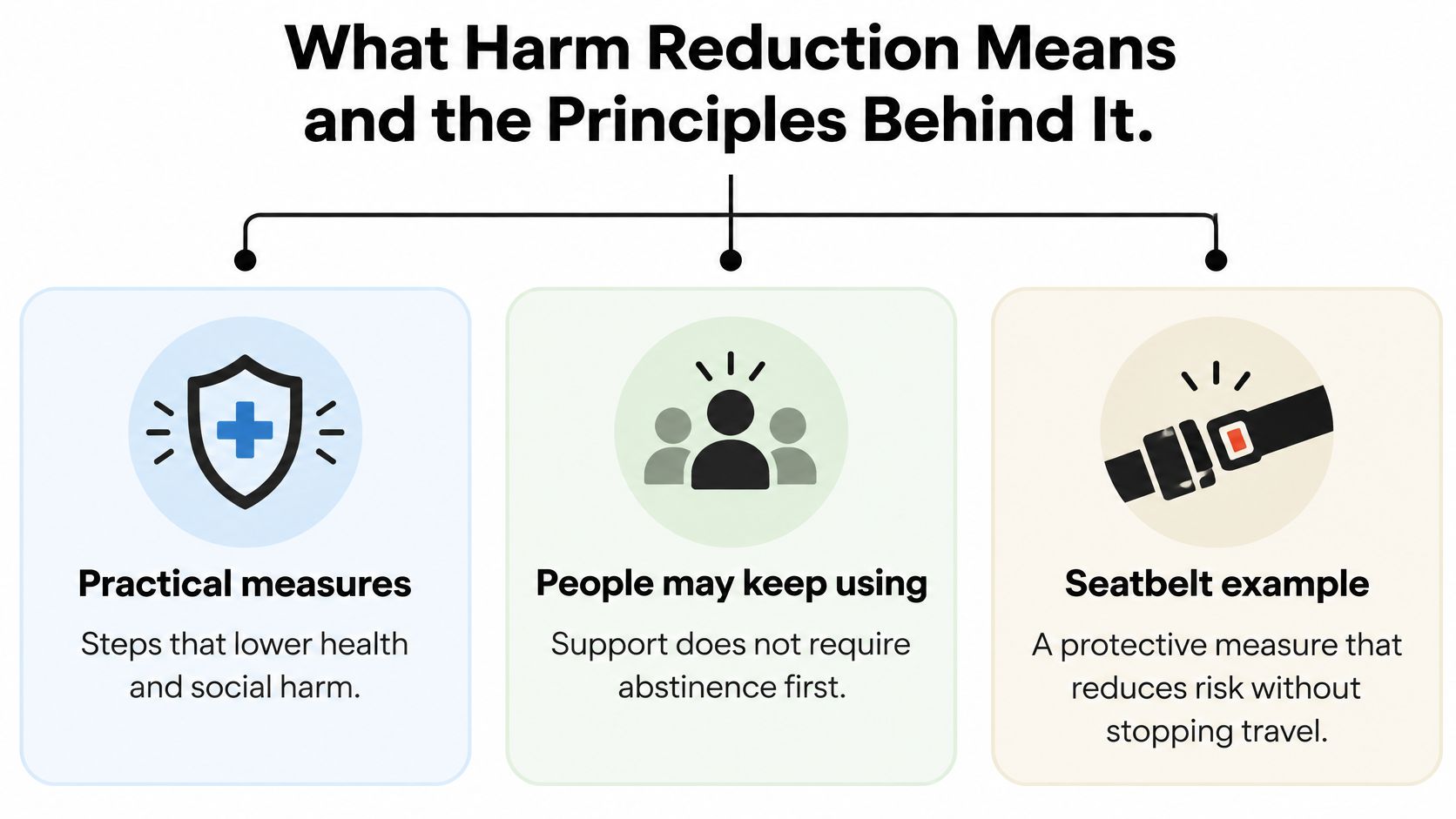
A seatbelt doesn't prevent every crash or require someone to stop travelling. It provides protection during an activity that still carries risk. Harm reduction follows a similar logic, although each drug-related intervention needs its own evidence.
Harm reduction means practical measures intended to reduce the health and social harms of drug use without requiring abstinence before someone receives support.
Say someone continues injecting drugs but starts using sterile equipment and carrying naloxone. They haven't necessarily changed their long-term goal. They've changed what protection is available today.
Principles that change how care works
- Meet people where they are. Offer useful support whether someone wants to stop, cut back or isn't ready to change their use.
- Recognize a spectrum. Occasional use, dependence, treatment and recovery aren't interchangeable experiences.
- Respect autonomy and dignity. Explain options clearly without making healthcare conditional on agreement.
- Measure meaningful outcomes. Count infections, overdoses, treatment engagement and wellbeing, not abstinence alone.
- Include people who use drugs. Ask them to help design opening hours, communication and services they can use.
The umbrella includes syringe services, naloxone distribution, medication treatment, drug checking and safer-use education. Sharing an umbrella doesn't mean these tools have equally strong evidence or solve the same problem.
Abstinence-focused care aims to stop use. Prohibition-based approaches primarily restrict access or possession. Harm reduction instead asks what protection someone can use while risk remains, and it can support someone who also chooses abstinence.
A program therefore shouldn't be judged as unsuccessful because participants haven't all stopped using. The relevant question is whether it achieves its stated health goals while respecting the people it serves.
How Harm Reduction Produces Measurable Results
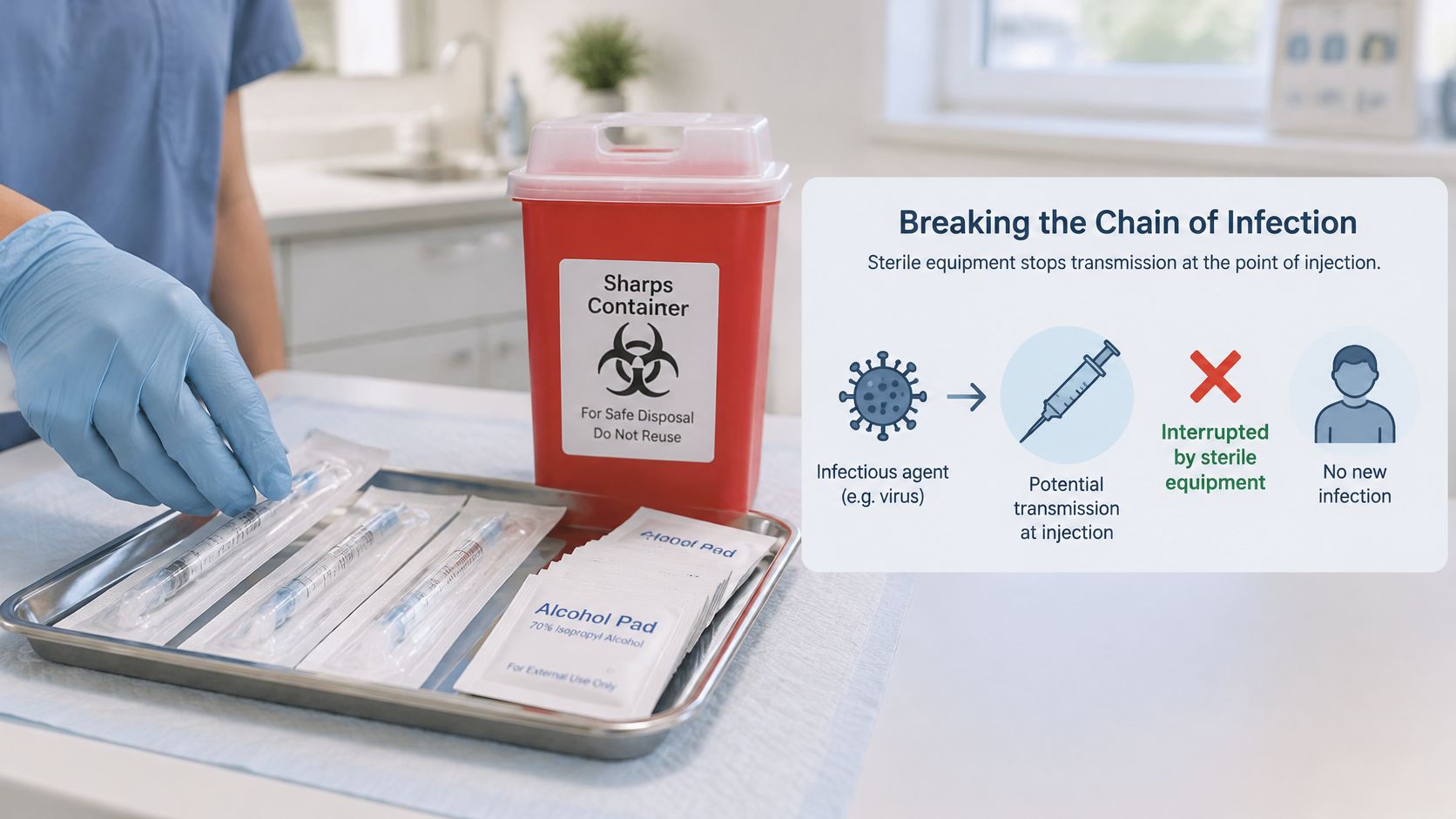
The clearest mechanism is also the simplest: reduce contact with contaminated injection equipment. A CDC-cited meta-analysis covering North America and Europe found 58% lower HIV infection risk among syringe-services attendees than among people who didn't attend, according to the CDC surveillance document.
Sterile supplies make that prevention pathway tangible.
Protection at the point of use
Replacing a reused syringe with a sterile one removes a potential route of blood-borne exposure. This is risk substitution: changing a dangerous part of an activity without requiring someone to change everything at once.
For example, someone who isn't ready for treatment can still collect sterile supplies and a sharps container. That practical change doesn't depend on a promise about future behavior.
Repeated contact and a route into care
Returning for supplies also creates opportunities for testing, vaccination, overdose education and treatment referral. A Veterans Affairs systematic review concluded that syringe services likely reduce HIV transmission and injection-risk behaviors, may reduce hepatitis C transmission, and facilitate access to naloxone and substance-use treatment.
A participant might initially want equipment only. Later, they may accept a test or ask for help arranging treatment. Staff can support that transition without making supplies conditional on it.
The video below offers another format for exploring harm reduction.
Reach determines practical impact
A service needs more than a name and an address. Its supply, hours and accessibility must allow people to obtain protection when they need it.
Useful evaluation measures include:
- Equipment coverage: Whether people can obtain enough sterile supplies.
- Infection outcomes: HIV and hepatitis C incidence.
- Overdose response: Naloxone distribution and reported reversals.
- Care connections: Referrals completed and continued engagement.
For psychedelic questions, apply the same discipline when reading psychedelic therapy research: identify the actual intervention and outcome rather than borrowing confidence from another field.
Observational cohort findings describe associations, not guaranteed effects. Check the comparison group, attendance and follow-up before treating a single percentage as a prediction for your own situation.
How Well It Works for Each Substance
Opioids have the strongest mortality evidence in this comparison. A U.S. study summarized by the National Institute on Drug Abuse found that, during 12 months after a nonfatal opioid overdose, opioid-overdose deaths were 59% lower with methadone and 38% lower with buprenorphine than among comparable people receiving neither medication. The summary also reports 27% to 46% lower opioid-overdose death rates in communities implementing overdose education and naloxone distribution.
Medication helps manage withdrawal and craving. Naloxone responds to an overdose emergency. They address different risks, so one does not replace the other.
Evidence strength and key tools by substance
| Substance group | Strongest evidence | Key harm-reduction tools | Main evidence gap |
|---|---|---|---|
| Opioids, including heroin, fentanyl and prescription opioids | Reduced overdose deaths and mortality with opioid agonist treatment and naloxone | Medication treatment, naloxone, overdose education; supervised consumption where available | Treatment access, continuity and unpredictable supply |
| Injected drugs in general | Reduced HIV transmission through sterile equipment and syringe services | Sterile equipment, HIV and hepatitis C testing, referral | Hepatitis C effect less firmly established |
| Psilocybin and psychedelics | Encouraging safety observations under clinical screening and monitoring | Screening, product information, a planned environment and avoiding mixing | Insufficient real-world behavioral outcome evidence |
| Stimulants, including cocaine and methamphetamine | No stimulant-specific outcome is quantified here | Drug checking, avoiding solo use, avoiding overheating; clinical assessment for treatment options | Direct effectiveness of individual informal-use precautions |
| Alcohol | No tactic-specific outcome has been quantified in current research | Pacing, eating, arranging transport and drink-spiking awareness | How much each precaution changes risk in a given setting |
| Cannabis and edibles | No tactic-specific outcome has been quantified in current research | Cautious edible use, avoiding alcohol and not driving | Product-specific potency and behavioral outcome evidence |
Sterile equipment addresses an infection pathway for people who inject drugs, regardless of the substance. It does not establish that the substance itself is chemically safe.
Psychedelic precautions raise a separate question: whether a specific product or setting has been shown to be safe. Reviewing psilocybin drug interactions can help someone prepare questions for a pharmacist or clinician, but a webpage cannot determine whether a medication combination is safe for an individual.
For stimulants, alcohol and cannabis, practical precautions may make sense, but their effects should not be assigned opioid-treatment numbers. Contingency management is a clinical treatment approach; its evidence does not establish that a particular recreational-use tactic works.
An evidence gap does not prove that a precaution has no effect. It means the size and reliability of its effect on a specific behavior and outcome remain uncertain.
Clinics, Communities and Private Use Compared
A clinical study doesn't test a substance in isolation. It tests a package that may include participant selection, known dosing, supervision and a response plan. Remove those conditions and you've changed the situation being evaluated.
A review of psilocybin use outside clinical settings identified common cannabis co-use, warned that it may increase adverse-event risk, and concluded that existing clinical evidence is insufficient to guide real-world harm-reduction policy. Clinical safety observations therefore shouldn't be interpreted as certification of informal products.
What the evidence supports in each setting
| Setting | What the evidence supports | Main limitation | Practical implication |
|---|---|---|---|
| Syringe services and outreach | Sterile supplies, testing and referral pathways | Uneven coverage and attendance | Choose an accessible service you can return to |
| Supervised medical care, including opioid treatment clinics | Lower mortality associated with remaining in treatment | Interruptions and loss of engagement | Arrange continuity before moving or changing providers |
| Clinical psychedelic trials | Safety observations and treatment outcomes under specified protocols | Selected participants and inconsistent adverse-event reporting | Don't assume findings transfer to informal use |
| Unsupervised home or social use | Little direct evidence quantifying safer-use behavior outcomes | Unknown potency, co-use and limited monitoring | Resolve uncertainties before use; a sober companion isn't medical supervision |
Uncertainty is part of the risk assessment
Headache, nausea, vomiting, fatigue, anxiety and high blood pressure are relevant concerns in psychedelic safety assessment. Inconsistent definitions and reporting make it harder to compare adverse events across studies, even before considering differences between clinical and informal use.
Unknown potency creates a practical problem: someone can't reliably plan around information they don't have. A familiar strain name, attractive packaging or a previous comfortable experience doesn't establish the contents or strength of another batch.
A precaution can be reasonable without proving that the surrounding activity is safe.
Place your situation in the table according to the support available, not the atmosphere or branding. Unsupervised use with unknown potency deserves the most caution, because neither the exposure nor the available response is well controlled.
Online education can help someone prepare, but access to instructions isn't the same as access to testing, transport, a clinician or emergency assistance.
Who Harm Reduction Reaches and Who It Misses
An intervention can work for participants while remaining inaccessible to people who need it. A systematic review of U.S. opioid harm-reduction interventions found moderate-to-strong evidence overall, alongside a lack of culturally relevant interventions prioritizing Black and Brown communities disproportionately affected by overdose.
That's a distinction between effectiveness when received and the ability to receive it. A service's average outcome doesn't tell you whether its hours, language or location exclude particular residents.
Barriers that change real-world usefulness
- Criminalization and fear: Someone may avoid a service if they fear police attention or legal consequences.
- Stigma: Dismissive treatment can discourage a return visit.
- Transport and cost: A nominally available service may still be out of reach.
- Language and healthcare access: Instructions and referrals must be understandable and usable.
Consider a service that distributes supplies during working hours only. Extending those hours or offering community outreach may be a more useful response than repeating instructions to people who can't attend.
Information isn't the same as action
A person may understand guidance but lack a private place, reliable transport or money to act on it. Digital reminders can't supply those missing resources, and page views don't demonstrate safer behavior.
Programs should ask:
- Who receives guidance? Examine reach across neighborhoods, languages and circumstances.
- Who trusts it? Invite candid feedback about staff, privacy and cultural relevance.
- Who acts on it? Measure completed referrals and usable access, not information distribution alone.
Culturally adapted, low-cost, community-led approaches deserve evaluation against those practical outcomes. For an individual reader, a useful test is whether the service can explain how it accommodates people with your circumstances.
Ask about language support, confidentiality, transport and follow-up. You shouldn't need to fit an ideal participant profile to receive respectful help.
Readiness Check and Safer Session Plan
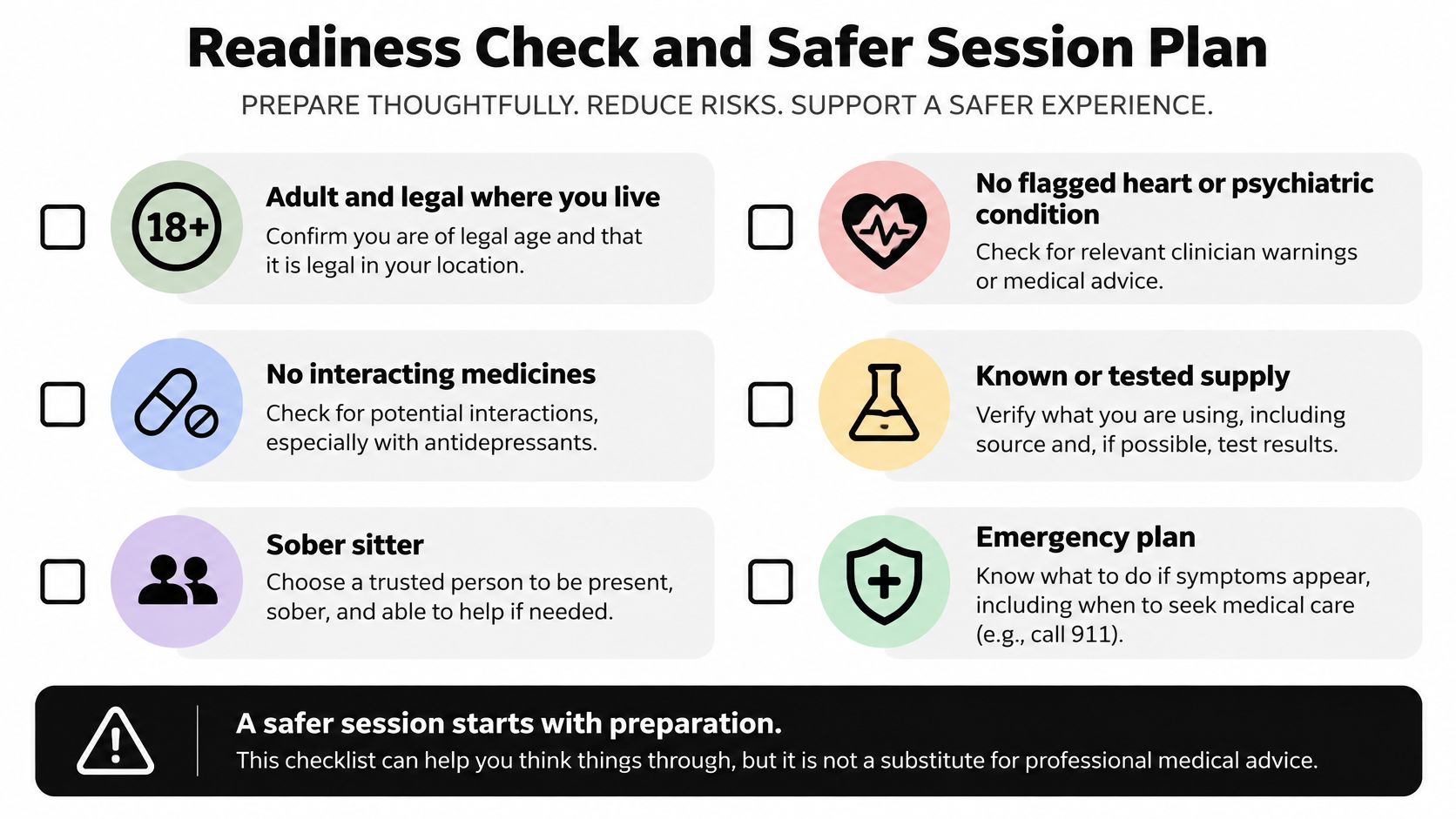
Treat unresolved safety questions as a reason to delay, not a detail to work around. This checklist is a practical planning aid for adults considering psychedelics, not a validated screening tool or medical clearance.
Before proceeding, confirm the following:
- Legal eligibility: You're an adult and have checked the rules where you are, including any travel involved.
- Health review: No unresolved heart, blood pressure or psychiatric concern has been flagged, and pregnancy or other medical uncertainty has been discussed with a clinician.
- Medication review: A pharmacist or prescriber has assessed possible interactions, including antidepressants. Don't stop prescribed medication to make drug use possible.
- Product information: Identity and potency information are sufficiently clear to assess, rather than assumed from a name.
- Support and surroundings: A trusted sober companion, a safe place to remain and transport without driving are arranged.
- Emergency readiness: A charged phone, local emergency contact and an agreement to stop or seek help are in place.
If an item remains unresolved, don't use that day.
Before
- Decide whether to proceed at all. Feeling unwell, distressed or pressured is a sufficient reason to cancel. A plan doesn't create an obligation.
- Review your health and medications with an appropriate professional. Include psychiatric history, cardiovascular concerns and blood pressure treatment rather than asking only whether psychedelics are generally safe.
- Treat potency as uncertain unless substantiated. Our current Hillbilly Pumpkin strain that we've grown tends to result in higher potency levels. That's a reason not to assume different mushrooms or batches are interchangeable, not a basis for a standardized dose.
- Prepare a familiar space with water, food and a charged phone. Agree on boundaries with your companion, including who will call for help and provide responders with product information.
- Avoid alcohol and other drugs, including cannabis. Don't take more because an expected effect hasn't arrived; onset and duration can be unpredictable, particularly when product information is incomplete.
During
- Stay with the sober companion and stop adding substances. If distressed, reduce noise and stimulation, move away from hazards and communicate what you're feeling. Don't dismiss physical warning signs as merely part of the experience.
After
- Rest, eat when comfortable and drink normally. Check in with your companion afterward, note unexpected effects and seek professional advice for symptoms that persist or interfere with daily life.
Keep packaging or available product information accessible, but treat marketing and potency statements as claims rather than independent verification. Take any unclear health, medication or product question to a clinician, pharmacist or local harm-reduction service before making another plan.
What to Do If a Session Goes Wrong
Chest pain, trouble breathing, fainting, seizure or unresponsiveness means calling emergency services now. Don't wait to identify the substance or decide whether the reaction is psychological.
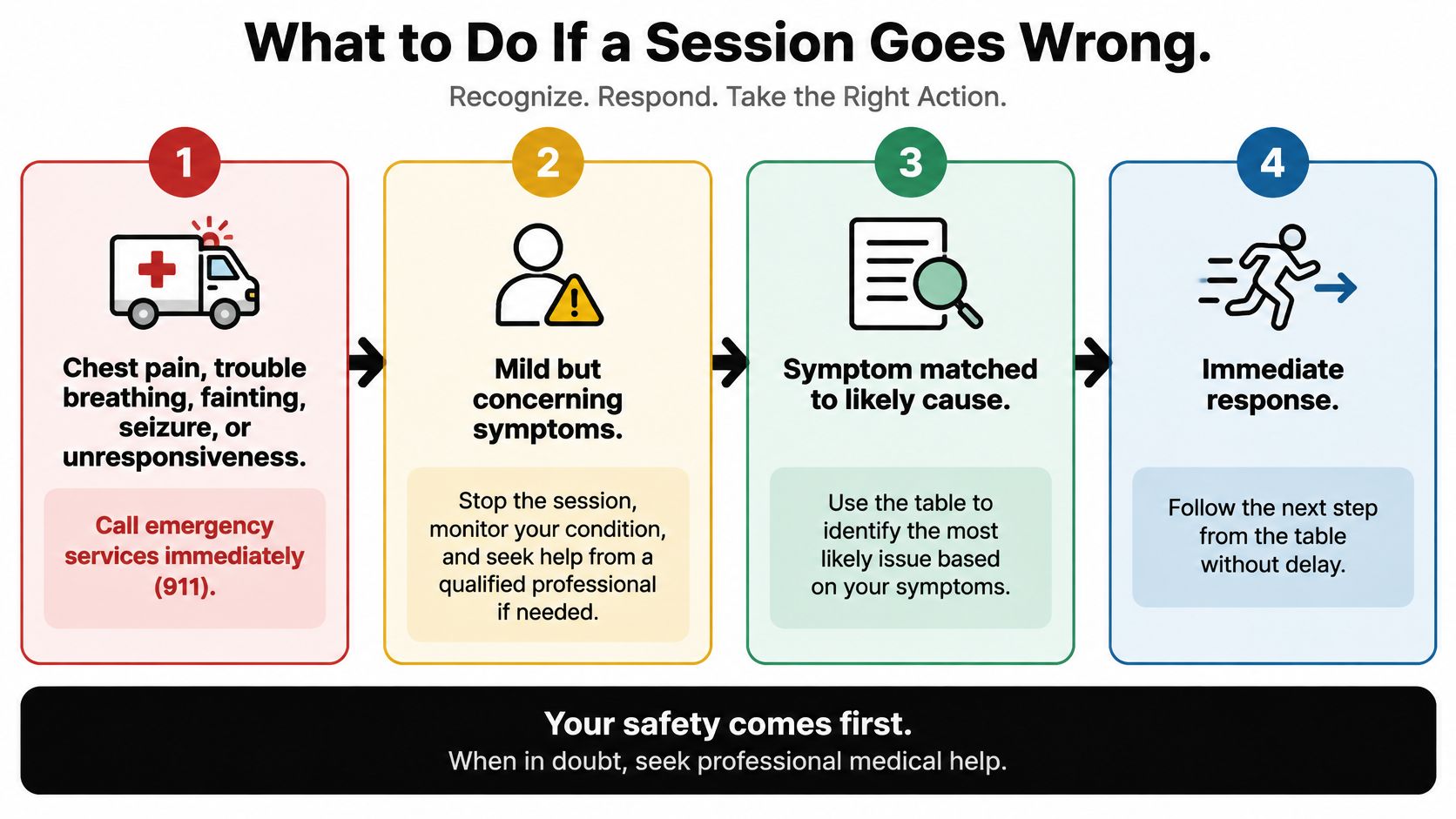
Warning signs, likely causes and responses
Symptoms can have several causes. The possibilities below aren't diagnoses.
| Symptom | Likely cause | Immediate response |
|---|---|---|
| Chest pain, trouble breathing or fainting | Possible cardiovascular stress, mixed substances or another medical emergency | Call emergency services immediately |
| Seizure, severe confusion or unresponsiveness | Possible overdose or severe reaction | Call emergency services; if unresponsive but breathing normally, place on their side |
| Intense panic or anxiety | May involve dose, distress or surroundings | Reduce stimulation, speak quietly and stay present; seek help if it doesn't ease |
| Overheating or very high body temperature | Possible heat exposure or substance-related illness | Move somewhere cool; seek emergency help for severe symptoms |
| Persistent headache, nausea or vomiting | Several possibilities, including medication or substance effects | Rest; small sips only if fully alert; seek care if severe, sudden or persistent |
| Confusion or unusual thinking beyond the session | Possible ongoing psychological or medical reaction | Contact a clinician urgently; use emergency services if safety is threatened |
If breathing isn't normal, follow the emergency dispatcher's CPR instructions. Give naloxone if opioid exposure is possible and it's available; don't let that delay the emergency call. Never give drinks to someone who is drowsy or unresponsive.
For non-emergency distress, guidance on responding to a difficult psychedelic experience can support calm companionship. It cannot replace medical assessment.
Metro Mush offers psilocybin products for adult consumers in the Detroit and Ann Arbor areas, alongside educational guidance on planning and risk awareness. Visit Metro Mush to review product information and safety resources, and take unresolved medical or medication questions to a qualified clinician before deciding whether to use.