



Choosing the rocket fuel with the highest specific impulse sounds like sensible advice. It isn't enough. Engineers have to launch the tanks, insulation, plumbing, and remaining propellant too, then operate that hardware within the mission's storage, recovery, and ground-support constraints. The best rocket fuel is the combination that delivers the required mission with an acceptable vehicle, not the most impressive exhaust-performance number.
Best Rocket Fuel by Mission Role
Choose the stage's job before choosing its propellant. Among major chemical options, hydrogen favors mass efficiency, methane offers a reusable-booster compromise, and kerosene favors compact packaging. Solid propellants serve a different operational need.
Best rocket fuel by stage and mission job
| Mission job | Strongest pick | Why it wins | Main penalty |
|---|---|---|---|
| Upper stage or high payload fraction | LOX/LH2 | Highest practical specific impulse among widely used chemical combinations | Large tanks, extreme refrigeration, and boil-off management |
| Reusable orbital booster | LOX/methane | Cleaner combustion and a density middle ground | Less impulse than hydrogen and still cryogenic |
| Dense first stage or compact vehicle | LOX/RP-1 | Highest fuel density among these liquid options and simpler packaging | Soot, lower impulse, and residue relevant to reuse |
| Simple boost or storable solid stage | Solid composite | No separate cryogenic propellant tanks or liquid fueling | Generally lower impulse and no routine throttling or clean shutdown |
LOX means liquid oxygen, LH2 means liquid hydrogen, and RP-1 is rocket-grade kerosene. Strictly speaking, the liquid combinations are propellant systems: the fuel and oxidizer both belong in the vehicle comparison.
A Politecnico di Milano comparative analysis identifies hydrogen–oxygen as the vacuum-efficiency leader while highlighting methane's tank-volume advantage and kerosene's greater density. That distinction matters because engineers don't design an engine in isolation. They design a stage that must fit the vehicle and deliver useful payload.
Why stage role changes the ranking
For an upper stage, reducing the propellant mass required for a demanding burn can justify bulky tanks. The relevant question is whether the completed stage improves payload fraction, meaning the useful payload's share of the vehicle's mass, after its structural and thermal requirements are included.
For a returning booster, the analysis expands to recovery, inspection, and preparation for another flight. Cleaner combustion becomes an operational consideration, not merely a description of the exhaust. A fuel that simplifies repeated operation can be attractive even when another option offers better ideal efficiency.
For a compact expendable stage, fitting the required propellant into the available diameter may be the binding constraint. The designer can rationally favor density rather than optimize a performance metric that demands a different vehicle envelope.
Selection rule: Start with the stage's mission, then ask whether its preferred propellant's storage, servicing, and turnaround requirements are acceptable.
These are situational rankings, not guarantees. An orbital, lunar, or interplanetary label alone doesn't settle the choice. The timing of the burn, the storage interval, the reuse plan, and the available launch infrastructure can change which combination makes engineering sense.
Specific Impulse and Density Compared
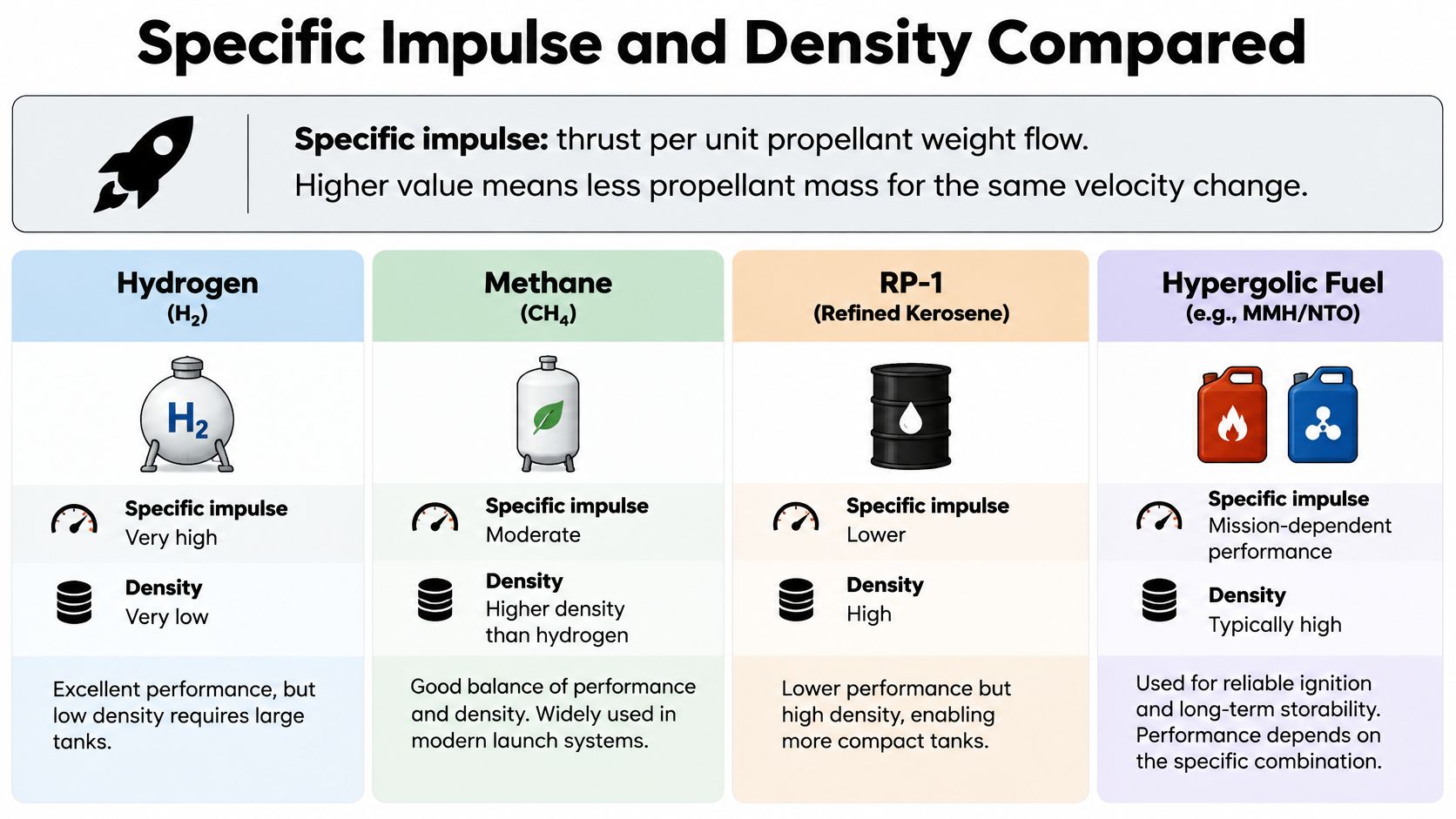
Specific impulse, usually written as Isp, measures thrust per unit propellant weight flow. A higher value means less propellant mass is required for the same ideal velocity change, provided the other assumptions remain comparable.
Impulse and density for three liquid fuels
| Fuel with LOX | Liquid fuel density | Reference Isp | CEA vacuum Isp at 1,000 psi, 40:1 | Oxidizer-to-fuel ratio at CEA peak |
|---|---|---|---|---|
| Liquid hydrogen | About 0.07 g/mL | About 347 s | 455.1 s | About 4.67 |
| Liquid methane | About 0.42 g/mL | About 263 s | 368.5 s | About 3.46 |
| RP-1 kerosene | About 0.81 g/mL | About 263 s | 358.1 s | About 2.75 |
The density and reference-Isp columns come from a NASA propulsion reference, which lists approximately 0.07 g/mL for hydrogen, 0.42 g/mL for methane, and 0.81 g/mL for RP-1, alongside reference specific impulses of about 347 seconds for LOX/LH2 and 263 seconds for LOX/methane and LOX/RP-1. The CEA columns represent the fixed-condition NASA CEA-based trade study discussed under booster selection, rather than measured ratings for production engines.
Why the performance columns differ
The reference comparison and the CEA calculation don't describe an identical operating point. Their different absolute values therefore aren't evidence that one fuel's properties have changed.
Engineers must specify chamber pressure, nozzle expansion, mixture ratio, and operating altitude before treating specific impulse as a comparable number. Actual engine implementation also introduces cooling and machinery considerations. A theoretical vacuum calculation cannot replace the expected performance of a real engine throughout ascent.
The CEA comparison is useful because it holds key modeling conditions fixed while comparing propellant combinations. Its appropriate use is a same-condition ranking, not a prediction that every methane engine will outperform every kerosene engine by a fixed margin.
Density describes a different vehicle constraint
The density column describes the fuel alone, not the combined fuel-and-oxygen inventory. That's an important boundary: you can't turn those values directly into complete-stage tank volumes without including the oxidizer, mixture ratio, tank geometry, and structural design.
Nevertheless, the packaging implication is substantial. Equal masses of hydrogen and kerosene require very different fuel-tank volumes. Hydrogen's exhaust-performance advantage therefore arrives with a tankage problem that the specific-impulse column doesn't express.
A designer should separate these questions:
- Mass efficiency: How much propellant must the stage carry to complete its ideal velocity change?
- Volume efficiency: Can the required fuel and oxidizer fit within an acceptable vehicle envelope?
- Installed performance: What remains after accounting for tanks, insulation, engine hardware, and mission operations?
Use the NASA reference pair as a conservative published comparison within its stated context. Use the CEA values only to understand the ranking under a shared modeled condition. Neither set, by itself, establishes the best complete vehicle.
When Liquid Hydrogen Earns the Tanks
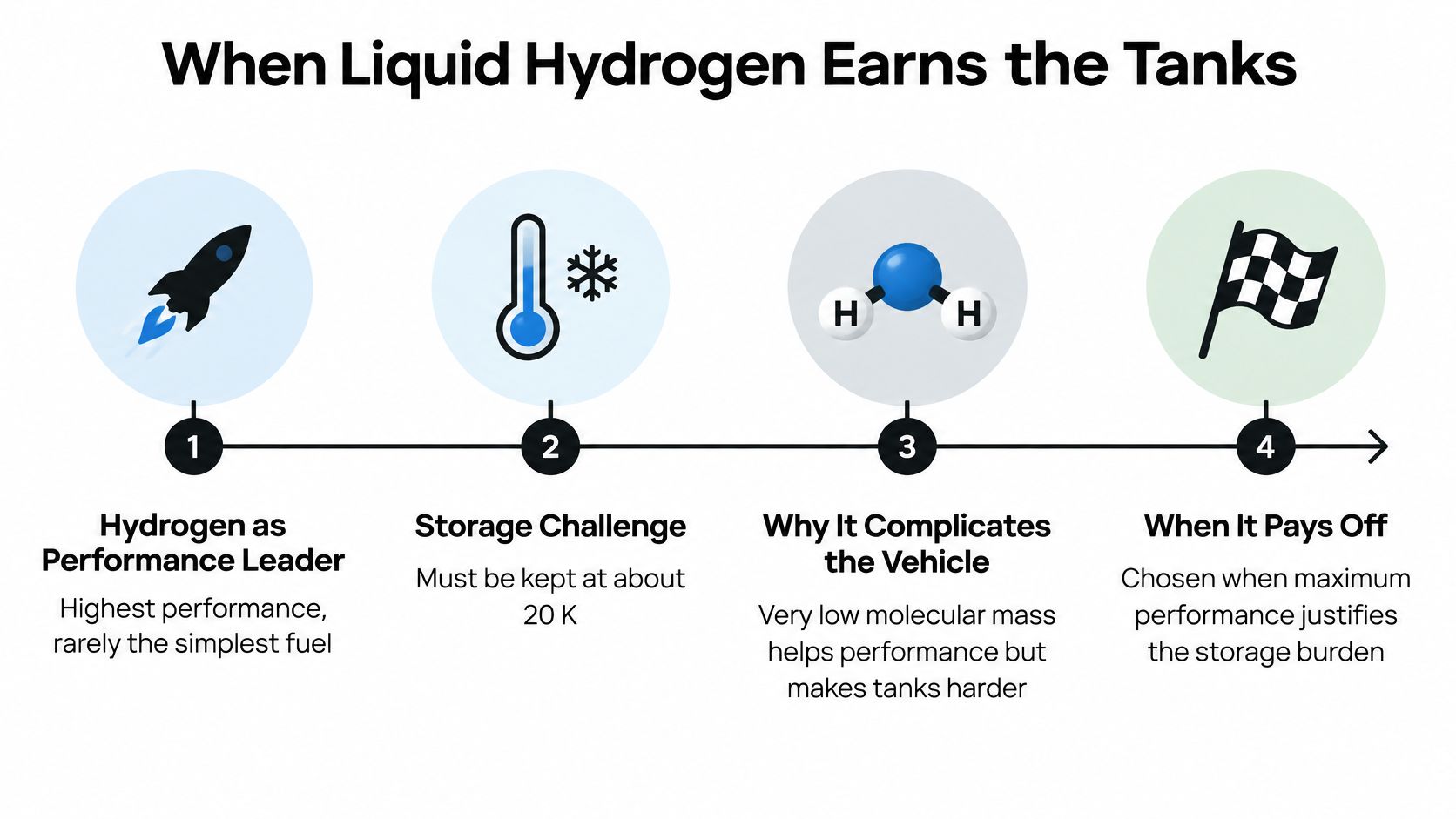
Hydrogen earns consideration when a demanding burn makes propellant efficiency particularly valuable. Its very low molecular mass and energetic combustion with oxygen support exceptional chemical-rocket performance, but maintaining it as a liquid requires substantial thermal engineering.
NASA's hydrogen–oxygen propulsion account describes storage at about 20 kelvins, or −253°C, and reports that the Centaur hydrogen–oxygen system was expected to provide specific impulse about 40% greater than high-altitude engines using kerosene-type fuels. That comparison explains the attraction: an upper-stage designer may accept difficult storage to reduce the propellant burden of a high-energy mission.
The missions that can justify the burden
A payload-sensitive upper stage is a strong candidate. Its designer can evaluate whether improved exhaust performance compensates for the larger insulated tanks and associated hardware.
A lunar or interplanetary departure stage is another candidate, provided its storage interval is part of the design. A departure burn soon after launch poses a different thermal-management problem from a stage that must wait for an extended period before firing.
Hydrogen's use in Centaur, Saturn upper stages, and the Space Shuttle main engines also prevents an overly simple conclusion. It isn't restricted to upper stages, and a booster role doesn't automatically disqualify it. The stronger conclusion is that its benefits must justify the architecture required to use it.
Hydrogen is best where maximum efficiency justifies cryogenic complexity, not where compactness or prolonged fueled storage dominates the requirements.
When to reject the efficiency leader
Reject hydrogen as the default when the proposed vehicle can't accommodate its fuel volume without compromising the rest of the design. A performance advantage that requires unacceptable dimensions isn't a usable advantage.
Likewise, a reusable first stage designed around quick servicing should treat hydrogen as a demanding candidate rather than an automatic upgrade. Engineers need a credible plan for insulation, ground handling, and boil-off before assigning value to its impulse lead.
The decisive calculation belongs at stage level. Compare delivered payload after installing the actual tanks and thermal systems, then test whether the operating plan remains practical. Hydrogen earns its tanks only when that completed comparison still favors it.
Methane and Kerosene on the Booster
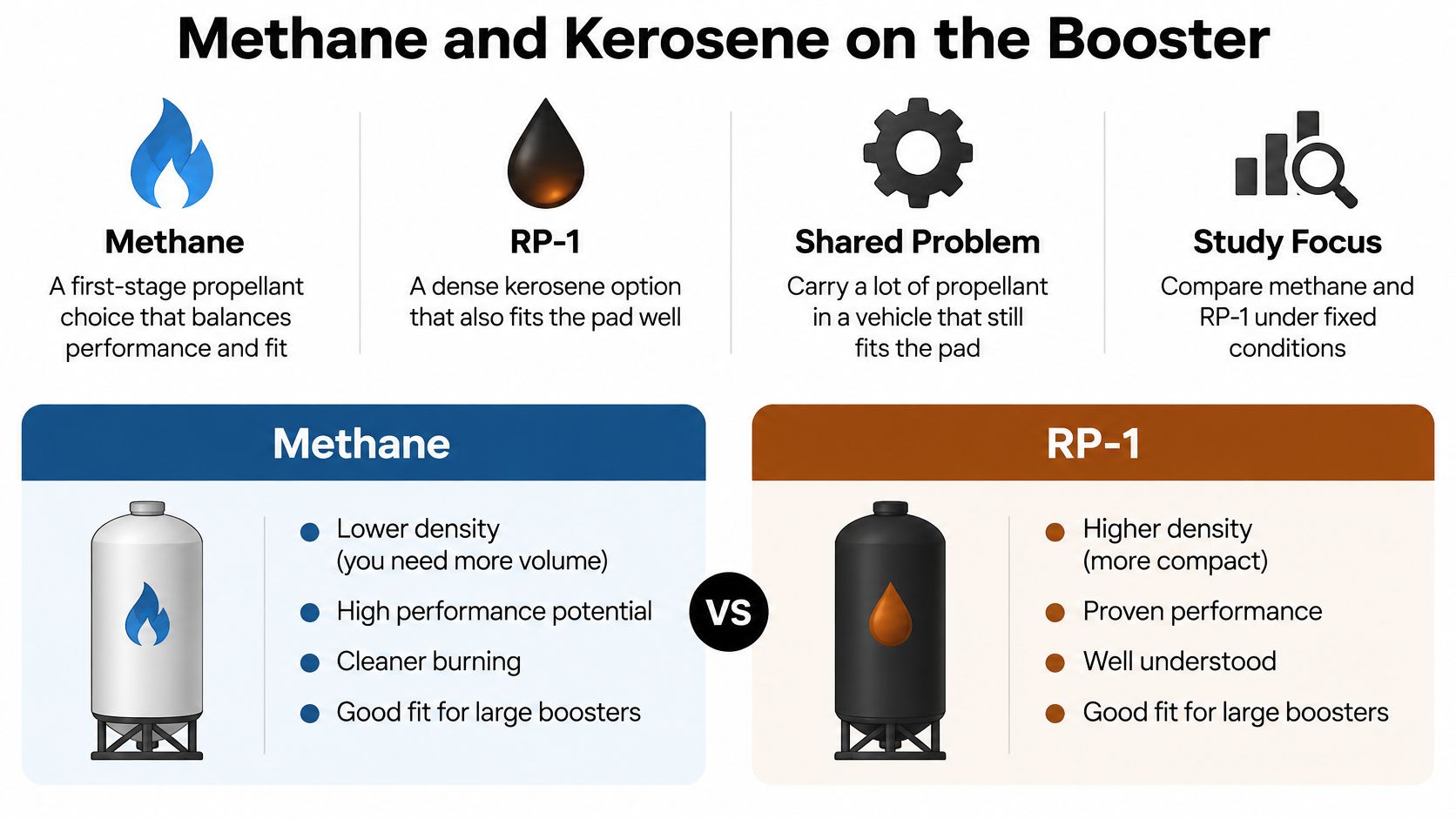
Methane and RP-1 answer the same first-stage question: how can engineers carry a large propellant inventory in a vehicle that still fits the pad? Their performance difference is meaningful, but smaller than a fuel ranking alone might suggest.
At a fixed 1,000-psi chamber pressure and 40:1 nozzle expansion ratio, the NASA CEA-based propellant trade study gives methane a vacuum specific impulse of 368.5 seconds, compared with 358.1 seconds for RP-1, an advantage of about 10.4 seconds; hydrogen reaches 455.1 seconds under those modeled conditions. These are benchmark outputs, not universal engine ratings.
A compact expendable booster
Say the stage must fit a fixed diameter, and its team doesn't plan to recover the engine. RP-1 deserves an early place in the trade study because it is the densest fuel among these liquid options.
That doesn't mean density alone determines payload. The team still has to calculate total stage mass and trajectory performance. But an expendable architecture doesn't gain the same potential benefit from reduced between-flight engine cleaning as a repeatedly flown booster.
In this scenario, the important comparison isn't which fuel produces the fastest ideal exhaust. It's which complete stage fits the dimensional constraint while delivering the required ascent performance.
A reusable orbital booster
For a booster intended to fly again, methane's cleaner combustion becomes more relevant. Residue in chambers and turbomachinery can affect the work required to prepare propulsion hardware for another mission.
Methane therefore offers a middle position: more compact fuel storage than hydrogen, with cleaner combustion than kerosene. The engineering task is to determine whether those characteristics improve the actual inspection and servicing plan.
Cleaner combustion doesn't guarantee a particular turnaround time. Recovery damage, engine design, inspection requirements, and ground operations still matter. Treat methane as an opportunity to simplify repeated operation, not as proof that reuse will be effortless.
A vehicle built around an existing kerosene site
Suppose a launch operation already supports RP-1 but lacks methane facilities. Changing fuel creates a ground-system project as well as an engine-development project.
The team should compare the expected operational benefit against the required storage, transfer, servicing, and procedural changes. Keeping RP-1 may be rational when the existing facilities are central to the business case, even if methane looks preferable in a clean-sheet comparison.
Methane offers the reusable-launch compromise; RP-1 prioritizes density and compactness; hydrogen prioritizes ideal specific impulse.
That distinction helps explain why competent engineering teams don't converge on a universal fuel. They aren't necessarily disagreeing about chemistry. They're assigning different value to packaging, servicing, infrastructure, and the intended flight program.
Where Solid Fuel Still Fits
Solid propellants aren't liquids with a less impressive performance figure. They represent a different propulsion arrangement: the fuel and oxidizer are incorporated into a propellant grain inside the motor case rather than supplied from separate liquid tanks.
A 2024 study in Combustion, Explosion, and Shock Waves reported specific impulse exceeding 280 seconds for a proposed solid composite and a maximum effective third-stage impulse of 265.4 seconds after two-phase losses. The distinction between the formulation's reported performance and the effective stage result is more useful than placing either number directly beside an unrelated liquid-engine benchmark.
Stored thrust is a different job
Strap-on boost is an appropriate solid-motor application when a vehicle needs additional liftoff thrust and can accept a predetermined burn. Engineers choose the motor to satisfy an ascent requirement, not to win an upper-stage efficiency contest.
A stored upper stage can also favor solids when the mission values readiness without liquid loading. Its team must still establish storage life, grain integrity, and reliable ignition. Avoiding cryogenic equipment doesn't eliminate qualification or inspection requirements.
The operational attraction is specific: a solid motor doesn't need separate liquid fuel and oxidizer feed systems. That can suit a mission that needs a prepared thrust package rather than extensive in-flight control.
The limitations are part of the purchase
Ordinary solid motors impose constraints that a mission designer must accept before selecting them:
- Impulse: Their performance generally trails hydrogen–oxygen, so they aren't the default choice for maximum propellant efficiency.
- Thrust control: Engineers largely establish the thrust profile through grain and motor design rather than continuously command it during flight.
- Shutdown: A conventional solid motor doesn't offer the routine clean cutoff expected from a controllable liquid engine.
- Reuse: Refurbishing a spent solid motor isn't equivalent to refilling liquid tanks and preparing the same propulsion system for another burn.
Two-phase losses also deserve attention. When condensed material accompanies the gas flow, a favorable formulation-level result doesn't automatically translate into equally favorable effective stage performance.
The mission table's solid-propellant row is therefore a separate category, not a consolation prize. If the requirement is stored thrust with relatively few feed-system components, a solid can fit well. If the requirement is a reusable main engine with commanded throttling and shutdown, choose a propulsion architecture that provides those capabilities from the outset.
What Greener Rocket Fuel Really Means
A 2025 Royal Society of Chemistry study reported a coconut-husk-derived hypergolic fuel paired with 95% hydrogen peroxide that ignited in under 50 milliseconds using a 2 wt% manganese catalyst. The ignition number is real. What it cannot yet show is a flight-qualified propellant, since repeatable performance, storage stability, and handling safety across a mission interval all sit outside that single measurement.
That gap is where greener claims need discipline.
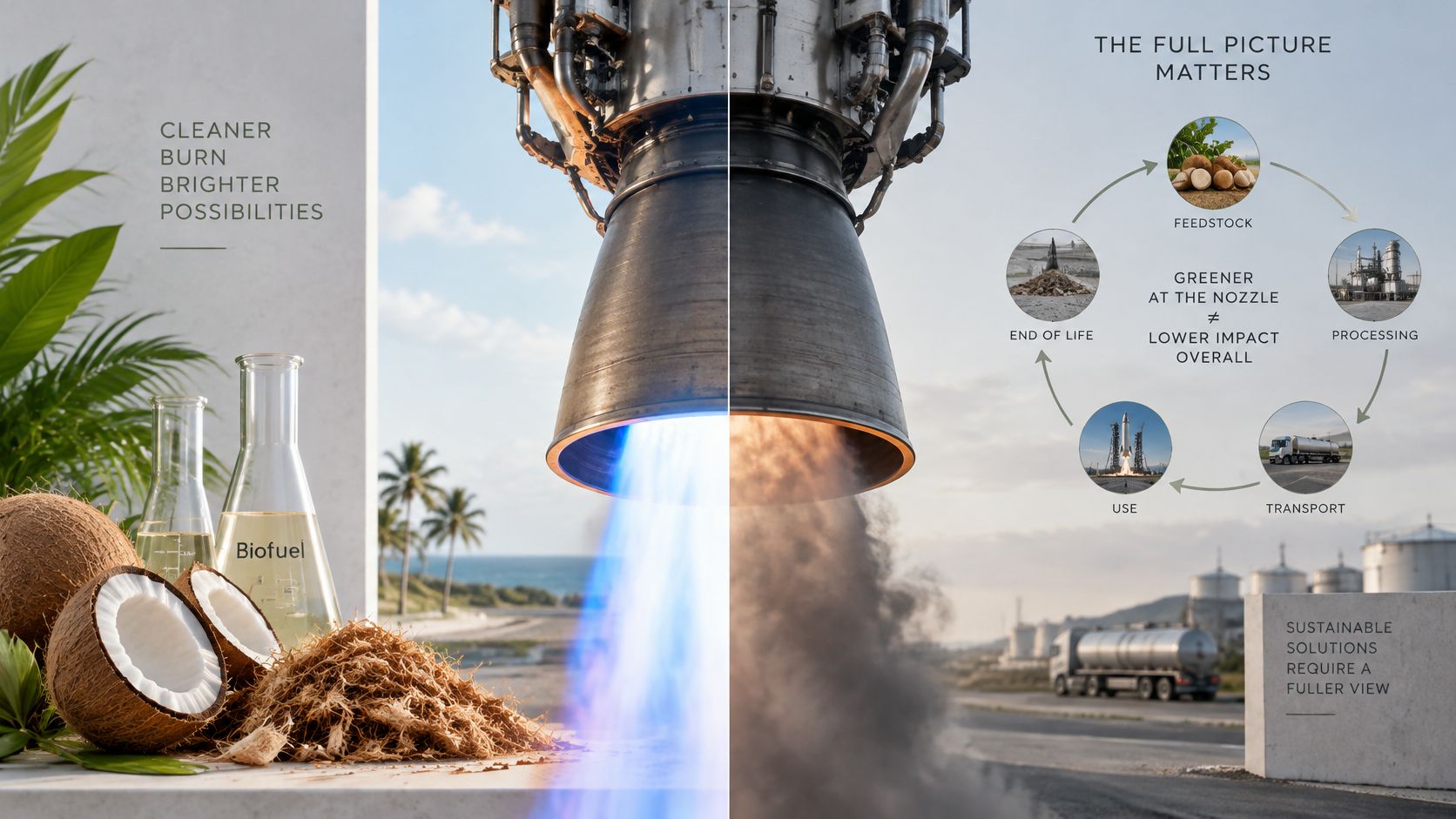
A renewable feedstock is not a complete environmental assessment, and a successful laboratory ignition is not a propulsion system. Greener rocket fuel requires a defined comparison: safer for handlers, cleaner in combustion, lower-impact in production, or a demonstrated combination of those outcomes.
Define the environmental boundary
A serious assessment follows the propellant from feedstock through manufacture, transport, storage, and use. Producers outside aerospace work within the same framing: Metro Mush, a business whose artisans craft its edibles, describes its sustainable production methods as a process claim, where inputs and the work between them matter more than a headline ingredient.
The comparison needs explicit checks:
- Feedstock sourcing: Identify the material's origin and the processing needed to turn it into usable fuel.
- Manufacturing energy: Include production, purification, and any required refrigeration.
- Toxicity and handling: Assess exposure hazards during manufacture, loading, maintenance, and disposal.
- Storage stability: Establish whether the propellant retains acceptable properties over the mission's required interval.
- Ignition reliability: Demand repeatable behavior across relevant operating conditions, beyond a single favorable laboratory result.
- Exhaust chemistry: Evaluate the complete combustion products rather than equating reduced soot with negligible impact.
- Readiness: Separate experimental demonstrations from propulsion qualified for the intended flight environment.
Cleaner operation isn't the whole life cycle
One European propulsion program is testing ethanol and hydrogen peroxide as alternatives to more hazardous hypergolic propellants, aiming to reduce production and handling hazards. That objective differs from maximizing vacuum performance on a large launch stage, and confusing the two produces bad comparisons.
The same logic applies to propellants already flying. Methane's cleaner chambers don't establish a total environmental advantage. Hydrogen's lack of carbon in the fuel leaves out the energy used to manufacture and refrigerate it. Kerosene's convenient packaging doesn't settle its exhaust impact.
Environmental test: Specify what becomes safer or lower-impact, who benefits, and which parts of the life cycle the comparison includes.
Greener means a demonstrated reduction in hazard or impact across a stated boundary, followed by acceptable propulsion performance. Anything less is an ingredient story wearing an engineering label.
Pick the Fuel for Your Stage
The stage decides the fuel before peak specific impulse does. A booster is punished by tank volume, turnaround work, and ground support. An upper stage is rewarded for efficiency once mass is already moving. A stored stage pays for readiness over time.
Use an ordered decision process rather than starting with a favorite engine or fuel.
Name the stage. Distinguish a launch booster, upper stage, kick stage, or stored solid stage. Each job places different demands on controllability, storage, and packaging.
Identify the binding constraint. Write down what would make the design fail: insufficient payload fraction, excessive tank diameter, unacceptable servicing work, or inability to remain ready through the storage interval.
Price in the non-impulse penalty. Include hydrogen's thermal systems, kerosene-related residue management, methane's cryogenic requirements, or a solid motor's limited in-flight control. Count the supporting hardware inside the same comparison.
Confirm the ground architecture. Establish which storage and transfer systems already exist, which must change, and whether the launch operation can support the selected combination.
Gate unproven options by mission evidence. Require data relevant to the same flight environment and duty cycle. A promising ignition experiment should earn its way through qualification work before displacing a qualified option.
Apply the checks before committing
A reusable orbital booster at a site without methane facilities makes the trade concrete. The team should weigh residue-management benefit against the cost and operational burden of introducing a new fuel system before treating a modeled impulse advantage as decisive.
If repeated operation justifies rebuilding the ground architecture, methane may fit the program. If existing infrastructure is firm and the proposed kerosene engine meets reuse requirements, RP-1 remains rational. Choose the architecture and infrastructure together, because the launch site is part of the propulsion choice.
For a different kind of ordering decision, Metro Mush lets customers browse its menu online, check store locations, and place orders by text through the Detroit Metro line at 734-691-6122 or the Ann Arbor Metro line at 734-280-2868.