


Most growers should expect about 1 to 2 months from start to first harvest. Under optimized conditions, Psilocybe cubensis often finishes in 30 to 45 days, while slower genetics like Penis Envy and Enigma can stretch that to 60 to 90 days.
If you're asking because you've been staring at a spore kit, a grow bag, or a Reddit thread full of conflicting answers, you're not alone. This is one of the most common mushroom questions because the honest answer isn't just one number. It depends on what you're starting with, what strain you're growing, and whether your home setup stays stable enough for the fungus to keep moving.
That last part trips people up. A lot of beginners hear "three to four weeks" and assume mushrooms work like herbs on a windowsill. They don't. Growing is a sequence. First the mycelium has to establish itself, then it has to fully colonize its food source, then the environment has to tell it it's time to fruit. If any one of those phases slows down, the whole schedule slides.
For readers around Detroit and Ann Arbor, that matters even more. Indoor temperature swings, dry winter air, and inconsistent humidity can turn an "easy" timeline into a much longer project. So, for a realistic understanding of how long shrooms take to grow in real life, not just in ideal grow-guide language, the useful answer is this: plan for a month or two, and build in extra patience if your setup isn't dialed in.
The Allure and Reality of Growing Your Own
You buy a kit on a Friday, set it on a shelf, and start hoping for mushrooms by next weekend. That expectation is easy to understand. A lot of grow guides make the process sound quick and tidy. Real home growing usually feels slower, fussier, and far less predictable.
The appeal is still genuine. Growing your own lets you watch a strange little ecosystem develop in real time. You get a closer look at how mycelium spreads, how pins form, and how small changes in moisture or temperature can affect the outcome. For some people, that hands-on part is the whole point.
It's about the time commitment. Best-case estimates are only part of the story. Home growers are dealing with room temperature swings, dry air, uneven humidity, genetics that do not all behave the same way, and the occasional mistake in cleanliness or timing. A fast, forgiving cubensis variety may move along without much drama. Slower genetics, including Penis Envy, often ask for more patience.
Why one grower gets mushrooms faster than another
Two people can start with similar supplies and still end up on very different schedules. The biggest reasons are usually straightforward:
- Starting point. A ready-to-fruit kit is much further along than spores or a fresh grain project.
- Genetics. Some varieties colonize and fruit with less resistance. Others take their time.
- Home conditions. Stable warmth and humidity help. A cold apartment, dry winter heat, or frequent airflow changes can slow progress.
- Handling. Clean technique and good timing keep a grow on track. Rushing steps often creates delays instead of saving time.
A simple rule helps here. If you want mushrooms for a specific date, do not plan around the fastest timeline you saw online.
What new growers often miss
The hardest part is usually not the harvest. It is the long stretch where the project looks like nothing is happening.
Mycelium works more like sourdough starter than a house project. The activity starts, below the surface, and the visible payoff comes later. If that hidden growth is healthy, fruiting has a chance. If it stalls, everything else stalls with it.
That is why realistic expectations matter. Growing can be rewarding, but it is rarely an instant-gratification hobby. For readers comparing effort versus convenience, that contrast matters. You can spend weeks or months dialing in a grow, especially with slower strains, or you can skip the waiting and buy high-quality products from a trusted local source like Metro Mush.
The Complete Mushroom Growth Timeline Deconstructed
A home grow usually feels slow in the beginning, then suddenly speeds up near the end. That rhythm throws off a lot of first-time growers.
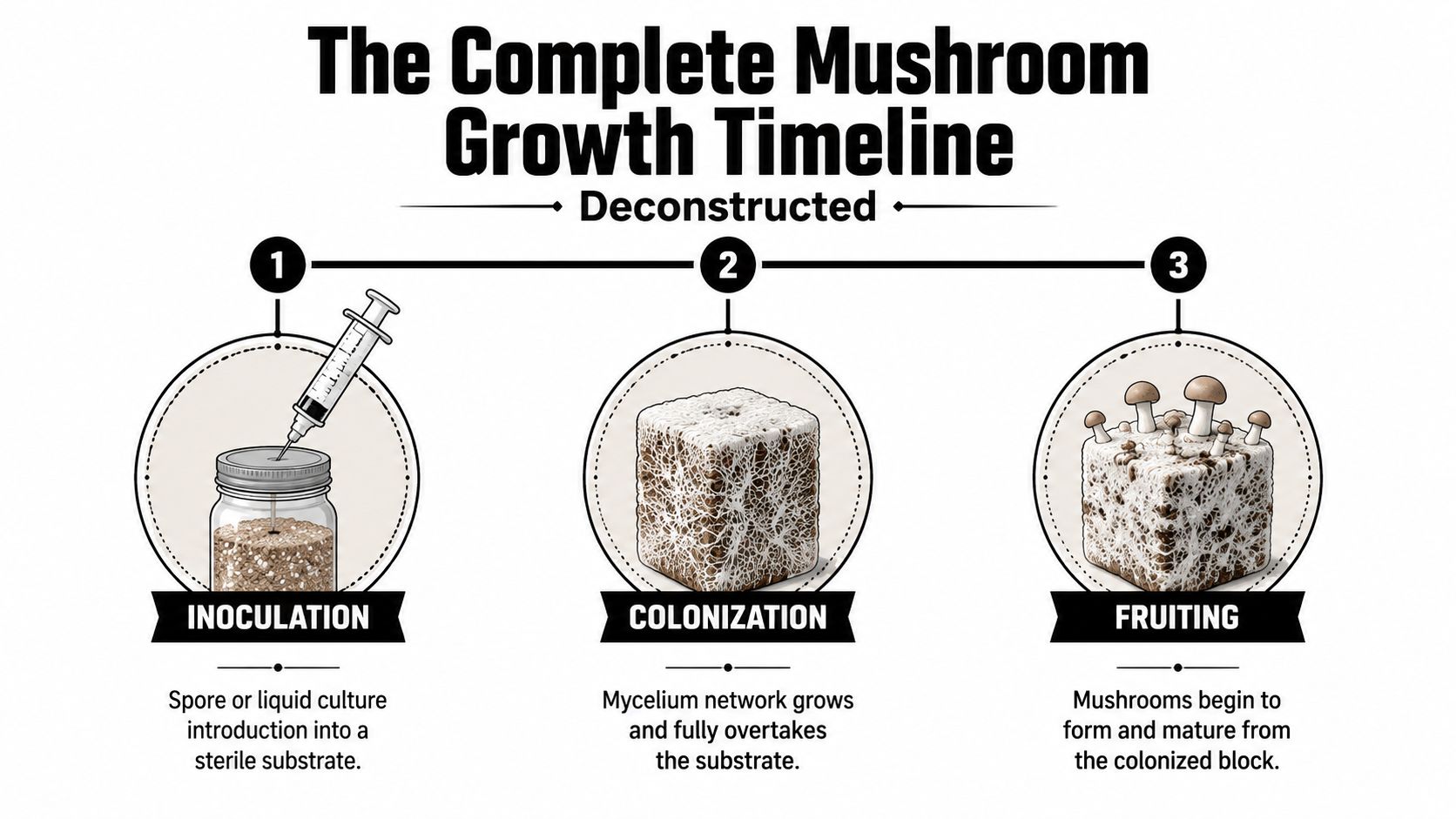
The clearest way to understand the timeline is to break it into three stages: inoculation, colonization, and fruiting. Each stage depends on the one before it. If the first step starts weak or the middle step gets delayed, harvest moves back too. That is why two growers can begin in the same month and finish weeks apart, especially if one is working from spores and the other starts with a mushroom liquid culture.
Here's the process at a glance.
Inoculation
Inoculation is the setup phase. You introduce spores, liquid culture, or clean agar-grown material into a sterile medium and then wait for the first signs of life.
That waiting period confuses new growers because the container often looks unchanged at first. Under the surface, the culture is trying to establish itself. The first visible progress is usually small white patches of mycelium, and those patches can take time to show depending on what you started with.
A video walkthrough can make those early signs easier to recognize.
Colonization
Colonization is where the main clock runs. During this stage, mycelium spreads through the grain or substrate until it has taken over enough territory to support mushrooms later.
The timing here varies a lot at home. In the YouTube grow timeline linked above, the creator shows how colonization can finish fairly quickly in some setups and stretch much longer in others, with the full path from inoculation to first harvest often landing around a couple of months for standard varieties. Faster results usually come from clean genetics, stable temperatures, and a strong starting culture. Slower results are common with spores, inconsistent room conditions, or varieties that move at their own pace.
This is also the stage that tests patience. From the outside, it can look like very little is happening. Inside the container, the fungus is building a dense network that will later feed the fruiting bodies.
What success looks like
A healthy colonizing container usually shows:
- Bright white growth spreading through the medium
- Coverage that becomes more even over time
- Steady progress instead of sudden stalling, dark spots, or odd colors
Containers that stop changing for days on end often have a condition problem, a weak culture, or contamination.
Fruiting
Fruiting begins after the substrate is fully colonized and exposed to the right conditions. Humidity, fresh air, and light help trigger the shift from hidden growth to visible mushrooms. The first sign is usually pinning, where tiny mushroom buds begin to form.
This stage feels different because progress becomes easy to see. Once pins arrive, many growers stop worrying because the project finally looks alive. Even then, the timing is not identical from one grow to the next. Ready-to-fruit products can move much faster than a grow started from scratch, while slower genetics can add extra waiting even after healthy colonization.
Healthy mushroom growing often feels quiet for weeks, then busy all at once.
A simple timeline summary
| Stage | What happens | Typical timing |
|---|---|---|
| Inoculation | Culture is introduced into sterile medium | Starting point, followed by an initial waiting period |
| Colonization | Mycelium spreads through grain or substrate | Often the longest phase, ranging from relatively quick to several weeks |
| Fruiting | Pins form, then mature into harvestable mushrooms | Usually the final stretch after full colonization |
For many readers, this is the key takeaway: growing is not one single countdown. It is a chain of biological checkpoints. Under good home conditions, a standard variety may finish in about two months. Slower strains, especially ones like Penis Envy, can push that commitment further. That is the appeal and the tradeoff. You can grow your own, learn the process, and wait through each stage, or skip the long timeline and buy from a trusted local source like Metro Mush when you want something ready now.
Critical Factors That Influence Your Grow Schedule
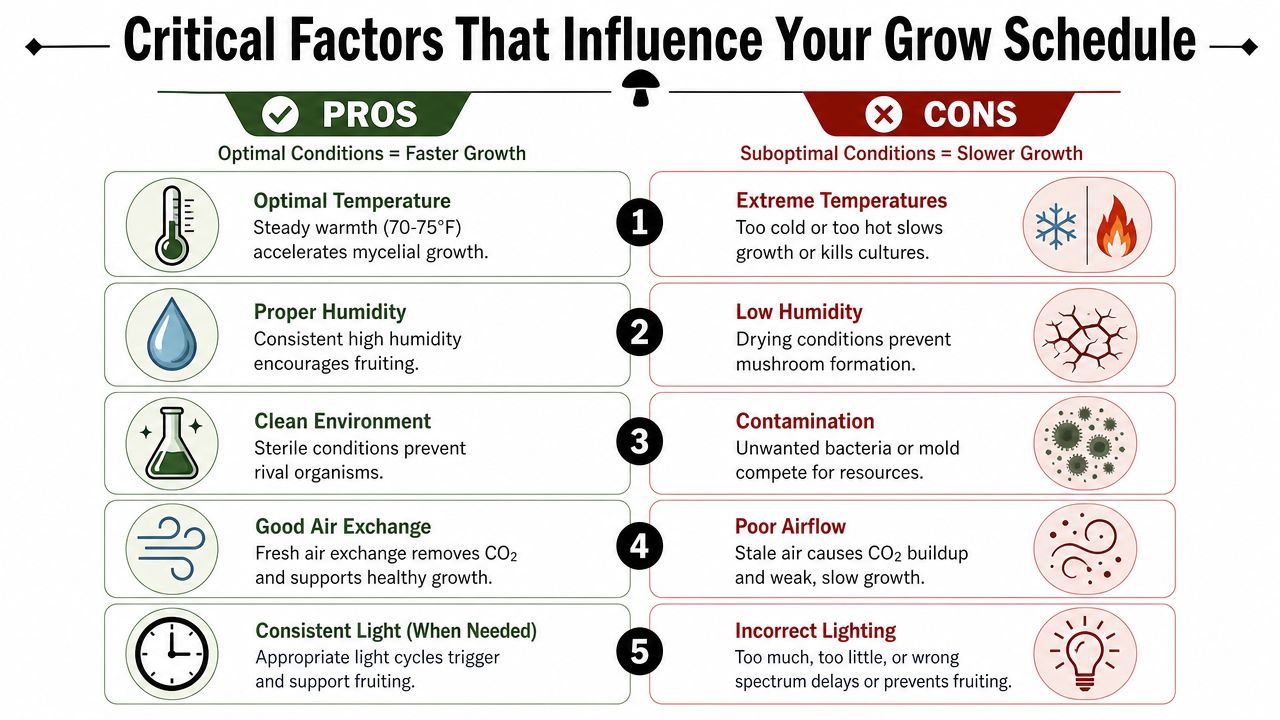
The fastest way to ruin a mushroom timeline is to think the fungus only needs "roughly warm" conditions and occasional misting. Mushrooms respond to specifics. If those specifics drift, the schedule changes with them.
Humidity and temperature do most of the damage
The fruiting phase is where many home grows wobble. According to Cornell's cultivation stage reference, humidity must stay above 85% for the first 4 days post-pinning, and failing to do that causes a 40 to 60% reduction in yield because young pins dry out. The same source says temperatures above 78°F (26°C) can trigger sterile mycelial overgrowth instead of fruiting, which can halt progress entirely.
That's why a grow can look fine one week and disappoint the next. Pins are fragile. Once they start, they need consistency more than guesswork.
Four variables that change the schedule
- Temperature: Too cool and metabolism slows. Too warm and the culture can stop fruiting properly.
- Humidity: Mycelium can tolerate a lot, but fresh pins don't forgive dry air.
- Fresh air exchange: Fruiting needs a different environment than colonization. Stale, trapped air often delays visible development.
- Clean handling: Contamination doesn't just lower quality. It can end the grow before fruiting even begins.
If you're using mushroom liquid culture, culture quality and clean technique matter even more because you're trying to give the desired organism a clean head start.
A mushroom grow doesn't usually fail all at once. It slips off course through small inconsistencies.
Why home setups vary so much
Apartments and houses don't hold stable conditions all day. Heat kicks on. Air conditioning dries the room. Windows leak cold air. A closet can feel perfect at noon and completely different at night.
That gap between "ideal" and "normal home life" explains why some growers breeze through and others wait far longer. A good setup isn't just warm enough. It's predictable.
How Popular Strains Impact Growth Speed
Not all strains move at the same pace. That's one of the biggest reasons people get wildly different answers when they ask how long do shrooms take to grow. They're often comparing different genetics without realizing it.
Standard cubensis versus slower specialty genetics
For Psilocybe cubensis, the total growth cycle from grain inoculation to first harvest typically spans 30 to 45 days under optimized conditions, according to this strain timeline from Real Mushrooms. That same source notes that Penis Envy and Enigma often take 60 to 90 days because they colonize and fruit more slowly.
So when someone says, "Mine took just over a month," and someone else says, "I waited almost three," both can be telling the truth.
A practical comparison
The easiest way to think about strain choice is patience versus payoff. Standard cubensis varieties are usually the friendlier option if your main goal is learning the process and seeing a first harvest without a long wait. Slower genetics ask more from the grower. They don't just require more time. They require steadier conditions over that longer period.
If you're browsing different Psilocybe cubensis strains, it helps to treat growth speed as part of the strain's personality, not just a footnote.
Mushroom Strain Growth Time Comparison
| Strain | Colonization Time | Fruiting Time | Total Avg. Time |
|---|---|---|---|
| Standard Psilocybe cubensis | Faster relative pace under optimized conditions | Shorter relative fruiting window | 30 to 45 days |
| Penis Envy | Slower colonization | Longer fruiting period | 60 to 90 days |
| Enigma | Slower colonization | Longer fruiting period | 60 to 90 days |
Why beginners often choose the wrong starting point
A lot of first-time growers pick a famous strain instead of a manageable one. That's understandable. Potent genetics get the attention. But slower strains leave more time for room conditions to drift, for moisture management to get uneven, and for small mistakes to compound.
Potency and convenience don't always live in the same strain.
If your goal is education, a standard cubensis timeline is easier to learn from. If your goal is chasing a sought-after strain, you should expect a longer commitment and less wiggle room.
Maximizing Your Harvest With Multiple Flushes
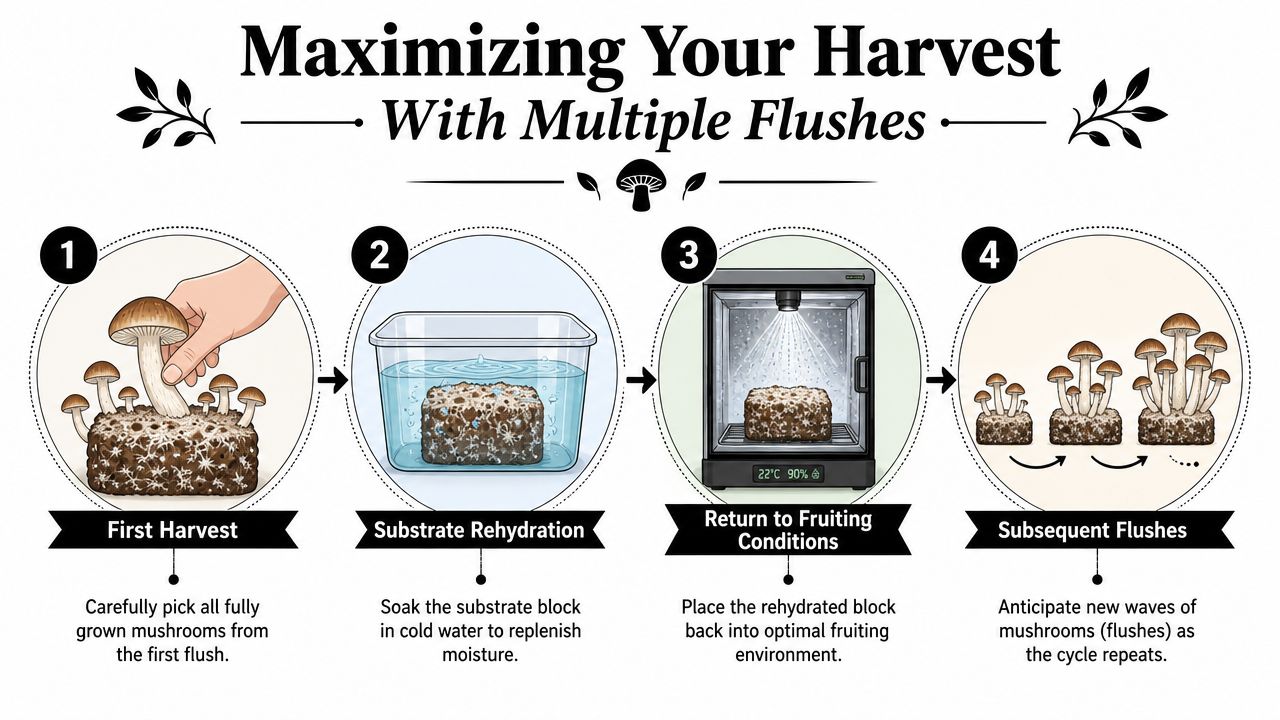
The first harvest isn't the end of the grow. A healthy block can often produce more than one wave of mushrooms. Growers call those waves flushes.
What a flush actually means
After the first harvest, the substrate is partly spent and partly dry. If it's still healthy, the grower can rehydrate it and return it to fruiting conditions. That gives the mycelium another chance to convert remaining nutrients into mushrooms.
According to this flush-cycle discussion in the Uncle Ben's community, Psilocybe cubensis can produce 3 to 4 harvests from a single bulk block, with each later flush arriving 14 to 21 days after the prior harvest. The same source notes that Enigma and Penis Envy often produce only 1 to 2 flushes.
How growers encourage another round
The basic rhythm looks like this:
- Harvest cleanly. Remove mature mushrooms without tearing up the surface more than necessary.
- Rehydrate the block. Growers often soak or otherwise re-wet the substrate so the mycelium has moisture to work with again.
- Restore fruiting conditions. Humidity, airflow, and light cues need to return.
- Wait for the next wave. The substrate won't rebound instantly. It needs recovery time.
That extra cycle is where growing shifts from "one project" to "ongoing care." The first flush might feel exciting. The second and third flushes feel more like maintenance work.
Why later flushes matter for planning
If you're only thinking about the first harvest, a grow may seem like a one-month or two-month project. If you're hoping to get everything a block can produce, the timeline gets much longer. Standard cubensis blocks can stay productive over multiple rounds, while slower specialty strains may give fewer waves and ask for more patience between them.
Flush expectations by type
| Grow type | Likely flush pattern |
|---|---|
| Standard cubensis block | More repeat harvest potential |
| Penis Envy or Enigma block | Fewer flushes, slower total cycle |
The takeaway is simple. Harvest day isn't always the finish line. It may just be halftime.
The Growers Dilemma Legal Risks and Easier Alternatives
Growing sounds simple when reduced to a few steps online. In practice, it asks for time, clean handling, environmental control, and patience with biology that doesn't care about your weekend plans.
For people in Southeast Michigan, there's another layer to think through. Decriminalization and local policy shifts aren't the same as broad legalization. Anyone considering cultivation should look closely at the current local and state legal environment before treating home growing as risk-free.
Real timelines are usually messier than ideal ones
One reason growing feels harder than expected is that many guides focus on best-case conditions. Real homes don't behave like controlled labs. According to Bootstrap Farmer's beginner cultivation timeline, temperature shifts can delay colonization by 2 to 4 weeks and fruiting by 3 to 7 days, and many guides don't prepare people for that reality.
That means a grow you hoped would be straightforward can turn into a longer project with no guarantee of success. A room that runs cool at night or dries out during the day can gradually push the whole schedule back.
The trade-off most people are really making
For some people, growing is the point. They want the hands-on process, the experimentation, and the satisfaction of producing a flush themselves. That's valid.
For a lot of adults, though, their primary goal isn't cultivation. It's access. If that's you, it's worth comparing the full effort of a home grow with the simplicity of browsing a curated menu instead of managing substrate, moisture, airflow, and contamination risk over weeks or months. Anyone still interested in the DIY route can look at a magic mushroom spore kit and decide whether the process matches their time, space, and patience.
Buying a finished product and growing one from scratch solve two different problems.
If you enjoy projects, growing can be rewarding. If you want convenience, consistency, and no waiting period, it probably isn't the best route.
If you'd rather skip the long grow timeline and go straight to vetted options, Metro Mush offers a convenient way to browse premium psilocybin products in the Detroit and Ann Arbor area, including dried strains, chocolates, and drinks for adult consumers.